


Blog
EUDR Cocoa Compliance: The New Rule Driving Market Access

One regulation is quietly reshaping how cocoa moves across borders. Not tariffs. Not freight rates. Traceability.
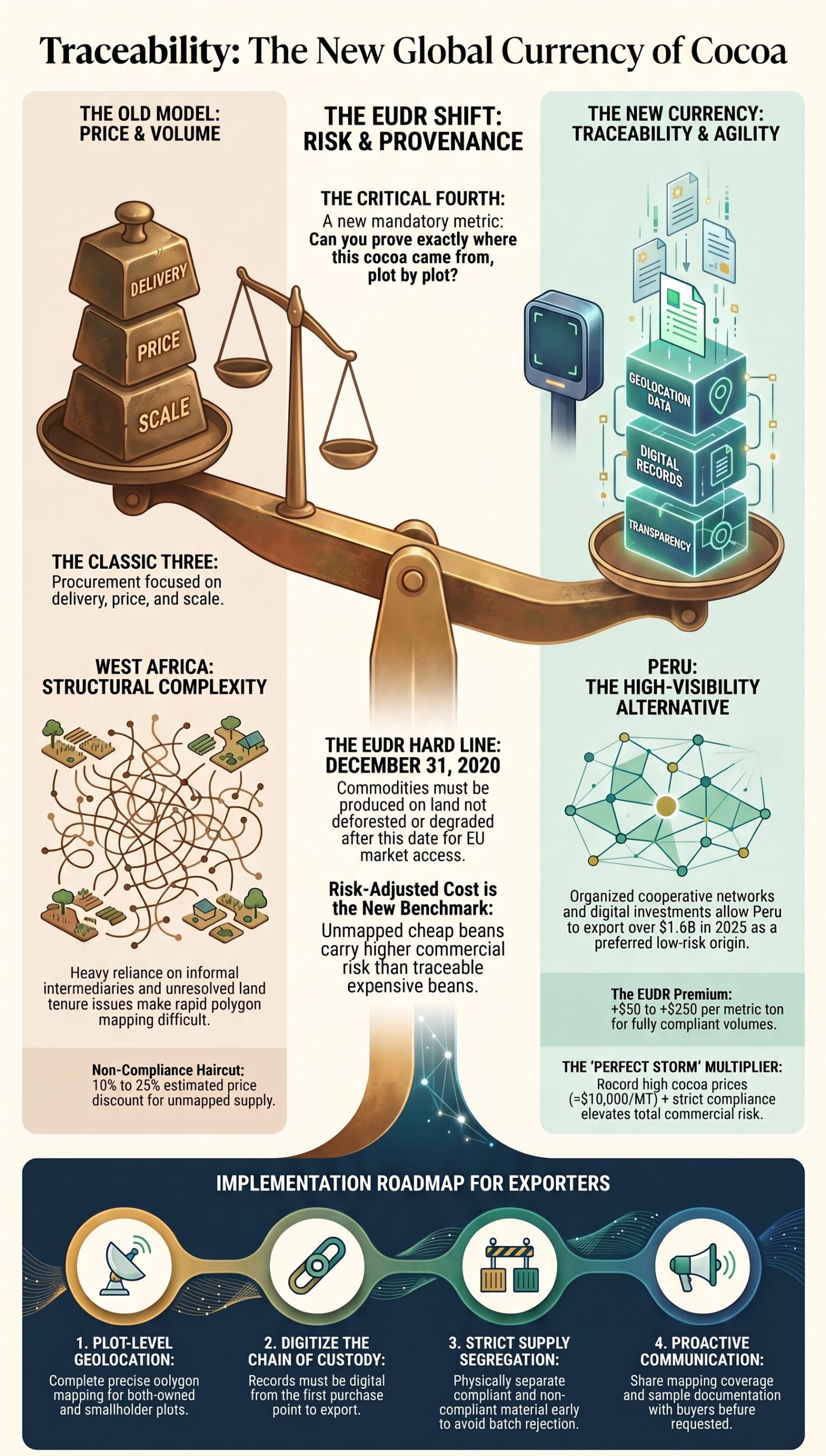
Under HS Code 1801 — cocoa beans, whole or broken, raw or roasted — buyers no longer stop at the familiar three questions: Can the supplier deliver? At what price? In what volume? A fourth question now carries equal weight: Can you prove exactly where this cocoa came from, plot by plot?
As the EU Deforestation Regulation (EUDR) approaches full application, global buyers are rewriting sourcing playbooks. Visibility across the supply chain has become a commercial necessity rather than a sustainability add-on. Origins that can deliver verifiable, low-risk cocoa are gaining preferred-supplier status. Those that cannot face shrinking market access.
This is not merely a compliance story. It is a trade-intelligence story. The companies that win will not necessarily source from the cheapest origin. They will source from the origin that offers the lowest supply-chain risk.
Why Traceability Now Defines Market Access
For decades, cocoa procurement operated on volume, price, and basic quality specs. Mass-balance systems and certification labels provided partial reassurance. That model is breaking down under regulatory pressure.
The EUDR requires operators placing cocoa and cocoa products on the EU market to demonstrate that the commodities were produced on land that was not deforested or degraded after 31 December 2020. Compliance hinges on geolocation data — polygons for larger plots, precise coordinates for smallholder farms — linked to every shipment. Operators must submit a due diligence statement confirming legality under the laws of the country of production and the absence of post-cutoff deforestation.
Traceability Global Cocoa Market Shift
Large and medium-sized operators face the core obligations from 30 December 2026. Micro and small operators have until 30 June 2027. The regulation covers cocoa beans (HS 1801) and a range of derived products. Non-compliant shipments risk exclusion from the world’s largest chocolate market.
The practical effect is immediate. Buyers are shifting from transactional purchasing to risk-managed sourcing. They track shipment flows, map supplier relationships, monitor origin shifts, and assess compliance readiness long before the formal deadlines bite. Visibility has become as valuable as volume.
Experiences from regional supply-chain assessments show that origins investing early in farm-level mapping, digital traceability platforms, and segregated or fully documented chains are capturing premium demand and longer-term contracts. Origins still relying on complex, multi-intermediary systems face higher rejection risk and weaker negotiating positions.
The Four Questions That Now Drive Cocoa Procurement
Procurement teams have expanded their evaluation framework. The classic three questions remain necessary. The fourth has become decisive.
| Evaluation Metric | Core Focus & Operational Question | Trade Intelligence Signal |
|---|---|---|
| 1. Delivery Reliability | “Can the supplier consistently meet volume and quality commitments under real operational constraints?” | Historical shipping performance & port clearance speed. |
| 2. Price Competitiveness | “Does the landed cost, including premiums for verified sustainability, remain viable against alternatives?” | Landed cost vs. alternative origin spot rates. |
| 3. Scale Capacity | “Can the origin and its suppliers grow or adjust volumes without compromising standards?” | National yield trends & cooperative capacity. |
| 4. Provenance Proof NEW CRITICAL | “Can the supplier provide auditable geolocation data, chain-of-custody records, and deforestation-free evidence for every consignment?” | Polygon mapping % & EUDR due-diligence statement readiness. |
The fourth question changes the economics. A cheaper bean that cannot be traced to a compliant plot carries higher commercial risk than a more expensive bean backed by complete documentation. Risk-adjusted cost, not headline price, is becoming the real benchmark.
In practice, this means procurement teams now monitor:
- Farm-to-export digital records and polygon mapping coverage
- The proportion of supply moving through direct or tightly controlled channels versus multi-layered intermediaries
- National or cooperative-level traceability system maturity
- Shipment-level documentation quality and consistency across seasons
- Emerging compliance trends and buyer preference shifts in key destination markets
Teams that treat these signals as early indicators rather than last-minute checks gain negotiating leverage and reduce disruption risk.
Quantifying the Risk: The Rise of “The EUDR Premium”
Risk-adjusted sourcing is no longer a theoretical benchmark—it is actively reframing physical contract pricing. As compliance deadlines near, physical trading desks are splitting cocoa lots into two distinct commercial tiers: compliant supply backed by verifiable geolocation data, and unverified bulk material.
Commercial Takeaway: Procurement teams that lock in traceable, plot-mapped supply early are not merely absorbing compliance overhead—they are hedging against severe spot market squeezes. In high-volatility environments, paying a controlled traceability premium now secures physical market access and prevents emergency substitution costs later.
The 2024–2026 Perfect Storm: Historic Volatility Meets Regulatory Squeezes
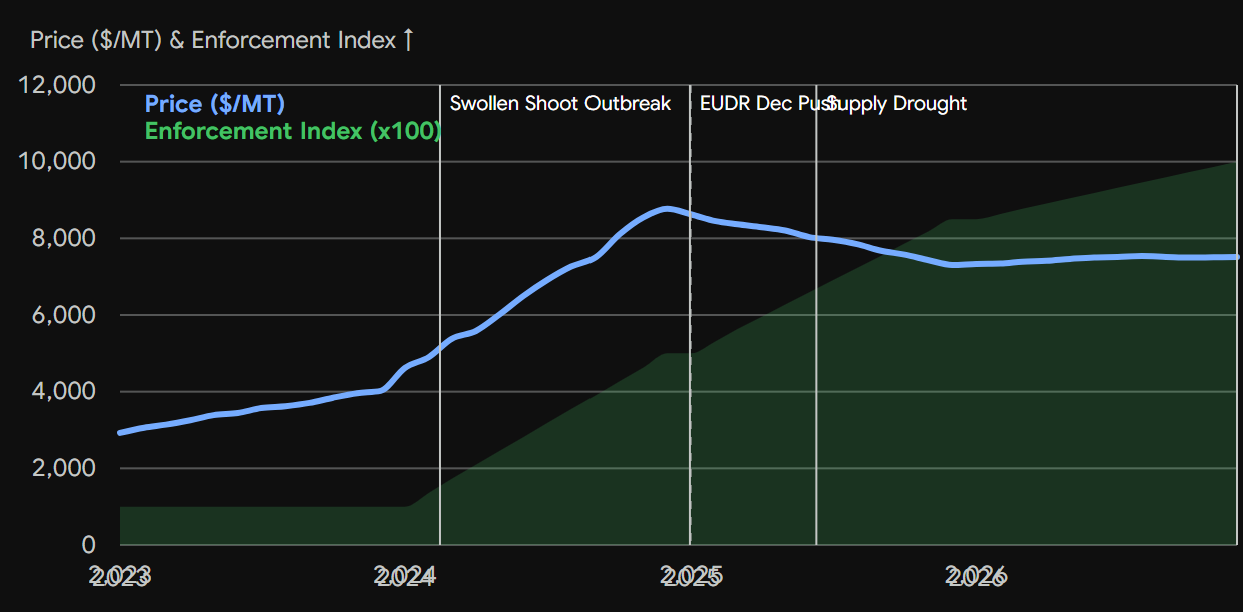
Global cocoa markets have experienced unprecedented turmoil between 2024 and 2026. Extreme weather events, severe droughts, and widespread crop diseases across West Africa (notably Côte d’Ivoire and Ghana, which historically account for roughly 60% of global bean supply) sent cocoa futures soaring to record highs exceeding $10,000 per metric ton.
For international procurement teams, high prices alone were a severe headwind. However, the convergence of unprecedented supply scarcity with strict EUDR compliance enforcement created a compounded multiplier effect:
Supply Contraction: Traditional high-volume origins faced physical volume shortfalls, forcing buyers to scramble for alternative origins.
Compliance Friction: Unmapped or non-compliant lots—even when available at high spot prices—could not be legally placed on European markets without risking severe statutory penalties.
Multiplier Effect: The combination of record raw material costs and mandatory geolocation due-diligence elevated total commercial risk to historic highs.
Cocoa Market & EUDR Compliance Outlook
Peru’s Position in the New Landscape
Consider Peru. In 2025 the country exported more than US$1.6 billion worth of cocoa and cocoa products, reached more than 70 international markets, and ranked as the sixth-largest cocoa-bean exporter globally. Bean exports alone accounted for roughly US$900 million, with strong growth in both volume and value driven by higher international prices and expanding processed products such as butter, paste, and powder.

EUDR Cocoa
Peru’s trajectory illustrates how quality, sustainability credentials, and improving traceability can convert into commercial advantage. The country’s cocoa sector has emphasized fine-flavor and specialty varieties alongside conventional beans. Cooperative and exporter investments in farm mapping, organic and fair-trade certifications, and tighter chain-of-custody systems have positioned Peruvian supply favorably with buyers seeking lower compliance risk.
Operational assessments of Andean and Latin American origins show that smaller, more organized supply bases often achieve higher traceability coverage faster than highly fragmented, high-volume systems. When buyers need reliable geolocation data and documented legality, these characteristics reduce friction. Peru’s multi-market reach — spanning Europe, North America, and Asia — further demonstrates that diversified demand can reward origins that invest in verifiable provenance.
This is not an isolated success story. It is evidence that the market is beginning to price risk and transparency alongside traditional quality and volume metrics.
Structural Pivot: Why Peru Is Gaining Ground Over West African Giants
Historically, Côte d’Ivoire and Ghana have dominated global cocoa supply, producing roughly 60% of the world’s beans. However, their traditional dominance is being tested under the dual weight of environmental shocks and new regulatory mandates. Highly fragmented smallholder networks, complex multi-tiered intermediary chains (Pisteurs and Traitants), and widespread lack of land tenure records make plot-level polygon mapping exceptionally difficult to deploy rapidly at scale across West Africa.
Conversely, Peru has turned structural agility into a major trade advantage. Leveraging a more organized cooperative network, established organic/fair-trade traceability channels, and early investments in digital farm registries, Peruvian exporters are capturing high-value market share while buyers seek low-risk alternatives.
West Africa (Côte d’Ivoire & Ghana)
- Supply Chain Complexity: Heavy reliance on informal intermediaries makes chain-of-custody tracking prone to data gaps.
- Structural Bottlenecks: Unresolved land tenure issues hamper official polygon mapping on boundary borders.
- Risk Profile: Higher exposure to EU customs holds due to aggregated, unverified bean blending at collection hubs.
Peru (High-Visibility Alternative)
- Cooperative Maturity: Direct farm-to-coop structures streamline digital data collection and polygon verification.
- Quality & Compliance Hybrid: Strong focus on fine-flavor varieties combined with pre-mapped, deforestation-free plots.
- Market Advantage: Preferred status for European buyers seeking immediate, fully documented EUDR-compliant shipments.
Strategic Market Shift: Peru’s export performance—exceeding $1.6B in cocoa and derived products—proves that when global supply faces regulatory and climatic friction, origins with superior traceability infrastructure can successfully command premium pricing and expand global market share.
How Leading Buyers Are Adjusting Sourcing Strategies
Forward-looking procurement organizations have moved beyond reactive compliance. They treat traceability data as a continuous intelligence stream. Typical adjustments include:
- Mapping existing supply bases at plot level
before the formal EUDR deadlines. Teams identify which volumes already carry usable geolocation data and which require urgent remediation. - Prioritizing direct or near-direct relationships
with cooperatives and exporters that maintain farm registries and digital records. Indirect, multi-hop chains create data gaps that are expensive to close later. - Building dual-track sourcing
— one stream optimized for full EUDR-compliant volumes destined for Europe, another for markets with different or slower regulatory timelines. - Embedding compliance metrics into supplier scorecards.
On-time documentation completeness, polygon accuracy rates, and audit readiness now sit alongside price and delivery performance. - Tracking origin-level progress.
National systems, cooperative digitalization rates, and third-party verification coverage are monitored as leading indicators of future supply reliability.
🛡️
Overcoming the Data Privacy & Disintermediation Dilemma
A primary friction point in full-chain traceability is commercial exposure. Intermediaries, aggregators, and local exporters often fear that sharing granular farm-level coordinates directly with global buyers risks supplier bypass and disintermediation.
To bridge this trust gap, leading procurement ecosystems are adopting zero-knowledge data architectures and independent third-party platforms. These solutions hash sensitive geolocation data, allowing buyers to verify strict EUDR compliance, cutoff dates, and deforestation status without revealing the underlying proprietary supply network or exact farmer contact registries.
These steps reduce the chance of last-minute volume shortfalls or forced premium purchases when non-compliant material is excluded from key markets. They also create early signals of which origins are pulling ahead in the race for preferred-supplier status.
For teams still building internal capability, platforms that aggregate shipment data, supplier networks, and compliance signals can compress the intelligence cycle. One such tool is available at Platform.Tendify.Net; used selectively, it supports monitoring of flows and relationship shifts without requiring every organization to build proprietary systems from scratch.
Practical Steps for Exporters and Origin Stakeholders
Exporters and producing-country actors face a parallel set of operational requirements. The following sequence has proven effective in regional supply-chain work:
Implementation Roadmap for Exporters
7 priority operational steps to secure compliant status for EU market access.
1
2
3
4
5
6
7
Origins that treat these steps as commercial infrastructure rather than pure compliance cost are already seeing stronger buyer engagement and, in some cases, preferential contract terms.
The Broader Trade-Intelligence Implications
The cocoa market is not unique. Similar visibility pressures are appearing across other forest-risk commodities. What is distinctive in cocoa is the combination of high EU market concentration, predominantly smallholder production, and historically complex first-mile chains. These characteristics amplify the value of reliable data.
Procurement teams that track only prices miss the structural shift. Shipment-flow analysis reveals which origins are gaining or losing share as buyers reallocate risk. Supplier-relationship mapping shows where long-term partnerships are forming around verified supply. Compliance-trend monitoring highlights which national systems are progressing fast enough to support scaled trade.
In this environment, the lowest-cost origin is not automatically the lowest-risk origin. The origin that can demonstrate continuous, auditable visibility reduces the total cost of ownership for the buyer — fewer rejections, fewer emergency switches, lower reputational exposure, and smoother customs clearance.
Related analysis on how digital tools are changing cross-border commodity visibility can be found in the Tendify blog resources on supply-chain data platforms. Parallel discussion of regulatory timelines for agricultural commodities appears in the coverage of emerging due-diligence frameworks. Both pieces sit under the main blog structure at tendify.net/blog and provide additional operational context for teams building longer-term sourcing strategies.
⚖️
The Compliance Cost Burden & Risk of Market Bifurcation
Traceability is not cost-neutral. Mapping millions of smallholder plots, deploying digital registries, and verifying chain-of-custody require substantial capital. A critical question remains: Who absorbs these administrative and operational costs? When smallholders are forced to bear the burden alone, resource-constrained farmers risk exclusion from high-value destination markets.
This dynamic creates a growing risk of a bifurcated global market: a premium, highly verified EUDR-compliant trade flow serving Europe, alongside a secondary, less-regulated bulk market supplying regions with relaxed due-diligence mandates (such as China or India). To prevent supply chain fragmentation, forward-looking buyers are co-investing in origin-level mapping infrastructure rather than treating compliance as a cost transferred purely to producers.
Ultimately, navigating these cost and compliance pressures requires trading partners to treat supply-chain data as a shared strategic asset rather than an operational burden.
What Comes Next
Implementation of the EUDR will not be frictionless. Technical systems, data standards, and capacity gaps remain. Yet the direction of travel is clear. Traceability requirements will intensify rather than recede. Other major markets are watching and, in some cases, developing parallel frameworks. Corporate procurement policies are already incorporating the same logic even where regulation has not yet arrived.
The winners will be the organizations — buyers and sellers alike — that treat visibility as a core commercial capability. They will map their chains earlier, invest in data quality, and use trade intelligence to anticipate rather than react to shifts in preferred origins.
Ready to Bring Structured Visibility to Your Procurement Workflow?
Reduce supply-chain risk, accelerate EUDR documentation readiness, and gain clear, real-time insights into shipment and supplier dynamics across international origins.

