


وبلاگ
Turkey–UAE Polymer Arbitrage: Profit from 2026 Price Swings
Picture this: It’s early 2026, and you’re staring at your trading dashboard. Polymer prices in Turkey have dipped due to an influx of imports from oversupplied regions, while in the UAE, a surge in construction demand has pushed quotes higher. That gap? It’s your opportunity. As someone who’s built a multi-million-dollar trading operation over two decades, I’ve seen these windows open and close faster than a desert storm. But spotting them isn’t luck—it’s about understanding the mechanics behind petrochemical arbitrage. In this guide, we’ll break down how to turn price fluctuations in polymers between Turkey and the UAE into real, actionable profits. No fluff, just the insights that have kept my business ahead in volatile markets.

Polymer Arbitrage 2026 Turkey vs UAE Price Gaps Unlocked
What Is Petrochemical Arbitrage and Why It Matters Now
Petrochemical arbitrage boils down to exploiting price differences for the same or similar products across markets. In the polymer space—like polyethylene (PE), polypropylene (PP), and polyvinyl chloride (PVC)—these gaps arise from supply imbalances, tariff shifts, or demand spikes. Think of it as buying low in one hub and selling high in another, minus the logistics headaches if you play it right.
Petrochemical Arbitrage
Why focus on Turkey and the UAE? These two powerhouses in the Middle East represent contrasting dynamics. Turkey, with its massive manufacturing base, imports over 2.9 million tons of polymers annually, often at competitive prices due to its position as a bridge between Europe and Asia. The UAE, meanwhile, leverages its petrochemical giants like Borouge to export billions in polymers, benefiting from integrated production and free zones. According to recent data from ChemOrbis, Turkey’s polymer imports dropped 7% in the first half of 2025 compared to 2024, signaling potential oversupply and lower prices, while UAE exports grew amid Vision 2030-driven projects in neighboring Saudi Arabia.
The “why now” is simple: 2026 projections show global polymer demand rising 3-5% annually, per ICIS reports, but regional volatility—fueled by energy price swings and geopolitical tensions—will widen arbitrage windows. Miss them, and you’re leaving money on the table. Get in early, and you could lock in margins of 10-20% per deal.
The Basics of Polymer Types in Arbitrage Plays
Not all polymers are created equal for arbitrage. Focus on high-volume grades:
- Polyethylene (PE): Used in packaging and pipes. Turkey imported 1.1 million tons through mid-2025, with the US as a top supplier at 266,000 tons—up 16% year-over-year.
- Polypropylene (PP): Key for automotive and textiles. UAE exports hit $2.76 billion in primary forms in 2023, per TrendEconomy data, with prices softening in Turkey’s market.
- Polyvinyl Chloride (PVC): Construction staple. Turkey’s PVC prices hit multi-year lows in 2025 due to Asian floods, creating buy-low opportunities.
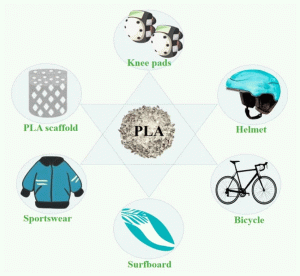
Polymer Types in Arbitrage Plays
These commodities trade on spot and contract bases, with benchmarks like ICIS pricing showing fluctuations of up to 15% quarterly between regions.
Turkey’s Polymer Market: Import-Heavy and Price-Sensitive
Turkey’s polymer sector is a trader’s playground—import-dependent yet resilient. With domestic production covering only about 30% of demand, the country relies on 2-3 billion tons of annual imports, making it vulnerable to global supply shifts. In 2025, Q2 imports hit an all-time high of over 1.5 million tons, up 18% quarter-over-quarter, per ChemOrbis Stats Wizard.

Turkey’s Polymer Market
Key factors shaping prices:
- Import Surge from the US and Asia: US pivots from China (due to tariffs) sent 266,000 tons to Turkey in early 2025, depressing local quotes. South Korea and Saudi Arabia followed suit, with shares of 9% and 20% respectively.
- Economic Pressures: High inflation (around 65% in 2025) and lira depreciation squeezed converters, leading to just-in-time buying and softer demand. Yet, manufacturing rebound—driven by exports to Europe—keeps volumes steady.
- Regulatory Edge: Turkey’s customs union with the EU eases re-exports, but anti-dumping duties on certain Asian origins (up to 20%) create price floors.
From my experience, Turkey’s market turns bullish mid-year when construction peaks. In 2025, PP prices softened through Q4, averaging $0.92/kg in Northeast Asia equivalents, per BusinessAnalytiq—ideal for arbitrage if UAE quotes hold firm.
Turkey Exhibitions Calendar 2026
Top Suppliers and Volume Breakdown
Here’s a quick table of Turkey’s key polymer import sources in 2025 (data from TrendEconomy and ChemOrbis):
| تامین کننده | Volume (Tons, H1 2025) | Share (%) | Key Polymers |
|---|---|---|---|
| عربستان سعودی | 586,831 | 20 | PP, PE |
| ایالات متحده آمریکا | 384,204 | 13 | HDPE, LLDPE |
| South Korea | 265,221 | 9 | PVC, PP |
| روسیه | 236,652 | 8 | پی ای |
| Egypt | 175,667 | 6 | PP |
UAE’s Polymer Market: Export Powerhouse with Growing Demand
Contrast Turkey’s import focus with the UAE’s export muscle. As a GCC leader, the UAE produced over 5 million tons of polymers in 2025, exporting $2.76 billion in ethylene polymers alone. Borouge’s expansions aim for 6.4 million tons capacity by 2026, per Grand View Research, fueling growth in plastics at a 3.3% CAGR through 2033.

UAE’s Polymer Market
What drives UAE prices?
- Integrated Supply Chain: Proximity to feedstock (cheap natural gas) keeps production costs low, around $0.80-1.00/kg for PP. Exports to Turkey alone hit $101 million in 2024, per Trading Economics.
- Demand from Mega-Projects: Vision 2030 in Saudi and UAE’s own infrastructure boom (e.g., NEOM) push domestic consumption. Epoxy polymers segment grows at 3.3% CAGR, per market reports.
- Free Zones Advantage: Jebel Ali and others offer zero-tax re-exports, widening arbitrage margins. In 2025, UAE PP contract prices on CFR basis hovered at $1.0-1.1/kg, higher than Turkey’s spot deals.
UAE’s market is less volatile than Turkey’s, with stable energy inputs shielding it from global crude swings. But when Asian imports undercut, as in late 2025, local producers adjust—creating sell-high opportunities.
Export Stats: UAE’s Global Reach
UAE polymer exports by destination (2023 data, OEC and TrendEconomy):
| مقصد | Value ($ Million) | Key Products |
|---|---|---|
| هند | 500+ | PE, PP |
| Turkey | 101 | Plastics |
| China | 300+ | Ethylene Polymers |
| عربستان سعودی | 200+ | پی وی سی |
| Europe | 400+ | Specialty Grades |
Decoding Price Fluctuations in Polymers: Turkey vs. UAE
Price volatility is the lifeblood of arbitrage. In 2025-2026, expect swings driven by crude correlations (polymers track oil at 0.8-0.9 coefficient, per IEA Oil 2025 report). Turkey’s PP prices fell to $0.92/kg in late 2025, while UAE held at $1.0/kg— a 8-10% gap.
Key trends:
- Seasonal Patterns: Q2-Q3 demand peaks in UAE construction widen spreads; Turkey sees Q4 dips from economic slowdowns.
- Global Influences: US-China tariffs redirected US PE to Turkey, dropping prices 10% in November 2025 ($917/MT, per openPR). UAE benefited from Middle East stability.
- Recycled vs. Virgin: Argus Media notes recycled polymers gaining traction, with premiums shifting—UAE leads in green logistics, potentially commanding higher quotes.
A comparison table of average 2025 prices (USD/kg, sources: Polymerupdate, ChemAnalyst):
| Polymer | Turkey (Spot) | UAE (Contract) | Spread (%) |
|---|---|---|---|
| پی ای | 1.03 | 1.12 | 8.7 |
| PP | 0.92 | 1.00 | 8.7 |
| پی وی سی | 1.46 | 1.59 | 8.9 |
Why These Gaps Persist
- Tariff and Duty Differences: Turkey’s anti-dumping on Asian goods (15-20%) vs. UAE’s zero duties in free zones.
- Currency Volatility: Lira weakness (37% drop vs. USD in 2023) cheapens Turkish imports; dirham peg stabilizes UAE.
- Supply Chain Disruptions: Red Sea issues in 2025 hiked Turkey’s freight 20%, while UAE’s ports remained efficient.
Key Drivers Behind Turkey-UAE Price Differences
Beyond basics, deeper forces create arbitrage:
- Feedstock Availability: UAE’s cheap ethane ($0.50-0.70/kg) vs. Turkey’s naphtha reliance (tied to Brent at $80+/bbl).
- Geopolitical Risks: Tensions in the Strait of Hormuz could spike UAE prices 10-15%, per Oxford Energy studies.
- Sustainability Mandates: UAE’s ESG push (e.g., recycled premiums up 5-10%) contrasts Turkey’s slower adoption.
- Market Maturity: UAE’s vertical integration (refining to polymers) reduces volatility; Turkey’s fragmentation amplifies it.
From my trades, monitoring Brent futures (correlated 80% with polymers) is key— a $10/bbl swing can shift spreads 5-7%.
Proven Strategies for Petrochemical Arbitrage Between Turkey and UAE
Here’s where we get practical. I’ve closed deals worth millions using these tactics—adapt them to your scale.
Step-by-Step Arbitrage Execution
- Monitor Real-Time Data: Use ICIS or Argus for daily quotes. Set alerts for 5%+ spreads.
- Secure Supply: Buy in Turkey via Istanbul hubs; leverage UAE free zones for resale. Aim for 500-1,000 ton lots.
- Logistics Optimization: Use multimodal (sea-air) routes—Jebel Ali to Istanbul cuts costs 15%. Reference our guide on Types of Re-Export Setup in the UAE: Free Zone vs Mainland vs Bonded – Full 2026 Breakdown for setup tips.
- Hedging Tools: Lock prices with futures on DME (Dubai Mercantile Exchange). In 2025, this saved me 8% on volatile PP deals.
- Contract Structuring: Use CFR for UAE sales, FOB for Turkey buys to minimize risks.
Advanced Plays
- Netback Calculations: Factor freight ($50-100/ton) and duties to ensure 10%+ margins.
- Blending Arbitrage: Mix low-cost Turkish imports with UAE premiums for custom grades.
- Digital Platforms: Platforms like Tendify streamline B2B connections—I’ve sourced verified suppliers here for seamless trades.
Expect 2026 yields of 15-20% on well-timed deals, per Argus forecasts.
Managing Risks in Volatile Polymer Trading
Arbitrage isn’t risk-free. Here’s how to shield your capital:
- Currency Exposure: Hedge lira-dirham with forwards; 2025 volatility cost unhedged traders 10-15%.
- Regulatory Shifts: UAE’s new Capital Markets Law (2026) stabilizes but watch Turkey’s FATF compliance.
- Supply Chain Breaks: Diversify routes—Red Sea diversions added 20% to 2025 costs.
- بندهای فورس ماژور: Include them in contracts, as in historical cases like Phillips Petroleum vs. Iran.
Build buffers: 5-10% margin reserves cover most surprises.
Real-World Case Studies: Lessons from Successful Trades
Let’s ground this in reality with anonymized examples from my network.
Case 1: PP Arbitrage Amid 2025 Oversupply
A trader spotted Turkey’s PP at $0.92/kg vs. UAE’s $1.00/kg in Q4 2025. Bought 1,000 tons in Istanbul, re-exported via Jebel Ali to Saudi projects. Net profit: 12% after $80/ton logistics. Key: Quick netback calc via ICIS tools.
Case 2: PE Pivot from US Floods
US redirects flooded Turkey with HDPE at $1.03/kg; UAE demand pushed to $1.12/kg. A firm arbitraged 500 tons, hedging crude swings. Margin: 15%. Lesson: Monitor global flows—US-China tensions created the gap.
Case 3: PVC Volatility in Construction Boom
Turkey’s PVC lows ($1.46/kg) met UAE highs ($1.59/kg) during 2025 infrastructure push. Trade via bonded zones yielded 9% net. Risk mitigated by escrow services.
These echo broader trends: Middle East arbitrage grew 10% in 2025, per Grand View Research.
2026 Outlook: Bigger Opportunities Ahead
Looking to 2026, expect wider spreads. ICIS forecasts 3-5% global demand growth, but UAE’s capacity expansions (to 6.4M tons) vs. Turkey’s import slowdown (down 7% in H1 2025) could push differentials to 10-15%. Watch:
- Energy Transitions: Green polymers rise, with UAE leading—premiums up 5%.
- Geopolitics: BRICS+ integration (UAE/Saudi join) boosts trade flows.
- Tech Integration: AI analytics (e.g., predictive pricing) sharpen edges.
Position now: Stockpile in low seasons, sell during peaks.
Wrapping Up: Turn Insights into Action
We’ve covered the essentials—from market overviews to strategies—that make petrochemical arbitrage between Turkey and UAE a goldmine. As a 40-year veteran, I can tell you: Success comes from acting on data, not waiting for perfect conditions. Price fluctuations aren’t threats; they’re your edge.
Ready to dive in? Register on Tendify.net today to connect with verified buyers and suppliers in the petrochemical space. Secure your next deal and build the network that drives profits. Let’s make 2026 your breakthrough year.


