وبلاگ
Iraq Development Road 2026 : Faster Than Suez to Europe?

I’ve watched massive infrastructure projects reshape entire trade corridors over the past two decades. Back when I first scaled my export operations across the Gulf, routes were predictable: everything flowed through Jebel Ali or the Suez, with delays and costs baked in. Fast-forward to 2026, and Iraq’s Development Road (also called the “جاده توسعه” or “Dry Canal”) is forcing a serious rethink. This $17 billion mega-project isn’t just another road—it’s a deliberate bid to turn Iraq into a transit hub linking the Persian Gulf directly to Europe via Turkey.
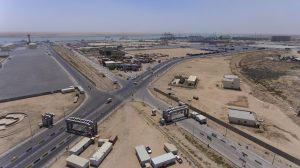
Iraq Development Road
The question every serious trader, importer, and logistics manager in the GCC is asking right now: Is this a legitimate rival to the Suez Canal, or an overhyped opportunity with too many risks? Let’s break it down honestly, based on what’s actually happening on the ground in early 2026.
What Exactly Is the Development Road Project?
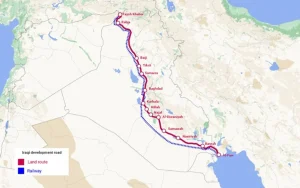
At its core, the Development Road is a 1,200-kilometer integrated corridor of high-speed railway and modern highway stretching from Iraq’s Grand Faw Port in Basra (southern Iraq) north to the Turkish border at Ovaköy/Faysh Khabur. From there, it connects seamlessly into Turkey’s existing logistics network, then onward to Europe via Istanbul and beyond.
Grand Faw Port
Key route highlights:
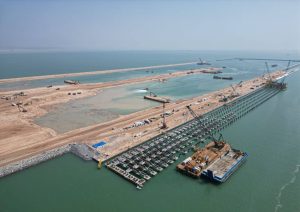
- Starts at Grand Faw Port (set to handle massive container volumes, rivaling regional giants like Jebel Ali).
- Passes through major Iraqi hubs: Basra → Diwaniyah → Najaf → Karbala → Baghdad → Mosul.
- Crosses into Turkey, linking to established routes toward the Mediterranean and EU borders.
- Includes parallel energy pipelines and plans for 15 industrial cities/stations along the Iraqi stretch to spark local manufacturing and value-add processing.
The project breaks into three phases:
- Phase 1 (target operational by 2028): Initial stretches from Faw to key connections, with partial rail/highway ready.
- Phase 2 (around 2033): Major expansions and full integration.
- Phase 3 (full completion by 2050): Maximum capacity, potentially handling millions of tons annually.
As of early 2026, progress is real—soil surveys complete, design at 87% for rail and 73% for highway in key segments, initial 63km stretches under construction, and the Grand Faw Port hitting operational milestones this year. This isn’t vaporware; it’s moving.
The Real Cost and Timeline Breakdown
Estimated total: $17 billion (some analysts push it toward $20-24 billion with escalations). Breakdown includes roughly $10.5 billion for rail/electric trains and $6.5 billion for highways, bridges, and facilities.
Funding mix: Iraqi government lead, plus heavy involvement from قطر و امارات متحده عربی (via the 2024 quadrilateral MoU with Turkey), and Turkish investment commitments. Private sector and international lenders are circling as security stabilizes.
Why the long timeline to 2050? Scale—building greenfield rail through varied terrain, plus industrial zones—takes time. But partial benefits kick in earlier: expect meaningful transit volumes by late 2020s if Phase 1 holds.
UAE & Saudi Arabia in BRICS+: The New Trade Routes Every GCC Exporter Must Know in 2026
Why This Could Disrupt Traditional Middle East Logistics
The big promise: speed and cost savings over sea routes via Suez Canal.
- Time advantage: 10-15 days faster for Asia-to-Europe shipments (vs. Suez’s typical 14-26 days depending on routing/red sea issues).
- Cost edge: Lower fees, fewer chokepoints, reduced exposure to Red Sea disruptions (Houthi attacks, canal blockages).
- Capacity boost: Grand Faw aims for 55+ million tons/year initially, scaling higher—perfect for bulk commodities, containers, and time-sensitive goods.
- Regional freight: 20 million tons projected by 2040, plus international volumes up to 14 million tons.
For Gulf-based B2B traders, this means faster access to European markets without maritime bottlenecks. Iraqi reconstruction demand (steel, cement, machinery) could flow south more efficiently, while Asian imports reach Turkey/Europe quicker.
Türkiye-Iraq Development Road
It’s not replacing Suez outright—Suez still wins for pure volume and established lanes—but it diversifies risk. Think of it as the overland backup when sea routes get messy.
Remote Joint Ventures in Iraq: How UAE Investors Run Everything from Dubai in 2026
The Challenges: Why It’s Not a Slam Dunk Yet
I’ve lost money on “sure-thing” infrastructure plays before. Here’s the reality check for 2026:
- Security risks — Northern stretches near Mosul and borders still carry instability concerns. Turkey’s anti-PKK operations tie directly to securing the route.
- Political and corruption hurdles — Iraq’s track record means delays, cost overruns possible. Governance improvements are happening, but vigilance required.
- Financing and execution — $17B+ needs sustained commitment; any OPEC cuts or oil price dips could squeeze budgets.
- Competition — IMEC (India-Middle East-Europe Corridor), China’s Belt and Road extensions, and established Gulf ports fight for the same traffic.
For traders, the real question is timing: Partial benefits emerge by 2028-2030, but full game-changing scale hits later.
Strategic Opportunities for GCC and Regional Traders in 2026
If you’re exporting from or importing to the Gulf, here’s how to position:
- Monitor Faw Port milestones — Operational in 2026 means early testing for bulk shipments (bitumen, construction materials, FMCG).
- Explore industrial zones — 15 planned cities offer warehousing, processing, and low-cost manufacturing near the corridor.
- Diversify routes — Use this as a hedge against Suez/Red Sea volatility; test small consignments once Phase 1 ramps.
- Partner early — Turkish and Iraqi logistics firms are gearing up—build relationships now for preferential rates.
- Leverage incentives — Duty exemptions, transit perks, and industrial city benefits could slash landed costs.
This corridor aligns perfectly with Vision 2030 in Saudi, UAE diversification, and Iraq’s post-oil push.
Final Thoughts: Opportunity Over Hype
The Iraq-Turkey Development Road isn’t the “new Suez” overnight—Suez’s scale and history are massive. But in a world of supply chain shocks, redundancy wins. By 2030, this could shave serious time and money off Gulf-to-Europe flows, create jobs, and pull investment into Iraq.
I’ve seen projects like this transform regions when executed right. If security holds and funding flows, this becomes one of the smartest logistics bets in the Middle East for the next decade.
Ready to explore how this new corridor fits your supply chain? ثبت نام در Tendify.net today—our platform connects you directly to verified partners across Iraq, Turkey, GCC, and beyond. Get early access to route intel, freight quotes, and B2B matchmaking tailored for 2026 realities. Don’t wait for the corridor to mature—position yourself now. Register free and start building your edge.