


وبلاگ
India-Vietnam Trade: A Strategic Corridor for B2B Growth
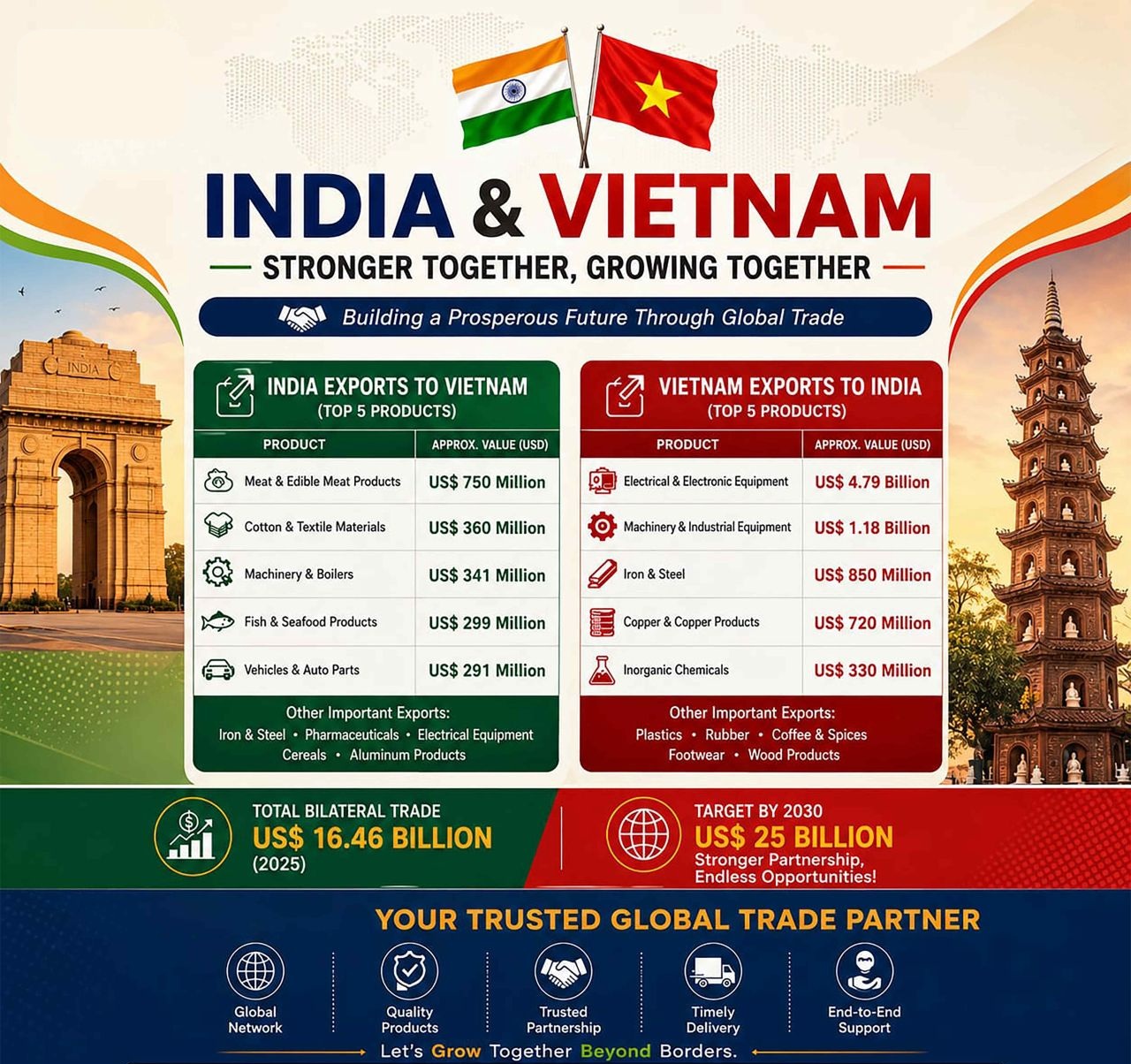
The flags of India and Vietnam fly side by side in boardrooms and ports across Asia. What began as modest exchanges has evolved into a dynamic partnership powering manufacturing resilience, supply chain diversification, and cross-border growth. In 2025, bilateral trade reached US$16.46 billion, with both nations targeting US$25 billion by 2030. This is not aspirational rhetoric—it reflects complementary strengths in agriculture, manufacturing, technology, and logistics that savvy B2B traders are already leveraging for competitive advantage.
The Current State of India-Vietnam Bilateral Trade
For global traders, importers, exporters, and supply chain leaders, India-Vietnam ties represent a practical hedge against volatility. Vietnam excels in high-volume electronics assembly and efficient export processing. India brings scale in pharmaceuticals, agricultural products, machinery, and a massive domestic market. Together, they form a resilient corridor that reduces single-market risks while opening doors to broader ASEAN, South Asian, and global value chains.
This guide delivers actionable insights: current trade flows, sector opportunities, operational strategies, challenges with proven mitigations, and forward-looking tactics for 2026 and beyond. Whether sourcing components, scaling exports, or building integrated supply chains, here is how to turn bilateral momentum into measurable results.
LPG Infrastructure: Pakistan’s Strategic Shift to Refrigerated Storage
The Current State of India-Vietnam Bilateral Trade
Trade volumes have grown steadily. From around US$200 million in 2000, flows expanded significantly, hitting records in recent years. In FY 2024-2025, Indian data shows exports to Vietnam at approximately US$5.43 billion and imports from Vietnam at US$10.33 billion, for a total near US$15.76 billion (with Vietnamese figures aligning closely at US$16.46 billion for 2025).

India-Vietnam Trade
Key trends in 2025-2026:
- India’s exports to Vietnam rose notably in categories like meat, marine products, and metals.
- Vietnam’s exports to India surged in electronics, machinery, and steel—driven by India’s growing demand for components and intermediates.
- Monthly data for early 2026 shows continued momentum, with India’s exports to Vietnam up over 50% year-on-year in some periods.
This imbalance reflects specialization rather than weakness. Vietnam’s export-oriented manufacturing feeds India’s industrial needs, while India’s raw and semi-processed goods support Vietnam’s processing industries.
Top Trade Flows: What Moves Between India and Vietnam
Understanding product-specific dynamics is essential for B2B decision-making.
*Note: Estimates based on average market data for 2026. Actual costs vary by volume and specific carrier.
India’s Key Exports to Vietnam (Top Categories):
- Meat and edible meat products (e.g., buffalo meat).
- Cotton and textile materials.
- Machinery, boilers, and mechanical appliances.
- Fish and seafood.
- Vehicles and auto parts.
- Other notables: Iron & steel, pharmaceuticals, chemicals, cereals, aluminum products.
Vietnam’s Key Exports to India:
- Electrical and electronic equipment (including telecom instruments).
- Machinery and industrial equipment.
- Iron and steel.
- Copper and copper products.
- Inorganic chemicals.
- Other: Plastics, rubber, footwear, wood products, coffee, spices.
These flows highlight complementarity. Vietnam imports agricultural and resource-based inputs from India while exporting finished and intermediate manufactured goods. For traders, this means opportunities in value-added processing, re-export setups, and integrated supply chains.
Why India and Vietnam Complement Each Other Perfectly
Geographic proximity, demographic dividends, and policy alignment create natural synergy:
- Manufacturing strengths: Vietnam leads in labor-intensive, high-volume assembly (electronics, textiles, footwear). India shines in complex manufacturing, R&D, and sectors like pharma and autos.
- Supply chain resilience: Post-pandemic diversification (“China+1”) has accelerated investments in both. Companies route components through Vietnam for efficiency and India for scale or specific capabilities.
- Market access: Vietnam’s ASEAN membership and multiple FTAs provide gateways to Southeast Asia. India’s growing FTA network (including recent deals) opens South Asia, Middle East, and beyond.
- Demographics and demand: India’s large population drives consumption; Vietnam’s youthful workforce supports production.
Real-world examples include electronics firms diversifying assembly between the two countries and auto component collaborations. This “Vietnam-India corridor” enables cost optimization—low-cost production in one paired with specialized inputs or final markets in the other.
Strategic Opportunities for B2B Traders in 2026
The India-Vietnam corridor is not merely a trade route; it is an ecosystem of complementary industrial strengths. To capture maximum market share in 2026, traders should focus on the following high-growth pillars:
1. Electronics and Machinery Integration 📱
Vietnam’s prowess in high-volume consumer electronics assembly creates a perfect synergy with India’s rapidly expanding semiconductor design and automotive electronics sectors. Traders can source intermediate components from Vietnam and integrate them with high-end Indian hardware and software solutions to produce higher-margin, value-added exports.
Actionable Strategy: Leverage our HS Code Finder to map specific tariff advantages and explore cross-border joint ventures for specialized component sourcing.
2. Agro and Food Processing 🌾
While India remains a global powerhouse for meat, seafood, and cereal exports, Vietnam contributes world-class processing expertise, spices, and premium coffee production. The most lucrative opportunity lies in creating value-added, ready-to-eat (RTE) food products targeting the GCC and broader global markets.
Actionable Strategy: Analyze potential market demand by utilizing trade data to identify gaps in the supply chain.
3. Textiles and Apparel 🧵
A natural integration exists where raw cotton from India fulfills the massive input requirements of Vietnam’s sophisticated garment manufacturing sector. By utilizing re-export models through established free trade zones (FTZs), businesses can significantly optimize duty payments and streamline production timelines.
Actionable Strategy: Review your duty liability using our tariff calculators to determine the feasibility of re-export setups.
4. Pharmaceuticals and Chemicals 💊
India’s leadership in the production of Active Pharmaceutical Ingredients (APIs) and generic drugs perfectly aligns with Vietnam’s rising domestic demand and healthcare infrastructure upgrades. Emerging regulatory alignment between the two nations is actively lowering barriers to market entry.
Actionable Strategy: Monitor regulatory updates to ensure seamless compliance during the registration and distribution of pharma products.
5. Infrastructure and Capital Goods 🏗️
Driven by India’s massive infrastructure development boom and Vietnam’s rapid expansion of industrial parks, the demand for machinery, steel, and advanced construction materials is surging. This bidirectional flow offers substantial volume opportunities for bulk traders.
Actionable Strategy: Focus on logistics efficiency—use standardized documentation and digital freight forwarding to reduce lead times in bulk shipments.
نکته حرفهای: Focus on sectors with high complementarity to minimize competition and maximize margins. Avoid generic commodities where market saturation is high, and instead, target specialized value chains where India-Vietnam synergies create unique competitive advantages.
Navigating Logistics, Compliance, and Operations
Key operational realities:
- Ports and shipping: Leverage major hubs—Jawaharlal Nehru Port (India) and Cai Mep-Thi Vai (Vietnam). Multimodal routes via Singapore reduce times.
- Customs and documentation: Harmonize with ASEAN-India FTA (AIFTA) for preferential tariffs. Proper Rules of Origin (RoO) compliance is critical to avoid disputes.
- Incoterms and payments: Prefer FOB/CIF based on volume. Escrow or digital platforms reduce risks in new relationships.
- چالشها:
- Trade deficit for India requires balanced flows.
- Logistics bottlenecks (congestion, documentation).
- Regulatory differences in standards and certifications.
- Currency and payment risks.
Mitigation strategies (step-by-step):
- Conduct thorough due diligence on partners.
- Use digital tools for real-time tracking and compliance checks.
- Build buffer inventory for key routes.
- Diversify payment methods beyond traditional LCs where suitable.
- Engage local freight forwarders familiar with both markets.
Case insight: Traders optimizing container loading and phytosanitary protocols for agro shipments have cut rejection rates significantly.
Regulatory Compliance Checklist: India to Vietnam (Meat Export)
Ensuring smooth customs clearance requires strict adherence to these requirements. Use our HS Code Finder و Document Builder to automate these steps.
- ✅ Certificate of Origin (CoO): Essential for AIFTA tariff benefits.
- ✅ Phytosanitary/Health Certificate: Issued by Indian authorities (APEDA/EIC).
- ✅ Commercial Invoice & Packing List: Must match the HS code classification accurately.
- ✅ Bill of Lading (BL): Standard transport documentation.
- ✅ Import Permit (Vietnam): Pre-approval from Vietnamese authorities (MARD).
The Role of FTAs and Policy Support
Both nations prioritize trade liberalization. Vietnam’s extensive FTA network (including AIFTA with India) provides tariff reductions. India’s evolving agreements enhance access.
Monitor updates on AIFTA upgrades and bilateral initiatives. These frameworks lower barriers but demand precise compliance to capture benefits—many exporters underutilize preferences due to complexity.
💡 Financial Insight: Settlement & Liquidity
Beyond standard Letters of Credit (LCs), trade between India and Vietnam requires agile financial mechanisms to mitigate currency volatility. For businesses operating in high-compliance environments, leveraging local currency settlement (LCS) frameworks و blockchain-based escrow protocols is becoming an essential “safety layer.” These tech-forward financial workflows reduce settlement friction and FX exposure, providing a significant competitive edge in modern cross-border trade.
Future Outlook: Toward $25 Billion and Beyond
As we look toward 2030, the India-Vietnam trade corridor is poised to evolve from simple exchange into a sophisticated, high-tech industrial partnership. The target of US$25 billion is not merely a benchmark; it represents a deep structural integration in green supply chains, advanced manufacturing, and service-based trade.
Key trends shaping the next decade include:
FDI & Complementary Manufacturing: We anticipate a significant surge in Foreign Direct Investment (FDI) aimed at vertical integration. Investors are increasingly diversifying their manufacturing base to leverage Vietnam’s export-oriented infrastructure and India’s scalable production capacity.
The Digital Trade Revolution: The proliferation of digital B2B matching platforms is eliminating information asymmetry. For traders, this means faster partner vetting, transparent pricing, and more secure cross-border matchmaking.
Sustainability & ESG Compliance: Green supply chains are no longer optional. Logistics providers and manufacturers are prioritizing ESG-compliant (Environmental, Social, and Governance) operations to meet the rigorous standards of global markets, particularly in the EU and North America.
Strategic Expansion into Third Markets: The true power of this partnership lies in the “India-Vietnam-Global” model. By combining India’s R&D capabilities with Vietnam’s efficient logistics, both nations are set to conquer third-party markets across the ASEAN region, the Middle East, and beyond.
The Strategic Advantage: Businesses that position themselves early—through pilot shipments, joint ventures, or deep-dive market intelligence—will capture disproportionate gains. In a rapidly shifting global trade landscape, the cost of hesitation is high, while the rewards for early movers are substantial.
Internal Resources for Further Strategy:
Streamlining Cross-Border Logistics for Efficient B2B Trade (Adaptable tactics for Asia-based routes).
The Role of Digital Freight Forwarders in Modern B2B Supply Chains.
Mastering HS Code Classification: Your first step toward reducing trade friction.
Internal resources for deeper dives:
- Vietnam Coffee Exports: B2B Sourcing Guide & 2026 Market Outlook
- The Role of Digital Freight Forwarders in Modern B2B Supply Chains.
- India-China Trade Shift: Navigating the $76B Import Substitution.
Platform.Tendify.Net offers practical utilities like HS code finders, cost calculators, and document builders that support these flows without replacing core operations.
Implementation Roadmap for Traders
- Market Assessment: Analyze specific product HS codes and tariffs using reliable tools.
- Partner Sourcing: Attend exhibitions or use verified B2B networks.
- Pilot Transactions: Start small with clear contracts.
- بهینهسازی: Integrate logistics, finance, and compliance.
- Scale: Expand to re-exports or joint ventures.
- Monitor: Track policy changes and performance metrics.
Conclusion: Turning Partnership into Performance
India and Vietnam are not just trading partners—they form a strategic axis for resilient global supply chains. The data shows clear momentum; the opportunities lie in execution. Businesses that map complementary flows, master compliance, and act on real-time intelligence will lead the next wave of cross-border growth.
The path to $25 billion is paved with practical deals, efficient logistics, and trusted ecosystems. Start building yours today.
Ready to facilitate, secure, and accelerate your global trade operations? Register at https://tendify.net/my-account/ and access tools designed for cross-border efficiency. Let’s grow together beyond borders.

