


وبلاگ
Automotive Landed Cost: China to GCC Import Guide
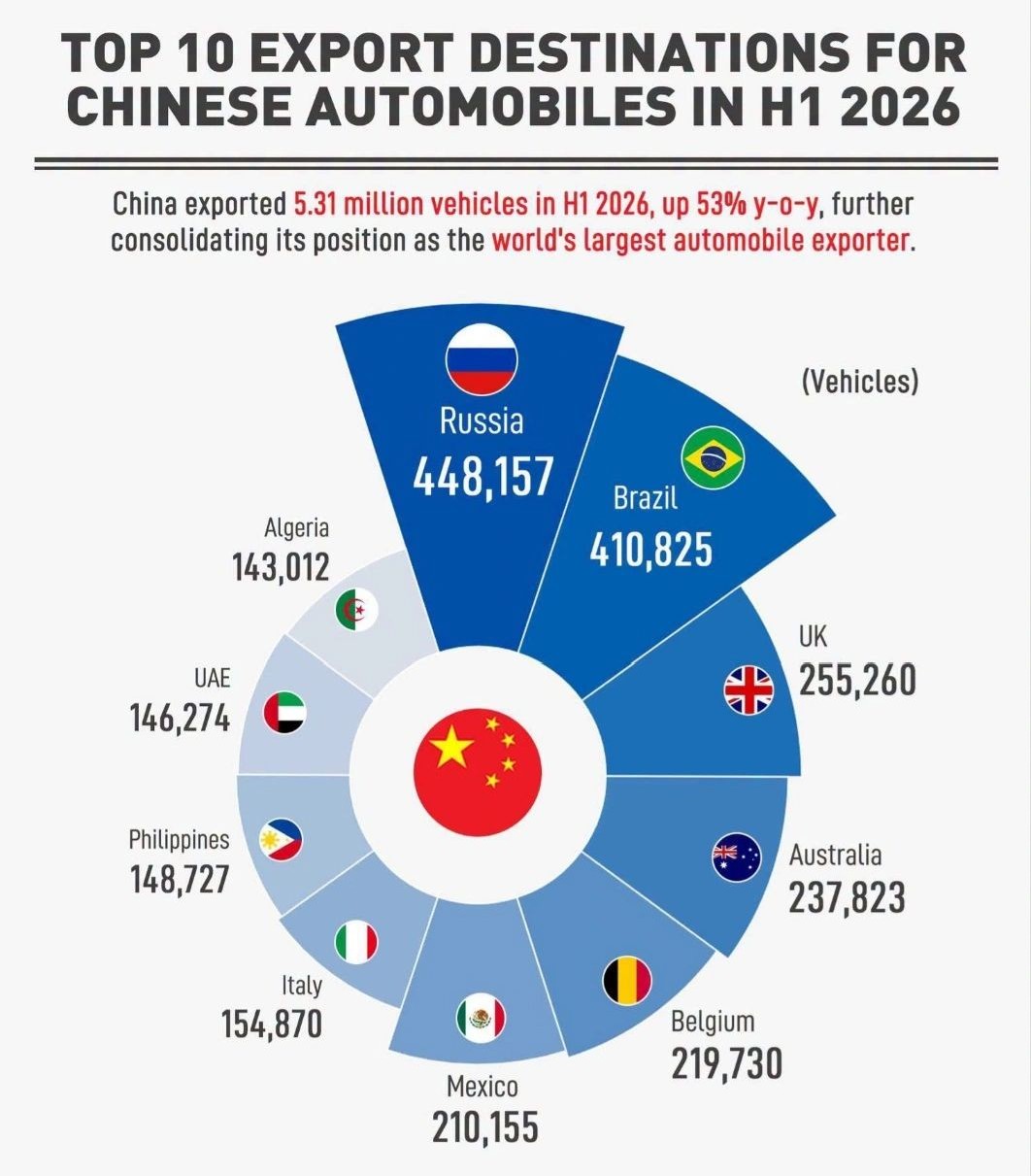
China shipped 5.31 million vehicles in the first half of 2026, a 53 percent year-on-year jump. Russia led with 448,157 units, followed by Brazil at 410,825 and the United Kingdom at 255,260. Australia, Belgium, Mexico, Italy and the Philippines filled the middle ranks. The United Arab Emirates secured ninth place with 146,274 units, just ahead of Algeria.
📈
Top Destination Markets for Chinese Vehicle Exports (H1 2026)
Global breakdown of China’s 5.31 million vehicle export volume in the first half of 2026 (+53% YoY growth), highlighting the UAE’s position as a key regional hub.
| رتبه | Destination Country | Export Volume (Units) | Market Role / Tier |
|---|---|---|---|
| 1 | روسیه | 448,157 | Top Global Destination |
| 2 | برزیل | 410,825 | Latin America Lead |
| 3 | United Kingdom | 255,260 | European Lead |
| 4–8 | Australia, Belgium, Mexico, Italy, Philippines | Mid-tier Volumes | Established Regional Hubs |
| 9 | United Arab Emirates (UAE) | 146,274 | GCC Gateway & Re-export Node |
| 10 | Algeria | Trailing Top 10 | North Africa Gateway |
That ranking is not accidental. The UAE functions as both a final market and a high-velocity re-export platform for Chinese vehicles moving into the wider Gulf Cooperation Council and beyond. Operational data from ports and free zones show that a substantial share of these arrivals never remain in local registration. They clear, stage and move onward under bonded or free-zone procedures.
For B2B operators, distributors and logistics teams the numbers create a clear commercial window. The combination of low uniform GCC external tariffs, mature free-zone infrastructure and expanding direct RoRo capacity from Chinese ports turns volume into margin if the process is structured correctly.
The Scale of the Shift and What It Means for Regional Supply Chains
New energy vehicles now drive a large portion of the growth. In H1 2026 NEV exports from China reached roughly 2.35 million units, more than double the prior-year figure and representing close to half of total vehicle shipments in some months. June alone saw more than one million vehicles leave Chinese ports for the first time in a single month.
European and Latin American markets absorbed the largest absolute increases. The Middle East, however, continues to operate on a different logic. Volumes into the UAE moderated from the peak years yet remain substantial enough to keep the country inside the global top ten. The drop relative to earlier hyper-growth years reflects a maturation phase rather than a collapse in demand. Local dealers report Chinese brands capturing 15–20 percent of new-car sales in the UAE, with particular strength in SUVs and mid-range electric models.
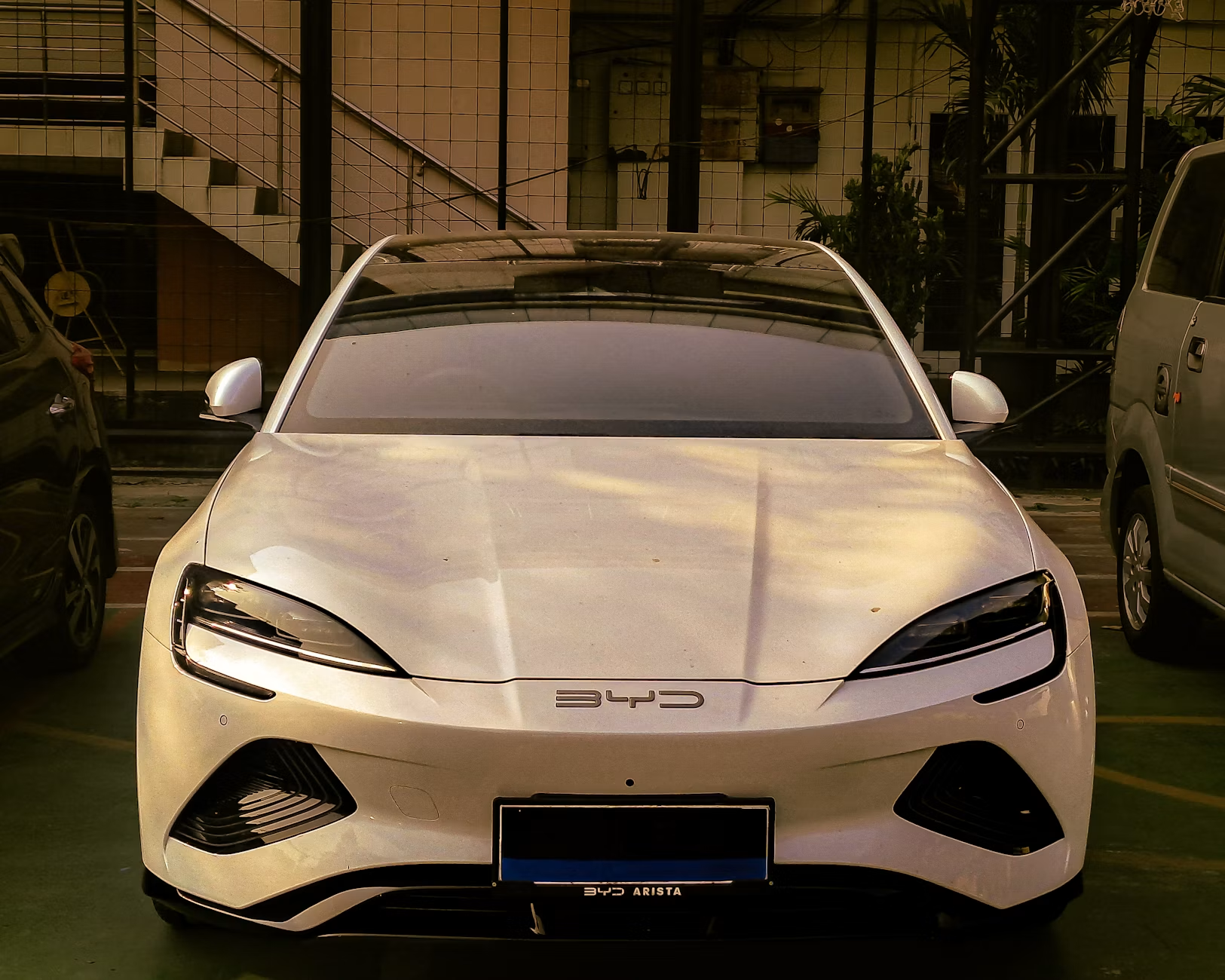
China-to-GCC automotive
The practical implication is straightforward. Chinese manufacturers have moved from opportunistic container shipments to scheduled RoRo programs. Direct sailings from ports such as Xiaomo in Shenzhen to Khorfakkan have cut transit times by three to five days compared with traditional multi-stop routes. One recent sailing carried more than 6,000 BYD new-energy vehicles in a single voyage, setting a record for that Chinese terminal.
⏱️
Port-to-Port Direct Transit Times & Corridor Benchmarks
Transitioning from feeder connections to direct RoRo liner service significantly shortens the port-to-port voyage, optimizing working capital for B2B distributors and reducing holding costs in transit.
| Origin Port (China) | Destination Port (UAE) | Sailing Type | Average Transit Time |
|---|---|---|---|
| South China Ports (Xiaomo / Nansha / Shenzhen) | Khorfakkan / Jebel Ali | Direct Express RoRo | 12 – 14 Days |
| East China Ports (Shanghai / Taicang / Ningbo) | Jebel Ali / Khalifa Port | Standard Direct Liner | 15 – 18 Days |
| Traditional Multi-Stop Routes | UAE Main Ports | Transshipment / Feeder Services | 22 – 28 Days |
These operational changes reduce inventory risk for regional traders who previously faced longer lead times and higher demurrage exposure.
Why the UAE Remains the Preferred Gateway
Three structural advantages keep the UAE at the center of Chinese vehicle flows into the region.
First, the GCC Common External Tariff applies a flat 5 percent duty on the CIF value of passenger vehicles. No anti-dumping duties or country-specific surcharges have been layered on Chinese cars, in contrast to measures seen in other major markets. VAT sits at 5 percent. The combined tax load on mainland entry is therefore predictable and relatively low.
Second, free-zone treatment suspends that duty entirely while goods remain inside the zone. Jebel Ali Free Zone and related facilities allow vehicles to land, be stored, inspected, and re-exported without the 5 percent duty crystallizing. Only when units move to the UAE mainland does the duty become payable. Re-exports to other GCC states or third countries can proceed under transit or re-export declarations with minimal friction.
Third, port infrastructure has adapted. Jebel Ali continues to handle the bulk of volume, yet Khorfakkan has emerged as a high-throughput alternative for pure RoRo traffic. Discharge rates exceeding 140 vehicles per hour have been recorded, with peaks near 200. The ability to clear and release vehicles within 96 hours under optimized “discharge and drive” models further compresses the cash cycle.
These mechanics turn the UAE into a forward distribution node rather than a pure end-market. A single container or RoRo allotment can be split: some units register locally, others move under bond to Saudi Arabia, Oman, Kuwait, Qatar or further afield into East Africa.
📊
Key Takeaways: Operational Comparison (Jebel Ali vs. Khorfakkan Port)
Evaluating the strategic and cost advantages of the UAE’s primary automotive entry nodes helps traders select the optimal hub based on cargo volume, storage duration, and final destination.
| Comparison Metric | Jebel Ali Port (JAFZA Hub) | Khorfakkan Port (East Coast Node) |
|---|---|---|
| Primary Vessel / Handling Mode | Massive RoRo liners, containerized racks, and mixed carrier fleets. | High-speed, dedicated Pure Car and Truck Carriers (PCTC / RoRo). |
| Discharge Rate & Berth Efficiency | High volume capacity; subject to seasonal congestion during peak ocean flows. | Ultra-fast discharge rates (140 to 200 units/hour); minimal berth wait time. |
| Transit Route Advantage | Direct access to Arabian Gulf maritime routes and UAE mainland distribution networks. | Bypasses the Strait of Hormuz, cutting 1–2 sailing days for direct China express routes. |
| Free-Zone & Storage Infrastructure | Extensive JAFZA bonded warehousing, HAZMAT-certified EV battery yards, and PDI centers. | Streamlined staging and direct overland re-export corridors into neighboring GCC countries. |
| Strategic Fit | Ideal for long-term free-zone staging, UAE mainland retail clearance, and complex logistics. | Optimal for high-velocity bulk re-exports and rapid transit time compression. |
Practical Compliance Requirements for Chinese Vehicles
Success depends on documentation discipline. Vehicles destined for UAE registration or GCC re-export must meet Gulf Standardization Organization technical regulations. Key requirements include:
- Left-hand drive configuration
- GCC hot-weather performance certification covering cooling systems, air-conditioning and battery thermal management for electric models
- Manufacturer certificate of origin
- Type-approval documentation from the Chinese OEM or an authorized certification body
- Arabic-language owner’s manuals for retail units
- Commercial invoice, packing list and bill of lading matching the physical cargo
Non-GCC-spec vehicles can still enter free zones but face costly retrofits and delays if later registered on the mainland. Reputable Chinese exporters now produce factory GCC-spec builds for major brands. Operators should insist on these specifications at the purchase stage rather than attempting post-arrival conversion.
🔀
Official Agency Channels vs. Parallel Import (Grey Market) Dynamics
A distinct operational dichotomy shapes the UAE automotive market: authorized national agency distribution versus parallel imports (grey market trade). Understanding how customs handling, registration procedures, and warranty enforcement differ between these two models is vital for commercial risk management.
- Official Distribution (Agency Route): Franchised local distributors import factory-homologated GCC specs directly under OEM authorization. Goods clear customs with full manufacturer warranty support, standardized local type-approval registration, and immediate eligibility for mainland retail sales without compliance friction.
- Parallel Imports (Grey Market Route): Independent B2B traders leverage price differentials or supply shortages by sourcing non-GCC specs or domestic Chinese market inventory. While these units enter free zones duty-suspended with minimal initial friction, mainland registration requires individual GSO conformity clearance, software retrofits (such as language and infotainment localization), and third-party warranty underwriting.
- Re-Export Positioning: Parallel import shipments excel as fast-turning stock within free zones specifically tailored for onward re-export to secondary markets (such as East Africa, CIS, or Levant), where local agency agreements do not restrict trading flexibility.
Emission standards have tightened. New type approvals in the UAE must meet Euro 6b limits from early 2026, with full applicability for all vehicles phased in later. Early confirmation of the specific model’s certification status prevents clearance hold-ups.
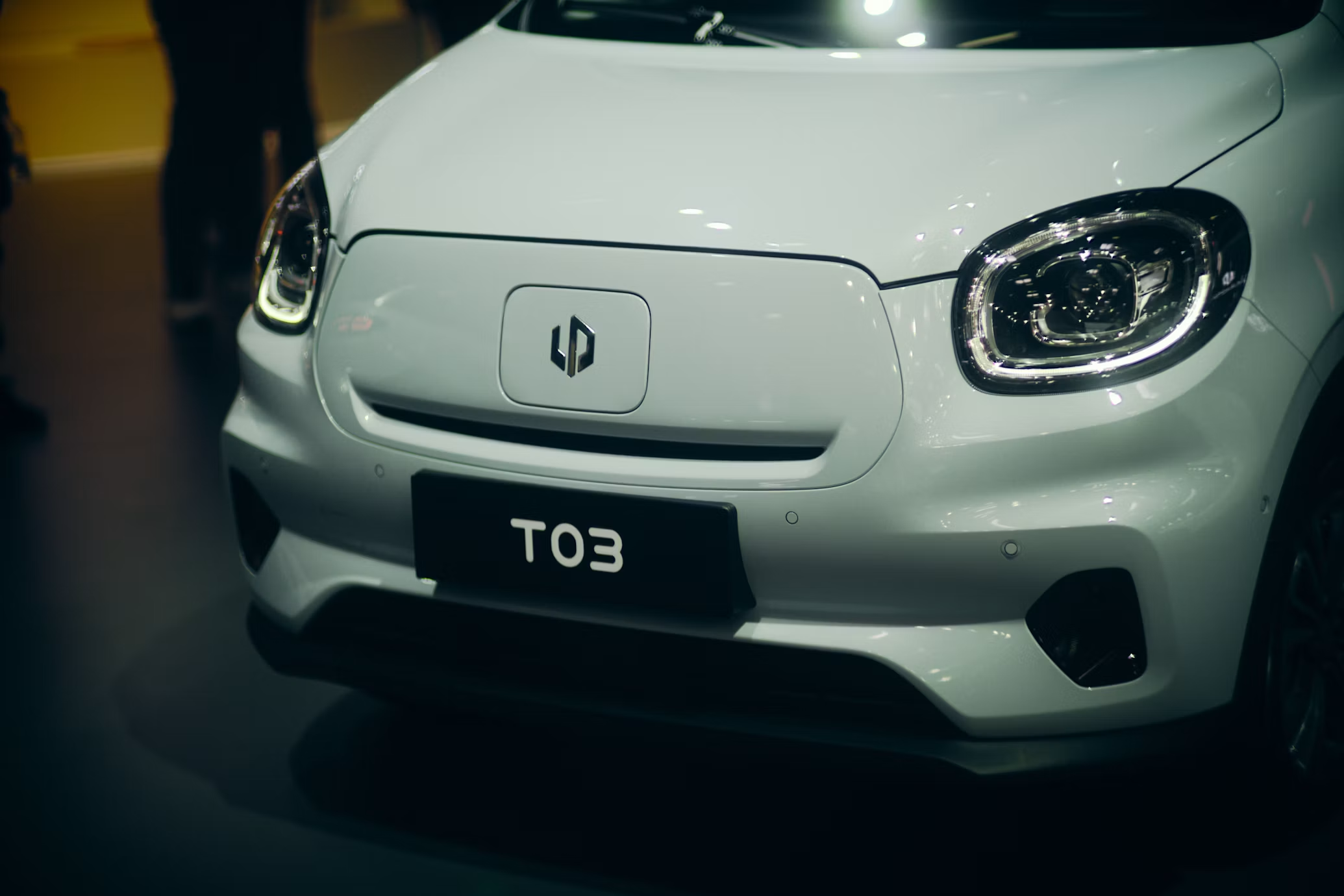
Chinese automobiles
HS classification for complete vehicles falls under Chapter 87. Accurate coding is essential for both customs declarations and any preferential treatment under bilateral arrangements. Misclassification triggers valuation disputes and potential penalties.
Step-by-Step Operational Playbook for B2B Importers and Re-Exporters
- Source and contract structure Secure factory GCC-spec units through authorized channels. Prefer FOB Chinese port or CIF UAE port terms that clearly allocate marine insurance and responsibility for export documentation. Include clauses requiring the supplier to furnish complete homologation packages before sailing.
- Shipping mode selection RoRo remains the most efficient for volume. Container shipping suits smaller or mixed lots. Monitor direct sailings into Khorfakkan or Jebel Ali; the reduction in voyage days lowers both freight and inventory carrying cost.
- Arrival and free-zone entry File the appropriate Mirsal-2 declaration for free-zone transfer. Goods remain under customs control with duty suspended. Storage, pre-delivery inspection and any minor preparation can occur inside the zone.
- Decision point: local sale versus re-export
- Mainland sale: clear under Import to Local, pay 5 percent duty plus 5 percent VAT, complete RTA or equivalent registration.
- Re-export: file the re-export declaration, provide destination documentation, and move under bond or transit procedures. No UAE duty is paid if the units leave without entering free circulation.
- Regional distribution Intra-GCC movements benefit from the Customs Union framework. Documentation must still be complete, but physical inspections are typically lighter once the initial free-zone clearance is clean.
- Cash-flow and risk controls Use free-zone storage to match inventory to confirmed orders. Escrow or documentary collection arrangements protect against non-payment on high-value lots. Track demurrage and storage free time closely; modern ports offer competitive windows but penalties accumulate quickly on stalled cargo.
📋
GSO Compliance & Digital Customs Clearance Architecture (Mirsal II & Dubai Trade)
Accelerating vessel-to-free-zone turnover requires seamless integration with UAE digital customs platforms and absolute precision in technical conformity documentation prior to vessel arrival.
- GSO Certificate of Conformity (CoC): Every vehicle batch destined for mainland registration or GCC distribution must be accompanied by a valid Gulf Standardization Organization (GSO) Conformity Certificate issued by an accredited notified body. For Saudi-bound cargo, compliance aligns directly with the SABER / SASO CoC portal standards.
- Digital Declaration via Mirsal II: Inbound shipments through Dubai ports require pre-filing of Electronic Customs Declarations on Dubai Customs’ Mirsal II platform (or equivalent port systems like Kwateer in Sharjah). Declarations must explicitly specify whether cargo is entering under “Free Zone Deposit” (duty suspension) or “Import to Local”.
- Dubai Trade Single-Window Execution: Booking delivery orders, managing vessel discharge manifests, and initiating Discharge and Drive clearance protocols are streamlined through the Dubai Trade Portal. Automated matching of the Bill of Lading, Commercial Invoice, Packing List, and GSO CoC prevents physical inspection holds at the terminal gates.
🚢
Ocean Freight Mode Comparison: RoRo vs. Containerized Racks (40ft High Cube)
Choosing between Pure Car and Truck Carriers (PCTC / RoRo) and containerized shipping with specialized multi-car rack systems directly impacts landed costs, transit speed, and cargo protection depending on order volume and vehicle valuation.
| Logistics Feature | Roll-on/Roll-off (RoRo) | Containerized Racks (40ft HC) |
|---|---|---|
| Optimal Shipment Volume | High-volume commercial allocations (hundreds to thousands of units) | Small-to-medium lots (3–4 vehicles per 40ft HC container using specialized cassettes) |
| Cost Efficiency & Freight Structure | Lowest freight cost per unit for mass-market SUVs and sedans on direct sailings | Higher ocean freight per unit, but cost-effective for high-value/luxury EVs or mixed spare parts lots |
| Port Handling & Transit Speed | Ultra-fast discharge (up to 140–200 units/hr); no container unstripping required | Standard container discharge; requires specialized unstripping ramps inside free zones |
| Cargo Risk & Security | Exposed to weather/ramp driving operations during loading/unloading | Fully sealed and protected from salt spray/handling damage; zero ramp exposure |
Operators who treat the free zone as a true staging warehouse rather than a temporary parking lot consistently achieve faster turns and lower effective landed cost.
Logistics Cost Drivers and Margin Levers
Ocean freight, insurance and local handling remain the largest variable costs after the vehicle itself. Direct sailings have compressed the ocean component. Local terminal charges, inspection fees and inland transport within the UAE add another layer. The decisive lever is duty avoidance through correct free-zone or re-export routing.
A typical mid-range Chinese EV arriving under CIF terms might see the 5 percent duty add several thousand dirhams. Keeping the unit inside the free zone and re-exporting eliminates that charge for the ultimate buyer outside the UAE. For pure local sales the duty is unavoidable but predictable, allowing accurate pricing.
Battery logistics introduce additional complexity for pure electric models. Specialized storage meeting dangerous-goods standards is now available inside Jebel Ali, reducing the need for ad-hoc solutions.
🔋
ESG Compliance, EV Battery Recycling & HAZMAT Logistics (Class 9 Dangerous Goods)
With New Energy Vehicles (NEVs) driving over 40% of Chinese automotive export growth, compliance with international hazardous material standards and local environmental management frameworks has become a prerequisite for seamless port handling.
- HAZMAT Classification & Port Regulations: High-capacity lithium-ion battery packs fall under UN 3480 / UN 3481 (Dangerous Goods Class 9). Inbound ocean shipments and port staging in Jebel Ali or Khorfakkan require strict adherence to IMDG Code documentation, certified MSDS (Material Safety Data Sheets), and thermal-runaway protection protocols before discharge clearance.
- End-of-Life (EoL) & Recycling Frameworks: UAE municipal environmental regulations mandate clear tracking of battery life cycles. B2B importers are increasingly required to demonstrate partnerships with certified regional battery recyclers or secondary-life battery storage facilities to manage damaged or degraded cells responsibly.
- ESG Risk Mitigation for Fleet Operators: Institutional buyers and corporate fleet managers across the GCC prioritize suppliers with verified carbon-footprint disclosures and compliant battery disposal pipelines, directly influencing tender eligibility.
⚙️
Market Opportunities Beyond Simple Import
After-Sales Architecture & Spare Parts Supply Chain (HS Code Classification)
The rapid penetration of Chinese automotive brands into the GCC market has highlighted a critical commercial hurdle: long-term after-sales sustainability and spare parts availability. Establishing a resilient regional parts hub is essential to securing retail buyer confidence and protecting brand equity.
- Harmonized System (HS) Classification: Key vehicle body, mechanical, and electronic components fall under HS Chapter 8708 (parts and accessories of motor vehicles) and Chapter 8507 (electric storage batteries). Accurate tariff sub-heading mapping prevents customs misclassification fines and ensures smooth re-export declarations within the GCC region.
- Free-Zone Warehousing & Buffer Stocks: Utilizing UAE free-zone hubs (such as JAFZA or KIZAD) for SKUs and fast-moving components enables duty-suspended storage. Distributors can maintain regional safety stock and dispatch replacement parts across GCC borders within 24 to 48 hours without upfront customs duties.
- Warranty & Technical Compliance: Factory warranty support mechanisms and localized diagnostic software systems must be paired with physical parts inventories to meet local consumer protection mandates across Gulf markets.
Re-export into secondary markets in East Africa and the Levant continues to grow. Units that clear UAE free zones carry the advantage of established documentation and can often move with lighter additional compliance than direct China-origin shipments into those destinations.
Arbitrage between models remains active. Certain Chinese SUV and crossover platforms deliver strong value propositions against established Japanese and Korean competitors once logistics and compliance costs are controlled.
Risk Factors That Require Active Management
Port congestion during peak sailing periods can still occur. Diversifying between Jebel Ali and Khorfakkan reduces exposure. Documentation errors remain the most common cause of delay; incomplete homologation packages or mismatched values trigger inspection holds.
Currency and payment risk is manageable through standard trade-finance instruments, yet the absolute values involved in vehicle lots demand careful counterparty assessment. Sanction screening on ultimate destinations is non-negotiable for any re-export program.
China–GCC Automotive Landed-Cost & Duty Optimization Framework
A comprehensive financial guide covering cost breakdowns, tariff mechanisms, free-zone staging, and currency hedging strategies for B2B importers.
💡
Currency Volatility & B2B Settlement Mechanisms (RMB / AED / USD)
Due to the high transaction value of cross-border vehicle supply chains, managing currency risk and establishing secure payment architecture are non-negotiable for sustainable margins.
- Direct RMB Clearing: Settling B2B invoices directly in Chinese Yuan (RMB) via UAE offshore clearing hubs mitigates FX conversion spreads and bypasses USD volatility risks.
- Trade Finance Structuring: Utilizing UAE-based Escrow frameworks, confirmed Letters of Credit (L/C), or structured documentary collections safeguards cash flow against delivery and homologation disputes.
- Hedging Currency Pairs: Implementing forward contracts on AED-RMB peg dynamics locks in landed-cost margins before vessel departure.
Emission and safety standards will continue to evolve. Operators who maintain direct relationships with certification bodies stay ahead of changes rather than reacting after cargo has sailed.
UAE Corporate Bank Freeze: How to Unfreeze Accounts Fast
GCC Mobility Megaprojects: 2026 Supply Chain Status & Opportunities
❓
Frequently Asked Questions (FAQ) – Chinese Vehicle Logistics & GCC Re-Export
1. What is the customs duty rate for importing Chinese vehicles into the UAE mainland?
Under the GCC Common External Tariff, passenger vehicles imported into the UAE mainland are subject to a flat 5% customs duty based on their CIF (Cost, Insurance, and Freight) value, plus 5% VAT. No anti-dumping duties or country-specific surcharges currently apply to Chinese vehicle imports.
2. How can B2B importers avoid paying customs duties on vehicles destined for re-export?
By utilizing UAE Free Zones like Jebel Ali Free Zone (JAFZA) or bonded transit corridors. Vehicles stored within free zones enter under duty suspension (using Mirsal II “Free Zone Deposit” declarations). Customs duties are only payable if the vehicles enter the local UAE mainland market; onward re-exports to other GCC states or third countries remain duty-free.
3. What are the mandatory technical compliance requirements (GSO) for GCC vehicle entry?
Vehicles intended for registration or GCC mainland trade must hold a valid Gulf Standardization Organization (GSO) Certificate of Conformity. Key specifications include Left-Hand Drive (LHD) layout, GCC hot-weather performance packages (high-capacity cooling and battery thermal management), Arabic user manuals, and compliance with local emissions standards (Euro 6b compliance taking effect in 2026).
4. What is the main operational difference between Jebel Ali Port and Khorfakkan Port for RoRo cargo?
Jebel Ali Port (JAFZA) offers extensive free-zone warehousing, PDI centers, and mainland connection. Khorfakkan Port (East Coast) acts as an ultra-fast express RoRo node that bypasses the Strait of Hormuz, saving 1–2 sailing days and offering discharge rates of 140–200 units per hour for fast-turning re-export flows.
5. What special shipping and logistics rules apply to Chinese Electric Vehicles (NEVs)?
Electric vehicle lithium-ion batteries are classified as Class 9 Dangerous Goods (UN 3480 / UN 3481). Maritime shipments must strictly adhere to the IMDG Code, provide certified MSDS documentation, and ensure thermal runaway protection. Staged storage in ports requires HAZMAT-approved facilities with dedicated battery thermal monitoring.
6. How can B2B importers manage currency risk when paying Chinese suppliers?
Importers can settle invoices directly in Chinese Yuan (RMB) via UAE offshore RMB clearing channels, eliminating double FX conversion costs (USD-AED-RMB). Utilizing trade-finance instruments such as UAE Escrow services, confirmed Letters of Credit (L/C), or AED-RMB forward contracts further locks in margins before vessel departure.
Building a Durable Position in the 2026 Flow
The H1 2026 figures confirm that Chinese vehicle exports have moved from a rapid-expansion phase into a more structured global distribution system. The UAE’s combination of tariff predictability, free-zone flexibility and port capacity positions it as the natural consolidation point for the GCC and adjacent markets.
Traders who master the free-zone versus mainland decision tree, insist on factory GCC-spec product, and align shipping schedules with confirmed demand convert volume into consistent margin. Those who treat arrivals as generic inventory without documentation discipline absorb unnecessary cost and delay.
For teams seeking structured support on HS classification, duty calculation, free-zone setup comparisons or documentation checklists, the practical tools available through Platform.Tendify.Net can compress the learning curve on routine calculations and compliance mapping.
The same platform hosts related operational resources, including detailed comparisons of free-zone, mainland and bonded re-export structures and practical guidance on container and RoRo optimization for high-value cargo. Cross-referencing these with current Incoterms selection and cost modeling produces cleaner landed-cost projections before the first vessel is booked.
The underlying opportunity is durable. Chinese manufacturing scale, competitive product positioning and improving logistics links into the Gulf will continue to generate flow. The operators who capture it will be those who treat compliance and routing as core commercial skills rather than afterthoughts.
To move from analysis to execution, establish the free-zone presence, lock preferred RoRo slots, and formalize documentation protocols with suppliers. The difference between watching the numbers and participating in them is measured in process discipline.
Register on تندیفای to unlock interactive landed-cost calculators, free-zone vs. mainland routing simulators, and live market intelligence that transform complex GCC trade corridors into structured, low-risk operational workflows.
→
Instant Access to B2B Customs & Duty Calculators

