


Blog
GCC Mobility Megaprojects: 2026 Supply Chain Status & Opportunities

Six months can rewrite the map of a region’s infrastructure pipeline. In the first half of 2026 several flagship mobility schemes moved from paper to steel, from prequalification to active tunnelling, and from planning slides to passenger trains already carrying people. For suppliers of rails, signalling, rolling stock, construction materials, specialised equipment and logistics services, the window for positioning is no longer theoretical.
The numbers now on the ground matter more than the press releases issued two years earlier. Here is where the major GCC mobility programmes actually stand in August 2026, what that status means for delivery timelines, and where commercial opportunity still exists for traders who understand both the technical requirements and the procurement rhythms of these projects.
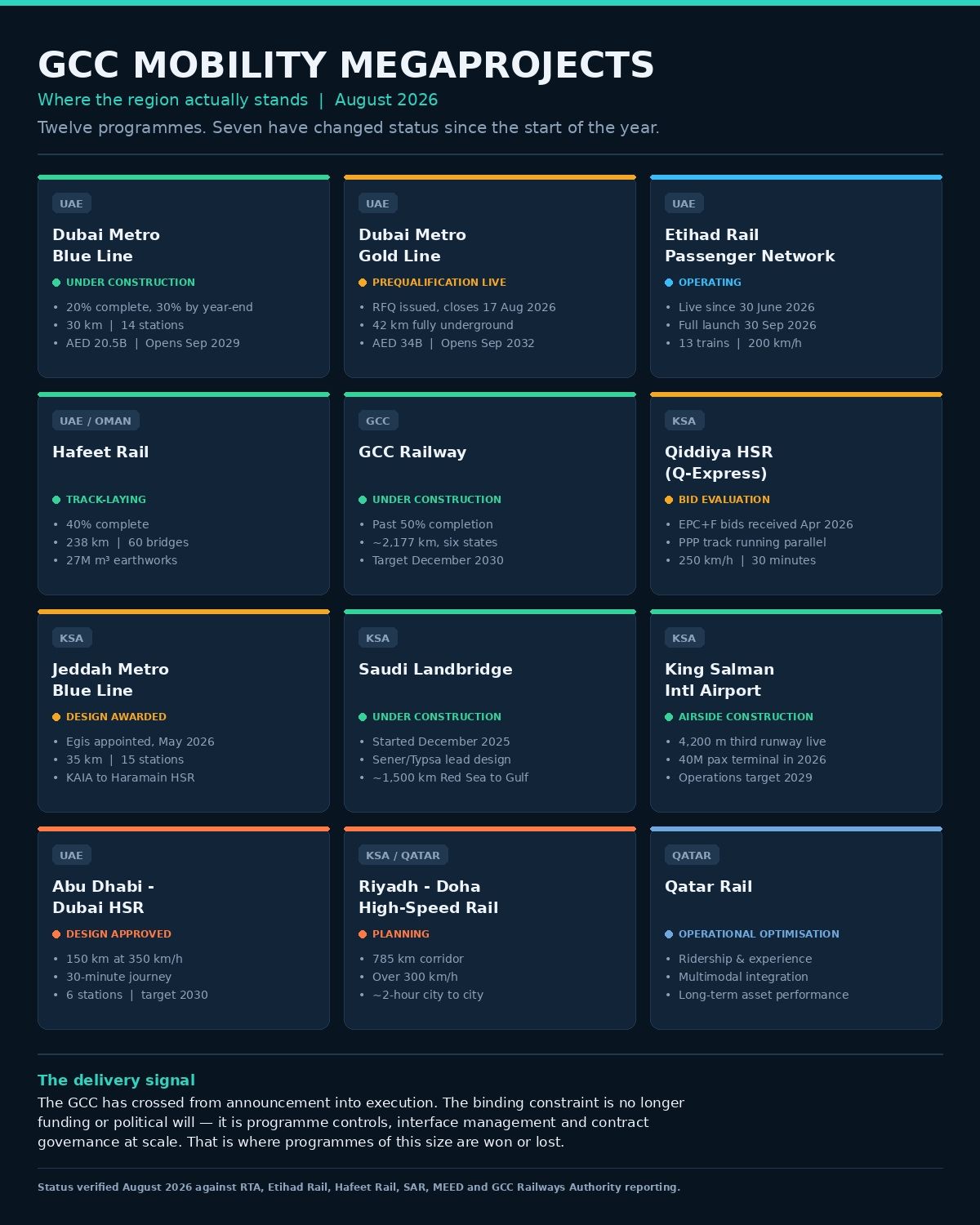
GCC Mobility Megaprojects
Quick Status: GCC Mobility Megaprojects (August 2026)
Dubai Metro Blue Line: Tunnelling Underway and Schedule Holding
The Blue Line remains the most advanced heavy metro project currently under construction in the Gulf. By May 2026 it had reached roughly 20 percent physical completion and is tracking toward 30 percent by year-end. The first tunnelling phase closed within two months of commencement. Tunnel boring machine Al Wugeisha has already reached Dragon Souq station, the first underground station on the alignment.
Key parameters remain unchanged: AED 20.5 billion contract value, 30 km route, 14 stations, target opening 9 September 2029. The early progress on the first TBM drive is the single most important signal for suppliers. Once the second and third machines are fully mobilised, demand for segment moulds, precast concrete, waterproofing systems, and specialised tunnel ventilation equipment will accelerate. Contractors who can demonstrate consistent delivery of high-tolerance precast segments will find themselves preferred for subsequent packages.
Dubai Metro Gold Line: Prequalification Window Closing
The Gold Line has shifted from concept to live procurement. RTA issued the RFQ for the design-and-build package; prequalification submissions closed 17 August 2026. Award is targeted for 2027. At AED 34 billion, 42 km fully underground and 18 stations, this is the largest single metro package currently in the prequalification phase in the region. Opening remains scheduled for 9 September 2032.
Because the alignment is entirely underground, the technical requirements differ sharply from the Blue Line. Expect heavier emphasis on large-diameter TBMs, complex station boxes in dense urban fabric, and advanced fire-and-life-safety systems. Suppliers of segmental lining, station architectural finishes, and platform-screen doors should already be preparing capability statements and local-content plans. The prequalification stage is the last realistic moment to insert yourself into the shortlist before the main tender documents lock in preferred technologies.
Etihad Rail Passenger Network: Already Operating
The narrative around Etihad Rail has changed completely. It is no longer a future network; it is a functioning passenger railway. The Abu Dhabi–Fujairah section entered service on 30 June 2026. Formal network launch is set for 30 September 2026 with the addition of Dubai and Al Dhaid. Al Dhafra follows on 30 December 2026 and Sharjah on 30 March 2027. Thirteen trainsets capable of 200 km/h form the initial fleet.
For rolling-stock maintainers, spare-parts specialists, and operators of station commercial space, the opportunity has moved from construction-phase supply to long-term operations and maintenance contracts. Companies that previously focused only on civil works should reorient toward the aftermarket. Predictive maintenance systems, specialised lubricants, and rapid-response logistics for remote stations will become recurring revenue streams once the full network is live.
Hafeet Rail (UAE–Oman Link): Track-Laying Phase
The 238 km Hafeet Rail corridor connecting the UAE and Oman has reached approximately 40 percent overall completion and is now in the rail-installation phase. The project includes 60 bridges, 2.5 km of tunnels, 27 million cubic metres of earthworks, and has already recorded more than 10 million safe man-hours.
Track-laying is the point at which demand for rail, sleepers, fastening systems, and ballast intensifies. Because the line crosses an international border, documentation and customs procedures for materials moving between the two countries add a layer of complexity that pure domestic projects do not face. Traders experienced in dual-jurisdiction logistics hold a measurable advantage here.
GCC Railway: Past the Halfway Mark
The GCC Railways Authority reports that the overall network has surpassed 50 percent completion against a December 2030 target. The system covers roughly 2,177 km. Parallel to the main freight and passenger spine, the 785 km Riyadh–Doha high-speed link continues as a distinct programme.
Crossing the 50 percent threshold changes the risk profile for suppliers. Early-stage civil works packages are largely awarded; attention now shifts to systems—signalling, electrification, telecommunications, and rolling stock. Companies that can supply interoperable systems compliant with the technical specifications adopted across multiple GCC member states will be better positioned than those offering country-specific solutions.
Qiddiya High-Speed Rail (Q-Express): Bid Evaluation Underway
EPC+F bids for the Qiddiya high-speed link were received in April 2026. PPP prequalification is running in parallel. The route will connect King Salman International Airport, King Abdullah Financial District and Qiddiya at design speeds of 250 km/h, delivering a 30-minute journey.
This project sits at the intersection of tourism, entertainment and transport policy. Suppliers of high-speed track components, overhead catenary systems, and station commercial fit-out should treat the current evaluation phase as the final opportunity to influence technical specifications before preferred bidder status is awarded.
Jeddah Metro: Design Phase Reactivated
After years of limited visible progress, the Jeddah Metro Blue Line has moved forward. Egis has been appointed as preliminary design consultant for the 35 km, 15-station line. This is the first substantive design appointment on the scheme in a decade.
Design awards typically trigger a cascade of sub-consultant appointments and early material studies. Firms specialising in urban rail planning, geotechnical investigation, and traffic modelling should monitor the next six months closely. Once the preliminary design is complete, the project is expected to move into detailed design and then into procurement of the main construction packages.
Saudi Landbridge: Construction Underway on a Phased Basis
Construction of the Saudi Landbridge began in December 2025. The programme has been restructured as a phased design-and-build rather than a single mega-PPP. Lead design is held by Sener/Typsa; Hill International and Italferr are providing project management consultancy. The corridor runs approximately 1,500 km from the Red Sea to the Gulf.
The shift to a phased approach alters cash-flow and risk profiles for contractors and suppliers. Smaller, sequential packages reduce the capital intensity of each tender but increase the number of interfaces. Logistics providers capable of staging materials across multiple simultaneous work fronts will find more opportunities than those structured only for single large-site delivery.
King Salman International Airport: Airside Already Under Construction
The third runway (4,200 m) has been under construction since January 2026. The 40-million-passenger terminal is scheduled to enter construction this year, with a direct connection to the Riyadh Metro. Operations are targeted for 2029.
Although primarily an aviation project, the airport’s rail interface and the scale of airside civil works create secondary demand for specialised paving, drainage systems, and high-capacity baggage-handling equipment. Suppliers already active on the Riyadh Metro packages are naturally positioned to extend their scope into the airport interface works.
Abu Dhabi–Dubai High-Speed Rail: Design Approved
The 150 km high-speed line between Abu Dhabi and Dubai has received design approval. Design speed is 350 km/h, journey time 30 minutes, six stations. Target operational date is 2030.
With design frozen, the next commercial step is the main construction and systems tenders. High-speed rail components—particularly slab track, high-speed switches, and aerodynamic rolling stock—have long lead times. Early engagement with the client and its technical advisors remains the only reliable way to influence specification and secure a place on the shortlist.
Qatar Rail: Focus on Optimisation Rather Than Expansion
Qatar Rail continues to prioritise ridership growth, multimodal integration and long-term asset performance over construction of new lines. For suppliers this means a shift toward operations and maintenance contracts, spare parts, and digital asset-management platforms rather than new civil works packages.
What These Status Changes Mean for Supply Chains
Several practical patterns emerge from the August 2026 picture.
- First, the centre of gravity has moved from civil works toward systems and rolling stock on the more advanced projects. Companies whose portfolios are still dominated by earthworks and concrete should accelerate partnerships with systems specialists or risk being relegated to lower-value packages.
- Second, international interfaces are increasing. Hafeet Rail, the broader GCC Railway, and the Saudi Landbridge all cross or connect multiple jurisdictions. Logistics providers that already operate dual-customs procedures and understand documentation requirements on both sides of these borders hold a structural advantage.
- Third, local-content and in-country value rules continue to tighten across the region. Even when the main contractor is international, a growing share of materials and subcontracts must be sourced or executed locally. Traders who can demonstrate genuine local manufacturing, assembly or value-addition capacity will find themselves preferred over pure import models.
- Fourth, the timeline compression on several projects means that suppliers who wait for formal tender notices will often arrive too late. The most successful operators are already holding technical discussions with designers and client representatives while prequalification documents are still being drafted.
Practical Next Steps for Traders and Suppliers
- Map every project against your actual product or service capability. A generic “construction materials” pitch is less effective than a precise statement of which grades of rail, which types of fastening systems, or which classes of precast segments you can deliver to the required standards.
- Track the precise procurement stage of each package. Prequalification, RFQ, RFP and preferred-bidder stages each require different documentation and different commercial postures.
- Build relationships with the project management consultancies and design houses already appointed. These organisations often influence technical specifications long before the main construction contracts are awarded.
- Prepare dual-language capability statements and local-content plans that meet the specific requirements of each GCC member state. One generic document will not serve both UAE and Saudi processes.
- Secure reliable logistics partners who understand the border-crossing and temporary-storage requirements of long linear projects. Demurrage and detention costs on rail and metro sites can quickly erode margins if material arrivals are poorly sequenced.
For traders seeking structured market intelligence, HS-code classification support, or early visibility into related procurement pipelines, the tools available through Platform.Tendify.Net can reduce the time spent on preliminary research. Internal resources on Saudi Vision 2030 building-materials demand and GCC multimodal logistics cost structures provide additional operational context for companies already active in the region.
The mobility programmes now moving through construction and early operations represent multi-year demand for specialised products and services. The difference between capturing a meaningful share of that demand and watching it pass to better-prepared competitors usually comes down to timing, technical precision, and the ability to navigate both the engineering requirements and the commercial procedures of each client organisation.
The projects listed above will continue to evolve. Tracking their actual physical progress, rather than relying solely on announced target dates, remains the most reliable way to align supply capacity with real demand. Companies that treat these schemes as living programmes rather than static announcements will be the ones still delivering value when the first trains run on the newest lines.
Download the Full Executive Briefing (PDF)
To accelerate positioning across these corridors—whether through verified supplier matching, documentation support, or structured market access—register and begin building your operational profile.
“The next wave of package awards will not wait for those still compiling capability statements after the RFQs have closed.”

