


وبلاگ
GCC Fast Track: Automating Border Crossings & Logistics
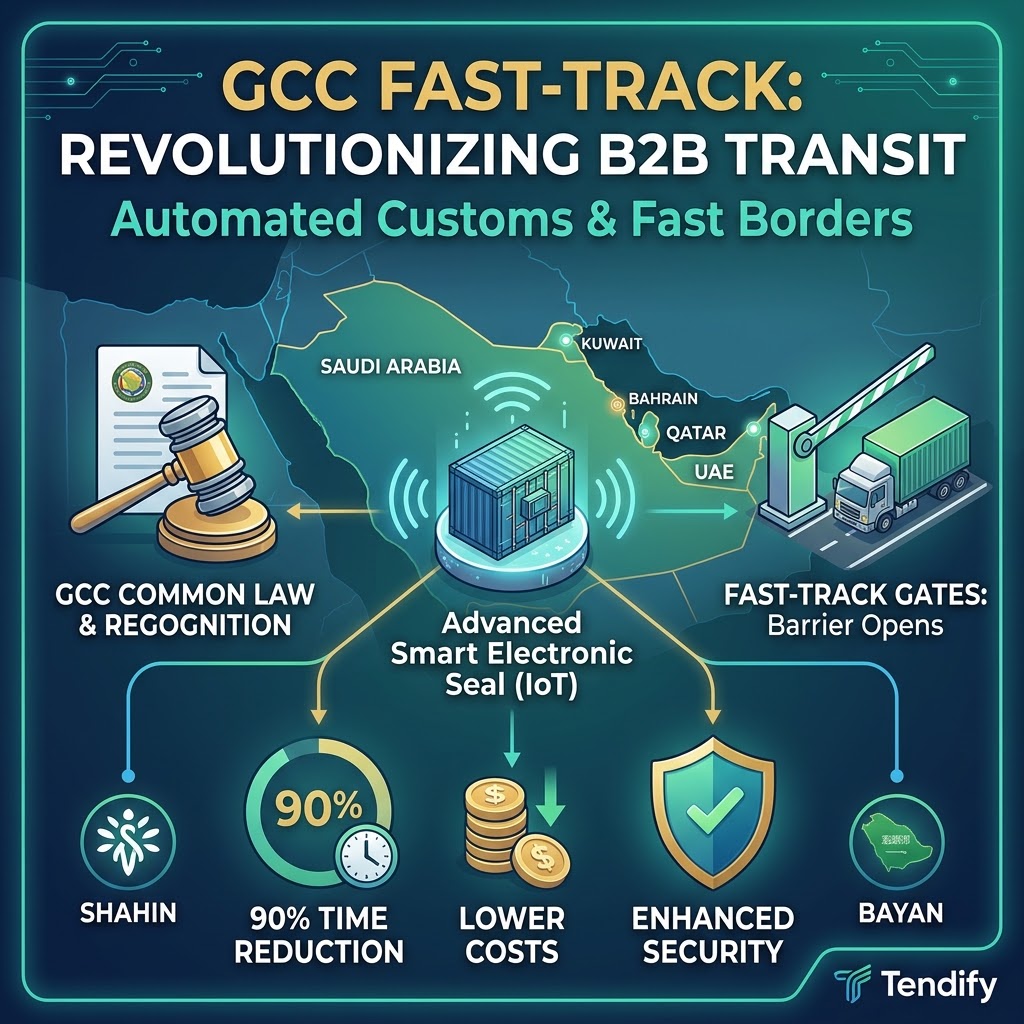
A loaded truck leaves Jebel Ali under a smart electronic seal. By the time it reaches the Saudi border, the gate opens automatically. No queue. No physical inspection. No paper exchange. The seal’s sensors confirm the doors never opened, the route never changed, and the temperature stayed within limits. The driver keeps moving. What once required hours or days of intermediate stops now takes minutes.
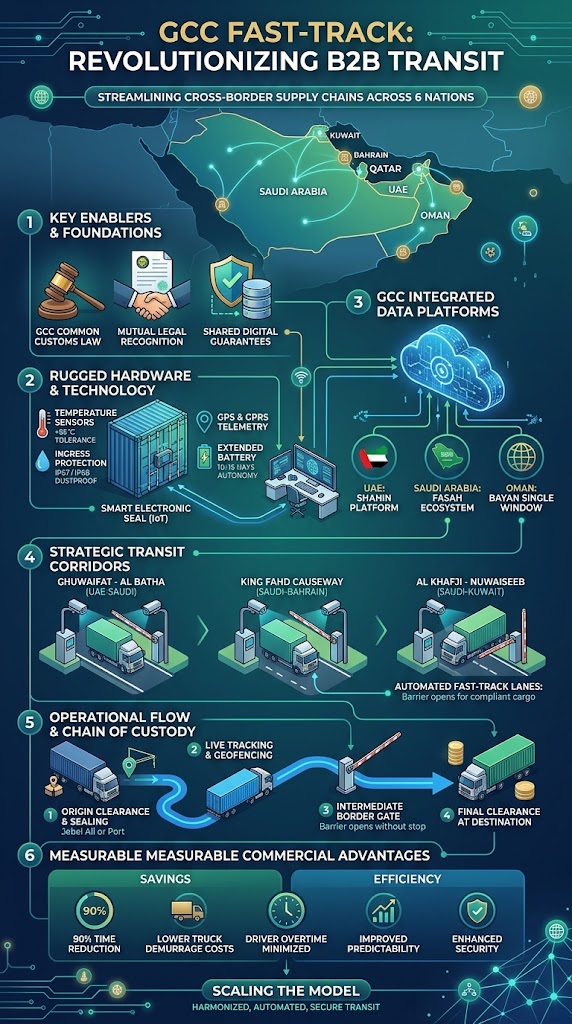
This is the operational reality of the GCC Fast-Track transit model. It rests on two tightly integrated layers: high-security digital seals equipped with GPS and multi-sensor arrays, and continuous monitoring through geofencing, RFID and real-time data exchange among the six member customs administrations. The result is a corridor that treats the physical borders between UAE, Saudi Arabia, Qatar, Kuwait, Bahrain and Oman more like internal checkpoints of a single logistics zone.
GCC Fast Track
Operational assessments across the region show that sealed, continuously tracked movements under this model cut intermediate dwell time dramatically while raising the security baseline. The technology does not eliminate customs control. It relocates most of the control upstream and makes the intermediate borders essentially transparent for compliant cargo.
How the Digital Seal and Identity Layer Works at Origin
At the first customs point—typically a major port such as Jebel Ali or a designated inland facility—the process begins with the physical and digital locking of the load.
A high-security electronic seal is affixed to the container doors or the truck’s load compartment. These seals incorporate a GPS module, impact sensors, door-open detection, and in many cases temperature or humidity probes. Once locked, any unauthorized attempt to open, cut or force the seal triggers an immediate alert to the central monitoring platform.
Simultaneously, a unique digital identity is assigned. This is usually a combination of an RFID tag and a QR code that carries or points to the full electronic declaration: cargo description, HS classification, bill of lading data, authorized transit route, and the guarantee or bond details. The identity is registered in the shared GCC customs data environment so that every subsequent checkpoint can query the same record without requiring the driver to present paper.
The combination of physical seal integrity and digital identity creates a continuous chain of custody. As long as the seal remains unbroken and the vehicle stays inside the defined geofence, the shipment is treated as low-risk and eligible for automated passage.
Live Tracking and Geofencing During Transit
Once the truck leaves the origin facility, the monitoring system takes over. The GPS unit reports position at short intervals. The route is pre-defined in the customs system as a virtual corridor. Any deviation beyond the allowed corridor, any prolonged stop outside designated rest or fuel points, or any sensor event (door opening, impact, temperature excursion) generates an automated alert.
Customs control rooms across the participating states receive the same live picture through the electronic data linkage that now operates among GCC administrations. The system does not rely on intermittent radio checks or manual reporting. It maintains continuous visibility.
Because the integrity of the seal and the adherence to the route are verifiable in real time, intermediate border posts no longer need to perform routine physical examinations. The assumption flips: the load is presumed secure unless the data indicates otherwise. This is the core efficiency gain of the model.
Stakeholder Mapping: Who Interacts with the System?
Roles, Responsibilities & Cross-Border System Touchpoints
An automated border crossing framework relies on synchronized inputs from five key international trade pillars. By converting paper workflows into cryptographically signed digital assets, each entity interacts with the platform at precise operational intervals to maintain an unbroken chain of custody.
Initiates the trade lifecycle by generating structured e-Invoices, e-Packing Lists, and digital Certificates of Origin directly via ERP or platform interface.
Issues electronic Bills of Lading (e-BL) or e-CMR, binds IoT tracking tags/smart seals to the cargo, and broadcasts real-time telemetry along transit corridors.
Executes pre-arrival risk profiling (eTIR/eCustoms), validates automated ANPR border gate scans, and triggers digital clearance flags without manual stopovers.
Verifies trade documents against Letters of Credit (LC), automates trade financing releases upon digital proof of border crossing, and manages transit insurance risk.
Monitors real-time ETA updates, pre-clears import duties automatically, and confirms digital Proof of Delivery (PoD) upon final warehouse arrival.
Instead of fragmented communications via email and paper manifests, all five parties operate within a single, secure digital continuum—dramatically reducing clearance times from days to minutes.
Strategic Transit Infrastructure
Primary GCC Fast-Track Strategic Corridors
Key cross-border checkpoints equipped with automated RFID lanes and telemetry-linked gate infrastructure.
High Volume
Ghuwaifat – Al Batha Border
The central artery for overland freight connecting Jebel Ali and Abu Dhabi to Riyadh and Western Saudi Arabia, running automated ANPR clearance for sealed containerized trucks.
Express Gateway
King Fahd Causeway
Connects Bahrain’s Khalifa Bin Salman Port to Saudi’s Eastern Province via dedicated high-speed electronic lanes, eliminating historical congestion bottlenecks.
Northern Link
Al Khafji – Nuwaiseeb Gate
Serves as the primary northern entry corridor for industrial and consumer goods traveling from GCC production hubs directly into Kuwait Metropolitan Area.
Eastern Corridor
Khatmat Malaha / Wajajah
Facilitates uninterrupted trade flow between Northern Emirates/Oman ports and the Sohar Industrial Zone using synchronized Bayan platform risk engines.
GCC Common Customs Law (Article 2)
The Legal Foundation: Single Point of Entry Principles
The operational seamlessness of the GCC Fast-Track corridor is not merely a technological achievement; it is legally anchored in the GCC Common Customs Law and the regional mandate for a unified Single Point of Entry (First Port of Entry) framework. Under this agreement, duty collection, primary security screening, and risk assessments are consolidated exclusively at the outer border of the Gulf Cooperation Council.
Customs duties and import taxes are collected at the first GCC entry point (e.g., Jebel Ali or Dammam). Internal land borders function purely as transit verification checkpoints without double taxation.
All six member states legally recognize digital declarations, e-Invoices, and cryptographically signed IoT seal telemetry issued by accredited regional port authorities.
Replaces individual national transit bonds with a single unified digital guarantee, backed by real-time GPS chain-of-custody tracking across all intermediate borders.
📌
Automated Border Crossing Without Driver Intervention
When the truck approaches an internal GCC land border, fixed readers and cameras do the work. Automatic number-plate recognition identifies the vehicle. RFID or long-range readers capture the seal and digital identity data from several meters away. The system cross-checks the live tracking history against the original declaration and the shared risk profile.
If no alerts have been registered and the data matches, the Fast-Track lane barrier opens. The driver does not leave the cab. No additional documents are stamped. No secondary inspection is triggered. The truck continues under the same seal toward the final destination.
This sequence is already visible in operational form through systems such as Dubai Customs’ Shahin electronic seal platform, which applies satellite-tracked seals and generates alerts on route deviations, and through the broader GCC electronic data-exchange platform that enables real-time sharing of declaration and risk data among the six states. The Fast-Track concept simply scales these capabilities into a corridor-wide operating model.
Final Clearance Only at Destination
The seal remains intact until the designated final customs office. Only there is it opened by authorized personnel. At that point the full formalities—duty calculation if any residual liability exists, final risk assessment, and physical verification where required—are completed. Because the intermediate legs have already been monitored continuously, the destination office works with a complete, verified history rather than starting from zero.
Data from the entire journey is already present in the single-window environment. There is no need to reconstruct the movement or chase missing paper. The process is faster, the audit trail is stronger, and the opportunity for undocumented diversion is sharply reduced.
Practical Advantages for Shippers and Logistics Operators
The measurable outcomes appear in several operational categories.
Transit time compression. Intermediate border stops that previously consumed hours or full days are reduced to automated gate passages measured in minutes. For multi-country itineraries the cumulative saving is substantial.
Cost reduction. Lower dwell time reduces demurrage exposure, driver overtime, and fuel burned while idling. Insurance risk profiles improve because continuous monitoring and seal integrity lower the probability of theft or contamination claims.
Security and integrity. Unauthorized opening, route diversion or environmental breach is detected immediately rather than discovered days later at destination. High-value or temperature-sensitive cargo gains a continuous protective layer.
Predictability. Shippers and receivers can plan onward distribution with higher confidence because the arrival window at the final customs point becomes narrower and more reliable.
Compliance leverage. Carriers and shippers that consistently operate under the sealed, tracked regime build a favorable risk score. Over time this can translate into preferential lane access or reduced examination rates on future movements.
Commercial Analysis
Cost Structure, Commercial Models & Economic ROI
Evaluating smart digital seals strictly as a hardware expense overlooks their primary financial role: a strategic risk-mitigation tool that eliminates exponential border dwell costs. Understanding the prevailing commercial models helps operators measure the true return on investment (ROI).
Most prevalent in GCC transit corridors. Operators pay a single inclusive fee covering hardware rental, reverse logistics, GPS data transmission, and customs API integration for one cross-border leg.
Preferred by large enterprise fleets. Fleet operators buy the heavy-duty reusable seals outright and pay a recurring cloud platform subscription ($10–$25/month) for live dashboarding and analytics.
| Cost Component | Conventional Border Transit | GCC Fast-Track (Smart Sealed) |
|---|---|---|
| Border Dwell Time | 24 to 72 Hours | 15 to 45 Minutes |
| Truck Demurrage & Idling | $150 – $300 / day | $0 (Zero Dwell) |
| Driver Overtime / Allowance | $80 – $150 per corridor leg | Minimized to driving hours |
| Smart Technology Fee | $0 (Mechanical seal $5) | $50 – $75 per trip (Avg.) |
| Net Financial Outcome | High Variability & Hidden Losses | Net Saving of $200 – $450 per Trip |
Implementation Requirements for Operators
To use the Fast-Track corridor effectively, operators need to align their processes with the technical and procedural requirements.
- Confirm that the chosen origin facility supports the issuance of the approved electronic seals and the registration of the digital identity into the shared GCC data environment.
- Ensure the vehicle and container configuration meets the physical standards that allow secure application of the seal (single-door load compartment or container doors designed for high-security sealing).
- Pre-file the electronic declaration with complete and accurate data so that the digital identity can be created without delays.
- Equip or contract for the GPS-enabled seal that the relevant customs administration recognizes.
- Train drivers on the geofenced routes and the protocol for authorized stops. Unauthorized stops or route deviations will generate alerts even if the seal remains intact.
- Maintain the ability to respond quickly if an alert is triggered—either by providing explanation to the control center or by diverting to a secondary inspection point as instructed.
Operators that treat the digital seal and the tracking data as core process elements rather than optional add-ons capture the full benefit. Those that continue to rely on paper-based intermediate procedures will find themselves in the slower conventional lanes.
GCC Extreme Climate Compliance
Hardware Specifications for Harsh Desert Corridors
Deploying smart electronic seals across intra-GCC transit corridors requires hardware built to withstand extreme environmental stress. To maintain uninterrupted telemetry and prevent false tamper alarms during long desert crossings, IoT devices must strictly adhere to three core ruggedization standards:
Engineered with industrial-grade electronic components certified to operate under direct sunlight and high ambient thermal radiation without thermal throttling or sensor failure.
Fully sealed enclosures designed to resist severe desert dust storms, fine sand infiltration, and high-pressure washdowns at port gate checkpoints.
High-capacity rechargeable lithium power units maintaining active GPS telemetry ping intervals without external charging across extended multi-border journeys.
Integration with ERP & Supply Chain Systems (API Infrastructure)
Seamless Enterprise Interoperability via RESTful APIs & Webhooks
For enterprise traders and logistics conglomerates, adopting digital transit solutions cannot mean operating in a silo. A robust, developer-first API architecture ensures direct connectivity between custom cross-border logistics engines and internal ERPs—eliminating manual data re-entry, reducing clearance latencies, and synchronizing inventory levels in real time.
Pre-built integration pipelines support industry-standard ERP platforms, including SAP S/4HANA, Oracle SCM, Microsoft Dynamics 365, and custom WMS/TMS solutions.
Commercial invoices, packing lists, and customs declarations are pushed automatically via RESTful endpoints, triggering instant order fulfillment and warehouse dispatch notifications.
Instant status updates (e.g., “Customs Cleared”, “Border Gate Passed”, “Inspection Flagged”) trigger automated workflows in your SCM system for precise ETA forecasting.
Architected around JSON-REST APIs, GraphQL, and UN/EDIFACT standard protocols, providing high throughput, sub-second payload execution, and full backward compatibility with legacy supply chain management frameworks.
Integration with Broader GCC Digital Customs Infrastructure
The Fast-Track model does not stand alone. It sits on top of the electronic data-linkage platform that now connects the customs administrations of the six states, allowing real-time exchange of declarations, risk profiles and supporting documents. It also aligns with national systems such as the UAE’s national truck-and-shipment tracking framework and Dubai’s Shahin platform, which already apply satellite monitoring and smart seals on selected corridors.
Together these systems move the region toward a single operational space for compliant cargo. Goods cleared or sealed at the first point of entry under the appropriate regime can move with far fewer repeated interventions. The physical borders remain, but the administrative friction that once defined them is progressively removed for low-risk, continuously monitored movements.
Regional Customs Integration
Harmonized GCC Data Exchange & Regional Transit Protocols
Rather than relying on disjointed international transit frameworks or manual carnets, the GCC Fast-Track framework natively embeds cross-border guarantees directly into the unified digital platforms of member states. By orchestrating data directly across national customs engines, the regional corridor achieves end-to-end automated passage without multi-system fragmentation.
Integrates satellite-tracked electronic seals with Dubai & Federal Customs data streams for instant origin clearance.
Syncs pre-arrival manifest data directly with automated ANPR border gates at Al Batha and King Fahd Causeway.
Connects Southern regional transit flows via real-time risk engine synchronization and automated green-lane routing.
⚡
Unified GCC Electronic Data Exchange (GCC-EDX)
Inter-regional cargo moving under this model bypasses duplicate financial guarantees. The smart electronic seal acts as a single, cryptographically verified transit permit recognized continuously across all six GCC customs authorities.
Cybersecurity & Data Privacy in Cross-Border Logistics
Safeguarding Sensitive Commercial Intelligence in Automated Transit
As cross-border supply chains transition to automated border crossings and real-time document exchange, digital infrastructure becomes a prime target for cyber threats and commercial espionage. Protecting proprietary trade routing, pricing structures, and counterparty identities is paramount to maintaining competitive advantage in international trade.
All trade documents—including Bills of Lading, Commercial Invoices, and Certificates of Origin—are encrypted in transit (TLS 1.3) and at rest (AES-256), ensuring zero unauthorized interception.
Advanced data anonymization and cryptographic masking prevent commercial leakage. Sensitive buyer-seller relationships and ultimate shipment destinations remain compartmentalized.
Customs authorities, freight forwarders, and logistics operators receive strict, minimal-privilege access. Stakeholders only view data points essential to their specific operational role.
Architected to adhere to international cybersecurity protocols, including ISO/IEC 27001 certification standards, WCO SAFE Framework of Standards, and regional data protection regulations (e.g., UAE Data Protection Law and GDPR-compliant cross-border transfers).
Risk Management and Exception Handling
No system eliminates all risk. The Fast-Track model is designed around continuous verification rather than the absence of control. When a sensor event or route deviation occurs, the control center receives the alert and can instruct the vehicle to a secondary inspection point or require the seal to be examined. The same data that enables speed also enables targeted intervention.
For high-risk commodity profiles or operators with incomplete compliance histories, the system can still require conventional processing. The Fast-Track lanes remain available primarily to shipments that demonstrate seal integrity and route discipline throughout the journey.
Regulatory & Operational Risk
Legal Framework & Fault Allocation in Technical Exceptions
While continuous digital custody streamlines compliant traffic, real-world operations inevitably encounter hardware or network exceptions. Clarifying liability during system faults is critical for maintaining supply chain predictability and avoiding disputes among stakeholders.
If a seal suffers battery failure or sensor malfunction without physical tampering:
- Customs Action: The shipment is routed to a secondary inspection lane for manual verification and resealing.
- Liability: Demurrage and re-inspection costs are absorbed by the authorized technology provider under SLA agreements, provided the carrier adhered to the approved route.
- Carrier Obligation: Drivers must report system anomalies immediately via the driver app to prevent false tamper flagging.
Operational Realities
Operational & Human Challenges in Full-Scale Adoption
While the GCC Fast-Track framework offers significant time and cost efficiency, achieving a seamless multi-country transit environment requires overcoming key physical, technological, and human constraints on the ground.
Automation levels vary across GCC border posts. High-density corridors such as the Ghuwaifat (UAE–Saudi Arabia) border feature fully integrated Fast-Track RFID gates, whereas secondary checkpoints along certain Kuwaiti or Omani land borders are still upgrading to high-throughput electronic scanners, creating localized bottlenecks.
A large percentage of long-haul drivers across the GCC are non-native expatriates facing language barriers. Unplanned rest stops, unauthorized route detours, or accidental seal tampering often trigger false system alerts—requiring standardized multilingual driver apps and protocol training.
High desert temperatures and multi-day transit delays can drain active GPS seal batteries faster than nominal specs. Devices operating on long-haul multi-border itineraries require extended-life lithium batteries or active solar/harvesting components, alongside local reverse-logistics collection hubs.
Knowledge Base
سوالات متداول (FAQ)
Essential insights on GCC Fast-Track Transit and Smart Electronic Seals
Q1: What happens if a smart electronic seal loses GPS signal in a desert area?
Q2: Does the GCC Fast-Track system replace the international TIR convention?
Q3: Who pays for the electronic seal, and what is the typical cost structure?
Q4: How does the automated border gate recognize the truck without stopping?
Q5: What causes a truck to be diverted from the Fast-Track lane to secondary inspection?
Looking Ahead: Scaling the Model
As more origin facilities are equipped to issue the recognized seals and as the shared data environment deepens, the proportion of intra-GCC road freight that can travel under continuous digital custody will increase. Complementary technologies—longer-range RFID, improved battery life for seals, and tighter integration with free-zone and bonded-warehouse systems—will further expand the eligible cargo base.
For logistics planners the implication is clear. Routes and service designs that ignore the sealed, tracked corridor will carry higher time and cost variability. Those that design around it gain both speed and a stronger security narrative for customers.
The GCC Fast-Track transit model, built on digital seals, GPS monitoring and RFID identity, is already converting what used to be multi-day border sequences into automated passages measured in minutes. The technology is operational. The data linkages are live. The remaining work is for shippers, carriers and forwarders to align their processes so that every eligible load can travel under continuous digital custody from first seal to final clearance.
Operators ready to reduce intermediate dwell, tighten chain-of-custody control and improve delivery predictability can begin by mapping their highest-volume intra-GCC lanes against the current seal and data-exchange capabilities at the main origin points. The corridor is open. The next step is to use it at full capacity.
For practical support in mapping routes, verifying documentation readiness or coordinating with recognized seal providers across the GCC logistics network, explore the tools and market connections available at Platform.Tendify.Net. When the operational foundation is in place, the Fast-Track lanes deliver their full value.

