وبلاگ
Stop! The 7 Deadly Mistakes in Iraqi Government Contracts You Must Avoid
هفت مورد از موارد هشدار دهنده زیر دقیقاً همان بندهایی هستند که باعث تک تک این فاجعهها شدهاند. اگر حتی یکی از آنها در پیشنویس شما ظاهر شد، قبل از اینکه جوهر روی کاغذ بنشیند، از آن صرف نظر کنید یا درخواست حذف/اصلاح آن را بدهید.
The 2026 Regulatory Landscape: What Changed?
Success in Iraqi government tenders now requires alignment with the “Iraq Vision 2030” infrastructure mandates. As of late 2025, the هیئت عالی حسابرسی فدرال has intensified its oversight on “Price Escalation Clauses.” If your contract doesn’t explicitly define how to handle currency volatility between the IQD and USD, you are walking into a financial trap that cost vendors an average of 14% margin loss last year.
Red Flag #1: The “Subject to Fund Availability” Trap
n many Iraqi tenders, you will encounter phrases like “Payment shall be made after budget allocation” or “Subject to the availability of federal liquidity.” While they sound like standard administrative terms, in the Iraqi legal landscape, they are financial landmines.
Real Meaning & Deep Analysis: This clause effectively shifts the sovereign risk of the Iraqi state onto your company’s balance sheet. In Iraq, the national budget is often delayed by political negotiations in the Parliament. If the budget isn’t passed, your “binding” contract becomes a voluntary service. You are essentially providing an interest-free loan to the ministry with no guaranteed repayment date.

The 2024–2025 Data: Statistics from the previous fiscal cycle show that the Ministry of Electricity and the Ministry of Construction & Housing were the most affected. Currently, there is an estimated $1.9 billion to $4.7 billion in unpaid invoices across these sectors. Many contractors have completed 100% of their physical work but remain stuck in an “administrative queue” because their specific Project ID was never fully funded in the federal ledger.
Field Experience – The “Operational Freeze”: I have seen international firms go into liquidation because they mobilized heavy machinery and specialized staff to sites in Basra or Al-Anbar based on a “Letter of Intent,” only to find that the Ministry’s internal funding code hadn’t been activated by the Ministry of Planning. Without an active Project ID (known locally as the ‘Tabweeb’), no payment can legally be processed, regardless of what the contract says.
The “Fix or Kill” Strategy: Never sign a contract where the payment trigger is an external political event. To secure your investment, you must insist on these three safeguards:
Sovereign Guarantee: Demand a payment guarantee backed by the Trade Bank of Iraq (TBI) or a confirmation from Rafidain/Rasheed Bank.
Irrevocable & Confirmed L/C: Ensure the Letter of Credit is irrevocable and confirmed by a first-class international bank to hedge against local liquidity shifts.
The Stop-Work Provision: Insert a legal clause allowing for immediate suspension of services without penalty if payment is delayed beyond 45 days.
Red Flag #2: The “Political Force Majeure” Loophole
A dangerous trend in recent Iraqi tenders is the expansion of the “Force Majeure” clause to include terms like “Change of Law,” “New Government Policy,” “Ministerial Decree,” or “Parliament Decision.”
Real Meaning & Deep Analysis: In international law, Force Majeure is reserved for “Acts of God” (unforeseeable, uncontrollable natural disasters). However, by including “New Government Policy,” the Iraqi ministry effectively grants itself a “get out of jail free” card. This means the government can cancel, pause, or rewrite your contract terms whenever a new Prime Minister is appointed or a parliamentary committee changes its mind, without paying you a single cent in damages.
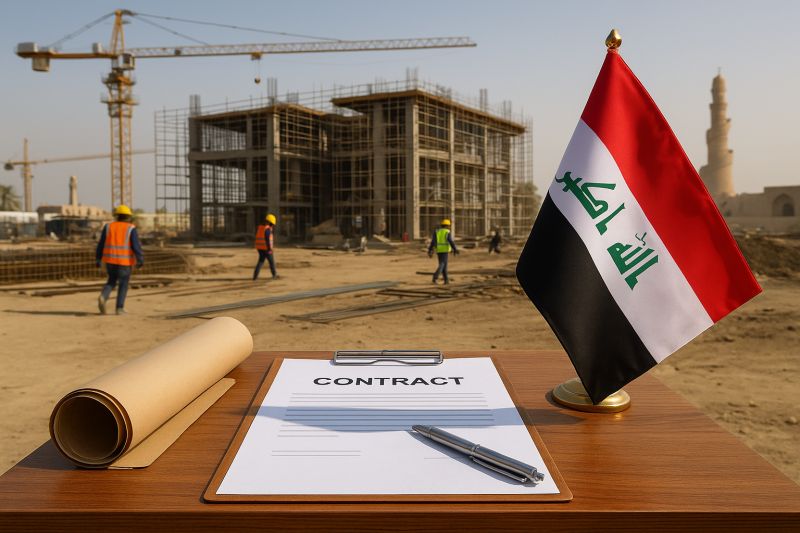
Iraqi Political Force Majeure
The 2023 Infrastructure Crisis: We saw the devastating impact of this in 2023. This exact legal loophole was used to halt or cancel 14 major power-plant contracts with Chinese and Turkish consortiums. These projects, valued at over $11 billion, were stalled not because of war or earthquakes, but because of a “shift in national energy priority” that was legally categorized as Force Majeure. Many of these firms had already spent millions on site preparation and are still fighting for compensation in local courts.
Field Experience – The “Policy Pivot”: I have personally witnessed cases where a change in the Ministry’s leadership led to a sudden “re-evaluation” of technical specifications. Because the contract included “Administrative Decisions” under Force Majeure, the company was forced to absorb the costs of the delay and the subsequent design changes. They had no legal standing to claim for “idle time” because the delay was technically “legalized” by that one single clause.
The “Fix or Kill” Strategy: You must protect your project from the whims of political cycles. Do not accept a broad Force Majeure definition.
Define strictly: Limit Force Majeure exclusively to true “Acts of God” (e.g., war, civil unrest, earthquake, flood, or epidemic).
The Exclusion Clause: Explicitly state: “For the avoidance of doubt, changes in domestic law, ministerial reshuffles, or administrative policy shifts shall NOT constitute Force Majeure.”
Stabilization Clause: Insist on a “Stabilization Clause” (often called a ‘Freezing Clause’) which ensures that even if laws change, the economic equilibrium of your specific contract remains protected for its duration.
Red Flag #3: Local Arbitration & The “Home Court” Disadvantage
You will often see a clause stating: “Any disputes shall be settled by the Iraqi courts in Baghdad, under Iraqi Law, with Arabic as the sole official language of the proceedings.”
Real Meaning & Deep Analysis: To put it bluntly: This is a jurisdictional trap where you are destined to lose. While the Iraqi legal code is sophisticated on paper, the practical reality of litigating against a government ministry in local courts is near-impossible for foreign entities. Data from the last 20 years shows a staggering trend: Iraqi courts have almost never upheld a major financial award for a foreign contractor against a state ministry. Language barriers in Arabic-only proceedings often lead to “lost in translation” technicalities that can dismiss your case before it even reaches a judge.

Local Arbitration & The “Home Court” Disadvantage
The Enforcement Reality: Even if you win a local judgment, enforcing it against a Ministry that controls the local police and the local central bank is an exercise in futility. Without an international oversight mechanism, your contract is only as strong as the Ministry’s willingness to follow it.
Field Experience – The Banking Mirror Trap: Experience shows that legal risks are often tied to operational ones. For instance, in 2023, a logistics firm ignored specific TBI (Trade Bank of Iraq) verification protocols, assuming a standard SWIFT confirmation was sufficient for their payment security. Because their contract was governed by local norms rather than international banking standards, they suffered a 4-month payment freeze. This “administrative friction” is common when you lack a neutral legal anchor.
نکته حرفهای: Always demand a “Dual-Confirmation” clause where payments are mirrored in a neutral international bank. This hedges your risk against local liquidity shifts and administrative whims.
The “Fix or Kill” Strategy: Do not compromise on where and how your disputes are settled. If the deal is worth millions, it is worth a neutral venue.
Neutral Venue: Demand arbitration in ICC Paris, DIAC Dubai, or LCIA London. These are venues where the Iraqi government has a history of participation and compliance.
Language & Law: Ensure the contract specifies انگلیسی as the governing language for dispute resolution and the New York Convention as the framework for enforcement.
Sovereign Immunity Waiver: Insist on a clause where the Ministry explicitly waives its “Sovereign Immunity” regarding the enforcement of an arbitration award. Without this, they can claim they are “above the law” during the collection phase.
Red Flag #4: The “Bottomless” Liability & Penalty Trap
I recently reviewed a 2025 contract from the وزارت نفت that contained this chilling sentence: “The Contractor shall be liable for all direct and indirect damages, losses, and expenses without any limitation or cap.”
Real Meaning & Deep Analysis: In the world of high-stakes infrastructure, “Unlimited Liability” is a corporate death sentence. It means that if a minor equipment failure on your end causes a secondary delay in the Ministry’s production, they can hold you financially responsible for the entirety of their lost revenue. In the oil and gas sector, where daily production is worth millions, a single mistake could lead to a claim that exceeds your company’s entire net worth.
The $147 Million Disaster (Real Case Study): This isn’t just a theoretical fear. There is a currently ongoing case involving a delayed drilling rig. Because the contractor signed an “Unlimited Liability” clause, the Ministry is pursuing a $147 million penalty for lost production time—a figure that is nearly 10 times the value of the original service contract. The contractor’s insurance refused to cover the claim because most professional indemnity policies explicitly exclude “unlimited” or “consequential” damages.
Field Experience – The Insurance Gap: One thing many firms realize too late is that your insurance policy is only as good as your contract’s liability clause. If you agree to “Indirect” or “Consequential” damages (lost profits), you are likely flying without a safety net. I’ve seen CFOs realize during an audit that their $5 million coverage is useless against a $50 million government claim because they failed to “Cap” the liability at the negotiation table.
The “Fix or Kill” Strategy: You must treat the liability cap as a non-negotiable red line. If the Ministry refuses to cap your exposure, you are not a contractor; you are an unpaid insurer for the Iraqi government.
The Total Cap: Limit total aggregate liability to a maximum of 10% to 20% of the total contract value.
Liquidated Damages (LDs): Explicitly define penalties for delays. A standard, fair rate is 0.05% per day, capped at a maximum of 5% to 7% of the contract value.
Exclude Consequential Losses: Ensure the contract states that the contractor is not liable for “loss of profit, loss of production, or any indirect/consequential damages.”
Red Flag #5: The TBI Monopoly & The Sanction Shadow
A standard requirement in many Iraqi government procurement contracts is the mandate that: “The Contractor shall open 100% of the required Letters of Credit (LCs) exclusively through the Trade Bank of Iraq (TBI).”
Real Meaning & Deep Analysis: While the TBI is the primary vehicle for Iraq’s international trade, a 100% reliance on a single, state-owned institution creates a “Single Point of Failure.” In the complex geopolitical landscape of Iraq, the TBI is under constant scrutiny from the U.S. Treasury and OFAC. If the TBI faces administrative freezes or technical audits due to international pressure, your liquidity disappears overnight. You become a collateral victim of diplomatic friction that has nothing to do with your project.
The 2021 & 2023 Liquidity Crunch: We have seen this play out twice in recent years. In both 2021 and 2023, increased OFAC pressure on Iraqi dollar auctions led to significant delays and freezes in LC processing at the TBI. Contractors who were exclusively tied to TBI found themselves unable to pay their global suppliers for months. Some were forced to halt operations entirely, while the Ministry still expected them to meet project deadlines.
Field Experience – The Supplier’s Rejection: I have personally managed cases where top-tier European and American suppliers refused to accept LCs issued solely by an Iraqi bank without a “Confirmation” from a Western bank (like Commerzbank, JPMorgan, or Standard Chartered). When your contract mandates “TBI Only,” and your supplier demands an “International Confirmation,” you end up in a deadlock. The Ministry won’t change the bank, and the supplier won’t ship the goods. You are stuck in the middle, losing time and money.
The “Fix or Kill” Strategy: Financial flexibility is the only way to survive long-term projects in Iraq. You must break the banking monopoly in your contract language.
Diversify the Banks: Amend the clause to allow LCs to be opened through “any Class-A Iraqi commercial bank approved by the Central Bank of Iraq (CBI).”
Mandatory Confirmation: Insist on the right to have any local LC confirmed by a first-class international bank outside of Iraq. This moves the payment obligation from Baghdad to a neutral financial hub like London, Frankfurt, or Dubai.
Alternative Payment Channels: For smaller milestones or service fees, negotiate the option for direct wire transfers (TT) to an offshore account to ensure your operational expenses (salaries, local logistics) remain funded even if the LC system slows down.
Red Flag #6: The “Blank Check” Tax Clause
A common but lethal clause in Iraqi tenders reads: “The Contractor shall be solely responsible for all taxes, duties, levies, and fees, whether currently in force or imposed in the future, for the entire duration of the contract.”
Real Meaning & Deep Analysis: By signing this, you are giving the Iraqi government a “Blank Check.” In a volatile economy, the state often uses new taxes or reconstruction levies to plug budget deficits. Because the clause includes “future” taxes, you are agreeing to pay for laws that don’t even exist yet. You cannot price this risk into your initial bid because you don’t know if the tax will be 2% or 20%.
The 2024–2025 “Tax Surge”: The danger is real and documented. During the 2024–2025 fiscal cycle, we witnessed the introduction of four new types of levies, including an “Austerity Tax” and updated “Reconstruction Fees” for infrastructure projects. What made it worse was that these were applied retroactively to ongoing contracts. Contractors who didn’t have protective language saw their projected 15% profit margin shrink to less than 5% overnight.
Field Experience – The Customs Surprise: I’ve seen cases where a contractor budgeted for a 0% custom duty on “Specialized Machinery” based on a temporary exemption decree. Six months into the project, the decree expired and a new 10% “Import Modernization Fee” was introduced. Because of the “All Future Fees” clause, the Ministry refused to reimburse the contractor for the millions of dollars in unexpected customs costs at the Umm Qasr port.
The “Fix or Kill” Strategy: You must freeze your tax liability the moment you sign the contract. If the rules of the game change, your compensation must change accordingly.
The “Freezing” Clause: Explicitly state: “The tax regime applicable to this contract is limited to the laws and rates in effect as of the date of Signature.”
The Gross-Up Provision: Insert a “Gross-Up” clause. This ensures that if a new tax is introduced that reduces your net payment, the Ministry must increase the gross contract value to ensure your net profit remains exactly what was originally agreed.
Exemption Verification: If the Ministry promises you a tax exemption (e.g., under the Investment Law No. 13), do not take their word for it. Demand that the specific exemption certificate be an integrated part of the contract’s legal annexes.
تسلط بر حمل و نقل فله به بصره و ام قصر ۲۰۲۶
Red Flag #7: The “Termination for Convenience” Death Spiral
I have reviewed several contracts, including a 2024 template from the Ministry of Transport, that contained this seemingly innocent line: “The Employer reserves the right to terminate the contract at any time for convenience, with a 30-day written notice, without further liability.”
Real Meaning & Deep Analysis: In the international legal world, “Termination for Convenience” is common, but in the Iraqi context—without a compensation framework—it is a disaster. This clause allows the Ministry to wait until you have brought in all your heavy machinery, hired hundreds of specialists, and finished the most difficult 20% of the project, only to fire you and hand the remaining “easy” work to a local competitor. Since the contract says “without further liability,” you are left with zero recourse to recover your massive upfront investments.
The $10–$40 Million Sunk Cost Trap: This is a real-world nightmare for logistics and construction firms. When a project is terminated early in Iraq, the contractor often loses between $10 million and $40 million in “Sunk Costs.” These include mobilization fees, specialized shipping, camp setup, and demobilization expenses. Under the 2024 Ministry of Transport clause mentioned above, several firms were forced to absorb these costs entirely, leading to massive balance sheet write-offs.
Field Experience – The “Asset Hostage” Situation: I’ve personally seen situations where, after a termination for convenience, a contractor tried to move their equipment out of the country, only to find that their customs bonds and exit permits were tied to an “active” contract. Because the contract was terminated “conveniently” by the Ministry, the administrative path for equipment exit became a bureaucratic maze. The contractor didn’t just lose the contract; their assets were effectively held hostage because there was no “Exit Clause” linked to the termination.
The “Fix or Kill” Strategy: A government’s “convenience” should not be your “bankruptcy.” You must attach a high price tag to this right.
Full Cost Reimbursement: The contract must state that in case of termination for convenience, the Ministry is legally obligated to pay 100% of all verified costs incurred up to the date of termination, including all mobilization and demobilization expenses.
The Lost Profit Penalty: Demand a “Termination Fee” to cover lost opportunities. A standard fair rate in high-risk zones is 15% to 25% of the remaining contract value.
The 90-Day Buffer: Change the notice period from 30 days to at least 90 days to give your team enough time to secure assets and manage labor contracts legally.
قاتل خاموشِ جایزه: فقدان یا ضعف بند قانون حاکم
اگر قرارداد چیزی در مورد قانون حاکم ذکر نکرده باشد، قانون عراق به طور خودکار اعمال میشود. اگر در قرارداد “قانون عراق” نوشته شده باشد، اما داوری در خارج از کشور همچنان قانون عراق باشد، شما بازنده هستید.
Quick Audit Checklist for Your Iraqi Contract
Before you put pen to paper, ensure your legal team has verified these five critical points:
- Jurisdiction Clause: Does it specify neutral arbitration (e.g., Dubai or London) if local courts are biased?
- Currency Protection: Is the exchange rate fixed for the duration of the contract to avoid Dinar volatility?
- Force Majeure: Does it explicitly cover regional security shifts or administrative restructuring?
- Tax Compliance: Are the social security (Inshira) and corporate tax withholdings clearly defined to avoid end-of-year surprises?
- Local Partnership: If a local agent is required, is their commission structure legally binding under the Ministry of Trade’s 2026 regulations?
سوالات متداول (FAQ)
Q: Can foreign companies bid directly for Iraqi government tenders?
A: Yes, but having a registered branch or a certified local partner significantly increases your “Technical Score” during the evaluation phase.
Q: What is the most common reason for payment delays in Iraq?
A: Administrative errors in the “Certificate of Completion” and mismatching documentation with the Ministry of Finance’s automated systems.
چک لیست رایگان قراردادهای دولت عراق در سال ۲۰۲۶ + الگوی تمیز
همین حالا به صورت رایگان در Tendify.net ثبت نام کنید و فوراً دانلود کنید:
- چک لیست ۷ صفحهای حاشیهنویسی شده (چک لیستی که من شخصاً قبل از هر امضایی استفاده میکنم)
- الگویی تمیز و مطابق با قوانین انگلیسی که از تمام مذاکرات وزارتخانه ۲۰۲۳-۲۰۲۵ جان سالم به در برده است
- واتساپ مستقیم سه وکیل بغدادی که سال گذشته این بندها را برای قراردادهای ۱TP4T200+ میلیون دلاری حذف کردند
- آموزش ضبط شده ۴۵ دقیقهای “چگونه با وزارتخانههای عراق مذاکره کنیم و برنده شویم”
→ https://tendify.net/my-account/
من همین الان هم هشت رقم را برای یادگیری این درسها در دادگاهها و تالارهای داوری بغداد از دست دادهام. شما مجبور نیستید این کار را بکنید.
قبل از امضای قرارداد بعدی وزارتخانه، شما را در داخل میبینم. پیمانکاری که به دلیل رد فلگ #2 از معامله $94 میلیون دلاری در سال 2024 انصراف داد - و شش ماه بعد $127 میلیون دلار با شرایط بهتر منعقد کرد.
من از سال ۲۰۱۲ تاکنون ۳۱۲ قرارداد وزارتخانهها و شرکتهای دولتی عراق را بررسی کردهام.
چهل و هفت مورد از آنها برای موکلان من (یا من) بین ۱.۲ میلیون تا ۱.۶۸ میلیون پوند هزینه داشته است، از جمله پولهای معوق، داوریهای بیپایان یا مصادره کامل.
The Scale of Opportunity vs. Risk in 2026
According to recent fiscal reports, Iraq’s federal budget for 2024-2026 allocates over $150 billion annually, with a significant portion dedicated to infrastructure and reconstruction. However, data from international arbitration centers indicates that nearly 15% of foreign-led projects face legal stalls due to administrative oversight. Understanding these “red flags” isn’t just about caution; it’s about securing your share of the reconstruction boom safely.
هفت مورد از موارد هشدار دهنده زیر دقیقاً همان بندهایی هستند که باعث تک تک این فاجعهها شدهاند. اگر حتی یکی از آنها در پیشنویس شما ظاهر شد، قبل از اینکه جوهر روی کاغذ بنشیند، از آن صرف نظر کنید یا درخواست حذف/اصلاح آن را بدهید.
The 2026 Regulatory Landscape: What Changed?
Success in Iraqi government tenders now requires alignment with the “Iraq Vision 2030” infrastructure mandates. As of late 2025, the هیئت عالی حسابرسی فدرال has intensified its oversight on “Price Escalation Clauses.” If your contract doesn’t explicitly define how to handle currency volatility between the IQD and USD, you are walking into a financial trap that cost vendors an average of 14% margin loss last year.
Red Flag #1: The “Subject to Fund Availability” Trap
n many Iraqi tenders, you will encounter phrases like “Payment shall be made after budget allocation” or “Subject to the availability of federal liquidity.” While they sound like standard administrative terms, in the Iraqi legal landscape, they are financial landmines.
Real Meaning & Deep Analysis: This clause effectively shifts the sovereign risk of the Iraqi state onto your company’s balance sheet. In Iraq, the national budget is often delayed by political negotiations in the Parliament. If the budget isn’t passed, your “binding” contract becomes a voluntary service. You are essentially providing an interest-free loan to the ministry with no guaranteed repayment date.
The 2024–2025 Data: Statistics from the previous fiscal cycle show that the Ministry of Electricity and the Ministry of Construction & Housing were the most affected. Currently, there is an estimated $1.9 billion to $4.7 billion in unpaid invoices across these sectors. Many contractors have completed 100% of their physical work but remain stuck in an “administrative queue” because their specific Project ID was never fully funded in the federal ledger.
Field Experience – The “Operational Freeze”: I have seen international firms go into liquidation because they mobilized heavy machinery and specialized staff to sites in Basra or Al-Anbar based on a “Letter of Intent,” only to find that the Ministry’s internal funding code hadn’t been activated by the Ministry of Planning. Without an active Project ID (known locally as the ‘Tabweeb’), no payment can legally be processed, regardless of what the contract says.
The “Fix or Kill” Strategy: Never sign a contract where the payment trigger is an external political event. To secure your investment, you must insist on these three safeguards:
Sovereign Guarantee: Demand a payment guarantee backed by the Trade Bank of Iraq (TBI) or a confirmation from Rafidain/Rasheed Bank.
Irrevocable & Confirmed L/C: Ensure the Letter of Credit is irrevocable and confirmed by a first-class international bank to hedge against local liquidity shifts.
The Stop-Work Provision: Insert a legal clause allowing for immediate suspension of services without penalty if payment is delayed beyond 45 days.
Red Flag #2: The “Political Force Majeure” Loophole
A dangerous trend in recent Iraqi tenders is the expansion of the “Force Majeure” clause to include terms like “Change of Law,” “New Government Policy,” “Ministerial Decree,” or “Parliament Decision.”
Real Meaning & Deep Analysis: In international law, Force Majeure is reserved for “Acts of God” (unforeseeable, uncontrollable natural disasters). However, by including “New Government Policy,” the Iraqi ministry effectively grants itself a “get out of jail free” card. This means the government can cancel, pause, or rewrite your contract terms whenever a new Prime Minister is appointed or a parliamentary committee changes its mind, without paying you a single cent in damages.
Iraqi Political Force Majeure
The 2023 Infrastructure Crisis: We saw the devastating impact of this in 2023. This exact legal loophole was used to halt or cancel 14 major power-plant contracts with Chinese and Turkish consortiums. These projects, valued at over $11 billion, were stalled not because of war or earthquakes, but because of a “shift in national energy priority” that was legally categorized as Force Majeure. Many of these firms had already spent millions on site preparation and are still fighting for compensation in local courts.
Field Experience – The “Policy Pivot”: I have personally witnessed cases where a change in the Ministry’s leadership led to a sudden “re-evaluation” of technical specifications. Because the contract included “Administrative Decisions” under Force Majeure, the company was forced to absorb the costs of the delay and the subsequent design changes. They had no legal standing to claim for “idle time” because the delay was technically “legalized” by that one single clause.
The “Fix or Kill” Strategy: You must protect your project from the whims of political cycles. Do not accept a broad Force Majeure definition.
Define strictly: Limit Force Majeure exclusively to true “Acts of God” (e.g., war, civil unrest, earthquake, flood, or epidemic).
The Exclusion Clause: Explicitly state: “For the avoidance of doubt, changes in domestic law, ministerial reshuffles, or administrative policy shifts shall NOT constitute Force Majeure.”
Stabilization Clause: Insist on a “Stabilization Clause” (often called a ‘Freezing Clause’) which ensures that even if laws change, the economic equilibrium of your specific contract remains protected for its duration.
Red Flag #3: Local Arbitration & The “Home Court” Disadvantage
You will often see a clause stating: “Any disputes shall be settled by the Iraqi courts in Baghdad, under Iraqi Law, with Arabic as the sole official language of the proceedings.”
Real Meaning & Deep Analysis: To put it bluntly: This is a jurisdictional trap where you are destined to lose. While the Iraqi legal code is sophisticated on paper, the practical reality of litigating against a government ministry in local courts is near-impossible for foreign entities. Data from the last 20 years shows a staggering trend: Iraqi courts have almost never upheld a major financial award for a foreign contractor against a state ministry. Language barriers in Arabic-only proceedings often lead to “lost in translation” technicalities that can dismiss your case before it even reaches a judge.
Local Arbitration & The “Home Court” Disadvantage
The Enforcement Reality: Even if you win a local judgment, enforcing it against a Ministry that controls the local police and the local central bank is an exercise in futility. Without an international oversight mechanism, your contract is only as strong as the Ministry’s willingness to follow it.
Field Experience – The Banking Mirror Trap: Experience shows that legal risks are often tied to operational ones. For instance, in 2023, a logistics firm ignored specific TBI (Trade Bank of Iraq) verification protocols, assuming a standard SWIFT confirmation was sufficient for their payment security. Because their contract was governed by local norms rather than international banking standards, they suffered a 4-month payment freeze. This “administrative friction” is common when you lack a neutral legal anchor.
نکته حرفهای: Always demand a “Dual-Confirmation” clause where payments are mirrored in a neutral international bank. This hedges your risk against local liquidity shifts and administrative whims.
The “Fix or Kill” Strategy: Do not compromise on where and how your disputes are settled. If the deal is worth millions, it is worth a neutral venue.
Neutral Venue: Demand arbitration in ICC Paris, DIAC Dubai, or LCIA London. These are venues where the Iraqi government has a history of participation and compliance.
Language & Law: Ensure the contract specifies انگلیسی as the governing language for dispute resolution and the New York Convention as the framework for enforcement.
Sovereign Immunity Waiver: Insist on a clause where the Ministry explicitly waives its “Sovereign Immunity” regarding the enforcement of an arbitration award. Without this, they can claim they are “above the law” during the collection phase.
Red Flag #4: The “Bottomless” Liability & Penalty Trap
I recently reviewed a 2025 contract from the وزارت نفت that contained this chilling sentence: “The Contractor shall be liable for all direct and indirect damages, losses, and expenses without any limitation or cap.”
Real Meaning & Deep Analysis: In the world of high-stakes infrastructure, “Unlimited Liability” is a corporate death sentence. It means that if a minor equipment failure on your end causes a secondary delay in the Ministry’s production, they can hold you financially responsible for the entirety of their lost revenue. In the oil and gas sector, where daily production is worth millions, a single mistake could lead to a claim that exceeds your company’s entire net worth.
The $147 Million Disaster (Real Case Study): This isn’t just a theoretical fear. There is a currently ongoing case involving a delayed drilling rig. Because the contractor signed an “Unlimited Liability” clause, the Ministry is pursuing a $147 million penalty for lost production time—a figure that is nearly 10 times the value of the original service contract. The contractor’s insurance refused to cover the claim because most professional indemnity policies explicitly exclude “unlimited” or “consequential” damages.
Field Experience – The Insurance Gap: One thing many firms realize too late is that your insurance policy is only as good as your contract’s liability clause. If you agree to “Indirect” or “Consequential” damages (lost profits), you are likely flying without a safety net. I’ve seen CFOs realize during an audit that their $5 million coverage is useless against a $50 million government claim because they failed to “Cap” the liability at the negotiation table.
The “Fix or Kill” Strategy: You must treat the liability cap as a non-negotiable red line. If the Ministry refuses to cap your exposure, you are not a contractor; you are an unpaid insurer for the Iraqi government.
The Total Cap: Limit total aggregate liability to a maximum of 10% to 20% of the total contract value.
Liquidated Damages (LDs): Explicitly define penalties for delays. A standard, fair rate is 0.05% per day, capped at a maximum of 5% to 7% of the contract value.
Exclude Consequential Losses: Ensure the contract states that the contractor is not liable for “loss of profit, loss of production, or any indirect/consequential damages.”
Red Flag #5: The TBI Monopoly & The Sanction Shadow
A standard requirement in many Iraqi government procurement contracts is the mandate that: “The Contractor shall open 100% of the required Letters of Credit (LCs) exclusively through the Trade Bank of Iraq (TBI).”
Real Meaning & Deep Analysis: While the TBI is the primary vehicle for Iraq’s international trade, a 100% reliance on a single, state-owned institution creates a “Single Point of Failure.” In the complex geopolitical landscape of Iraq, the TBI is under constant scrutiny from the U.S. Treasury and OFAC. If the TBI faces administrative freezes or technical audits due to international pressure, your liquidity disappears overnight. You become a collateral victim of diplomatic friction that has nothing to do with your project.
The 2021 & 2023 Liquidity Crunch: We have seen this play out twice in recent years. In both 2021 and 2023, increased OFAC pressure on Iraqi dollar auctions led to significant delays and freezes in LC processing at the TBI. Contractors who were exclusively tied to TBI found themselves unable to pay their global suppliers for months. Some were forced to halt operations entirely, while the Ministry still expected them to meet project deadlines.
Field Experience – The Supplier’s Rejection: I have personally managed cases where top-tier European and American suppliers refused to accept LCs issued solely by an Iraqi bank without a “Confirmation” from a Western bank (like Commerzbank, JPMorgan, or Standard Chartered). When your contract mandates “TBI Only,” and your supplier demands an “International Confirmation,” you end up in a deadlock. The Ministry won’t change the bank, and the supplier won’t ship the goods. You are stuck in the middle, losing time and money.
The “Fix or Kill” Strategy: Financial flexibility is the only way to survive long-term projects in Iraq. You must break the banking monopoly in your contract language.
Diversify the Banks: Amend the clause to allow LCs to be opened through “any Class-A Iraqi commercial bank approved by the Central Bank of Iraq (CBI).”
Mandatory Confirmation: Insist on the right to have any local LC confirmed by a first-class international bank outside of Iraq. This moves the payment obligation from Baghdad to a neutral financial hub like London, Frankfurt, or Dubai.
Alternative Payment Channels: For smaller milestones or service fees, negotiate the option for direct wire transfers (TT) to an offshore account to ensure your operational expenses (salaries, local logistics) remain funded even if the LC system slows down.
Red Flag #6: The “Blank Check” Tax Clause
A common but lethal clause in Iraqi tenders reads: “The Contractor shall be solely responsible for all taxes, duties, levies, and fees, whether currently in force or imposed in the future, for the entire duration of the contract.”
Real Meaning & Deep Analysis: By signing this, you are giving the Iraqi government a “Blank Check.” In a volatile economy, the state often uses new taxes or reconstruction levies to plug budget deficits. Because the clause includes “future” taxes, you are agreeing to pay for laws that don’t even exist yet. You cannot price this risk into your initial bid because you don’t know if the tax will be 2% or 20%.
The 2024–2025 “Tax Surge”: The danger is real and documented. During the 2024–2025 fiscal cycle, we witnessed the introduction of four new types of levies, including an “Austerity Tax” and updated “Reconstruction Fees” for infrastructure projects. What made it worse was that these were applied retroactively to ongoing contracts. Contractors who didn’t have protective language saw their projected 15% profit margin shrink to less than 5% overnight.
Field Experience – The Customs Surprise: I’ve seen cases where a contractor budgeted for a 0% custom duty on “Specialized Machinery” based on a temporary exemption decree. Six months into the project, the decree expired and a new 10% “Import Modernization Fee” was introduced. Because of the “All Future Fees” clause, the Ministry refused to reimburse the contractor for the millions of dollars in unexpected customs costs at the Umm Qasr port.
The “Fix or Kill” Strategy: You must freeze your tax liability the moment you sign the contract. If the rules of the game change, your compensation must change accordingly.
The “Freezing” Clause: Explicitly state: “The tax regime applicable to this contract is limited to the laws and rates in effect as of the date of Signature.”
The Gross-Up Provision: Insert a “Gross-Up” clause. This ensures that if a new tax is introduced that reduces your net payment, the Ministry must increase the gross contract value to ensure your net profit remains exactly what was originally agreed.
Exemption Verification: If the Ministry promises you a tax exemption (e.g., under the Investment Law No. 13), do not take their word for it. Demand that the specific exemption certificate be an integrated part of the contract’s legal annexes.
تسلط بر حمل و نقل فله به بصره و ام قصر ۲۰۲۶
Red Flag #7: The “Termination for Convenience” Death Spiral
I have reviewed several contracts, including a 2024 template from the Ministry of Transport, that contained this seemingly innocent line: “The Employer reserves the right to terminate the contract at any time for convenience, with a 30-day written notice, without further liability.”
Real Meaning & Deep Analysis: In the international legal world, “Termination for Convenience” is common, but in the Iraqi context—without a compensation framework—it is a disaster. This clause allows the Ministry to wait until you have brought in all your heavy machinery, hired hundreds of specialists, and finished the most difficult 20% of the project, only to fire you and hand the remaining “easy” work to a local competitor. Since the contract says “without further liability,” you are left with zero recourse to recover your massive upfront investments.
The $10–$40 Million Sunk Cost Trap: This is a real-world nightmare for logistics and construction firms. When a project is terminated early in Iraq, the contractor often loses between $10 million and $40 million in “Sunk Costs.” These include mobilization fees, specialized shipping, camp setup, and demobilization expenses. Under the 2024 Ministry of Transport clause mentioned above, several firms were forced to absorb these costs entirely, leading to massive balance sheet write-offs.
Field Experience – The “Asset Hostage” Situation: I’ve personally seen situations where, after a termination for convenience, a contractor tried to move their equipment out of the country, only to find that their customs bonds and exit permits were tied to an “active” contract. Because the contract was terminated “conveniently” by the Ministry, the administrative path for equipment exit became a bureaucratic maze. The contractor didn’t just lose the contract; their assets were effectively held hostage because there was no “Exit Clause” linked to the termination.
The “Fix or Kill” Strategy: A government’s “convenience” should not be your “bankruptcy.” You must attach a high price tag to this right.
Full Cost Reimbursement: The contract must state that in case of termination for convenience, the Ministry is legally obligated to pay 100% of all verified costs incurred up to the date of termination, including all mobilization and demobilization expenses.
The Lost Profit Penalty: Demand a “Termination Fee” to cover lost opportunities. A standard fair rate in high-risk zones is 15% to 25% of the remaining contract value.
The 90-Day Buffer: Change the notice period from 30 days to at least 90 days to give your team enough time to secure assets and manage labor contracts legally.
قاتل خاموشِ جایزه: فقدان یا ضعف بند قانون حاکم
اگر قرارداد چیزی در مورد قانون حاکم ذکر نکرده باشد، قانون عراق به طور خودکار اعمال میشود. اگر در قرارداد “قانون عراق” نوشته شده باشد، اما داوری در خارج از کشور همچنان قانون عراق باشد، شما بازنده هستید.
Quick Audit Checklist for Your Iraqi Contract
Before you put pen to paper, ensure your legal team has verified these five critical points:
- Jurisdiction Clause: Does it specify neutral arbitration (e.g., Dubai or London) if local courts are biased?
- Currency Protection: Is the exchange rate fixed for the duration of the contract to avoid Dinar volatility?
- Force Majeure: Does it explicitly cover regional security shifts or administrative restructuring?
- Tax Compliance: Are the social security (Inshira) and corporate tax withholdings clearly defined to avoid end-of-year surprises?
- Local Partnership: If a local agent is required, is their commission structure legally binding under the Ministry of Trade’s 2026 regulations?
سوالات متداول (FAQ)
Q: Can foreign companies bid directly for Iraqi government tenders?
A: Yes, but having a registered branch or a certified local partner significantly increases your “Technical Score” during the evaluation phase.
Q: What is the most common reason for payment delays in Iraq?
A: Administrative errors in the “Certificate of Completion” and mismatching documentation with the Ministry of Finance’s automated systems.
چک لیست رایگان قراردادهای دولت عراق در سال ۲۰۲۶ + الگوی تمیز
همین حالا به صورت رایگان در Tendify.net ثبت نام کنید و فوراً دانلود کنید:
- چک لیست ۷ صفحهای حاشیهنویسی شده (چک لیستی که من شخصاً قبل از هر امضایی استفاده میکنم)
- الگویی تمیز و مطابق با قوانین انگلیسی که از تمام مذاکرات وزارتخانه ۲۰۲۳-۲۰۲۵ جان سالم به در برده است
- واتساپ مستقیم سه وکیل بغدادی که سال گذشته این بندها را برای قراردادهای ۱TP4T200+ میلیون دلاری حذف کردند
- آموزش ضبط شده ۴۵ دقیقهای “چگونه با وزارتخانههای عراق مذاکره کنیم و برنده شویم”
→ https://tendify.net/my-account/
من همین الان هم هشت رقم را برای یادگیری این درسها در دادگاهها و تالارهای داوری بغداد از دست دادهام. شما مجبور نیستید این کار را بکنید.
قبل از امضای قرارداد بعدی وزارتخانه، شما را در داخل میبینم. پیمانکاری که به دلیل رد فلگ #2 از معامله $94 میلیون دلاری در سال 2024 انصراف داد - و شش ماه بعد $127 میلیون دلار با شرایط بهتر منعقد کرد.
من از سال ۲۰۱۲ تاکنون ۳۱۲ قرارداد وزارتخانهها و شرکتهای دولتی عراق را بررسی کردهام.
چهل و هفت مورد از آنها برای موکلان من (یا من) بین ۱.۲ میلیون تا ۱.۶۸ میلیون پوند هزینه داشته است، از جمله پولهای معوق، داوریهای بیپایان یا مصادره کامل.
The Scale of Opportunity vs. Risk in 2026
According to recent fiscal reports, Iraq’s federal budget for 2024-2026 allocates over $150 billion annually, with a significant portion dedicated to infrastructure and reconstruction. However, data from international arbitration centers indicates that nearly 15% of foreign-led projects face legal stalls due to administrative oversight. Understanding these “red flags” isn’t just about caution; it’s about securing your share of the reconstruction boom safely.
هفت مورد از موارد هشدار دهنده زیر دقیقاً همان بندهایی هستند که باعث تک تک این فاجعهها شدهاند. اگر حتی یکی از آنها در پیشنویس شما ظاهر شد، قبل از اینکه جوهر روی کاغذ بنشیند، از آن صرف نظر کنید یا درخواست حذف/اصلاح آن را بدهید.
The 2026 Regulatory Landscape: What Changed?
Success in Iraqi government tenders now requires alignment with the “Iraq Vision 2030” infrastructure mandates. As of late 2025, the هیئت عالی حسابرسی فدرال has intensified its oversight on “Price Escalation Clauses.” If your contract doesn’t explicitly define how to handle currency volatility between the IQD and USD, you are walking into a financial trap that cost vendors an average of 14% margin loss last year.
Red Flag #1: The “Subject to Fund Availability” Trap
n many Iraqi tenders, you will encounter phrases like “Payment shall be made after budget allocation” or “Subject to the availability of federal liquidity.” While they sound like standard administrative terms, in the Iraqi legal landscape, they are financial landmines.
Real Meaning & Deep Analysis: This clause effectively shifts the sovereign risk of the Iraqi state onto your company’s balance sheet. In Iraq, the national budget is often delayed by political negotiations in the Parliament. If the budget isn’t passed, your “binding” contract becomes a voluntary service. You are essentially providing an interest-free loan to the ministry with no guaranteed repayment date.
The 2024–2025 Data: Statistics from the previous fiscal cycle show that the Ministry of Electricity and the Ministry of Construction & Housing were the most affected. Currently, there is an estimated $1.9 billion to $4.7 billion in unpaid invoices across these sectors. Many contractors have completed 100% of their physical work but remain stuck in an “administrative queue” because their specific Project ID was never fully funded in the federal ledger.
Field Experience – The “Operational Freeze”: I have seen international firms go into liquidation because they mobilized heavy machinery and specialized staff to sites in Basra or Al-Anbar based on a “Letter of Intent,” only to find that the Ministry’s internal funding code hadn’t been activated by the Ministry of Planning. Without an active Project ID (known locally as the ‘Tabweeb’), no payment can legally be processed, regardless of what the contract says.
The “Fix or Kill” Strategy: Never sign a contract where the payment trigger is an external political event. To secure your investment, you must insist on these three safeguards:
Sovereign Guarantee: Demand a payment guarantee backed by the Trade Bank of Iraq (TBI) or a confirmation from Rafidain/Rasheed Bank.
Irrevocable & Confirmed L/C: Ensure the Letter of Credit is irrevocable and confirmed by a first-class international bank to hedge against local liquidity shifts.
The Stop-Work Provision: Insert a legal clause allowing for immediate suspension of services without penalty if payment is delayed beyond 45 days.
Red Flag #2: The “Political Force Majeure” Loophole
A dangerous trend in recent Iraqi tenders is the expansion of the “Force Majeure” clause to include terms like “Change of Law,” “New Government Policy,” “Ministerial Decree,” or “Parliament Decision.”
Real Meaning & Deep Analysis: In international law, Force Majeure is reserved for “Acts of God” (unforeseeable, uncontrollable natural disasters). However, by including “New Government Policy,” the Iraqi ministry effectively grants itself a “get out of jail free” card. This means the government can cancel, pause, or rewrite your contract terms whenever a new Prime Minister is appointed or a parliamentary committee changes its mind, without paying you a single cent in damages.
Iraqi Political Force Majeure
The 2023 Infrastructure Crisis: We saw the devastating impact of this in 2023. This exact legal loophole was used to halt or cancel 14 major power-plant contracts with Chinese and Turkish consortiums. These projects, valued at over $11 billion, were stalled not because of war or earthquakes, but because of a “shift in national energy priority” that was legally categorized as Force Majeure. Many of these firms had already spent millions on site preparation and are still fighting for compensation in local courts.
Field Experience – The “Policy Pivot”: I have personally witnessed cases where a change in the Ministry’s leadership led to a sudden “re-evaluation” of technical specifications. Because the contract included “Administrative Decisions” under Force Majeure, the company was forced to absorb the costs of the delay and the subsequent design changes. They had no legal standing to claim for “idle time” because the delay was technically “legalized” by that one single clause.
The “Fix or Kill” Strategy: You must protect your project from the whims of political cycles. Do not accept a broad Force Majeure definition.
Define strictly: Limit Force Majeure exclusively to true “Acts of God” (e.g., war, civil unrest, earthquake, flood, or epidemic).
The Exclusion Clause: Explicitly state: “For the avoidance of doubt, changes in domestic law, ministerial reshuffles, or administrative policy shifts shall NOT constitute Force Majeure.”
Stabilization Clause: Insist on a “Stabilization Clause” (often called a ‘Freezing Clause’) which ensures that even if laws change, the economic equilibrium of your specific contract remains protected for its duration.
Red Flag #3: Local Arbitration & The “Home Court” Disadvantage
You will often see a clause stating: “Any disputes shall be settled by the Iraqi courts in Baghdad, under Iraqi Law, with Arabic as the sole official language of the proceedings.”
Real Meaning & Deep Analysis: To put it bluntly: This is a jurisdictional trap where you are destined to lose. While the Iraqi legal code is sophisticated on paper, the practical reality of litigating against a government ministry in local courts is near-impossible for foreign entities. Data from the last 20 years shows a staggering trend: Iraqi courts have almost never upheld a major financial award for a foreign contractor against a state ministry. Language barriers in Arabic-only proceedings often lead to “lost in translation” technicalities that can dismiss your case before it even reaches a judge.
Local Arbitration & The “Home Court” Disadvantage
The Enforcement Reality: Even if you win a local judgment, enforcing it against a Ministry that controls the local police and the local central bank is an exercise in futility. Without an international oversight mechanism, your contract is only as strong as the Ministry’s willingness to follow it.
Field Experience – The Banking Mirror Trap: Experience shows that legal risks are often tied to operational ones. For instance, in 2023, a logistics firm ignored specific TBI (Trade Bank of Iraq) verification protocols, assuming a standard SWIFT confirmation was sufficient for their payment security. Because their contract was governed by local norms rather than international banking standards, they suffered a 4-month payment freeze. This “administrative friction” is common when you lack a neutral legal anchor.
نکته حرفهای: Always demand a “Dual-Confirmation” clause where payments are mirrored in a neutral international bank. This hedges your risk against local liquidity shifts and administrative whims.
The “Fix or Kill” Strategy: Do not compromise on where and how your disputes are settled. If the deal is worth millions, it is worth a neutral venue.
Neutral Venue: Demand arbitration in ICC Paris, DIAC Dubai, or LCIA London. These are venues where the Iraqi government has a history of participation and compliance.
Language & Law: Ensure the contract specifies انگلیسی as the governing language for dispute resolution and the New York Convention as the framework for enforcement.
Sovereign Immunity Waiver: Insist on a clause where the Ministry explicitly waives its “Sovereign Immunity” regarding the enforcement of an arbitration award. Without this, they can claim they are “above the law” during the collection phase.
Red Flag #4: The “Bottomless” Liability & Penalty Trap
I recently reviewed a 2025 contract from the وزارت نفت that contained this chilling sentence: “The Contractor shall be liable for all direct and indirect damages, losses, and expenses without any limitation or cap.”
Real Meaning & Deep Analysis: In the world of high-stakes infrastructure, “Unlimited Liability” is a corporate death sentence. It means that if a minor equipment failure on your end causes a secondary delay in the Ministry’s production, they can hold you financially responsible for the entirety of their lost revenue. In the oil and gas sector, where daily production is worth millions, a single mistake could lead to a claim that exceeds your company’s entire net worth.
The $147 Million Disaster (Real Case Study): This isn’t just a theoretical fear. There is a currently ongoing case involving a delayed drilling rig. Because the contractor signed an “Unlimited Liability” clause, the Ministry is pursuing a $147 million penalty for lost production time—a figure that is nearly 10 times the value of the original service contract. The contractor’s insurance refused to cover the claim because most professional indemnity policies explicitly exclude “unlimited” or “consequential” damages.
Field Experience – The Insurance Gap: One thing many firms realize too late is that your insurance policy is only as good as your contract’s liability clause. If you agree to “Indirect” or “Consequential” damages (lost profits), you are likely flying without a safety net. I’ve seen CFOs realize during an audit that their $5 million coverage is useless against a $50 million government claim because they failed to “Cap” the liability at the negotiation table.
The “Fix or Kill” Strategy: You must treat the liability cap as a non-negotiable red line. If the Ministry refuses to cap your exposure, you are not a contractor; you are an unpaid insurer for the Iraqi government.
The Total Cap: Limit total aggregate liability to a maximum of 10% to 20% of the total contract value.
Liquidated Damages (LDs): Explicitly define penalties for delays. A standard, fair rate is 0.05% per day, capped at a maximum of 5% to 7% of the contract value.
Exclude Consequential Losses: Ensure the contract states that the contractor is not liable for “loss of profit, loss of production, or any indirect/consequential damages.”
Red Flag #5: The TBI Monopoly & The Sanction Shadow
A standard requirement in many Iraqi government procurement contracts is the mandate that: “The Contractor shall open 100% of the required Letters of Credit (LCs) exclusively through the Trade Bank of Iraq (TBI).”
Real Meaning & Deep Analysis: While the TBI is the primary vehicle for Iraq’s international trade, a 100% reliance on a single, state-owned institution creates a “Single Point of Failure.” In the complex geopolitical landscape of Iraq, the TBI is under constant scrutiny from the U.S. Treasury and OFAC. If the TBI faces administrative freezes or technical audits due to international pressure, your liquidity disappears overnight. You become a collateral victim of diplomatic friction that has nothing to do with your project.
The 2021 & 2023 Liquidity Crunch: We have seen this play out twice in recent years. In both 2021 and 2023, increased OFAC pressure on Iraqi dollar auctions led to significant delays and freezes in LC processing at the TBI. Contractors who were exclusively tied to TBI found themselves unable to pay their global suppliers for months. Some were forced to halt operations entirely, while the Ministry still expected them to meet project deadlines.
Field Experience – The Supplier’s Rejection: I have personally managed cases where top-tier European and American suppliers refused to accept LCs issued solely by an Iraqi bank without a “Confirmation” from a Western bank (like Commerzbank, JPMorgan, or Standard Chartered). When your contract mandates “TBI Only,” and your supplier demands an “International Confirmation,” you end up in a deadlock. The Ministry won’t change the bank, and the supplier won’t ship the goods. You are stuck in the middle, losing time and money.
The “Fix or Kill” Strategy: Financial flexibility is the only way to survive long-term projects in Iraq. You must break the banking monopoly in your contract language.
Diversify the Banks: Amend the clause to allow LCs to be opened through “any Class-A Iraqi commercial bank approved by the Central Bank of Iraq (CBI).”
Mandatory Confirmation: Insist on the right to have any local LC confirmed by a first-class international bank outside of Iraq. This moves the payment obligation from Baghdad to a neutral financial hub like London, Frankfurt, or Dubai.
Alternative Payment Channels: For smaller milestones or service fees, negotiate the option for direct wire transfers (TT) to an offshore account to ensure your operational expenses (salaries, local logistics) remain funded even if the LC system slows down.
Red Flag #6: The “Blank Check” Tax Clause
A common but lethal clause in Iraqi tenders reads: “The Contractor shall be solely responsible for all taxes, duties, levies, and fees, whether currently in force or imposed in the future, for the entire duration of the contract.”
Real Meaning & Deep Analysis: By signing this, you are giving the Iraqi government a “Blank Check.” In a volatile economy, the state often uses new taxes or reconstruction levies to plug budget deficits. Because the clause includes “future” taxes, you are agreeing to pay for laws that don’t even exist yet. You cannot price this risk into your initial bid because you don’t know if the tax will be 2% or 20%.
The 2024–2025 “Tax Surge”: The danger is real and documented. During the 2024–2025 fiscal cycle, we witnessed the introduction of four new types of levies, including an “Austerity Tax” and updated “Reconstruction Fees” for infrastructure projects. What made it worse was that these were applied retroactively to ongoing contracts. Contractors who didn’t have protective language saw their projected 15% profit margin shrink to less than 5% overnight.
Field Experience – The Customs Surprise: I’ve seen cases where a contractor budgeted for a 0% custom duty on “Specialized Machinery” based on a temporary exemption decree. Six months into the project, the decree expired and a new 10% “Import Modernization Fee” was introduced. Because of the “All Future Fees” clause, the Ministry refused to reimburse the contractor for the millions of dollars in unexpected customs costs at the Umm Qasr port.
The “Fix or Kill” Strategy: You must freeze your tax liability the moment you sign the contract. If the rules of the game change, your compensation must change accordingly.
The “Freezing” Clause: Explicitly state: “The tax regime applicable to this contract is limited to the laws and rates in effect as of the date of Signature.”
The Gross-Up Provision: Insert a “Gross-Up” clause. This ensures that if a new tax is introduced that reduces your net payment, the Ministry must increase the gross contract value to ensure your net profit remains exactly what was originally agreed.
Exemption Verification: If the Ministry promises you a tax exemption (e.g., under the Investment Law No. 13), do not take their word for it. Demand that the specific exemption certificate be an integrated part of the contract’s legal annexes.
تسلط بر حمل و نقل فله به بصره و ام قصر ۲۰۲۶
Red Flag #7: The “Termination for Convenience” Death Spiral
I have reviewed several contracts, including a 2024 template from the Ministry of Transport, that contained this seemingly innocent line: “The Employer reserves the right to terminate the contract at any time for convenience, with a 30-day written notice, without further liability.”
Real Meaning & Deep Analysis: In the international legal world, “Termination for Convenience” is common, but in the Iraqi context—without a compensation framework—it is a disaster. This clause allows the Ministry to wait until you have brought in all your heavy machinery, hired hundreds of specialists, and finished the most difficult 20% of the project, only to fire you and hand the remaining “easy” work to a local competitor. Since the contract says “without further liability,” you are left with zero recourse to recover your massive upfront investments.
The $10–$40 Million Sunk Cost Trap: This is a real-world nightmare for logistics and construction firms. When a project is terminated early in Iraq, the contractor often loses between $10 million and $40 million in “Sunk Costs.” These include mobilization fees, specialized shipping, camp setup, and demobilization expenses. Under the 2024 Ministry of Transport clause mentioned above, several firms were forced to absorb these costs entirely, leading to massive balance sheet write-offs.
Field Experience – The “Asset Hostage” Situation: I’ve personally seen situations where, after a termination for convenience, a contractor tried to move their equipment out of the country, only to find that their customs bonds and exit permits were tied to an “active” contract. Because the contract was terminated “conveniently” by the Ministry, the administrative path for equipment exit became a bureaucratic maze. The contractor didn’t just lose the contract; their assets were effectively held hostage because there was no “Exit Clause” linked to the termination.
The “Fix or Kill” Strategy: A government’s “convenience” should not be your “bankruptcy.” You must attach a high price tag to this right.
Full Cost Reimbursement: The contract must state that in case of termination for convenience, the Ministry is legally obligated to pay 100% of all verified costs incurred up to the date of termination, including all mobilization and demobilization expenses.
The Lost Profit Penalty: Demand a “Termination Fee” to cover lost opportunities. A standard fair rate in high-risk zones is 15% to 25% of the remaining contract value.
The 90-Day Buffer: Change the notice period from 30 days to at least 90 days to give your team enough time to secure assets and manage labor contracts legally.
قاتل خاموشِ جایزه: فقدان یا ضعف بند قانون حاکم
اگر قرارداد چیزی در مورد قانون حاکم ذکر نکرده باشد، قانون عراق به طور خودکار اعمال میشود. اگر در قرارداد “قانون عراق” نوشته شده باشد، اما داوری در خارج از کشور همچنان قانون عراق باشد، شما بازنده هستید.
Quick Audit Checklist for Your Iraqi Contract
Before you put pen to paper, ensure your legal team has verified these five critical points:
- Jurisdiction Clause: Does it specify neutral arbitration (e.g., Dubai or London) if local courts are biased?
- Currency Protection: Is the exchange rate fixed for the duration of the contract to avoid Dinar volatility?
- Force Majeure: Does it explicitly cover regional security shifts or administrative restructuring?
- Tax Compliance: Are the social security (Inshira) and corporate tax withholdings clearly defined to avoid end-of-year surprises?
- Local Partnership: If a local agent is required, is their commission structure legally binding under the Ministry of Trade’s 2026 regulations?
سوالات متداول (FAQ)
Q: Can foreign companies bid directly for Iraqi government tenders?
A: Yes, but having a registered branch or a certified local partner significantly increases your “Technical Score” during the evaluation phase.
Q: What is the most common reason for payment delays in Iraq?
A: Administrative errors in the “Certificate of Completion” and mismatching documentation with the Ministry of Finance’s automated systems.
چک لیست رایگان قراردادهای دولت عراق در سال ۲۰۲۶ + الگوی تمیز
همین حالا به صورت رایگان در Tendify.net ثبت نام کنید و فوراً دانلود کنید:
- چک لیست ۷ صفحهای حاشیهنویسی شده (چک لیستی که من شخصاً قبل از هر امضایی استفاده میکنم)
- الگویی تمیز و مطابق با قوانین انگلیسی که از تمام مذاکرات وزارتخانه ۲۰۲۳-۲۰۲۵ جان سالم به در برده است
- واتساپ مستقیم سه وکیل بغدادی که سال گذشته این بندها را برای قراردادهای ۱TP4T200+ میلیون دلاری حذف کردند
- آموزش ضبط شده ۴۵ دقیقهای “چگونه با وزارتخانههای عراق مذاکره کنیم و برنده شویم”
→ https://tendify.net/my-account/
من همین الان هم هشت رقم را برای یادگیری این درسها در دادگاهها و تالارهای داوری بغداد از دست دادهام. شما مجبور نیستید این کار را بکنید.
قبل از امضای قرارداد بعدی وزارتخانه، شما را در داخل میبینم. پیمانکاری که به دلیل رد فلگ #2 از معامله $94 میلیون دلاری در سال 2024 انصراف داد - و شش ماه بعد $127 میلیون دلار با شرایط بهتر منعقد کرد.