


Blog
Fast-Growing African Markets : Top 10 Markets for B2B Trade in 2026

The map reveals a clear shift. Ethiopia leads at 9.2% projected growth, followed by Guinea at 8.7%, Uganda at 7.5%, Rwanda at 7.2%, and others including Benin, Libya, Niger, Côte d’Ivoire, Djibouti, and DR Congo. Notably absent from this IMF projection list are several traditional powerhouses that dominate boardroom discussions.
This gap between perception and reality creates a decisive advantage for agile B2B traders. Markets experiencing rapid expansion from a lower base often deliver faster market entry, stronger negotiating positions, and higher potential returns for international suppliers who position early. For businesses in the GCC and broader MENA region, these economies represent emerging corridors for construction materials, machinery, consumer goods, agricultural inputs, and logistics services.
Why Fast-Growing African Markets Matter for Cross-Border Trade in 2026
Economic momentum in these nations stems from infrastructure investments, urbanization, resource development, and improving governance frameworks. East Africa shows particularly strong compounding effects through regional integration, while Francophone West Africa remains under-served by many non-regional players, creating lower competitive density.
Key patterns stand out:
- East Africa corridor strength: Ethiopia, Uganda, Rwanda, and Djibouti form a connected growth cluster anchored by port access and internal market reforms.
- West Africa momentum: Multiple Francophone nations highlight opportunities in mining, agriculture, and basic infrastructure.
- Base effect advantage: Smaller economies allow mid-sized exporters to secure significant market share more rapidly than in saturated larger markets.
Companies that treat these as strategic entry points rather than secondary options frequently establish distribution networks that scale as economies mature.
Deep Dive: Opportunities in the Top 10 Fastest Growing African Economies
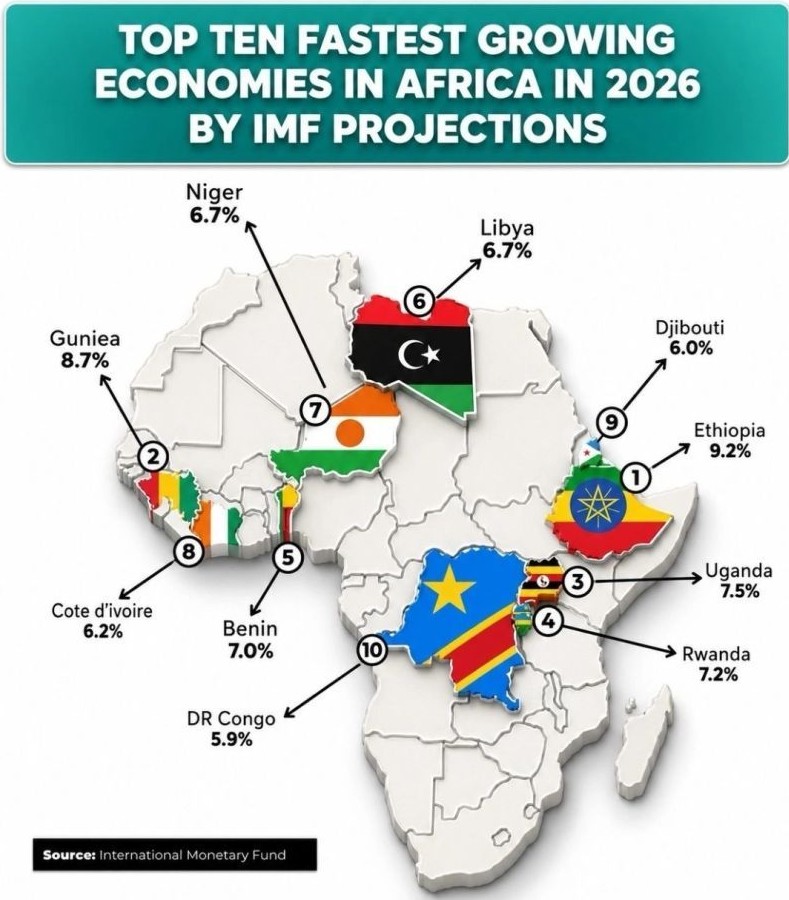
Fast-Growing African Markets
1. Ethiopia (9.2% projected growth)
Ethiopia combines a massive consumer market of over 120 million people with aggressive industrialization policies and major state-led infrastructure initiatives. The country’s growth model drives high-volume demand for construction inputs, heavy machinery, power generation transmission equipment, and high-yield agricultural technology. GCC and MENA suppliers—particularly those with established capacities in cement, steel rebar, and advanced building materials—find an immediate structural alignment with ongoing urban developments.
Critical Logistics Corridor: The primary challenge remains inland logistics. Approximately 95% of Ethiopia’s trade flows through the Port of Djibouti, requiring efficient multimodal transport networks along the Addis Ababa-Djibouti corridor. Navigating customs clearance, dry port storage bottlenecks, and foreign exchange shortages are critical operational hurdles that require experienced local trade partners.
2. Guinea (8.7%)
Guinea’s economic momentum is almost entirely fueled by its world-class mineral wealth, holding the world’s largest reserves of bauxite alongside significant iron ore deposits (notably the Simandou project). This mining boom translates into massive demand for specialized extraction machinery, heavy-duty transport vehicles, safety gear, and industrial bulk logistics.
B2B Strategy: International suppliers should focus on supporting mining supply chains rather than entering the consumer retail market. Partnerships with multinational mining operators and regional logistics specialists are the fastest routes to securing high-value procurement contracts.
3. Uganda (7.5%)
Uganda is transitioning into a significant regional energy player, driven by major oil discoveries in the Albertine Graben and the development of the East African Crude Oil Pipeline (EACOP). This energy transition is occurring alongside steady agricultural modernization and a growing services sector. Key import demands center on energy infrastructure, specialized food processing and packaging machinery, and commercial cold-chain logistics.
Regional Hub Potential: Located at the heart of East Africa, Uganda serves as an ideal land-linked distribution hub. Importers can establish warehousing networks here to easily re-export goods to the neighboring Democratic Republic of Congo and South Sudan.
4. Rwanda (7.2%)
Consistently ranked as one of the easiest places to do business in Africa, Rwanda has positioned itself as a regional technology and services hub. The government’s focus on green growth, smart cities, and digital infrastructure creates a premium market for high-quality building products, tech-enabled logistics tools, and green energy solutions.
Market Dynamics: While Rwanda’s domestic market is relatively small, its transparent regulatory environment, lack of corruption, and business-friendly reforms make it the perfect low-risk entry point for GCC companies testing East African waters before scaling to larger, more complex neighbors.
5. Benin (7.0%)
Benin is rapidly transforming into a pivotal maritime gateway for West Africa, anchored by the expansion of the Port of Cotonou. The economy is heavily driven by agriculture (particularly cotton) and transit trade. This creates a direct, high-value demand for modern port-handling equipment, agricultural inputs (fertilizers and seeds), and commercial fleet transport services.
Geographical Leverage: Benin serves as the direct transit corridor to Niger and the massive, landlocked northern regions of Nigeria. Exporters shipping to Benin can easily leverage local trade networks to capture market share across the wider ECOWAS region.
6 & 7. Libya and Niger (both 6.7%)
Libya: As Libya continues its path toward political stabilization, its reconstruction needs are staggering. There is an immediate and sustained demand for primary construction materials (cement, glass, steel), electrical grid infrastructure, and specialized oilfield services to boost crude production. For GCC suppliers, historical and cultural ties offer a distinct advantage, though securing transactions through trusted escrow services or multi-bank guarantees is highly recommended to manage payment risks.
Niger: Driven by uranium and crude oil exports, Niger offers specialized opportunities in mining infrastructure and public works. However, being a landlocked nation with complex security dynamics, exporters must place a heavy emphasis on securing robust regional partnerships and utilizing secured transit corridors through Benin or Togo.
8. Côte d’Ivoire (6.2%)
As the world’s top cocoa producer and the economic engine of Francophone West Africa, Côte d’Ivoire boasts a highly diversified agricultural and industrial base. Rapid urbanization in cities like Abidjan is driving demand for food processing machinery, industrial packaging materials, and premium FMCG products.
Regulatory Landscape: Unlike some of its neighbors, Côte d’Ivoire operates within the stable West African CFA franc zone, which is pegged to the Euro. This significantly reduces currency fluctuation risks for international suppliers and simplifies long-term financial planning.
9. Djibouti (6.0%)
Djibouti’s economic model is built entirely on its strategic geographical position at the entrance of the Red Sea, handling one of the busiest shipping lanes in the world. Its growth is driven by heavy investments in state-of-the-art maritime infrastructure, free zones, and digital telecommunications hubs.
The GCC Connection: Djibouti is the natural maritime partner for GCC ports (such as Jebel Ali and King Abdullah Port). Exporters can leverage Djibouti’s specialized free trade zones to store, repackage, and distribute bulk goods directly into the East African hinterland with minimal regulatory friction.
10. Democratic Republic of Congo (5.9%)
The DRC is a green energy transition powerhouse, holding vast, untapped reserves of cobalt, copper, lithium, and high-grade timber. The scale of its resource extraction drives a continuous need for heavy mining equipment, off-grid solar and hydroelectric energy solutions, and robust heavy-transport infrastructure.
Compliance & Risk Management: Operating in the DRC requires navigating high logistical friction, complex customs regulations, and strict international compliance standards. Exporters must conduct thorough due diligence, screen all local buyers against global sanction lists, and utilize secure, structured B2B escrow payment platforms to guarantee transaction safety.
Technical Gateway: HS Codes & Rules of Origin
When exporting high-value commodities like construction materials, heavy machinery, or industrial equipment to Africa’s fastest-growing markets, B2B trade transitions from macroeconomics to technical precision. Success hinges on mastering trade compliance.
- HS Code Harmonization:Accurate classification under the Harmonized System (HS) is mandatory to determine exact tariff rates, import restrictions, and customized customs clearing pathways.
- AfCFTA Rules of Origin: Under the African Continental Free Trade Area (AfCFTA), understanding rules of origin is critical to leveraging preferential tariffs. Aligning your manufacturing or re-export processes with these frameworks secures a decisive price advantage at destination ports.
Strategic Entry Frameworks for GCC and MENA Businesses
Successful expansion into these markets follows repeatable patterns observed across regional operations.

Top 10 Fastest Growing African Economies
The trade landscape of 2026 is defined by overlapping treaty frameworks. For GCC-based exporters and logistics providers, understanding the interplay between the Greater Arab Free Trade Area (GAFTA) and the fast-evolving African Continental Free Trade Area (AfCFTA) opens powerful tariff-arbitrage and re-export corridors.
- The GAFTA-to-Africa Bridge:North African Arab nations like Libya, Egypt, and Tunisia serve as vital trade bridges. By leveraging duty-free GAFTA arrangements with GCC nations, goods can be consolidated in regional hubs and seamlessly routed into the African mainland.
Landlocked Re-Export Optimization: Fast-growing landlocked economies (such as Ethiopia, Uganda, and Rwanda) heavily rely on entry-port corridors. GCC logistics hubs can consolidate shipments, manage regulatory clearances, and execute multi-modal transshipments to these target markets while strategically utilizing local AfCFTA preferential tariff rules.
1. Market Prioritization Matrix Evaluate opportunities using these criteria:
- Projected GDP growth and sector alignment
- Infrastructure pipeline and funding sources
- Ease of doing business indicators
- Logistics connectivity to GCC ports
- Competitive landscape density
2. Partnership Models
- Local distributors with established networks
- Joint ventures for market-specific adaptations
- Agent agreements for initial testing
- Digital B2B platforms for direct buyer connections
3. Supply Chain Optimization Tactics Focus on reducing lead times and costs through:
- Strategic use of GCC hubs for consolidation
- Multimodal routing via key African ports
- Digital tools for real-time tracking and compliance
- Inventory strategies tailored to local demand cycles
Logistics and Compliance Challenges – And How to Address Them
Cross-border trade into these markets involves navigating port capacities, customs procedures, and regulatory variations. Common friction points include:
- Port and inland transport bottlenecks: Plan for demurrage risks with accurate ETAs and buffer stock strategies.
- Documentation requirements: Harmonize HS codes, certificates of origin, and quality standards early.
Risk Mitigation: Securing Payments with B2B Escrow
While traditional Letters of Credit (LCs) remain a banking standard, they are often slow, expensive, and difficult to obtain for mid-sized transactions in rapidly shifting African markets. To protect your working capital, modern B2B traders are turning to digital alternatives.
Why B2B Escrow is Crucial:
•
Zero-Risk Down Payments: Buyer funds are held safely in a neutral third-party account and are only released to the supplier once verified shipping documents or proof of delivery are submitted.
•
Transactional Trust: Mitigates cross-border currency volatility and default risks, fostering strong early relationships between GCC exporters and African buyers.
Want to calculate fees and structure your next transaction safely?
Practical steps include building relationships with reliable freight forwarders experienced in African corridors and leveraging digital compliance tools for faster clearance.
Sector-Specific Opportunities for B2B Exporters
Construction and Building Materials Visionary projects across these economies drive sustained demand for cement, steel, machinery, and specialized inputs. Suppliers who align with local standards and offer technical support gain preference.
Machinery and Equipment Industrialization pushes needs for agricultural, mining, and processing equipment. Financing packages and after-sales service differentiate winners.
Consumer Goods and FMCG Urbanization and rising middle classes create markets for packaged foods, household items, and personal care products.
Logistics and Trade Services Demand grows for efficient freight, warehousing, and digital trade platforms that connect suppliers directly with buyers.
Risk Management in High-Growth Environments
Fast growth often accompanies volatility. Effective strategies include:
- Diversified market exposure across several of the top 10
- Strong contractual protections including force majeure and payment milestones
- Political and economic risk insurance where available
- Phased investment approaches starting with pilot shipments
Compliance Alert: Sanctions & Dual-Use Goods Screening
Expanding B2B operations into fast-growing but complex jurisdictions—such as the Democratic Republic of Congo (DRC), Libya, or Niger—introduces stringent trade compliance responsibilities. Exporters of industrial machinery, specialized electrical components, or chemicals run a high risk of unknowingly shipping dual-use goods (items that have both commercial and potential military or tactical applications).
Critical Export Control Requirements:
Denied Party Screening (DPS): You must actively screen corporate entities, buyers, and intermediaries against international sanctions lists (OFAC, UN, EU) prior to shipment clearance.
HS Code Restrictions: Many mechanical and dual-use HS codes require explicit export licenses or end-user certificates to pass through global transshipment hubs without detention.
Are your goods or buyers flagged under current global sanctions?
Building Sustainable Competitive Advantage
Companies that succeed long-term invest in local relationships, adapt offerings to market realities, and maintain operational agility. Early movers in these corridors often secure preferred supplier status as economies scale.
For traders seeking to streamline discovery, compliance, and transaction processes across these markets, targeted digital tools can reduce friction significantly. Platforms like Platform.Tendify.Net support efficient matching and operational coordination in cross-border flows.
Actionable Next Steps for 2026 Market Entry
1. Execute Targeted, Data-Driven Market Selection
Instead of attempting to enter multiple markets simultaneously, select 2 to 3 priority countries from the list that align directly with your sector.
Leverage Global Trade Intelligence: Use databases like the ITC Trade Map, UN Comtrade, and local port authority reports to analyze real import volumes, tariff rates, and active competitor footprints for your specific HS codes.
Map Public Procurement Pipelines: Identify upcoming national infrastructure projects funded by institutions like the African Development Bank (AfDB) or the World Bank, as these projects guarantee foreign currency availability for payments.
2. Establish Presence at Key B2B Trading Hubs & Exhibitions
Building personal, high-trust relationships is the cornerstone of doing business in Africa. Active participation in regional trade shows is the fastest way to build a network of vetted distributors and buyers.
Key Regional Events to Target:
In the GCC: Attend The Big 5 Global (Dubai) for construction and building materials, or Gulfood for FMCG and agricultural machinery. These events serve as the premier meeting grounds for African trade delegations seeking Gulf partnerships.
In Africa: Target major regional trade hubs such as the Intra-African Trade Fair (IATF), Ethiopia Five-to-One Expo (Addis Ababa) for industrial products, or West Africa Trade Show (Abidjan) for FMCG and machinery.
3. Initiate “Soft Launches” with Micro-Shipments
Never commit to high-volume contracts before testing the operational reality of a corridor.
Validate the Supply Chain: Send small trial shipments or sample batches using Less-Than-Container Load (LCL) consolidation through major hubs like Jebel Ali.
Test the Friction Points: Use these initial shipments to calculate realistic door-to-door transit times, uncover hidden customs port fees, evaluate the efficiency of your local freight forwarder, and gauge direct feedback from end-buyers.
4. Craft a Localized Value Proposition
Standard sales pitches designed for mature Western or Gulf markets rarely succeed in emerging African corridors. You must adapt your offering to the immediate economic needs of the buyer.
Focus on Total Cost of Ownership (TCO): If exporting machinery, emphasize long-term durability, fuel efficiency, ease of maintenance, and the availability of local spare parts.
Flexible Financing: Where possible, design flexible payment terms or support buyers by offering deferred payments secured through trade credit insurance or structured B2B escrow mechanisms.
5. Build Your Compliance and Risk Infrastructure Early
Regulatory delays at destination ports can quickly destroy your profit margins through heavy demurrage fees.
Pre-Screen Everything: Before a cargo leaves the port, run rigorous compliance checks. Ensure all HS codes are correctly classified, verify if your goods require a Certificate of Conformity (CoC) or pre-shipment inspections, and cross-reference your buyers against international sanction databases.
Secure Your Payments: Integrate modern B2B transactional security tools into your workflow. Utilize trusted escrow structures to lock in funds, protecting your business from sudden local currency devaluations or payment defaults.
Explore related strategies in our guide on streamlining cross-border logistics for efficient B2B trade in emerging markets.
Read more on mastering document preparation for international shipments.
Discover sector insights in GCC Seasonal Trade: High-Margin Summer B2B Opportunities.
The difference between observing growth and capturing value lies in decisive, informed action. These ten economies represent more than statistics — they are dynamic arenas where prepared international businesses can establish lasting positions.
Position your operations on the growth curve today. Register an account to access tools that facilitate secure, efficient, and scalable trade across these and other high-potential corridors: https://tendify.net/my-account/
Data based on IMF projections as visualized. Market conditions evolve; conduct independent due diligence for specific transactions.

