


Blog
Finternet: The New Operating System for Global Commerce
In over two decades of running export operations across volatile corridors in the Gulf and beyond, I’ve watched countless deals stall on the same bottlenecks: slow settlements, high correspondent bank fees, mountains of paperwork, and the constant risk of counterparties failing to deliver. A container of goods sits in Jebel Ali while funds crawl through SWIFT for days. A buyer in Riyadh wants immediate security, but the Letter of Credit process eats weeks and adds unnecessary costs.
That friction is exactly what Finternet is designed to eliminate.
Conceived by the Bank for International Settlements (BIS) as a vision for the future financial system, Finternet isn’t another buzzword or experimental crypto project. It’s a practical blueprint for a tokenized, programmable financial internet where value moves as seamlessly as information does today. For traders, exporters, importers, and supply chain operators in the Middle East and global markets, it represents the single biggest opportunity to slash costs, accelerate cash flow, and unlock new capital from assets that have historically sat idle.
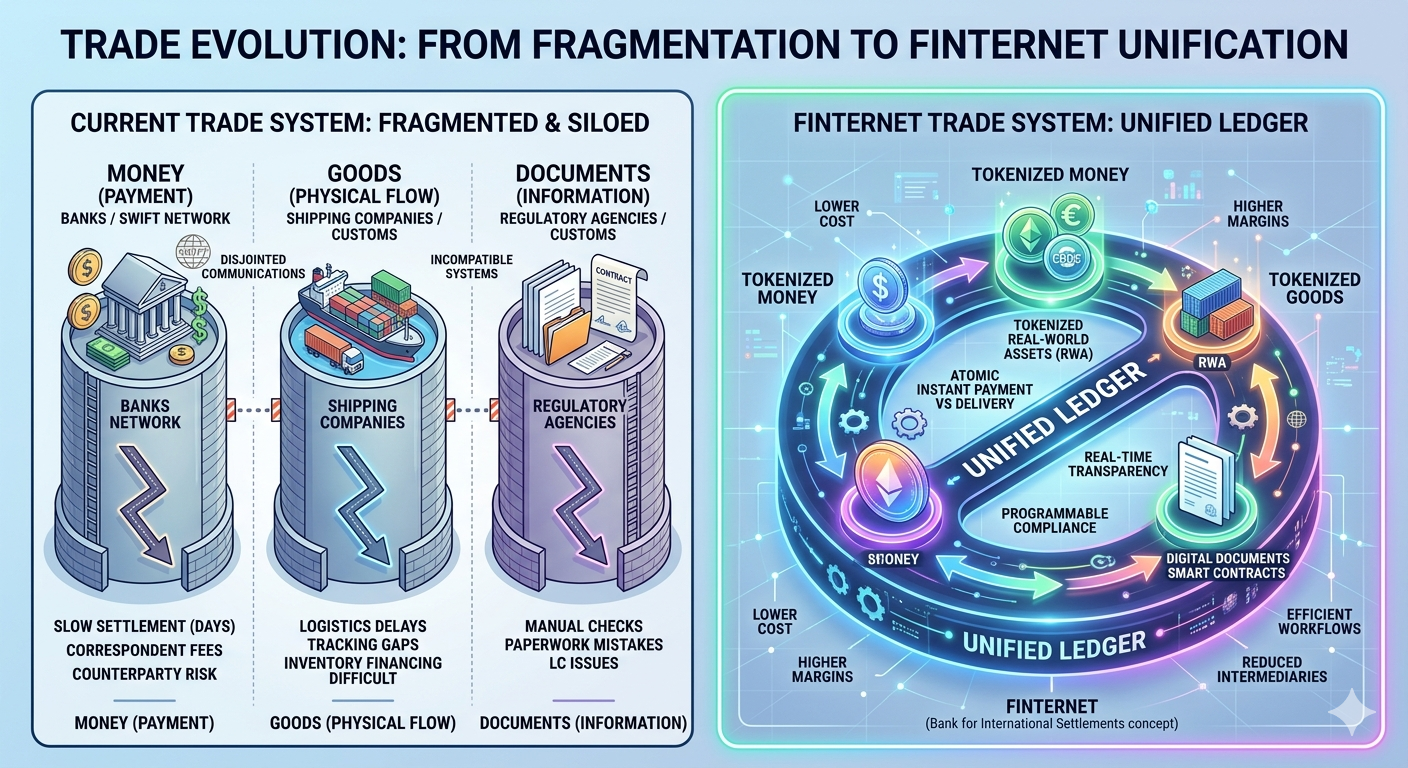
Trade Evolution : From fragmentation to Finternet Unification
In this comprehensive guide, I’ll break down exactly what Finternet means for your business, how it works in real trade scenarios, why the UAE and GCC are perfectly positioned to lead its adoption, and the actionable steps you can take right now to prepare. By the end, you’ll see why forward-thinking operators are already positioning themselves to move from traditional banking rails to this new operating system for global commerce.
The Global Trader’s Digital Stack : Apps to Scale Your Operations
Why Traditional Finance Is Holding Your Trade Back
Think about a typical cross-border deal today. You source goods, ship them, and then you enter the “waiting zone.” The buyer’s bank communicates with your bank through a labyrinth of correspondent networks, each operating on its own legacy system. This isn’t just a communication gap; it’s a structural bottleneck. Each intermediary bank along the chain takes its cut in fees, often with zero transparency on the final landing cost.

traditional finance
Documents—the lifeblood of trade—are still largely verified manually. Physical bills of lading, invoices, and certificates of origin are couriered across borders, leaving them prone to loss, forgery, or simple human error. Settlement typically drags on for 3–7 business days, and if a compliance flag pops up in a mid-stream bank, your funds could be frozen for weeks without a clear point of contact for resolution. Furthermore, foreign exchange (FX) conversion adds another opaque layer of cost, with spreads that favor the institutions rather than the traders. Disputes? In a fragmented system where data is siloed, resolving them quickly is nearly impossible.
These frictions aren’t just minor annoyances; they are a direct tax on your growth. They tie up vital working capital, increase counterparty risk, and severely limit how aggressively you can scale your operations. In high-volume commodity trades—such as bitumen, cement, or petrochemicals—margins are often thin. A mere 1–2% reduction in transaction costs or converting cash just a few days faster can be the difference between a stagnant year and transformative profit margins.
Finternet flips this broken model on its head. Instead of disparate systems trying to “talk” to each other, it creates interconnected “Unified Ledgers.” On these ledgers, tokenized money, tokenized real-world assets (RWAs), and programmable smart contracts coexist and operate together in real-time. The result is a paradigm shift: near-instant, transparent, and programmable transactions that bypass the traditional “toll booths” of correspondent banking. By unifying the flow of value and the flow of information, Finternet ensures that when the goods move, the value follows at the speed of light.
The Blacklisted Dollar Trap: Why “Cheap Cash” is the Most Expensive Mistake in Global Trade
What Exactly Is Finternet?
At its core, Finternet envisions the financial system as a “network of networks”—mirroring the architectural success of the internet itself. Just as the internet allowed disparate data networks to communicate through a common protocol, Finternet enables multiple financial ecosystems to connect seamlessly. This evolution is powered by three foundational, interlocked technologies that redefine how we handle value:
Tokenization: This is the process of converting rights to real-world assets—including cash, bulk commodities (like bitumen or urea), shipping invoices, and even warehouse receipts—into digital tokens on programmable ledgers.
Unified Ledgers: Unlike today’s fragmented bank databases, these are shared platforms where different forms of tokenized value (money and assets) coexist. This allows for atomic settlement, meaning the exchange of goods for payment happens simultaneously and conditionally: if the goods don’t move, the money doesn’t move.
Smart Contracts: These are self-executing lines of code that automate trade agreements based on verifiable real-world conditions. They act as a digital escrow, ensuring that compliance, taxes, and payments are handled automatically the moment a contractual milestone is met.

Finternet Open Banking
This is far from a theoretical concept. Practical, high-stakes projects like mBridge—a collaboration involving the Central Bank of the UAE alongside partners in China, Hong Kong, and Thailand—are already operational. mBridge demonstrates that multi-CBDC (Central Bank Digital Currency) cross-border payments can settle in seconds, bypassing the expensive and sluggish layers of the traditional correspondent banking system.
For a Gulf-based trader, the implications are massive. It means your dirham-denominated payments can flow directly to a supplier’s digital wallet or be swapped for tokenized commodity collateral in real-time. You are no longer just sending a “message” via SWIFT and hoping for the best; you are moving the actual value instantly across a digital corridor that you can track with 100% certainty.
Tokenization of Real-World Assets: Turning Your Cargo Into Instant Capital
This is where the theoretical meets the tactical for operators like us. In the traditional world, your capital is often “trapped” in physical form—whether it’s sitting in a warehouse or floating on a vessel in the middle of the ocean. Tokenization breaks these chains.
Tokenization of Real-World Assets
Imagine taking a massive shipment of construction materials or a bulk cargo of petrochemicals and representing it as a verifiable, tradable digital asset on a ledger. This tokenized representation isn’t just a digital receipt; it is a programmable claim on the value of that cargo. You can use it as high-velocity collateral to secure instant financing, bypassing the weeks of bank appraisals, manual inspections, and bureaucratic paperwork that typically drain your momentum.
Practical Applications in Modern Trade:
Inventory Financing: You can tokenize goods while they are still in transit or sitting in a free zone warehouse. This allows you to access liquidity immediately to fund your next deal, rather than having your working capital frozen until the buyer finally settles the invoice.
Invoice Tokenization: Transform your accounts receivable into liquid tokens. Because the entire history (provenance) and settlement terms are transparent and automated, you can sell or borrow against these invoices at much lower discount rates than traditional factoring.
Commodity-Backed Tokens: A bulk load of bitumen, wheat, or polymers can be broken down into fractional, tradable digital units. These units can be hedged, traded, or used in regulated decentralized finance (DeFi) structures, allowing for sophisticated risk management that was previously reserved for only the largest trading houses.
In the UAE, the timing for this couldn’t be better. With advanced logistics hubs like Jebel Ali, a robust regulatory sandbox, and forward-thinking free zone authorities, the infrastructure to tokenize physical goods is already taking shape. This opens a door to new, agile forms of trade finance that legacy banks simply cannot match in terms of speed, cost-efficiency, or accessibility. For the modern trader, your cargo is no longer just “stock”—it is a liquid financial instrument.
Unified Ledgers and the End of Correspondent Banking Drag
One of the most significant “hidden taxes” in international trade is the friction caused by correspondent banking. In the current landscape, your payment doesn’t travel a straight line; it “bounces” between multiple intermediary institutions, each adding its own layer of fees, delays, and redundant compliance overhead. This fragmented process is why a simple transfer can take days to arrive, often with a smaller amount than what you originally sent.

End of Correspondent Banking Drag
Unified Ledgers solve this by collapsing these silos. They integrate tokenized central bank money (CBDCs), commercial bank deposits, and tokenized assets onto a single, programmable platform. This environment enables Atomic Settlement, allowing for:
PvP (Payment versus Payment): Simultaneous exchange of two different currencies.
DvP (Delivery versus Payment): Simultaneous exchange of payment for the ownership of goods.
Real-World Impact on Your Operations:
Instantaneous Liquidity: Settlement times drop from 3–7 business days to mere seconds, drastically reducing the “value-at-risk” during transit.
Minimal FX Friction: Foreign exchange costs plummet because atomic swaps handle currency conversions directly on the ledger, removing the need for multiple spread-heavy conversions across different banks.
Elimination of Counterparty Risk: Funds and assets move only when specific, pre-defined conditions—verified by external oracles or real-time IoT data from your shipping containers—are met. If the cargo isn’t cleared, the payment isn’t released.
Compliance Autonomy: Because compliance rules are embedded into the programmable ledger, “Know Your Customer” (KYC) and “Anti-Money Laundering” (AML) checks happen in real-time, preventing the sudden, unexplained “compliance freezes” common in legacy rails.
For GCC traders managing the high-volume corridors between Asia and Europe, this is nothing short of transformative. As projects building on the mBridge infrastructure continue to scale, we are seeing exactly how multi-currency environments can thrive without the baggage of 20th-century banking legacy. You are no longer waiting for the system to catch up; you are operating at the speed of global demand.
Smart Contracts Replacing (and Improving) Traditional Trade Instruments
Letters of Credit (LCs) have been the bedrock of international trade for centuries, providing a layer of security between distant parties. However, in today’s fast-paced digital economy, they have become a major bottleneck—slow, expensive, and notoriously prone to minor discrepancies that can stall a multi-million dollar deal for weeks. Smart contracts on Finternet-style platforms don’t just replicate LCs; they exceed their security while completely removing the administrative friction.

Smart Contracts
The 2026 Trade Workflow: From Paper to Programmable Trust
Imagine a trade execution that looks like this:
Digital Agreement: Buyer and seller agree on terms via a programmable contract on a Unified Ledger. This isn’t just a PDF; it is a live, executable agreement.
Autonomous Tracking: As the goods ship, IoT sensors and customs “oracles” feed real-time, tamper-proof data directly to the ledger. Every milestone—location, temperature control for perishables, and customs clearance status—is verified automatically.
Atomic Release: Upon the verified fulfillment of delivery milestones, the smart contract automatically triggers the release of payment from the buyer’s tokenized funds to the seller.
In this environment, there is no manual document checking, no couriers flying paper across the globe, and no waiting for a bank officer to confirm a signature. This is the definition of Programmable Trust. It slashes the potential for disputes, eliminates human error in document verification, and finally frees your team from the endless cycle of chasing paperwork.
In my years of managing complex trade corridors, I’ve seen far too many deals collapse over a single misplaced comma in a bank document. By automating this layer through the Finternet, we aren’t just speeding up the process; we are changing the game of global commerce forever.
Green Gold, Grey Money: The Hidden Side of the Avocado Trade
Why the UAE and GCC Are Primed to Lead Finternet Adoption
The UAE isn’t just participating — it’s helping shape the future. The Central Bank of the UAE’s involvement in mBridge positions the country as a hub for next-gen cross-border payments.
Combined with:
- Progressive regulations around digital assets and tokenization.
- World-class infrastructure (free zones, ports, logistics).
- Ambition under Vision 2030-style initiatives across the Gulf.
This creates a perfect environment for traders. You can experiment with tokenized trade finance, digital dirham rails, and integrated platforms without leaving the region’s supportive ecosystem.
Regional players are already exploring how tokenized assets can support everything from commodity trading to real estate-backed supply chain finance.
Beyond mBridge: The Expansion of Regional Corridors
While mBridge is the headline-grabber, we are seeing a broader shift. The integration of India’s UPI with the UAE’s instant payment platforms, and the exploration of “Digital Trade Corridors” between Central Asia and the Gulf, are early iterations of the Finternet vision. These are not isolated experiments; they are the building blocks of a unified financial fabric that will eventually bypass the liquidity traps of the 20th-century banking model.
Challenges and How to Navigate Them Realistically
No major shift is without hurdles. Key considerations include:
- Regulatory Harmonization: Different jurisdictions move at different speeds. Focus on platforms operating in well-regulated environments like the UAE.
- Interoperability: Not every ledger will connect immediately. Start with solutions that bridge to existing systems.
- Security and Compliance: Use established players with strong KYC/AML integration. The technology itself can enhance compliance through transparent, auditable records.
- Adoption Curve: Your counterparties need to be ready too. Begin with willing partners in progressive markets.
- Privacy in a Transparent World: The Role of ZK-Proofs
A common concern for traders in sensitive corridors is privacy. If everything is on a “ledger,” doesn’t that expose my trade secrets or counterparty data? This is where Zero-Knowledge Proofs (ZKPs) change the game. Within the Finternet framework, ZKPs allow you to prove that a transaction is valid, that the funds exist, or that a regulatory requirement has been met—without revealing the underlying sensitive data. For operators navigating complex global compliance landscapes, this provides a “cloak of privacy” over a transparent infrastructure, ensuring that your competitive edge and trade relationships remain confidential while your settlements remain lightning-fast.
The winners won’t be the earliest speculators — they’ll be the operators who integrate these tools thoughtfully into existing workflows.
The Intelligence Layer: Why Finternet Needs AI (Trade OS)
Moving from Static Data to Autonomous Trade
Finternet provides the “rails” for value to move, but the “engine” driving that value is increasingly Artificial Intelligence. In the coming years, we won’t just see tokenized assets; we will see Autonomous Trade Agents. Imagine an AI-driven Trade Operating System (Trade OS) that doesn’t just track your shipment but automatically triggers a Finternet-based financing request the moment it detects a weather delay in the Atlantic, or switches settlement currencies in real-time based on AI-predicted FX volatility. By combining programmable money with programmable logic (AI), we are moving away from reactive management to a proactive, self-optimizing supply chain. This is the core of the Trade OS vision: a system that thinks as fast as the Finternet moves.
How to Prepare Your Trade Business for Finternet Today
Transitioning to a Finternet-ready operation doesn’t require an overnight overhaul of your entire infrastructure. Instead, it’s about strategic, incremental steps that build “digital muscle.” Here is your practical playbook for staying ahead of the curve:
Short-term (Next 3–6 Months): The Foundation
Cost & Friction Audit: Conduct a deep dive into your current payment and financing overheads. Identify which trade corridors are suffering most from high intermediary fees and multi-day delays.
Market Exploration: Start researching tokenized invoice and receivable platforms already gaining traction in the GCC. Understanding the UI/UX of these platforms today will lower the learning curve tomorrow.
Digital Documentation: Transition from physical to high-quality digital document management. Integrating tools for precise tracking and structured data storage is essential to prepare your data flows for future “oracles” that trigger smart contracts.
Medium-term (6–18 Months): The Pilot Phase
Smart Contract Pilots: Identify a trusted, long-term counterparty to run a pilot program using smart contract-based agreements for a small percentage of your volume.
Tokenized Collateral Testing: Work with emerging fintech providers to test using tokenized receivables or inventory for working capital lines. This is the fastest way to see the impact of Finternet on your cash flow.
Ecosystem Connection: Begin connecting with platforms that are actively experimenting with Central Bank Digital Currency (CBDC) rails or unified ledger pilots in the region.
Long-term: Full Integration
Interoperable Ecosystems: Move toward a model where your inventory, contracts, and payments live natively on interoperable ledgers. At this stage, your trade operations move from being “managed” to being “orchestrated.”
Data-Driven Intelligence: Leverage the granular data from tokenized transactions to enhance your forecasting, optimize inventory levels, and negotiate better financing rates based on transparent performance history.
Pro Tip: In the early stages, the biggest wins won’t come from complex blockchain maneuvers, but from tools that seamlessly combine trade documentation, compliance, and payment rails into a single interface.
This is precisely why we are developing the next generation of trade infrastructure at Platform.Tendify.Net. Whether you are automating HS code classification, generating compliant proforma invoices, or seeking faster ways to handle cross-border settlements, our “Trade Command Center” brings all these engines together. We are building the tools that allow you to operate efficiently in this new environment today, so you are ready to dominate it tomorrow.
Explore the Command Center at Platform.Tendify.Net and see how we streamline everything from market intelligence to final execution in the age of Finternet.
Comparison: Traditional Trade Finance vs. Finternet-Enabled Operations
| Aspect | Traditional System | Finternet Approach | Business Impact |
|---|---|---|---|
| Settlement Time | 3–7+ days | Seconds to minutes | Dramatically improved cash flow |
| Transaction Costs | High (intermediaries + FX) | Significantly lower | Higher margins |
| Counterparty Risk | High (reliance on trust/paper) | Reduced via atomic settlement | Safer scaling |
| Capital Access | Slow, collateral-heavy | Instant via tokenized RWAs | Unlocks liquidity from assets |
| Automation | Manual document checks | Smart contracts + oracles | Lower operational overhead |
| Transparency | Limited | Full audit trail on ledger | Better compliance & trust |
The Bigger Picture: Why This Matters for Your Competitive Edge
Markets reward efficiency. In the Gulf’s hyper-competitive trade environment, operators who master programmable finance will source better, close deals faster, finance more aggressively, and manage risk more intelligently.
Finternet doesn’t replace human judgment or relationships — it amplifies them. You still negotiate smart deals, but execution becomes frictionless.
I’ve built businesses by obsessively removing bottlenecks. This next wave of financial infrastructure is one of the largest bottlenecks disappearing in our lifetime.
Ready to Move Beyond Legacy Finance?
The transition to Finternet won’t happen in one big bang. It will be gradual, with islands of innovation connecting over time. The businesses that thrive will be those that start experimenting now, build internal capabilities, and partner with forward-looking platforms.
If you’re serious about dominating your trade lanes in 2026 and beyond, the time to understand and adopt these tools is today.
Head over to Platform.Tendify.Net to explore the full suite of trade engines, calculators, document builders, and intelligence tools designed to help you operate at the speed of the new financial system. Whether you need real-time market pulse, compliance checklists, or seamless ways to connect with verified partners, it’s built for operators who refuse to let old infrastructure limit their growth.
Sign up, explore the command center, and start positioning your business for the tokenized trade era. The deals of tomorrow will go to those who move value as fast as information.
Your next competitive advantage is already taking shape. Don’t watch from the sidelines.
Join thousands of traders already streamlining operations on Tendify. Register Free on Platform.Tendify.Net and access the tools that power efficient, future-ready global trade

