Blog
The RCEP Agreement: The World’s Largest Trade Bloc
Its Strategic Impact on ASEAN Relations with China and Australia
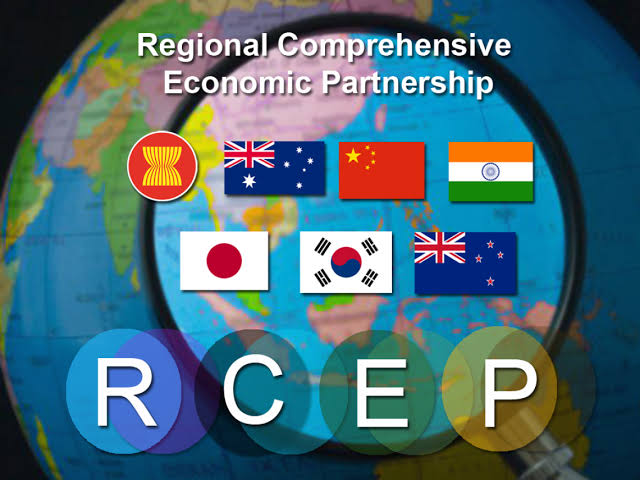
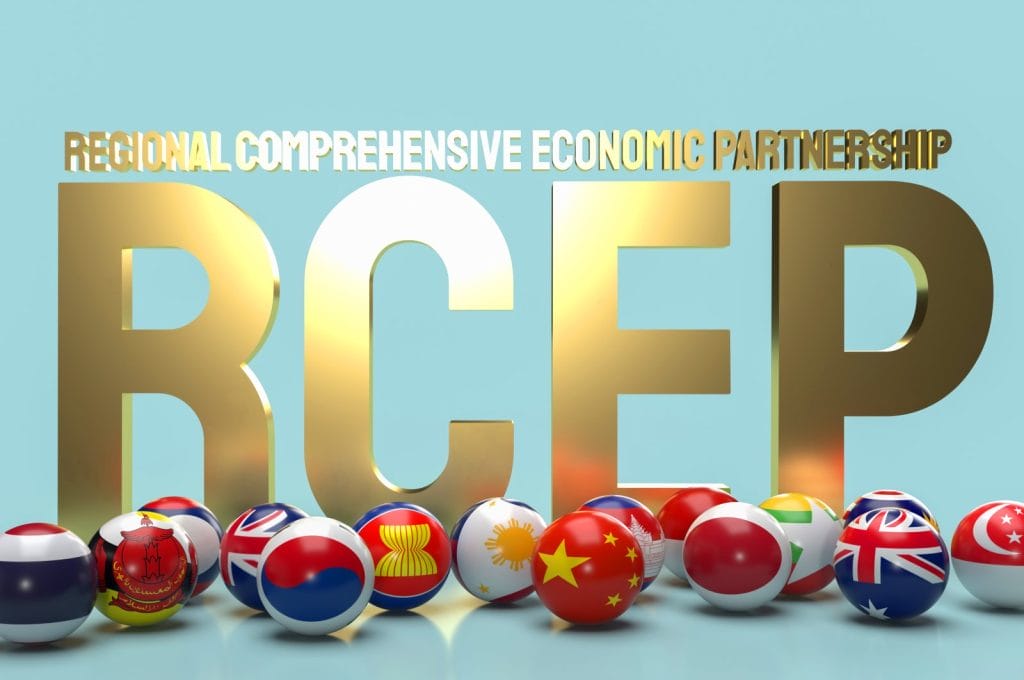
The Regional Comprehensive Economic Partnership (RCEP) is the largest free trade agreement in history by population, GDP coverage, and trade volume. Signed in 2020 and entering into force in phases from 2022, RCEP brings together the ten ASEAN member states with five key dialogue partners: China, Japan, South Korea, Australia, and New Zealand. This mega-regional agreement creates a unified economic space encompassing nearly one-third of the global economy and over 2.2 billion people.
The RCEP Agreement: The World’s Largest Trade Bloc
This comprehensive guide provides business leaders, trade compliance professionals, and strategic planners with a clear, audit-ready understanding of the RCEP Agreement. It examines the agreement’s structure, tariff liberalization schedules, rules of origin, impact on ASEAN-China and ASEAN-Australia economic relations, and practical strategies for businesses seeking to capitalize on the new opportunities while maintaining full regulatory compliance.
Strategic Insight: RCEP is more than a tariff-reduction agreement. It is a platform for deeper economic integration that reshapes supply chains, investment flows, and trade architecture across the Asia-Pacific. Companies that master its rules and leverage its preferences will gain significant advantages in one of the world’s most dynamic economic regions.
The Structure and Scope of the RCEP Agreement
RCEP is a modern, comprehensive free trade agreement covering trade in goods, services, investment, intellectual property, e-commerce, competition, and government procurement. Unlike many traditional FTAs, RCEP adopts a “living agreement” approach, allowing for future upgrades and expansions as economic conditions evolve.
The Structure and Scope of the RCEP Agreement
The agreement builds upon existing ASEAN+1 FTAs while introducing higher levels of ambition in several areas. It creates a single set of rules for the entire bloc, reducing the complexity of operating under multiple overlapping agreements. This “ASEAN centrality” principle ensures that the ten ASEAN countries remain at the core of the partnership.
For businesses, RCEP offers simplified rules, cumulative rules of origin, and improved market access. However, realizing these benefits requires careful attention to compliance requirements and origin documentation. A broader overview of ASEAN trade frameworks is available in our guide on Comprehensive Guide to Trading with ASEAN in 2026: Opportunities, Regulations, and Market Entry Strategies.
Chapter 12 Deep-Dive
Cross-Border E-Commerce & Data Governance Framework
Chapter 12 of the RCEP Agreement sets a binding legal foundation for digital trade across the 15 member states. It creates a paperless trading environment, standardizes cross-border e-commerce procedures, and establishes unified rules governing online consumer protection and international digital data flows.
Article 12.15
Prevents signatory states from restricting the cross-border transfer of information by electronic means for business operations, prohibiting arbitrary local server localization requirements while accommodating legitimate national security carve-outs.
Moratorium
Maintains the moratorium on imposing customs duties on electronic transmissions (software, SaaS, digital media, e-books), substantially lowering landed overhead for digital service providers operating within RCEP.
Articles 12.5 & 12.6
Mandates acceptance of electronic trade administration documents (e-Invoices, e-Certificates of Origin) and legal recognition of electronic signatures to streamline cross-border customs clearance.
Articles 12.7 & 12.8
Requires members to adopt and maintain legal frameworks for online user protection against fraudulent commercial practices and online personal information protection across digital storefronts.
Regulatory Compliance Note: While RCEP promotes digital data flow, foreign businesses must align cross-border trade operations with national regulatory frameworks—such as China’s Data Security Law (DSL) and Personal Information Protection Law (PIPL), as well as ASEAN’s Model Contractual Clauses (MCCs) for data transfers.
■ Strategic Context: India’s 11th-Hour Withdrawal
Geopolitical & B2B Insight
Despite active participation in seven years of negotiations, India formally withdrew from the RCEP agreement in November 2019. This strategic exit reshaped the bloc’s demographic footprint—reducing its population coverage from nearly 3.6 billion to 2.2 billion—while significantly altering regional trade dynamics.
New Delhi feared a massive surge in low-cost Chinese industrial imports (steel, electronics) that could widen India’s existing trade deficit with China ($53B+) and jeopardize domestic MSMEs.
Strong domestic political pressure from agricultural lobbies and dairy producers seeking protection from highly competitive Australian and New Zealand exports.
Negotiation stalemates over India’s demand for strict Rules of Origin to prevent Chinese circumvention and an automatic “snapback” tariff trigger on import surges.
Tariff Liberalization and Market Access Under RCEP
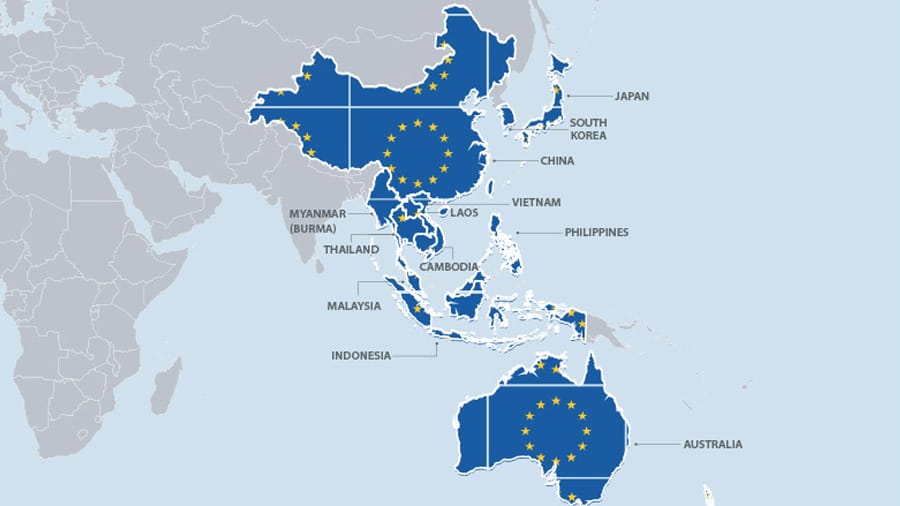
RCEP commits its members to substantial tariff reductions and eventual elimination on a high percentage of tariff lines. While the exact schedules vary by country pair, the agreement generally aims for 90%+ liberalization over time. ASEAN members offer each other and the five partner countries improved access compared to previous arrangements.
Market Access Under RCEP
China, as the largest economy in the bloc, grants significant concessions to ASEAN exporters, while ASEAN countries in turn provide enhanced access to their growing consumer and industrial markets. Australia and New Zealand benefit from streamlined access to both ASEAN and the Northeast Asian economies within the agreement.
■ Tariff Elimination Schedules & Structural Staggering
While RCEP targets over 90% tariff elimination across member states, the phase-out timeline is highly nuanced. Tariff concessions follow a dual-track mechanism based on country economic tiering and sectoral sensitivity, featuring grace periods extending up to 20 years for protected industries.
ASEAN-6 (Brunei, Indonesia, Malaysia, Philippines, Singapore, Thailand) execute rapid front-loaded tariff cuts. CLMV nations (Cambodia, Laos, Myanmar, Vietnam) receive extended transitional flexibility, with full tariff reductions stretched over 15 to 20 years to safeguard domestic industries.
Highly sensitive sectors are protected via long-term staging lists or outright exclusions. Key examples include Japan’s agricultural reserve (rice, wheat, beef/pork, dairy, sugar) and industrial goods such as specialized steel and automotive components in select economies.
| Category | Tariff Elimination Timeline | Key Commodity Focus |
|---|---|---|
| Immediate (Entry into Force) | 0 Years (Day 1) | Electronics, raw IT equipment, select chemicals, duty-free raw textiles. |
| Standard Staging | 5 – 10 Years (Linear Reductions) | Processed food, general machinery, plastics, footwear, apparel. |
| Extended Grace Period | 15 – 20 Years (Deferred Reductions) | Automobiles & auto parts, specialized steel, specific agricultural products. |
| Excluded / Sensitive Lists | No Concession (National Tariffs Retained) | Strategic agricultural staples (e.g., Japanese rice), strategic sovereign goods. |
Strategic Update 2026
RCEP in 2026: The New Operational Reality
As RCEP enters its fifth year of implementation in 2026, the mega-regional trade bloc has shifted from initial structural setup to deep operational maturity. The convergence of Year-5 tariff elimination milestones and wide-scale adoption of digital trade facilitation tools has significantly lowered landed costs and accelerated supply chain velocity across all 15 signatory states.
0% Duty Phase
Under the standard 5-year staging schedule, major categories of industrial machinery, raw electronics, semiconductor inputs, plastics, and intermediate chemical products have officially reached zero-tariff status across core RCEP markets.
Sub-6 Hour Clearance
The traditional paper-based Certificate of Origin (Form RCEP) has been largely superseded by the Approved Exporter Scheme. Qualified traders now issue origin declarations directly on commercial invoices, driving customs clearance times below 6 hours.
Supply Chain Advantage: The combination of zero-duty intermediate electronics and self-certification means B2B manufacturers in ASEAN can reconfigure sourcing in real-time, eliminating both duty burden and administrative border friction within intra-RCEP trade lanes.
The tariff phase-out schedules are staggered, with immediate cuts upon entry into force and gradual reductions over 10–20 years for sensitive products. This progressive approach gives industries time to adjust while providing early benefits for less sensitive goods. For companies engaged in regional manufacturing, understanding these schedules is essential for optimizing production location and sourcing decisions. Related supply chain strategies in Asia are examined in Vietnam: The New Factory of the World – Why Tech Giants Are Moving Production from China to Vietnam.
Chapter 12 Technical Update
Digital Trade Infrastructure & Paperless Customs Acceleration
Under RCEP’s Chapter 12 framework, member states have established binding rules to streamline the digital economy, protect cross-border data continuity, and eliminate administrative friction through paperless customs clearance.
Article 12.14
Signatory nations are prohibited from requiring covered entities to build local computing facilities or store data on in-country servers as a condition for conducting business, ensuring seamless regional cloud infrastructure management (subject strictly to legitimate essential security exemptions).
Articles 12.5 & 12.6
RCEP mandates member customs administrations to accept fully digital trade documentation, including electronic Certificates of Origin (e-CO), electronic invoices (e-Invoicing), and legally recognized e-signatures, eliminating physical paperwork delays at borders.
Operational Advantage for Tech & Logistics: Cloud providers, e-commerce platforms, and multinational logistics firms can centralize regional data centers in primary regional hubs while submitting fully automated digital manifests directly to customs authorities across all 15 signatory states.
Rules of Origin: The Technical Heart of RCEP
RCEP’s rules of origin are among the most business-friendly in any major trade agreement. The agreement allows for full cumulation, meaning materials originating in any RCEP member country can be counted toward origin qualification. This flexibility is particularly valuable for complex regional supply chains.
Key features include:
- Regional Value Content (RVC) of 40% in most cases
- Change in Tariff Classification (CTC) as an alternative or complementary criterion
- Product-specific rules for sensitive sectors
- Simplified certification procedures, including self-certification by approved exporters
■ Calculating Regional Value Content (RVC) Under RCEP
Article 3.5 Compliance Formula
To qualify for preferential tariffs under RCEP, goods utilizing the Regional Value Content rule must meet a threshold of at least 40% RVC. Under Article 3.5 of the RCEP Agreement, exporters can choose between two calculation methods depending on their cost accounting structure:
Most Common
Deducts the value of Non-Originating Materials (VNM) from the FOB price of the final product.
Direct Sourcing
Summates RCEP-originating materials, direct labor, direct overhead, and processing costs.
| Variable | Definition & Compliance Note |
|---|---|
| FOB | Free on Board value of the good, inclusive of transport to the port of export. |
| VNM | Value of Non-Originating Materials (CIF value at import or earliest proven price paid for non-RCEP components). |
| VOM | Value of Originating Materials sourced from any of the 15 RCEP member countries (Full Cumulation). |
| Direct Costs | Direct labor costs, direct overheads, processing costs, and profit generated within RCEP states. |
These liberal rules of origin make it easier for companies to qualify goods for preferential treatment compared to many older FTAs. Proper documentation and record-keeping remain essential for audit readiness and to defend against customs challenges. For practical compliance guidance on rules of origin in ASEAN, see our detailed analysis in What is the ATIGA Agreement? How Tariffs Are Being Eliminated Across ASEAN – A Complete Business and Compliance Guide.
■ Liberalization Framework: Services & Investment
Negative List Approach
Beyond tangible goods, RCEP introduces unprecedented market opening for professional services, financial technology, telecommunications, and cross-border investments. A core strategic shift in RCEP is its transition toward the modern “Negative List” approach for services and investment schedules.
Under a Negative List, all service sectors and foreign investment activities are fully liberalized by default unless specifically listed as a non-conforming measure (reservation). This provides significantly higher regulatory transparency and certainty compared to traditional Positive Lists.
Seven signatories (e.g., Australia, Japan, Korea, Singapore) adopted the Negative List approach immediately upon entry into force. The remaining eight members (including China and key ASEAN states) are bound by treaty obligations to convert from Positive to Negative Lists within 3 to 6 years.
2026 Regulatory Status Update
Accelerated Transition to the Negative List Approach
Under RCEP’s original framework, member states utilizing traditional Positive Lists for services and investment commitments were granted a 3-to-6-year transitional window to convert to a comprehensive Negative List framework. As of 2026, this structural transition has reached key completion milestones across major signatory nations.
Transition Complete
China, along with key ASEAN economies (including Vietnam, Indonesia, and Thailand), has formally published updated national Negative Lists. Non-conforming measures are now explicitly codified, granting foreign investors automatic entry across non-listed service sectors.
Finalizing (Phase 2)
Cambodia, Laos, Myanmar, and Vietnam (CLMV) are completing their final regulatory adjustments. Sectoral reservations in digital trade, logistics, and professional services are now substantially streamlined across the bloc.
Strategic Compliance Takeaway: With the Negative List mechanism now broadly active across 15 RCEP states, foreign service providers and B2B investors benefit from maximum market access by default. Any sector not explicitly restricted in national schedules is legally open to regional trade and cross-border commercial presence.
| Service / Investment Sector | Key RCEP Market Access Rights | Strategic Business Advantage |
|---|---|---|
| Financial & FinTech | Cross-border data transfers for financial processing, supply of new financial services. | Easier regional expansion for payment gateways and banking tech across Asia. |
| Professional Services | Streamlined temporary movement of business persons (Mode 4), recognition of credentials. | Smoother deployment of consultants, engineers, and technical auditors across the 15 states. |
| Foreign Investment Protection | Most-Favoured-Nation (MFN) treatment, prohibition of performance requirements (e.g., forced tech transfer). | Eliminates requirements for mandatory domestic equity thresholds or local content in manufacturing plants. |
RCEP vs ATIGA vs CPTPP – Quick Comparison (2026)
| Feature | RCEP | ATIGA | CPTPP |
|---|---|---|---|
| Number of Members | 15 (ASEAN + China, Japan, Korea, Australia, New Zealand) | 10 (ASEAN countries only) | 11 (includes Singapore, Vietnam, Australia, etc.) |
| Tariff Elimination | Over 90% over time (staggered schedule) | Nearly 99% for ASEAN-6 | Very high (close to 100%) |
| Rules of Origin | 40% RVC or CTC + Full Cumulation | 40% RVC or CTC | Often 45–55% RVC, more stringent |
| Self-Certification | Yes (for Approved Exporters) | Limited (mainly Form D) | Yes |
| Cumulation | Full Cumulation across all members | Limited cumulation | Limited |
| Best Suited For | Broad Asian supply chain integration | Pure intra-ASEAN trade | High-standard premium markets |
| Ease for Non-Member Countries (e.g. Iran/GCC) | Moderate (via ASEAN hub strategy) | Low | Moderate |
This comparison helps businesses decide which agreement best fits their regional strategy.
The Strategic Impact on ASEAN-China Economic Relations
RCEP significantly deepens economic ties between ASEAN and China. For ASEAN exporters, the agreement provides improved and more predictable access to the world’s second-largest economy. For Chinese manufacturers, RCEP facilitates access to ASEAN’s growing consumer markets and serves as a platform for regional production networks.
The agreement helps stabilize supply chains that were disrupted during recent global events and provides a framework for long-term investment cooperation. Many Chinese companies are using RCEP preferences to optimize their ASEAN footprint, particularly in Vietnam, Indonesia, Malaysia, and Thailand. This deepening integration creates both opportunities and competitive pressures for businesses across the region.
The RCEP Agreement
Supply Chain Integration
Supply Chain Realignment: The “China + ASEAN” Hybrid Model
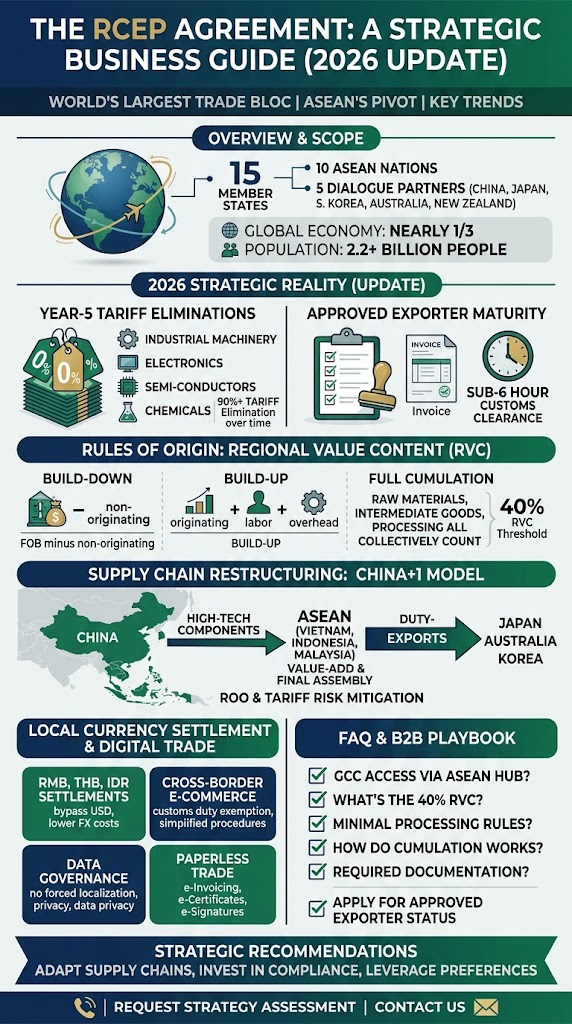
RCEP has fundamentally reshaped the “China + 1” manufacturing strategy. Rather than entirely exiting China, global and domestic Chinese manufacturers are establishing integrated production corridors—sourcing high-tech intermediate components from China and transferring labor-intensive assembly, final processing, and packaging to ASEAN hubs like Vietnam, Indonesia, and Malaysia.
Article 3.4 Origin Standard
Under RCEP’s Full Cumulation rules, raw materials and components supplied from China maintain their originating status when further processed in Vietnam or Indonesia. This combined regional value creation effortlessly clears the 40% Regional Value Content (RVC) threshold for duty-free entry into Japan, Korea, and Australia.
Origin Diversification
By shifting final manufacturing steps to ASEAN member states, multinational corporations secure dual benefits: preferential zero-duty access across intra-RCEP markets and structural mitigation against unilateral trade tariffs targeting direct exports originating from mainland China.
Operational Real-World Example: Intermediate electronic components manufactured in Shenzhen (China) shipped to Hai Phong (Vietnam) for final SMT assembly qualify for 0% RCEP preferential tariffs upon import into Tokyo (Japan) or Sydney (Australia), optimizing total landed cost by 12% to 18%.
The Impact on ASEAN-Australia Trade and Investment
For Australia, RCEP represents a major upgrade in trade relations with ASEAN and Northeast Asia. The agreement improves market access for Australian agricultural products, resources, education services, and professional services while providing Australian businesses with better protection for investments in the region.
Australian exporters benefit from reduced tariffs on key commodities such as beef, dairy, wine, and energy products. At the same time, Australian companies are increasing investment in ASEAN manufacturing and services, using RCEP as a platform for regional expansion. The agreement strengthens Australia’s economic engagement with Asia while complementing existing bilateral FTAs.
Compliance and Implementation Challenges
While RCEP offers substantial benefits, realizing them requires careful compliance management. Key challenges include:
- Understanding and correctly applying the complex rules of origin
- Maintaining adequate records for origin verification
- Coordinating compliance across multiple jurisdictions with different implementation timelines
- Integrating RCEP preferences into existing ERP and trade compliance systems
Successful companies invest in origin management systems, staff training, and regular third-party audits. They also maintain close relationships with customs authorities and trade associations to stay updated on implementation developments. For broader compliance strategies in Asian trade, refer to ESG Compliance Guide for Asian Exporters: How Chinese and Indian Companies Can Meet Western Environmental Standards.
■ Legal Framework & Dispute Settlement Mechanisms
Chapter 19 & Customs Appeals
A critical consideration for international investors and trading firms is how RCEP enforces its terms and resolves conflicts. The agreement establishes a robust State-to-State Dispute Settlement (SSDS) framework while intentionally deferring complex investor-state arbitration protocols.
Governed by Chapter 19, RCEP provides a binding dispute settlement panel system if a member government fails to honor tariff cuts or customs commitments. Private companies experiencing non-compliance must lobby their home government to initiate formal bilateral consultations or arbitral panels.
Unlike CPTPP, RCEP currently does not contain an Investor-State Dispute Settlement (ISDS) mechanism. Direct investor suits against host governments are excluded; however, a mandatory review clause requires member states to discuss introducing ISDS within 3 to 5 years post-entry into force.
Operational Customs Remedies for Importers & Exporters
- Advance Rulings (Chapter 3): Traders can apply for legally binding advance rulings from destination customs authorities regarding HS classification, valuation, and qualification under RCEP Rules of Origin prior to shipping.
- Administrative & Judicial Review: Importers facing duty disputes, administrative delays, or Origin Certificate rejections are guaranteed the legal right to appeal customs decisions through administrative review bodies and domestic courts in the importing state.
- Clearance Transparency: RCEP mandates customs authorities to clear express shipments and perishable goods within 6 hours of arrival, providing specific legal grounds to challenge unreasonable border detentions.
Strategic Recommendations for Businesses
Companies seeking to maximize the benefits of RCEP should consider the following actions:
- Conduct a thorough RCEP opportunity assessment for their product portfolio
- Review and optimize supply chain configurations to maximize regional value content
- Implement robust origin certification and record-keeping systems
- Engage with local chambers of commerce and industry associations for implementation support
- Monitor ongoing negotiations and potential future expansions of the agreement
Practical Playbook: 7-Step RCEP Implementation Guide
To turn RCEP opportunities into measurable advantages, companies should follow this actionable 7-step playbook:
1. Portfolio Opportunity Assessment
Map your current and planned product lines against RCEP tariff schedules and identify high-impact HS codes with significant duty savings.
2. Supply Chain Reconfiguration
Analyze and redesign sourcing and production footprints to maximize Regional Value Content (RVC) using full cumulation across all 15 RCEP members.
3. Rules of Origin Compliance System
Implement automated tools for calculating 40% RVC or Change in Tariff Classification (CTC) and integrate them with your ERP system.
4. Documentation & Record-Keeping
Establish a centralized digital repository that retains origin documentation for at least three years to ensure audit readiness.
5. Self-Certification Readiness
If eligible, apply for Approved Exporter status to benefit from self-certification and faster customs clearance.
6. Training & Internal Controls
Train trade compliance, procurement, and finance teams on RCEP specifics and set up quarterly internal audits.
7. Monitoring & Adaptation
Track future upgrades to the “living agreement” and adjust strategies as new members or sectors are added.
Companies that complete this playbook typically achieve 8–15% landed cost reduction on qualifying intra-RCEP trade within the first 12–18 months.
GCC Strategic Trade Gateway
The Middle East “Hub & Spoke” Playbook: Accessing RCEP Preferences
Although Middle East and GCC economies are not direct RCEP signatories, forward-thinking B2B enterprises are leveraging a Hub-and-Spoke Gateway Strategy. By combining Middle Eastern trade hubs (such as Dubai’s JAFZA, KIZAD, or Saudi Free Zones) with processing facilities in ASEAN states, non-member businesses can legitimately unlock preferential zero-tariff access across China, Japan, Korea, and Australasia.
Middle East Supply
Raw materials, energy inputs, petrochemical resins, or intermediate goods are exported from GCC hubs or Iran to ASEAN Special Economic Zones (SEZs) in Malaysia, Vietnam, or Indonesia.
ASEAN Processing
The materials undergo substantial transformation, blending, precision packaging, or final SMT assembly within an ASEAN subsidiary to satisfy either the 40% RVC threshold or a Change in Tariff Classification (CTC).
0% Tariff Entry
The finished goods obtain an official RCEP Certificate of Origin issued by ASEAN customs authorities, securing duty-free entry into tier-1 East Asian economies like China, Japan, and South Korea.
Strategic Commercial Example: GCC petrochemical polymer granules shipped to Port Klang (Malaysia), processed into specialized industrial film, qualify for RCEP preferential tariffs upon entry into Shanghai or Osaka—reducing landed duty overhead from 6.5% to 0%.
Strategic Trend 2026
De-Dollarization & Local Currency Settlement (LCS) Networks
While RCEP established the structural framework for duty-free trade, the rapid adoption of Local Currency Settlement (LCS) frameworks has become the key catalyst for cross-border cost optimization. Regional traders are increasingly bypassing third-party currencies (USD/EUR) in favor of direct local currency pairs, driven by central bank swap agreements and interlinked real-time payment systems across East and Southeast Asia.
Dominant Anchor
Over 30% of intra-RCEP trade with China is now settled directly in Renminbi (RMB), leveraging the CIPS network. This shift significantly reduces foreign exchange hedging costs and guarantees faster cross-border payment clearance for ASEAN exporters.
Multi-Currency Hub
The ASEAN Local Currency Transaction (LCT) framework seamlessly links local currencies—such as the Indonesian Rupiah (IDR), Thai Baht (THB), and Malaysian Ringgit (MYR)—enabling direct bilateral settlements without USD intermediation.
Actionable FX Takeaway for Global Traders: Businesses operating within RCEP can reduce transaction fees by 1.5% to 3.0% on landed goods by establishing dual-currency billing contracts (RMB/THB/IDR) and utilizing regional central bank-backed clearing houses.
-Compliance Advantage: Companies already experienced with single-window platforms and audit-ready documentation will find it easier to integrate RCEP origin requirements.
Businesses that treat RCEP as part of a broader “China+1 + ASEAN Hub” strategy can significantly diversify their export markets while maintaining robust compliance posture.
Frequently Asked Questions (FAQ)
Key insights on leveraging RCEP regional value chains for Middle East and global enterprises.
1. Can Middle Eastern or GCC-based companies directly apply for an RCEP Certificate of Origin?
No. Only goods exported directly from an official RCEP signatory member country (such as ASEAN nations, China, Japan, Korea, Australia, or New Zealand) qualify. However, Middle Eastern companies can establish a subsidiary or processing hub in an RCEP member state (e.g., Malaysia or Vietnam) to process goods, add required regional value, and legally obtain an RCEP Certificate of Origin.
2. What is the Regional Value Content (RVC) threshold required under RCEP?
Generally, goods must satisfy a minimum 40% Regional Value Content (RVC) threshold within the RCEP zone, calculated under the build-up or build-down method. Alternatively, goods may qualify through a Change in Tariff Classification (CTC) at the 2-digit, 4-digit, or 6-digit HS code level depending on Product-Specific Rules (PSRs).
3. Does minor processing or simple packaging in an ASEAN Free Zone qualify goods for RCEP preferences?
No. RCEP rules explicitly prohibit “Minimal Operations and Processes” (such as simple washing, repacking, labeling, or sorting) from bestowing origin status. The processing in the RCEP hub must constitute a substantial transformation—such as active manufacturing, chemical reaction, precision assembly, or meeting the 40% value-addition criterion.
4. How does Cumulative Origin work within the RCEP trading bloc?
Cumulative origin allows inputs sourced from any of the 15 RCEP member nations to be treated as domestic content when calculating the final origin status. For instance, raw materials from Japan combined with manufacturing in Vietnam count collectively toward the total 40% RVC required for duty-free entry into China.
5. What documentation is needed to verify RCEP origin during customs clearance?
Importers must present either an official Proof of Origin (Certificate of Origin Form RCEP) issued by an authorized issuing authority, or a Declaration of Origin issued by an Approved Exporter/Manufacturer. Accurate bill of materials (BOM), cost statements, and transport documents confirming direct consignment are mandatory.
Conclusion: RCEP as a Foundational Platform for Asian Economic Integration
The Regional Comprehensive Economic Partnership represents a landmark achievement in Asian economic cooperation. By creating the world’s largest trade bloc, RCEP provides a stable framework for tariff reduction, investment protection, and supply chain integration across 15 diverse economies.
For businesses, RCEP is both an opportunity and a call to action. Those that master its rules, adapt their supply chains, and invest in compliance infrastructure will be best positioned to thrive in the evolving Asian economic landscape. The agreement strengthens ASEAN’s central role in regional architecture and deepens economic ties with its major partners, particularly China and Australia.
As implementation continues and the agreement evolves, companies that approach RCEP with strategic foresight and disciplined compliance will gain lasting competitive advantages in one of the most important economic regions of the 21st century.
Platforms designed for regulated regional trade provide essential tools for managing RCEP compliance efficiently while supporting scalable business growth. Organizations seeking to strengthen their RCEP engagement are encouraged to adopt integrated, audit-ready solutions that combine commercial agility with full regulatory alignment.
Official RCEP Legal Texts, Authorities & Member Portals
Access verified legal documentation, country-specific tariff commitments, official Rules of Origin guides, and member state customs portals directly through official government sources.