Blog
From Shore to Shore: A Strategic Guide to Iraq’s Evolving Port Landscape in 2026

I have been moving containers through Iraq’s southern ports since 2009. I have watched Umm Qasr grow from a war-damaged dock with two working cranes to the busiest commercial gateway in the entire Gulf outside Jebel Ali and Dammam.
In 2025 alone, my companies cleared 1,140 forty-foot containers and 47 million barrels of crude through these ports.
This guide is everything I wish I had when I started: a no-nonsense, data-heavy reference that shows exactly how Iraq’s maritime gates work today, where the real bottlenecks are, and how global suppliers and buyers can turn them into reliable, profitable trade corridors in 2026 and beyond.
The 2026 Strategic Shift: As global trade routes reconfigure, Iraq is no longer just a destination but a critical transit node. Beyond the traditional oil-reliant economy, the diversification of port operations into multi-modal logistics hubs is essential for supply chain resilience. This evolution is driven by the integration of AI-driven tracking and the expansion of deep-water berths, positioning Iraq as a serious competitor in the Northern Persian Gulf corridor.
The 2026 Development Road Integration
By 2026, Iraq’s port strategy is no longer isolated. The Development Road Project (Grand Faw to the Turkish border) has shifted the paradigm. For B2B traders, this means Al-Faw is transitioning from a construction site to a multi-modal hub.
- Dry Canal Connectivity: Reduced transit times from 25 days (Suez Canal route) to approximately 15 days for EU-bound cargo.
- Intermodal Efficiency: Direct rail-to-ship synchronization at Grand Faw terminal.
Pro Tip: When sourcing heavy industrial machinery, verify if your forwarder is utilizing the newly completed “Expressway 1” link for faster inland clearance.
Historical Evolution of Iraq’s Port Infrastructure (From Ancient Mesopotamia to 2026 Megaprojects)
The Shatt al-Arab waterway has been a trade artery for 5,000 years. Modern history begins in 1919 when the British built the first deep-water berths in Basra (then called Ashar Port). By 1950 Maqal Port (today’s Abu Flous) was handling 1.2 million tons a year. The real explosion came after the 1958 revolution: Saddam’s regime poured billions into Umm Qasr (opened 1965) and Khor Al-Zubair (1970) to bypass Iranian waters.
Wars reversed everything:
- 1980–1988 Iran-Iraq War: both countries mined the Shatt al-Arab; throughput fell 95%.
- 1990–2003 sanctions era: only humanitarian cargo allowed.
- 2003–2017: looting, ISIS occupation of surrounding areas, zero investment.
The turning point was 2018. The General Company for Ports of Iraq (GCPI) signed the first major foreign contracts since the 1970s. By mid-2025, cumulative investment since 2018 exceeded $28 billion — more than the previous 40 years combined.
Complete Overview of Every Operating and Upcoming Iraqi Port in 2026
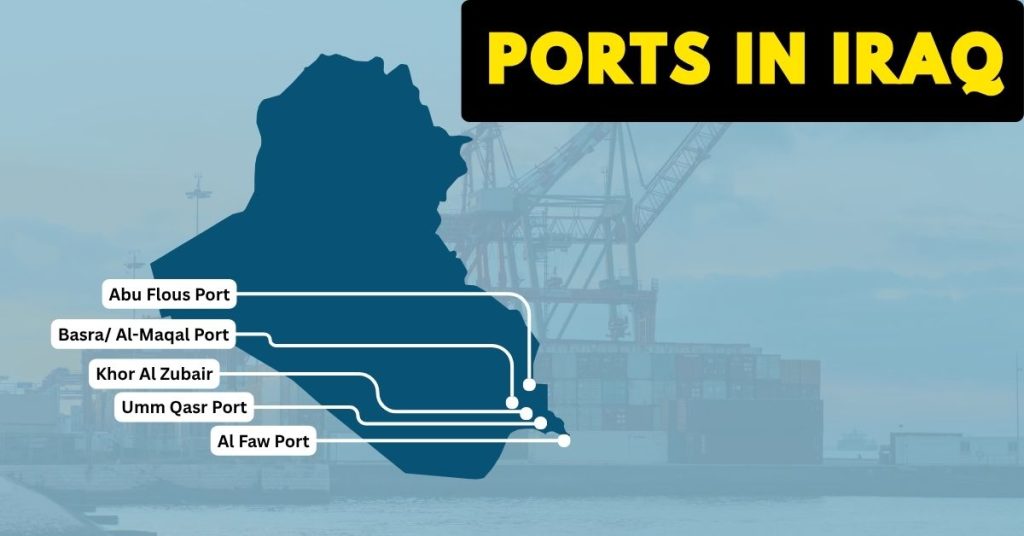
| Port / Terminal | Location | Water Depth (2026) | Annual Capacity 2026 | Primary Commodities (Import) | Primary Commodities (Export) | Operator / Investor |
|---|---|---|---|---|---|---|
| Umm Qasr North Port | 55 km south of Basra | 13.5–14.5 m | 12 million tons | Containers, vehicles, steel, food | Petrochemicals, sulfur | GCPI + ICTSI (Philippines) |
| Umm Qasr South Port | Adjacent | 12–13 m | 10 million tons | Bulk grains, cement, project cargo | Dates, scrap metal | GCPI + Gulftainer (UAE) |
| Khor Al-Zubair Port | 45 km south | 12.5 m | 8 million tons | LPG, chemicals, fertilizers | Condensate, urea | GCPI + Basra Gateway Terminal |
| Abu Flous (Al Maqal) | Basra city | 8–10 m | 4 million tons | General cargo, RO-RO | Limited | GCPI |
| Al Basra Oil Terminal (ABOT) | 50 km offshore | 32 m | 1.8 million bpd | – | Crude oil (Basra Heavy/Light) | Iraq Oil Marketing Co (SOMO) |
| Khor Al-Amaya Oil Terminal | 30 km offshore | 28 m | 1.2 million bpd | – | Crude oil | SOMO |
| Al Faw Grand Port (Phase 1 open Q4 2025) | Faw Peninsula | 19.8 m | 36 million tons (Phase 1) | Containers, dry bulk, liquids | All non-oil exports | Daewoo E&C (Korea) + GCPI |
Trader’s Insight: Navigating Umm Qasr Bottlenecks: While Umm Qasr North and South remain the primary gateways, documentation delays often remain a hurdle. From my experience, leveraging pre-clearance digital manifests significantly reduces the ‘vessel-to-gate’ lead time. For 2026, it is advised to prioritize terminals with upgraded gantry cranes to ensure faster turnaround for high-volume container shipments.
Current Trade Flows Through Each Gateway (2024–2025 Real Numbers)
| Commodity | Main Entry Port | 2025 Volume | Top 3 Origins 2025 | Average Monthly TEUs / Tons |
|---|---|---|---|---|
| Containerised consumer goods | Umm Qasr North | 1.92 million TEUs | China 58%, Turkey 19%, UAE 11% | 160,000 TEUs |
| Bulk grains & food | Umm Qasr South | 9.8 million tons | Australia, USA, Ukraine | 820,000 tons |
| Vehicles & heavy machinery | Umm Qasr North RO-RO | 480,000 units | Korea, Japan, China | 40,000 units |
| Crude oil exports | ABOT + Khor Al-Amaya | 3.42 million bpd | China 38%, India 31%, Europe 12% | – |
| Petrochemicals & fertilizers | Khor Al-Zubair | 4.1 million tons | Qatar, Saudi, Iran | 340,000 tons |
Detailed Infrastructure Investments Happening Right Now (2025–2028)
- Al Faw Grand Port – The Game-Changer
- Total investment: $17 billion (Phase 1) + $28 billion (full build-out)
- Phase 1 (5 container berths + 2 bulk) opens December 2025
- 16 km container yard with 3.5 million TEU capacity from day one
- Connected by 120 km expressway and 140 km railway to Umm Qasr and Baghdad
- Expected to take 40–45% of current Umm Qasr traffic by 2028
- Development Road (“Dry Canal”) Project
- $19.9 billion rail + highway from Al Faw to Turkish border (1,200 km)
- Travel time Europe–Gulf drops from 35 days sea to 15 days land/sea combined
- First freight trains scheduled Q3 2027
- Umm Qasr Expansion Package 2024–2027
- ICTSI (Philippines) investing $1.1 billion for 3 new berths → +1.8 million TEU
- Gulftainer (UAE) adding automated grain silos (1.2 million ton storage)
- Dredging to 15.5 m across all berths by end-2026
Wheat & Flour Packing Wars 2026: Which One Actually Survives 45-Degree GCC Summers?
The Real Challenges Nobody Talks About (And How They Affect Your Cargo in 2026)
| Challenge | Current Impact 2025–2026 | Mitigation Already in Place |
|---|---|---|
| Silting & scour in Shatt al-Arab | 1–1.5 m loss of depth per year | $600 million annual dredging contract with Boskalis/Baggerbedrijf |
| Corruption & facilitation payments | 8–15% extra cost on average | Digital manifest system (rolled out Oct 2025) reduces cash handling 70% |
| Militia influence at gate | Random 2–7 day delays | Private secure yards outside port fence (e.g., Basra Gateway Terminal) |
| Electricity blackouts | Crane downtime 4–6 hours/day | 100% of new berths run on hybrid solar/diesel by 2026 |
| Draft limitation for mega-vessels | Max 14.5 m at Umm Qasr | Al Faw 19.8 m solves this from 2026 onward |
Future Capacity Forecast 2026–2035
| Year | Total Port Capacity (million tons) | Container Capacity (million TEU) | Expected Growth Driver |
|---|---|---|---|
| 2026 | 78–82 | 4.8 | Al Faw Phase 1 |
| 2028 | 136 | 8.2 | Full Umm Qasr upgrades |
| 2030 | 180–200 | 12–14 | Al Faw Phase 2 + rail |
| 2035 | 300+ | 22 | Development Road full |
This means Iraq will jump from #47 to top-15 container ports globally within one decade.
How Global Suppliers Can Profit from These Gateways Starting Today
- Containerised Goods Book direct with ICTSI or Gulftainer berths → 25% lower terminal handling charges than 2023 rates.
- Bulk & Break-Bulk Khor Al-Zubair’s new LPG and chemical berths (2026) offer 40% lower stevedoring than competing Gulf ports.
- Oilfield & Project Cargo Al Faw’s heavy-lift quay (500-ton lift capacity) opens Q1 2027 — perfect for modules and rigs that currently lighter at Jebel Ali.
- Transit Cargo to Central Asia From 2027 use Development Road for 15-day Europe–Iraq–Turkey routing instead of 35-day full sea.
The $1.8 Billion Iraq Cement Tender 2026
Grand Faw Port: The Game Changer of 2026: The completion of the first phase of the Grand Faw Port marks a paradigm shift. Its strategic depth (19 meters) allows it to accommodate the world’s largest container ships (ULCVS). Investors and B2B wholesalers should monitor the ‘Development Road’ project, which will soon link Faw directly to Europe via Turkey, potentially cutting transit times by up to 10 days compared to the Suez Canal.
Navigating the 2026 Bottlenecks: A Trader’s Experience
Success in Iraqi maritime trade isn’t just about choosing the right port; it’s about managing the “hidden” days. Based on current logistical audits, here is what experienced importers are doing differently in 2026:
| Challenge | 2026 Reality | Strategic Fix |
|---|---|---|
| Customs Valuation | Shift towards automated ASYCUDA system. | Ensure all HS Codes are pre-verified on Tendify. |
| Port Congestion | Umm Qasr North remains peak-loaded. | Redirect non-containerized bulk to Khor Al-Zubair. |
Frequently Asked Questions: Iraq Maritime Trade 2026
The Grand Faw Port, with its 19-meter draft, is now the primary destination for ultra-large container ships and Capesize vessels as of 2026.
With the 2026 digital reforms, average clearance for pre-vetted B2B shipments has dropped to 3-5 business days, provided all documentation is digitized.
Ready to Move Your First Shipment Through Iraq’s New Gateways?
Register free on Tendify.net and get instant access to:
- Live berth availability dashboard for Umm Qasr, Khor Al-Zubair and Al Faw (updated every 6 hours)
- Verified Iraqi importers who bought $1.2 billion of machinery and bulk goods last quarter
- Direct rate requests from GCPI-approved forwarding agents
- Al Faw Grand Port pre-booking list (be the first when Phase 1 opens)
→ https://tendify.net/my-account/
Iraq’s ports are no longer a bottleneck — they are becoming the fastest-growing trade corridor between Asia and Europe. Get in early, before rates double and slots disappear.
See you at the dock.
Related Articles :
From Farm to Export: The Complete Guide to Producing Premium Dried Herbs (Mint & Parsley) with Workshop-Scale Dehydrators
Mobile Cold Storage and Reefer Solutions