


Blog
GCC Intermodal Connectivity and Strategic Partnerships: The Blueprint for Regional Logistics Dominance
Introduction: The New Era of Integrated Gulf Logistics
GCC intermodal connectivity and strategic partnerships have emerged as the defining forces reshaping trade across Saudi Arabia, the UAE, Qatar, Kuwait, Oman, and Bahrain in 2026. As global supply chains fragment and reconfigure, the Gulf Cooperation Council stands at a pivotal moment—transforming from a collection of individual logistics hubs into an integrated, multimodal powerhouse capable of competing with the world’s most sophisticated trade corridors. For B2B businesses, particularly those exporting from neighboring regions like Iran, understanding and leveraging this transformation represents the single most significant opportunity for scalable growth in the Middle East’s most dynamic economic bloc.
The Strategic Imperative of Intermodal Connectivity
The Gulf’s geographical position has always been strategic—linking East and West, connecting Asia’s manufacturing might with Europe’s consumer markets and Africa’s resource wealth . But geography alone no longer guarantees trade dominance. Today, success depends on how seamlessly sea, air, rail, and road networks integrate into a unified system that moves goods faster, cheaper, and more reliably than competing corridors.
Why Intermodal Connectivity Matters:
According to industry analysis, the GCC’s potential as a global logistics hub depends fundamentally on intermodal connectivity backed by strategic partnerships . By integrating multiple transport modes, goods can move with unprecedented efficiency, reducing bottlenecks and supporting everything from petrochemical exports to e-commerce fulfillment.
The numbers tell the story: UAE-GCC trade alone reached AED 333 billion in 2024, with non-oil exports at AED 85.6 billion and re-exports at AED 162.9 billion . These flows increasingly move through integrated multimodal systems rather than fragmented single-mode channels.
The GCC’s Multi-Billion Dollar Infrastructure Foundation
Maritime Gateways: The Region’s Global Front Door
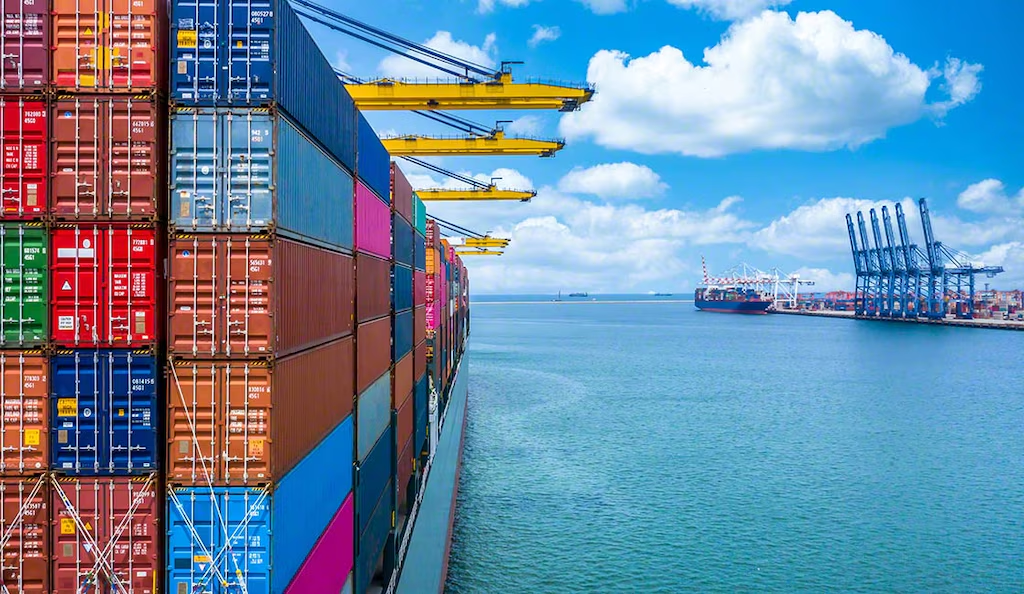
The GCC boasts over 25 major seaports, each evolving from standalone facilities into nodes within an integrated network :
Jebel Ali Port (Dubai): The region’s largest and busiest, handling over 14 million TEUs annually, serves as the anchor of DP World’s global network. Its integration with the Jebel Ali Free Zone (JAFZA) creates a seamless port-to-warehouse ecosystem that has attracted more than 700 manufacturers operating across metals, machinery, and engineered products .
King Abdullah Port (Saudi Arabia): A modern, automated deep-sea port near Jeddah offering efficient turnaround times and serving as a critical Red Sea gateway for Saudi Vision 2030 projects .
Hamad Port (Qatar): Built to world-class standards with extensive cold storage facilities, positioning Qatar as a strategic trade partner between Europe, Asia, and Africa .
Sohar Port (Oman): Strategically located outside the Strait of Hormuz, offering alternative access to Gulf markets and anchoring a growing base of export-oriented heavy manufacturing .
Air Cargo Hubs: Speed and Specialization
The region’s airports consistently rank among the world’s busiest cargo hubs:
Dubai International Airport (DXB): The world’s busiest international air cargo hub, with extensive connectivity to global markets and specialized facilities for perishables and pharmaceuticals .
Hamad International Airport (DOH): Qatar’s new gateway facility at Doha’s airport represents part of broader efforts to enhance the country’s trade and logistics landscape .
King Khalid International Airport (RUH): Saudi Arabia’s primary air cargo gateway for the central region, increasingly integrated with road networks serving Riyadh’s industrial cities.
The GCC Railway: The Missing Link
Perhaps the most transformative infrastructure project underway is the GCC Railway—a 2,177 km network scheduled for completion by 2030 that will connect all six member states . Extending from Kuwait in the north, passing through Dammam in Saudi Arabia to Bahrain, and from Dammam to Qatar via the Salwa crossing, the network then extends to Abu Dhabi through Al Ain before reaching its final destination in Muscat, Oman, via Sohar .
When operational, this railway will:
Tie together ports, airports, and industrial zones across all six states
Dramatically reduce logistics costs for heavy and bulk goods
Create seamless freight movement across the region
Reduce pressure on road networks and improve sustainability
Strategic Partnerships: The Force Multiplier
Physical infrastructure alone cannot guarantee success. What gives GCC connectivity its competitive edge are the strategic partnerships being forged across multiple regions . These collaborations expand market reach, enhance efficiency, and create resilience in an era of supply chain volatility.
Asia Partnerships: The Trade Engine
The GCC’s strongest logistics ties are with Asia, particularly China and India . The Belt and Road Initiative has brought significant Chinese investment into Gulf ports and rail projects, while Indian trade corridors through UAE and Saudi ports enable faster access to African and European markets.
According to logistics executives surveyed for the 2026 Agility Emerging Markets Index, supply chain diversification remains an active priority, with shifts in global production and sourcing accelerated by US-China trade tensions . The GCC’s ability to maintain working relationships with both powers positions it uniquely as a neutral, reliable hub.
Africa Partnerships: The Growth Frontier
Africa’s rising consumer markets and natural resources make it a critical trade partner . GCC ports such as DP World’s operations in Berbera (Somaliland) and Dakar (Senegal) highlight how Gulf logistics operators are extending their footprint deep into Africa, turning GCC hubs into gateways for African trade.
Dr. Tobias Meyer, CEO of DHL Group, emphasized this opportunity during a recent visit to Qatar: “What we do see is that the GCC and also Qatar have a bigger role to play as trading partners. We see in the region a significant build-up of regional distribution capacity to distribute a product not only here in the Middle East, but also in Africa” .
Europe Partnerships: Quality and Connectivity
Partnerships with European logistics operators and shipping lines enhance Gulf connectivity to Mediterranean and Northern European ports . Investments in digital customs processes and free trade agreements further ease cargo flows.
Germany’s recent high-level engagement with Qatar—including a visit by German Chancellor H E Friedrich Merz—reflects growing recognition of the GCC’s logistics importance . “Both sides appreciate the friendliness of the relationship and the reliability that we want to bring,” Meyer noted .
Eurasia Connections: The Middle Corridor
The growing Middle Corridor, linking Central Asia to Europe via the Caspian Sea and Turkey, creates opportunities for GCC hubs to serve as complementary nodes, especially as companies seek alternatives to traditional Eurasian routes .
The Technology Glue: Digital Integration
Intermodal connectivity today is as much about technology as physical assets. Smart ports in Dubai, Abu Dhabi, Jeddah, and Doha already use AI, blockchain, and IoT for real-time cargo tracking and predictive logistics .
Dubai’s Unified Multimodal Platform
Dubai is setting the benchmark for digital trade facilitation . The emirate is developing a single multimodal platform combining Emirates airline’s Sky Cargo services, Dnata services, and DP World’s port operations at Jebel Ali and other Dubai ports. “Air, sea, land, all in one place,” explained Mohamed Abu Hamra, Chief Operating Officer of Digital Technology at DP World GCC .
This unified trade window aims to transform what is currently a “mission impossible” for individual consumers—shipping goods internationally with all associated clearance, customs, and payment processes—into a seamless experience comparable to ordering from Amazon .
Digital Government Integration
All GCC states received a “Very High” rating in the UN 2024 E-Government Development Index (EGDI), reflecting successful alignment of regional digital policies . The unified GCC Digital Government Guiding Strategy (2024–2030) aims to integrate GCC e-government networks, launch a unified smart portal, and introduce standardized frameworks for digital accessibility .
Customs Digitalization
The GCC Customs Union Authority (CUA) is working closely with the GCC Standardization Organization (GSO) and the Gulf Organization for Industrial Consulting (GOIC) to enhance coordination on product safety and goods movement . These efforts focus on developing strategic partnerships that strengthen product reliability, facilitate smooth goods flow, and support industrial development objectives.
Dubai Customs’ innovative cross-border e-commerce platform has received widespread praise from the World Customs Organization (WCO), serving as a global model for digital transformation . The platform aims to convert 20–30% of low-value e-commerce shipments to its system, supporting e-commerce routes across the GCC and positioning Dubai among the top five global logistics hubs .
Case Study: How a Regional Logistics Provider Leveraged GCC Integration for Pan-Gulf Success
Company: A mid-sized logistics provider based in Dubai specializing in temperature-controlled pharmaceutical and healthcare logistics.
The Challenge: While they had built a strong reputation in the UAE, expanding across the GCC meant navigating fragmented regulations, coordinating multiple transport modes, and building relationships in each market—a resource-intensive proposition for a growing company.
The Strategic Partnership Approach:
Infrastructure Leverage: Rather than building their own facilities across the region, they utilized:
Jebel Ali Port’s cold chain infrastructure for sea freight consolidation
Dubai Airport’s pharma-corridor capabilities for air freight
Partner warehouses in Dammam, Doha, and Muscat for regional distribution
Strategic Alliances:
Formed partnerships with complementary logistics providers in Saudi Arabia, Qatar, and Oman
Joined DP World’s digital platform for seamless multimodal bookings
Participated in GSO’s standardization initiatives to ensure compliance across markets
Technology Integration:
Integrated their systems with Dubai’s emerging multimodal platform
Implemented real-time tracking visible to customers across the GCC
Utilized AI for route optimization across borders
Regulatory Navigation:
Leveraged GCC Customs Union progress to reduce clearance times
Utilized common GCC standards for pharmaceutical handling
Benefited from UAE’s leading position in GCC digital government initiatives
The Results:
Regional revenue grew from AED 45 million to AED 120 million within 24 months
Service expanded from UAE-only to all six GCC markets
Customer retention improved from 72% to 91%
They achieved preferred provider status with two major pharmaceutical distributors
Their integrated model became a case study for GCC expansion
“We realized early that trying to go it alone in every GCC market would be prohibitively expensive and slow. By leveraging the region’s emerging intermodal infrastructure and forming strategic partnerships, we achieved in two years what would have taken a decade through organic expansion. The GCC’s integration efforts aren’t just government policy—they’re practical business advantages.” — Managing Director, Regional Logistics Provider
The GCC’s Global Performance Rankings
The region’s logistics achievements are increasingly recognized in global benchmarks:
| Indicator | GCC Performance |
|---|---|
| World Bank Logistics Performance Index (LPI) | Above global average, ranked among top 21 emerging and leading markets |
| Digital Readiness | UAE and Saudi Arabia ranked among most digitally ready markets globally |
| International Logistics Opportunities | UAE and Saudi Arabia among highest-ranked markets |
| Domestic Logistics Performance | Qatar and Saudi Arabia leading in regional rankings |
| E-Government Development | All GCC states rated “Very High” in UN 2024 EGDI |
The 2026 Agility Emerging Markets Index confirmed that all six GCC countries ranked among the top performers globally for business conditions, with the UAE and Saudi Arabia leading in digital readiness . China, India, Mexico, the UAE, and Saudi Arabia ranked highest for international logistics opportunities .
The Manufacturing Transformation: From Import Hub to Export Machine
Perhaps the most significant shift reshaping GCC logistics is the region’s transformation from a destination market into an emerging source of project cargo . For decades, the Gulf’s role was defined by imports—power plants, refineries, and industrial complexes built on the back of heavy-lift cargo arriving from Europe, Asia, and North America. That dynamic is now reversing.
The Manufacturing Surge:
Industrial diversification strategies and local content policies are creating a structural, year-round requirement for heavy-lift, specialized transport, and engineering capability . According to Gagan Shetty, General Manager of Sales and Marketing at Al Faris Group: “We’ve seen a clear shift from project spikes to more steady, structural demand. As GCC countries push diversification and expand non-oil industries, there is a growing pipeline of steel mills, modular fabrication yards, process plants, data centers, renewables, and logistics hubs” .
This shift is translating into outbound cargo flows. Peter Dudas, Head of Industrial Projects MEA at DHL Global Forwarding, confirms: “We are consistently seeing outbound project cargoes, including fabricated steel structures, process equipment, and large, prefabricated modules” .
What’s Being Manufactured Locally:
Today, GCC-manufactured components moving through the region’s logistics networks include :
Large steel structures and modular building units
Preassembled process skids, pipe racks, and modules
Storage tanks, silos, pressure vessels, and reactors
Transformers, turbines, generators, and major electrical equipment
Solar components, wind turbine blades, and renewable energy equipment
Export Destinations:
According to industry experts, GCC-manufactured industrial goods are increasingly moving into export markets . Oman, in particular, is attracting investment targeted at international markets, with Duqm and Sohar positioned as export platforms for sub-Saharan Africa and beyond .
Challenges and Opportunities on the Integration Path
Despite remarkable progress, the GCC’s intermodal integration faces several challenges:
Infrastructure Gaps
Rail integration remains behind schedule, with the GCC Railway not expected to be fully operational until 2030 . Until then, road transport must handle the majority of intra-GCC freight, with varying border crossing efficiencies.
Regulatory Fragmentation
Despite customs union progress, customs procedures and product standards can still vary across member states . The GSO, Customs Union Authority, and GOIC are working to harmonize regulations, but implementation takes time .
Last-Mile Complexity
Within industrial zones, last-mile access remains challenging . Narrow internal roads, low pipe racks, overhead cables, and existing utilities inside industrial estates create persistent difficulties, requiring ground-pressure studies and temporary civil works .
Geopolitical Risks
Disruptions in key shipping corridors—the Red Sea, Bab el-Mandeb, and potential Strait of Hormuz closure—threaten routing reliability . Insurance volatility, particularly fluctuating war-risk premiums, increases costs and forces more dynamic coverage strategies .
Environmental Conditions
Extreme heat, humidity, and dust place additional strain on people and equipment, making detailed planning, redundancy, and preventive maintenance essential .
Opportunities for Businesses Leveraging GCC Integration
For B2B companies, particularly those exporting from Iran to GCC markets, the current moment presents unprecedented opportunities:
Gateway Strategy
The UAE’s position as the region’s most developed logistics hub makes it an ideal gateway for GCC market entry . By consolidating shipments through Dubai and leveraging its multimodal platform, businesses can serve all six markets efficiently.
Early Engagement in Project Cargo
As the region’s manufacturing sector grows, early engagement with EPCs and project owners becomes critical . Heavy-lift partners are increasingly brought in at concept or FEED stage to validate modularization strategies and confirm transport envelopes before equipment dimensions are finalized .
Free Zone Utilization
Free zones across the GCC—JAFZA, KIZAD, Duqm, and others—offer duty deferral and value-added service capabilities that transform regional distribution economics .
Digital Platform Adoption
Businesses that integrate with emerging digital platforms—Dubai’s multimodal system, Saudi Arabia’s FASAH, and others—gain visibility and efficiency advantages over competitors still operating with manual processes.
Your Strategic Action Plan for Leveraging GCC Intermodal Connectivity
Phase 1: Assessment (Months 1-2)
Map Your Current Logistics: Document how your goods move across the GCC today—modes, costs, timelines, pain points
Identify Gateway Opportunities: Assess whether consolidating through a regional hub (like Dubai) could improve efficiency
Research Partner Options: Identify potential logistics partners with pan-GCC capabilities
Phase 2: Strategy Development (Months 2-3)
Select Your Hub: Choose your primary GCC entry point based on your product characteristics and target markets
Partner Selection: Identify logistics providers with integrated multimodal capabilities and strategic partnerships
Technology Integration: Ensure your systems can connect with regional digital platforms
Phase 3: Implementation (Months 4-6)
Pilot Shipments: Test your new model with non-critical shipments to validate performance
Measure Results: Compare costs, transit times, and reliability against your baseline
Refine Approach: Adjust based on pilot learnings
Phase 4: Scaling and Optimization (Ongoing)
Expand to All Markets: Roll out your optimized model across all GCC destinations
Continuous Improvement: Regularly review performance and adjust partners and processes
Stay Informed: Monitor GCC integration developments for new opportunities
The Future of GCC Intermodal Connectivity
Full Railway Completion
When the GCC Railway becomes operational by 2030, it will transform regional logistics, creating seamless rail connectivity between all member states and dramatically reducing costs for bulk and heavy goods .
Digital Single Window
Efforts continue toward a GCC-wide single window for trade documentation, enabling single submissions accepted across all member states . Dubai’s multimodal platform points toward this integrated future .
Green Logistics Integration
As GCC economies push toward net-zero targets, investments in hydrogen-powered trains, electric trucking fleets, and sustainable port operations are emerging as competitive differentiators .
Expanded Global Partnerships
The GCC is likely to deepen logistics partnerships with Africa, Asia, and Europe, further cementing its position as a global trade crossroads .
Conclusion: The Integrated Future of Gulf Trade
GCC intermodal connectivity and strategic partnerships have transformed from aspirational concepts into operational reality. The combination of world-class infrastructure, digital integration, and deepening global partnerships has created a genuinely integrated logistics ecosystem spanning all six member states.
For businesses positioned to leverage this ecosystem—whether established regional players or new entrants from neighboring markets like Iran—the opportunities are substantial. Reduced friction, faster transit times, and simplified compliance translate directly into competitive advantage.
The key lies in strategic positioning: selecting the right regional hub, forming the right partnerships, and investing in the digital capabilities that transform connectivity from infrastructure into operational reality. In the integrated GCC market of 2026 and beyond, success belongs to those who treat the region as a single, connected opportunity rather than six separate challenges.
Ready to Leverage GCC Intermodal Connectivity for Your Business?
Stop navigating fragmented logistics across multiple markets. Tendify’s platform connects you with integrated multimodal solutions and strategic partnerships across Saudi Arabia, UAE, Qatar, Kuwait, Oman, and Bahrain.
👉 [Join Tendify’s GCC Trade Network Today]
With your Tendify business account, you gain access to:
Integrated Multimodal Logistics combining sea, air, and land transport across all GCC markets
Strategic Partner Network of logistics providers with proven intermodal capabilities
Digital Platform Integration connecting you with emerging GCC trade technologies
Real-Time Visibility across your entire regional supply chain
Market Intelligence on infrastructure developments and partnership opportunities
The GCC’s integrated logistics future is here. Is your business ready to seize the opportunity? Start your journey today.

