


Blog
The AfCFTA Blueprint: Trade, Logistics & Profit
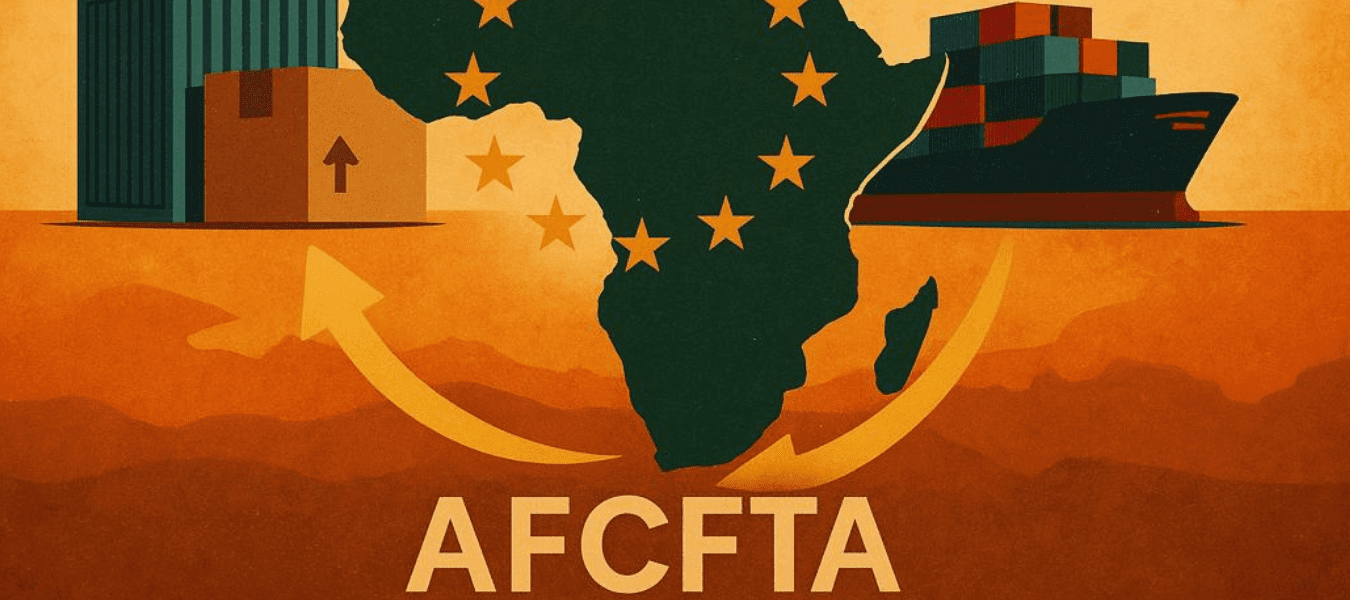
Over two decades building and scaling export operations across some of the world’s most volatile corridors, I’ve learned that the biggest money is made by moving early into markets others still see as too complicated. AfCFTA — the African Continental Free Trade Area — is exactly that kind of opportunity right now in 2026.
I still remember my first serious look at African markets back in the early 2000s. Shipping a container from the Gulf felt like solving a puzzle with half the pieces missing. Today, that puzzle has a clear picture: one unified market of 1.3 billion people and a combined GDP approaching $3.4 trillion. The tariffs on 90%+ of goods are coming down fast, digital trade protocols are live, and the Pan-African Payments and Settlement System (PAPSS) is slashing forex costs by 20-30%.
AfCFTA
This isn’t theory. Intra-African trade is projected to hit around $230 billion in 2026. For exporters and importers based in the GCC or sourcing globally, AfCFTA represents a strategic bridge to new demand centers, raw material security, and diversified supply chains.
In this comprehensive guide, I’ll walk you through exactly how to position your business to win — from understanding the power clusters to practical entry strategies, compliance pitfalls, and the tools that actually move the needle.
South Africa Export Guide: Solving Port Delays & Logistics Hurdles in 2026
Why AfCFTA Matters More in 2026 Than Ever Before
Let’s cut through the hype. Africa has always had potential. What changed is execution.
The agreement effectively creates the world’s largest free trade area by population. By eliminating or drastically reducing tariffs on the vast majority of tariff lines, it turns 54 fragmented markets into something approaching a single economic bloc. Non-LDCs get five years for phase-down; least developed countries get up to ten. Many schedules are already gazetted and operational.
Why AfCFTA Matters More in 2026 Than Ever Before
Key 2026 milestones you can actually use:
- Digital Trade Protocol is operational, harmonizing e-commerce rules, data flows, and digital payments.
- PAPSS is scaling, letting businesses settle in local currencies and avoid expensive dollar conversions.
- Rules of Origin (RoO) coverage is at ~92-97% across sectors, with automotive, textiles, and clothing negotiations largely resolved (40% African content threshold for autos in many cases).
- Guided Trade Initiative lessons are feeding into smoother national implementation.
For a Gulf-based trader like many of our Tendify users, this means reliable access to agricultural surpluses for food security, critical minerals for downstream industries, and growing consumer markets hungry for quality manufactured goods.
Strategic Deep Dive: The PAPSS Revolution
For decades, trading between two African nations often required a third-party currency—usually the USD or Euro—and a clearing bank in New York or London. In 2026, the Pan-African Payment and Settlement System (PAPSS) has effectively bypassed this bottleneck. By allowing instant, local-currency settlement, it doesn’t just cut costs; it slashes transaction times from days to minutes. For GCC-based companies with African subsidiaries, this means you can repatriate or reinvest capital within the continent without the double-conversion tax that used to bleed margins dry.
Dissecting Africa’s Power Clusters: SADC, EAC, and Beyond
Treating Africa as one country is a rookie mistake. Smart operators target clusters.
SADC (Southern African Development Community) — The Minerals Powerhouse
In 2026, the SADC region is no longer just a mining zone; it has become the central nervous system of the global energy transition. While the world focuses on the “Green Deal,” the actual physical components of that future are anchored in Angola, Zambia, Zimbabwe, South Africa, and the Democratic Republic of Congo (DRC).

SADC (Southern African Development Community)
This cluster represents a concentrated reserve of “Critical Minerals”—specifically Copper, Cobalt, Lithium, Diamonds, and Platinum Group Metals (PGMs). These are not just commodities; they are the non-negotiable building blocks of high-tech manufacturing, EV battery production, and renewable energy infrastructure.
From Extraction to Value-Addition: The Mid-Stream Shift
The real AfCFTA breakthrough in 2026 is the shift from raw exports to mid-stream processing. Under the AfCFTA framework, intra-regional trade preferences are now incentivizing the creation of “Regional Value Chains.”
The Battery Loop: Instead of shipping raw lithium from Zimbabwe and cobalt from the DRC to Asia, we are seeing the rise of processing hubs in South Africa and Zambia.
GCC Synergy: This creates a massive opening for GCC investors and tech entrepreneurs. By bringing Gulf-based chemical engineering expertise and capital to SADC-based processing facilities, you can transform raw ores into battery-grade precursors or refined cathodes. These “African-transformed” products can then move duty-free across the continent or be exported to the EU and GCC under preferential industrial statuses.
The Australia Hub: How to Access Markets with 0% Tariffs
Why SADC Matters for Your 2026 Strategy:
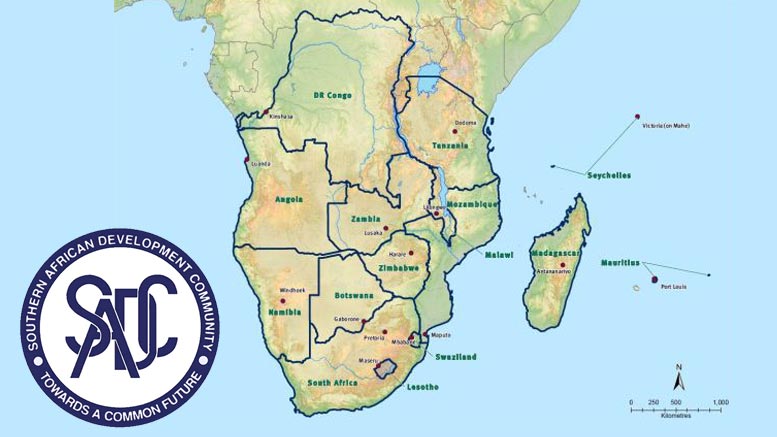
SADC
Critical Mineral Security: If your business touches EV batteries, semiconductor electronics, or industrial catalysts, SADC is your primary security hedge against global supply chain shocks.
Energy Transition Anchor: As the world moves toward 2030 climate goals, the demand for SADC’s PGMs (essential for hydrogen fuel cells) is hitting record highs.
The Lobito Corridor Advantage: Significant infrastructure investments in the Lobito Corridor (connecting the DRC and Zambia to the Atlantic via Angola) have slashed transit times for mineral exports by nearly 40%.
How Tendify Powers Your SADC Operations:
Navigating the SADC mineral landscape requires more than just a buyer’s list; it requires deep-tier transparency.
AI Market Pulse: Monitor real-time price volatility for LME-linked metals (Copper/Cobalt) to time your procurement perfectly.
Verification & Compliance: SADC trade is under intense global scrutiny (e.g., ESG and “Conflict Mineral” regulations). Use Tendify’s Verified Directory to connect with mines and processors that meet international compliance standards.
Logistics Modeling: Use our Multimodal Cost Calculators to compare routing via the Port of Durban versus the emerging Lobito Corridor to find the most cost-effective path for your industrial inputs.
Expert Insight: In 2026, the winners in SADC are those who stop acting like ‘traders’ and start acting like ‘partners in industrialization.’ By utilizing AfCFTA’s Rules of Origin to process minerals locally, you aren’t just saving on tariffs—you’re securing a seat at the table of the next industrial revolution.
EAC (East African Community) — Agriculture, Services & Digital Leap
If SADC is the continent’s “heavy industry” engine, the EAC—led by Kenya, Rwanda, Tanzania, Uganda, and Ethiopia—is its high-velocity “innovation hub.” This region has effectively bypassed legacy infrastructure to become a global leader in digital services, while simultaneously positioning itself as the primary strategic partner for Global Food Security.
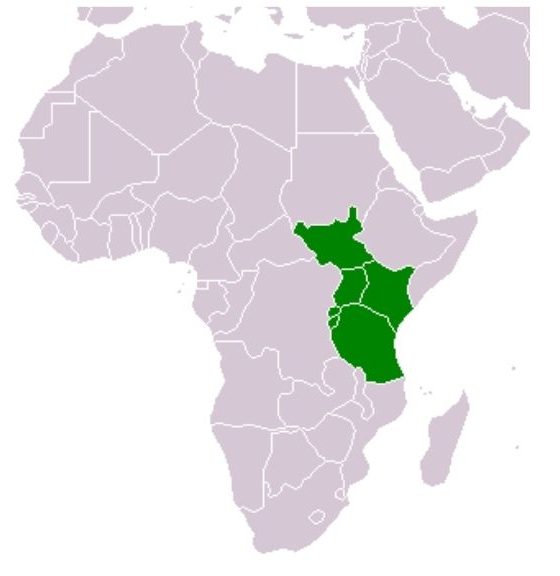
East African Community
Africa as the “Farm of the Middle East”: A 2026 Reality
The vision of Africa as the GCC’s primary food source is no longer a future projection; under AfCFTA, it is a operational reality.
The Commodity Mix: We are talking about world-class coffee, tea, horticulture, and premium fruits that meet stringent global standards.
The Logistical Edge: With the integration of the Northern and Central Corridors and the maturity of the Ethiopia-Djibouti rail link, the transit time for perishables from the East African highlands to Gulf ports has been slashed. AfCFTA’s removal of internal barriers means a single phytosanitary certificate can now move goods across multiple borders, ensuring that freshness—and margins—are preserved.
The Service & Digital Ecosystem: Beyond M-Pesa
Building on the legacy of M-Pesa, Nairobi and Kigali have evolved into “Silicon Savannahs.”
For GCC Exporters & Tech Firms: The opportunity here isn’t just in selling goods; it’s in B2B Services and Tech-Transfer. There is a massive, underserved demand for Packaging Technology, Cold-Chain Logistics solutions, and Agri-Tech platforms that can scale African production to meet international volumes.
Digital Trade: The EAC is the leading adopter of the AfCFTA Digital Trade Protocol, making it the easiest region for GCC traders to pilot digital-first supply chains.
Strategic Opportunities for Tendify Users:
Cold-Chain Integration: GCC-based logistics firms can partner with EAC producers to build “Smart Warehousing” hubs, leveraging AfCFTA preferences to distribute processed foods throughout the bloc.
The Ethiopia Factor: As a market of 120 million people, Ethiopia’s liberalization in 2026 has opened the door for GCC petrochemicals (fertilizers/plastics) to fuel their massive agricultural expansion.
How Tendify Bridges the EAC-GCC Gap:
The EAC market moves fast, and information asymmetry can be costly. Tendify provides the digital rails to navigate this:
Verified Agri-Directories: Connect directly with certified growers and exporters in Kenya and Tanzania who are “Export-Ready” for the Middle Eastern market.
HS Code & Tariff Engineering: Use our tools to navigate the EAC’s Common External Tariff (CET) versus AfCFTA preferential rates to ensure your “Total Landed Cost” is always competitive.
AI-Market Pulse: Track seasonal demand shifts in Nairobi or Kigali to time your machinery and industrial input shipments for maximum impact.
Expert Insight: “In the EAC, the real ‘Gold’ isn’t just the coffee or the flowers—it’s the data. The traders winning in 2026 are those using digital platforms to integrate their supply chains from a farm in the Rift Valley directly to a supermarket shelf in Riyadh. It’s about creating a seamless ‘Farm-to-Fork’ digital corridor.
Other Strategic Hubs:
While the SADC and EAC dominate the minerals and agri-tech sectors, the Western and Northern axes of the continent provide the critical “Industrial Anchors” and “Consumer Mass” that make AfCFTA a global heavyweight.
1. ECOWAS (West Africa): The Giant of the Atlantic
West Africa is defined by the sheer scale of Nigeria, alongside the rising economic stability of Ghana and Ivory Coast.
ECOWAS (West Africa)
The Consumer Engine: Nigeria isn’t just a market; it’s a demographic powerhouse. In 2026, its burgeoning middle class is driving a massive demand for processed goods, high-end electronics, and refined petrochemicals.
Commodity Powerhouses: Ivory Coast and Ghana remain the global heart of cocoa, but under AfCFTA, the focus has shifted to Internal Value Addition. We are seeing a boom in local manufacturing and oil refining (anchored by the Dangote Refinery’s impact), creating a huge demand for GCC-sourced industrial machinery and technical expertise.
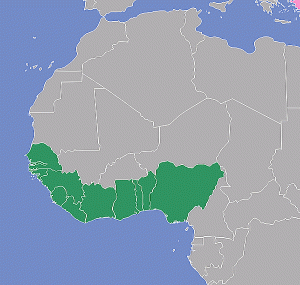
Economic Community of West African States
The Opportunity: For Tendify users, ECOWAS is the destination for high-volume exports of plastics, packaging materials, and construction inputs required for their “New City” infrastructure projects.
2. The Northern Corridor: The Mediterranean Bridge
Egypt and Morocco are the sophisticated “Industrial Gateways” of the AfCFTA. They represent the most successful models of integrating African production with EU and MENA supply chains.
Automotive & Aerospace: Morocco has established itself as a world-class automotive hub, while Egypt is the regional leader in industrial manufacturing and textiles. Under AfCFTA 2026, these nations act as the “Entry Points” for goods moving from the Mediterranean into the African interior duty-free.
The Strategic Linkage: If you are a trader operating in the Poland-GCC-Africa triangle, Morocco and Egypt are your logical hubs for “Triangular Manufacturing”—where European tech, Gulf capital, and African labor combine to produce goods for the entire continent.
Energy Hubs: Both nations are leading the charge in Green Hydrogen and solar energy, offering massive opportunities for GCC energy firms to partner on the continent’s first “Decarbonized Industrial Zones.”
Understanding these clusters lets you build targeted strategies instead of spraying efforts across the continent.
Understanding MENA, GCC, and Arab Countries: Key Regional Differences for Global Trade
The GCC-Africa Axis: Where the Real Synergies Live
In 2026, the trade route between the GCC and Africa is no longer just a “pathway”—it is a Strategic Power Corridor. This is where the real excitement begins for Tendify users. We are witnessing a perfect economic marriage: the GCC’s capital and industrial surplus meeting Africa’s vast resources and growing demand.

The GCC-Africa Axis
1. Food Security: The New Supply Chain Reality
GCC nations are moving aggressively to diversify their food sources. Under AfCFTA, East and Southern Africa have become the primary “breadbaskets” for the Gulf.
The Advantage: Trade in grains, horticulture, and livestock is now facilitated by integrated corridors, bypassing the traditional, high-cost suppliers from the West.
The Outcome: For Gulf-based importers, this means lower landed costs and a much more resilient supply chain against global geopolitical shocks.
2. Industrial Inputs & The Petrochemical Play
Africa’s massive infrastructure boom is hungry for what the Gulf (and Iran) produces best.
The Demand: Polymers, fertilizers, bitumen, and construction machinery are the “fuel” for Africa’s industrialization.
Predictable Pricing: AfCFTA’s porous borders mean that as these essential inputs move deeper into the continent, the pricing becomes more stable and predictable.
The Revenue Stream: For traders, the goal in 2026 is securing long-term supply contracts with African Industrial Zones. This isn’t just a sale; it’s a stable, multi-year revenue stream.
3. Investment Flows: Moving Beyond Trade
GCC capital is no longer just “buying and selling”; it is investing in the infrastructure.
Equity Stakes: AfCFTA makes taking equity in African processing facilities or logistics hubs highly attractive. Why? Because a factory in Ethiopia or a warehouse in Tanzania can now serve a unified market of 1.3 billion people duty-free.
Triangular Trade: We are seeing the rise of a powerful model: Gulf Financing/Tech + African Production + Global Market Access.
4. The Logistics Bridge: Triangular Mastery
Ports like Jebel Ali and DP World’s expanding network across African coasts (from Berbera to Dakar) have created a seamless bridge. These facilities act as natural hubs for triangular trade, where the GCC acts as the control center for goods moving from the African interior to the rest of the world.
I’ve seen firsthand how one well-structured deal in this axis can outperform multiple traditional routes. The “why” is simple: complementary economies plus falling trade frictions equal higher margins and lower risk through diversification.
CARICOM Trade Guide: How to Profit in the Caribbean Single Market
Real Challenges (And How Experienced Traders Overcome Them)
No serious operator ignores the hurdles. Here’s the unvarnished truth and actionable fixes:
Efficient trade in Africa is no longer about just “finding a port”; it is about choosing the right Integrated Trade Corridor. These are the digital and physical arteries that define your speed-to-market and your final landed cost. Here are the three most critical corridors currently transforming AfCFTA logistics:
1. The Northern Corridor: The East African High-Speed Gate
Connecting the Port of Mombasa (Kenya) to the landlocked markets of Uganda, Rwanda, South Sudan, and eastern DRC.
The Edge: This is the most technologically advanced corridor in the region. With the full implementation of the Single Customs Territory, goods cleared at Mombasa move through multiple borders with a single digital declaration.
Best For: High-value tech, consumer electronics, pharmaceuticals, and FMCG. If you are targeting the “Silicon Savannah” tech hubs, this is your primary route.
2. The Walvis Bay Corridor: The Atlantic Mineral Express
A fast-growing multimodal route connecting the Port of Walvis Bay (Namibia) into the SADC heartland (Zambia, Zimbabwe, and Botswana).
The Edge: While the traditional route via Durban often faces congestion, Walvis Bay offers a high-efficiency Atlantic alternative. It has become the “Green Corridor” for mineral logistics.
Best For: Mining equipment, industrial machinery, and the export of critical minerals (Copper/Lithium) back to global markets. It is the gold standard for Heavy-Lift and industrial logistics.
3. The Ethiopia-Djibouti Link: The Landlocked Power-Play
The modernized standard-gauge rail connecting the Port of Djibouti to the heart of Addis Ababa.
The Edge: This is the gold standard for how rail-infrastructure can revitalize a landlocked manufacturing giant. Transit times that used to take days by truck are now reduced to under 12 hours by rail.
Best For: Bulk commodities, textile exports, and heavy industrial inputs like fertilizers and bitumen. As Ethiopia continues its 2026 industrial expansion, this link is the lifeblood for any GCC trader looking at a 120-million-strong consumer base.
Rules of Origin Compliance
This is the make-or-break. You need genuine African transformation for preferences. Start with sectors where RoO are clear (many agricultural and basic manufactured goods). Document everything meticulously — origin certificates are non-negotiable.
The ‘Transformation’ Secret:
Compliance isn’t just about the stamp on the paper; it’s about the ‘Value-Added’ threshold. Under AfCFTA 2026 protocols, most manufactured goods require a minimum of 35-40% local content or a ‘Change in Tariff Heading’ (CTH) to qualify for zero-duty movement. This is a massive opportunity for GCC manufacturers to set up ‘Last-Mile’ assembly plants in hubs like Egypt or Kenya, effectively turning their exports into ‘African Goods’ for duty-free distribution across the remaining 53 nations.
Currency & Payment Risks
PAPSS is a game-changer here, reducing reliance on USD and cutting conversion costs. Still, layer in escrow services or platform trust accounts for larger deals. I always structure payments with milestones tied to verifiable delivery points.
Non-Tariff Barriers & Standards
Varying national regulations, SPS measures, and bureaucracy. Use the African Trade Observatory and national step-by-step guides now available in several countries. ARSO (African Organisation for Standardisation) harmonization is progressing — align early.
Political & Security Variability
Do deep due diligence per country. Start small, build relationships, and use verified directories. Never skip war-risk clauses or force majeure where relevant.
The difference between those who lose money and those who build lasting businesses? Systems. Document your processes, map workflows, and treat compliance as a competitive advantage.
Money Laundering or Terrorist Financing? The Ultimate Breakdown to Strengthen Your AML/CFT Program
Your Step-by-Step AfCFTA Entry Playbook for 2026
- Market Intelligence First Identify your cluster and product fit. Use HS Code tools to check tariff offers. Analyze demand via trade data portals.
- Compliance Setup Register for AfCFTA preferences where available. Secure necessary certificates of origin. Understand Rules of Origin for your category.
- Partner & Network Verified suppliers/buyers are gold. Platforms with real vetting cut through noise. Attend key exhibitions (many GCC-Africa focused calendars are live).
- Logistics & Finance Modeling Calculate full costs including any remaining duties, transport, insurance. Model scenarios with and without preferences. Secure trade finance that understands emerging corridors.
- Pilot, Learn, Scale Start with one corridor or product. Measure everything. Adjust. The operators winning big in 2026 are those iterating fastest.
- Leverage Technology Real-time market pulse, predictive analytics for prices, digital document builders, and compliance checkers separate professionals from amateurs.
How Tendify’s Tools Give You the Edge in AfCFTA Trade
In a market this complex, having the right operating system isn’t optional — it’s your unfair advantage.
Head over to Platform.Tendify.Net and explore the command center. You’ll find AI Market Pulse for sentiment and trend forecasting (critical for volatile commodities like cobalt or coffee), Sanctions & Compliance tools, advanced calculators for duties and costs, document builders for proformas and contracts, and a growing network of verified partners across key African hubs.
Whether you’re sourcing minerals, exporting machinery, optimizing container loads for African ports, or managing cross-border payments, these engines are built for exactly this kind of high-stakes, high-opportunity environment. Many users are already running GCC-Africa flows through the platform and cutting friction dramatically.
Strategic FAQ: What Experienced Traders Ask
Does AfCFTA automatically give preferential access to non-African exporters? Not directly. Benefits accrue primarily to qualifying African-origin goods. However, as a foreign exporter, you gain from larger, more efficient African markets, easier regional distribution from a manufacturing base inside the bloc, and overall lower barriers for your African partners.
Best entry country in 2026? It depends on your sector. Kenya or Rwanda for East Africa/services, Morocco/Egypt for North/industrial, South Africa or Nigeria as large anchors. Many start with countries that have gazetted schedules and strong infrastructure.
How important are Rules of Origin really? Critical. Without meeting them, you don’t get the tariff preferences that make the economics work. Invest in proper origin verification from day one.
What about currency risks? PAPSS helps enormously for intra-African legs. For GCC-Africa, smart hedging and multi-currency structuring remain key.
How do I handle the ‘Last Mile’ in Africa without being there? This is where technology bridges the gap. You don’t need a physical office in 54 countries. Use digital platforms to connect with ‘Verified Freight Forwarders’ who specialize in specific AfCFTA corridors. Always insist on real-time tracking and use escrow-based payments where the final release of funds is tied to the successful POD (Proof of Delivery) at the inland terminal.
The Bottom Line: Act Decisively in 2026
AfCFTA isn’t a future promise — it’s delivering measurable progress right now. Intra-trade is growing, digital rails are live, and the window for early positioning is open.
The traders who will dominate the next decade aren’t waiting for perfect conditions. They’re building systems, forging partnerships, and using technology to navigate complexity while others hesitate.
Your next move? Don’t just read about it. Map your first opportunity, run the numbers on Platform.Tendify.Net, and start a conversation with verified partners who are already active in these corridors.
The market rewards those who move with informed confidence.
Ready to turn AfCFTA insight into profitable action? Join Tendify today — list your products, post RFQs, access the full suite of trade engines, and connect directly with the network that’s making these opportunities real. Your African (and global) growth story starts here.

