Blog
Pakistani Ports vs Jebel Ali: The 2026 Trade Shift
Over two decades building and scaling export operations across some of the world’s most volatile corridors, I’ve learned one hard truth: no single port or route is forever. Markets shift, geopolitics bite, and the traders who survive are the ones who build redundancy before the crisis hits.
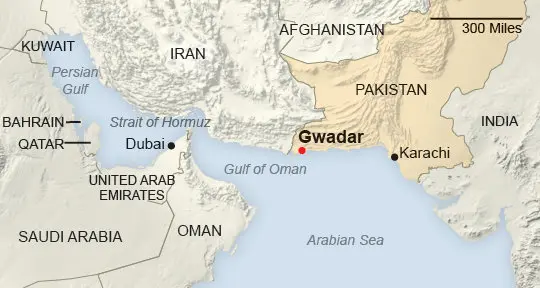
Right now, in 2026, we’re watching one of those historic pivots unfold. With tensions disrupting traditional Gulf shipping lanes, Pakistan has activated six overland transit corridors for third-country goods heading to Iran. Ports like Gwadar, Karachi, and Port Qasim are stepping up as practical alternatives to the long-dominant Jebel Ali hub in the UAE.
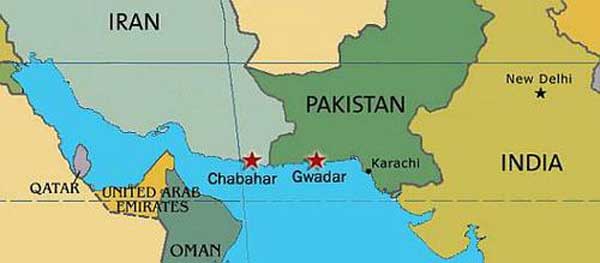
Chabahar and Gwadar port
This isn’t just temporary rerouting of a few containers. It’s a structural response to real vulnerabilities: chokepoints in the Strait of Hormuz, sanctions exposure, and the risks of over-reliance on any one logistics gateway. For exporters, importers, and trade businesses operating in the Middle East, South Asia, and beyond, understanding this shift isn’t optional—it’s essential for protecting margins and staying operational.
In this comprehensive guide, I’ll break down why this change is happening now, compare the practical realities of Pakistani routes versus Jebel Ali, map the key corridors, address the operational challenges head-on, and show you exactly how to adapt your supply chain. No fluff—just actionable insights from someone who’s moved millions in cargo through similar uncertain times.
Why the Transit Paradigm Is Shifting Now
For decades, Jebel Ali served as the undisputed re-export and transshipment gravity center for trade involving Iran and the broader Middle East. Its world-class infrastructure and seamless business environment made it the gold standard for efficiency. However, 2026 has taught the global trade community a brutal lesson: Efficiency without redundancy is a trap. When single points of failure are stressed by geopolitical friction, “efficient” routes quickly become “extortionate” bottlenecks.
The recent disruptions in the Strait of Hormuz—exacerbated by heightened naval tensions and strategic blockades—have done more than just delay cargo; they have fundamentally broken the traditional maritime trust model. With thousands of containers stranded and maritime insurance premiums (War Risk Surcharges) skyrocketing to unsustainable levels, the industry hit a breaking point. At one stage, over 3,000 Iran-bound containers were bottlenecked at Pakistani ports, creating a logistics emergency that required more than just a temporary fix.
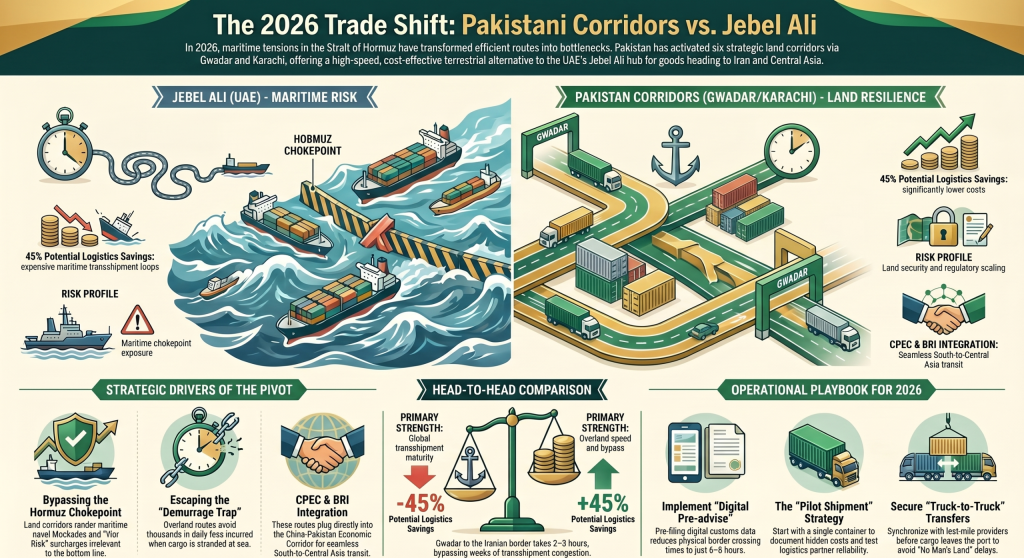
Pakistani Ports vs Jebel Ali The 2026 Trade Shift
Pakistan’s Ministry of Commerce stepped into this vacuum with a decisive, policy-level intervention: The Transit of Goods through Territory of Pakistan Order 2026. Effective immediately from late April, this isn’t just a minor administrative easing—it is a strategic pivot that formally integrates Pakistani road networks into the global supply chain for third-country goods heading to Iranian border crossings at Gabd and Taftan.
The Three Strategic Drivers of the Pivot:
Geopolitical Risk Mitigation (Beyond the Strait): Over-dependence on a narrow maritime chokepoint like the Strait of Hormuz has moved from a “calculated risk” to an “unacceptable exposure.” By activating land corridors, traders are effectively bypassing contested waters, rendering naval blockades and maritime “War Risk” surcharges irrelevant to their bottom line.
The “Demurrage Trap” & Time Sensitivity: Stranded cargo isn’t just sitting still; it’s hemorrhaging money through demurrage, detention fees, and lost market windows. Overland options from Pakistani ports (Gwadar and Karachi) are no longer just “Plan B”—they are becoming “Plan A” for time-sensitive cargo. In certain scenarios, moving goods from Gwadar to the Iranian border can save weeks compared to waiting for a transshipment slot in a congested Gulf hub.
The Diversification & BRI Imperative: Smart traders are no longer building supply chains; they are building Supply Grids. This move positions Pakistan as a resilient terrestrial gateway. By linking South Asian ports directly to Iranian borders, this corridor plugs into the broader China-Pakistan Economic Corridor (CPEC) and the Belt and Road Initiative (BRI), offering a seamless land-bridge that connects the Arabian Sea to Central Asia and beyond.
The Professional Edge: “In 2026, the question is no longer ‘How cheap is the route?’ but ‘How certain is the arrival?’ Pakistan’s new transit framework provides that certainty by offering a high-capacity land alternative that the maritime sector simply cannot guarantee right now.
I’ve seen this pattern before: when one door closes due to politics or conflict, the survivors quickly open windows. Those who move first capture the advantage.
Broken Ceasefires, Billion-Dollar Losses: The True Economic Cost of Iran-Arab Tensions
Jebel Ali vs. Pakistani Ports: A Head-to-Head Comparison
Let’s cut through the hype and look at the numbers and realities that matter for your P&L.
Jebel Ali Strengths (Still Formidable):
- World-class infrastructure with massive capacity for containers, bulk, and specialized cargo.
- Established re-export ecosystem, mature financial services, and seamless integration with global shipping lines.
- Reliable for high-volume, time-sensitive shipments where sea connectivity to global markets is paramount.
- Strong compliance and documentation frameworks that many traders already know inside out.
Pakistani Ports & Corridors Advantages (The Emerging Edge):
- Proximity for Overland: Gwadar to Gabd can take just 2-3 hours to the Iranian border—dramatically faster than sea-plus-transshipment loops in some scenarios.
- Cost Savings Potential: Reports indicate up to 45-55% lower logistics costs on certain Gwadar-linked routes compared to traditional alternatives, thanks to reduced transshipment and shorter final legs.
- Risk Diversification: Bypassing Hormuz reduces exposure to naval disruptions, insurance spikes (which have tripled in affected areas), and related delays.
- Policy Support: The new transit order provides a regulated framework under Customs Act 1969, with designated routes and procedures for third-country goods.
Practical Trade-offs:
- Infrastructure maturity: Jebel Ali wins on scale and polish; Pakistani ports are scaling rapidly via CPEC investments but may involve more coordination on the land side.
- Security and predictability: Balochistan routes require careful partner selection and risk assessment.
- Volume handling: Best suited for targeted diversions or growing corridors rather than replacing all Jebel Ali traffic overnight.
Here’s a quick comparison table for key decision factors:
| Factor | Jebel Ali (UAE) | Pakistan Corridors (Gwadar/Karachi) |
|---|---|---|
| Primary Strength | Global transshipment hub | Overland speed & bypass |
| Transit Time (to Iran) | Sea-dependent, variable | Hours via Gwadar-Gabd |
| Cost Sensitivity | Higher with disruptions | Potentially 45%+ savings |
| Risk Profile | Maritime chokepoint exposure | Land security + regulatory |
| Best For | High-volume re-exports | Diversified, urgent, or sanctioned-sensitive cargo |
| Maturity | Extremely high | Rapidly developing |
The 6 Key Transit Routes and Broader Corridor Strategy
In 2026, navigating the Pakistan-Iran corridor isn’t just about moving goods; it’s about selecting the right artery for your specific supply chain needs. Pakistan has formally designated six structured routes that transform its coastline into a direct launchpad for the Iranian market and beyond:
- Gwadar–Gabd (The “Sprinting” Route): As the fastest short-haul option, this route is the crown jewel of the new transit order. It offers the most direct link from the deep-sea Port of Gwadar to the Iranian border, making it ideal for high-priority, time-sensitive cargo.

Gwadar Port
- Karachi/Port Qasim–Lyari–Ormara–Pasni–Gabd: A robust coastal alternative that leverages the established infrastructure of Karachi’s main ports while maintaining a relatively fast transit to the Gabd crossing.

Port of Pasni
- Karachi/Port Qasim–Khuzdar–Dalbandin–Taftan (The “Central Backbone”): This route targets the Taftan border crossing—the historical and highest-capacity gateway between the two nations. It is designed for heavy-volume bulk and industrial shipments.

Port Muhammad Bin Qasim
- The Extended Gwadar-Taftan Network (via Turbat/Quetta): By linking Gwadar to the Taftan crossing through Quetta, this route offers a deeper penetration into the Pakistani interior, providing flexibility for cargo that might need consolidation or temporary warehousing.
Ports of Pakistan
- Gwadar-Lyari Variants & Multi-Port Combinations: These routes provide the necessary redundancy. If one segment faces maintenance or congestion, these variants ensure the flow remains uninterrupted—a critical feature for 2026’s “Just-in-Case” logistics mindset.

Port of Jiwani
The Broader Strategic Framework: Beyond the Border
These routes are not isolated roads; they are the missing links in a much larger global trade puzzle:
The CPEC Integration: These corridors effectively plug the Iranian market into the China-Pakistan Economic Corridor (CPEC). For traders, this means a seamless land-bridge for Chinese manufactured goods to enter Iran and Central Asia without ever touching contested maritime chokepoints.
INSTC Synergies: By connecting the Arabian Sea to the International North-South Transport Corridor (INSTC), these routes facilitate a high-efficiency flow between India, Russia, and Europe, positioning Iran and Pakistan as the dual-core intermediaries of East-West trade.
What This Means for the Modern Trader:
Reduced Maritime Dependency: You are no longer at the mercy of naval tensions in the Strait of Hormuz.
Sourcing Fluidity: New options for sourcing from South Asia and the Far East with predictable overland delivery timelines.
The Intermediary Advantage: Pakistani and Iranian businesses can now evolve into “Logistics Powerhouses,” managing the flow of goods across a newly unified terrestrial market.
Tendify Strategic Note: “Understanding these six routes is the first step. The next is knowing which one matches your cargo’s ‘DNA’—from weight limits to security requirements. In 2026, the route you choose is as important as the product you sell.
Green Gold, Grey Money: The Hidden Side of the Avocado Trade
Real Talk: Operational Challenges and How to Overcome Them
In two decades of logistics, I’ve never seen a major trade pivot that didn’t come with its share of “growing pains.” Moving from the polished, automated docks of Jebel Ali to the rugged, developing overland corridors of Pakistan is a shift that requires a Tactical Mindset.

Port of Ormara
Here is the unvarnished truth about the hurdles you will face in 2026, and more importantly, the exact mitigation steps to stay ahead of the curve:
1. Border Congestion & Infrastructure Readiness
The Mirjaveh/Taftan and Gabd crossings are currently witnessing a massive surge in volume. While the policy is live, the physical infrastructure (warehousing, scanning, and paved lanes) is still scaling to meet 2026 demands.
The Mitigation: Don’t go it alone. Work exclusively with freight forwarders who possess “Green Channel” status and established local relationships. These partners can often navigate the “administrative gravity” of a busy border faster than a standard operator.
2. Security in High-Vigilance Zones
Transit through certain segments of the Balochistan province requires a sophisticated approach to risk management. It is not just about the cargo; it’s about the Predictability of the Journey.
The Mitigation: Vet your partners to the highest degree. Use only GPS-tracked, insured convoys and prioritize carriers that have a proven “safe-passage” history. In 2026, real-time visibility isn’t a luxury—it’s your primary security layer.
3. Customs & Banking Synchronicity
The biggest bottleneck is often not the road, but the paperwork. Harmonizing Pakistani customs procedures with Iranian requirements—and managing the banking flows between them—can be complex.
The Mitigation: Leverage Digital Document Builders (like those on Tendify) to ensure your pre-clearance paperwork is 100% compliant before the truck even leaves the port. Digital pre-advise is the only way to avoid multi-day delays at the crossing.
4. Insurance Gap & Sanctions Nuances
Traditional maritime insurance may not cover the specific “Overland Transit” risks in these new corridors. Furthermore, third-country goods require meticulous origin-tracking to avoid compliance red-flags.
The Mitigation: Consult with specialized trade insurers to ensure your policy specifically covers “Territorial Transit” via Pakistan. Use compliance engines to verify that every node in your supply chain remains within the legal guardrails of your specific jurisdiction.
5. Last-Mile Integration into Iran
A seamless handoff at the border is where most deals succeed or fail. The transition from Pakistani fleet to Iranian distribution networks must be synchronized to avoid cargo sitting in “No Man’s Land.”
The Mitigation: Plan your logistics “Backwards.” Secure your Iranian last-mile provider before you ship the goods from Karachi or Gwadar. A synchronized “Truck-to-Truck” transfer at the border is the gold standard for 2026 operations.
Actionable Tip: The “Pilot Shipment” Strategy
The difference between those who lose money and those who build empires in new markets is Systems.
Don’t bet the farm on Day 1. Start with a pilot shipment—a single container—using a trusted logistics partner. Document every delay, every document required, and every “hidden cost.” Use this data to build your internal “AfCFTA/Pakistan Playbook.” As these routes mature and volumes grow, your pre-tested system will be your greatest competitive advantage.
Pakistani Ports
Case Study: Navigating the “Hormuz Bottleneck”
Client Profile: A mid-sized industrial polymers distributor based in the GCC, supplying high-grade resins to manufacturing plants in Central Iran.
The Challenge (The “Status Quo” Failure)
In early 2026, the client had 45 containers of specialty polymers sourced from Southeast Asia. Traditionally, these would be transshipped via Jebel Ali (UAE) and sent by feeder vessel to Bandar Abbas.
The Problem: Increased naval activity in the Strait of Hormuz led to a sudden “War Risk” surcharge of $2,800 per container.
The Crisis: The feeder vessel was denied entry for 14 days due to a regional blockade, leading to massive demurrage fees and a complete production halt at the client’s factory in Iran.
Total Projected Loss: Over $180,000 in fines, insurance spikes, and lost production time.
The Execution
Arrival at Gwadar: The containers were offloaded and cleared for transit within 36 hours.
The Overland Leg: A convoy of GPS-tracked trucks moved the cargo from Gwadar to the Iranian border at Gabd. The border crossing took only 5 hours due to pre-filed digital customs data.
Last-Mile: The cargo was synchronized with an Iranian fleet at the border and reached the factory in Central Iran 12 days faster than the projected maritime route.

Gadani Harbour & Ship Breaking Yard
The Results (By the Numbers)
| Metric | Traditional Route (Jebel Ali) | New Frontier (Gwadar-Gabd) |
| Transit Time | 24+ Days (Delayed) | 9 Days (Total from Port) |
| Insurance Surcharge | High (War Risk) | Standard (Land Transit) |
| Logistics Cost | $14,500 / Container | $8,200 / Container |
| Outcome | Factory Shutdown | Production Maintained |
By diversifying their route and leveraging Pakistani transit corridors, the client didn’t just save 43% in logistics costs; they saved their reputation and their production line. This case study proves that in 2026, resilience is the new efficiency.
How Tendify Helps You Navigate the New Reality
At Platform.Tendify.Net, we built our Command Center precisely for moments like this—when trade lanes shift and you need fast, reliable intelligence and tools.
Our suite includes:
- Trade Route Optimizers and cost calculators to model Pakistani corridors versus traditional Gulf paths side-by-side.
- AI Market Pulse for real-time sentiment and disruption alerts.
- Document Builders like Proforma Invoice and Export Checklist generators tailored for new transit requirements.
- HS Code Finder, tariff tools, and compliance checkers to keep you on the right side of regulations.
- Verified Logistics Partners directory— we’re actively expanding Pakistani and regional forwarders to support these emerging lanes.
- Risk Assessment engines powered by AI to evaluate corridor stability.
Whether you’re comparing duties, optimizing container loads with our 3D tool, or generating contracts, the platform turns complexity into executable plans. Head over to Platform.Tendify.Net and see how it streamlines your operations in this evolving landscape.
Building Resilience: Your 2026 Trade Playbook
- Diversify Routes: Never put all cargo through one hub. Allocate percentages across sea, land, and hybrid options.
- Strengthen Partnerships: Cultivate relationships with forwarders strong in both UAE and Pakistan corridors.
- Leverage Technology: Use dashboards for visibility across multi-modal journeys.
- Stay Informed: Monitor policy updates—transit orders can evolve quickly.
- Focus on Compliance: In uncertain times, clean documentation is your best defense.
Traders who treat logistics as a strategic asset—not just an expense—will thrive. Those waiting for “normal” to return may find themselves sidelined.

Keti Bander Port
Strategic FAQ: Navigating the Pakistan-Iran Transit Corridor
1. Does the new transit order allow for all types of goods?
The Transit of Goods through Territory of Pakistan Order 2026 broadly covers third-country goods. However, certain “negative list” items or highly regulated commodities may require specific NOCs (No Objection Certificates). Always use Tendify’s Compliance Checker to verify your specific HS Code against the latest 2026 regulatory updates before dispatching cargo.
2. How do logistics costs via Pakistan compare to Jebel Ali?
While Jebel Ali offers massive economies of scale, the current “War Risk” surcharges and maritime delays in the Gulf have flipped the script. Many traders are seeing a 40-50% reduction in total logistics costs by using overland routes from Gwadar or Karachi, primarily due to the elimination of expensive transshipment loops and maritime insurance spikes.
3. Is the route through Balochistan secure for high-value cargo?
Security is a top priority for the 2026 corridors. The Pakistani government has designated specific “Structured Routes” with enhanced monitoring. We recommend using only GPS-tracked, insured convoys and working with vetted partners from the Tendify Verified Directory who have a proven track record of safe passage in these specific segments.
4. Can I use the Pan-African Payments and Settlement System (PAPSS) here?
No. PAPSS is exclusive to the AfCFTA region. For the Pakistan-Iran-GCC axis, traders typically use multi-currency structuring or specialized trade finance vehicles. Tendify provides tools to help you model these financial flows and ensure your payment milestones are tied to verifiable digital tracking.
5. How long does the actual border crossing take?
Under the new 2026 protocols, if your documentation is pre-filed digitally, the physical crossing at Taftan or Gabd can take as little as 5 to 8 hours. Delays usually occur due to paperwork errors. Using a Digital Document Builder to harmonize your Pakistani and Iranian customs filings is the most effective way to ensure a same-day crossing.
6. Is this a temporary solution or a long-term shift?
While triggered by maritime tensions, this is a structural pivot. The integration with CPEC and the INSTC means that these land corridors are being built for the next decade of trade. Even if maritime tensions ease, the redundancy and speed offered by Pakistani ports have now established them as a permanent fixture in the regional supply chain.
The Bigger Picture: Opportunity in Disruption
This transit shift underscores a larger truth I’ve lived through multiple cycles: volatility creates winners. Pakistan’s move not only helps clear backlogs but positions the country as a more prominent player in regional connectivity, linking CPEC ambitions with Iranian and Central Asian networks.
For your business, it means fresh sourcing options, alternative market access, and the chance to lower costs while reducing risks. The businesses that integrate these routes thoughtfully will gain a competitive edge in 2026 and beyond.
I’ve built my career by staying one step ahead of these changes. You can too.
Ready to future-proof your trade operations? Sign up free at Platform.Tendify.Net today. Explore our full suite of AI engines, calculators, and trade tools designed for exactly these dynamic global conditions. Your next resilient supply chain starts here.