المدونة
Saudi vs. UAE: The 2026 Economic Tug-of-War and Its Impact on GCC Trade

I’ve been knee-deep in international trade for over two decades, watching Gulf economies evolve from oil-dependent giants into diversified powerhouses. But nothing has kept me up at night quite like the brewing Saudi vs. UAE economic rivalry.
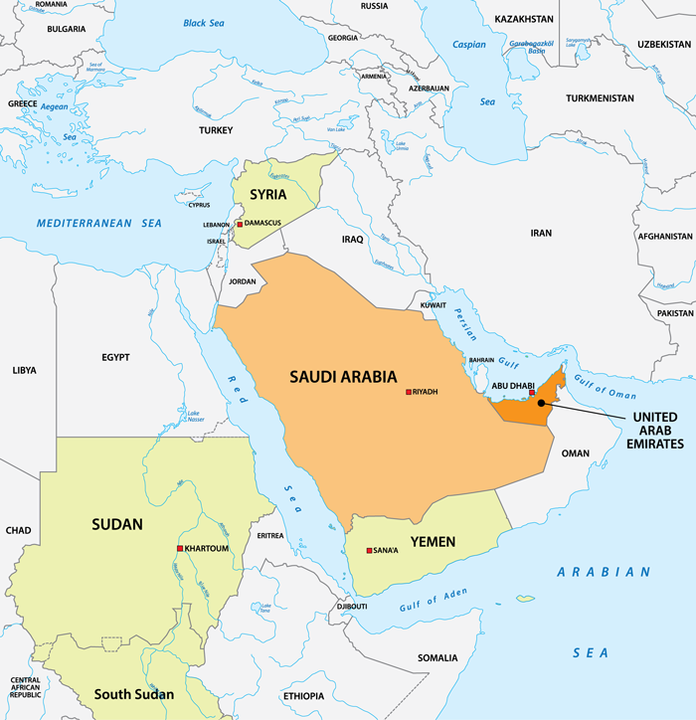
Saudi vs. UAE
It’s not just geopolitical posturing—it’s a full-blown economic tug-of-war that’s reshaping GCC trade flows, hitting merchants right where it hurts: their bottom lines. Picture this: a trader in Dubai wakes up to new tariffs on goods once duty-free, or a logistics firm in Riyadh scrambles as ports compete for the same cargo. As we head into 2026, this competition could add billions in costs or unlock new opportunities, depending on your strategy.
The State of Intra-GCC Trade: A Stark Reality
Statistics paint a stark picture. GCC non-oil trade has surged 15% annually since 2020 (per ICAEW), but intra-GCC friction threatens to slow that to single digits by 2027.
Saudi Arabia and the UAE, accounting for over 70% of the bloc’s GDP, are driving this shift with aggressive policies on:
- Regional Headquarters (RHQ) mandates
- Rules of Origin (RoO) overhauls
- Port and aviation expansion
- Foreign Direct Investment (FDI) competition
For merchants, it’s about survival—adapting to higher duties, rerouting supply chains, or pivoting to new markets. With $1.5 trillion in projected GCC investments by 2030, the stakes are sky-high.
Free AI CRM: Transform Your Business Without Spending a Dime
The Roots of the Rivalry: From Allies to “Frenemies”
Saudi Arabia and the UAE have long been pillars of the GCC. However, as oil’s dominance wanes, their visions diverge:
- Saudi Arabia’s Vision 2030: Focuses on domestic self-reliance and industrialization.
- UAE’s “We the UAE 2031”: Emphasizes global connectivity and maintaining its hub status.
What started as subtle jabs in the 2010s escalated in 2025 into an open economic tug-of-war impacting GCC trade. Intra-GCC trade, valued at $150 billion in 2024, faces fragmentation. Merchants now grapple with barriers that erode profits by 5-10% in affected sectors.
Exporting EPC Technical and Engineering Services to Basra Reconstruction Projects
Shipping Goods from UAE Ports to Riyadh via GCC Land Transport-Logistics Challenges
Historical Context: Competitive Shared Goals
The GCC (est. 1981) was built for unity, but economic disparities bred competition.
- المملكة العربية السعودية: Leverages its vast population and resources for regional dominance.
- الإمارات العربية المتحدة: Built nimble free zones that historically siphoned regional business.
- Post-COVID Shift: Saudi’s $27 billion tourism push now directly clashes with the UAE’s established attractions.
RHQ Policies: The Battle for Regional Headquarters
At the heart of the Saudi Arabia UAE rivalry هو Regional Headquarters (RHQ) battle.

Saudi Arabia and the United Arab Emirates
Saudi Arabia’s RHQ Mandate: The Stick and the Carrot
Effective 2024, Saudi Arabia bars firms without Riyadh HQs from state contracts worth trillions.
- Incentives: 30-year tax exemptions on corporate income.
- Impact: By late 2025, tech giants like Google and Siemens shifted, injecting $50 billion into the Saudi economy.
- The Cost: This fragments supply chains, adding 3-5% to operational expenses for cross-border traders.
UAE’s Strategic Counterplay
The UAE fought back in 2025 by slashing corporate taxes to 0% for qualifying free zone activities and offering Golden Visas.
أسبكت | Saudi Arabia (Riyadh) | UAE (Dubai/Abu Dhabi) |
|---|---|---|
Tax Exemption | 30 years on CIT & withholding | 0% in free zones for exports |
Visa Perks | Expedited for execs | Golden visas up to 10 years |
Contract Access | Priority for $1T+ Vision 2030 | Global trade focus, no mandates |
Setup Cost | $5-10M initial | $2-5M, faster approval |
Local Hiring | High hiring quotas | Flexible, expat-friendly |
Rules of Origin Overhaul: The Tariff Trap
In 2021, Saudi Arabia changed its Rules of Origin (RoO), a move that intensified in 2025.
The Rule: Saudi now treats UAE free zone products as “foreign,” stripping them of duty-free status.
The Threshold: Goods need 40% GCC value-add outside free zones to qualify for preferential treatment.
Direct Hit: Textiles from Jebel Ali (JAFZA) now face 12% duties in Saudi, up from zero. This could cost traders $5 billion in tariffs by 2026.
Ports and Logistics: Jebel Ali vs. King Abdullah Port
The 2026 economic tug-of-war extends to the seas.
Jebel Ali (UAE): Handled 15 million TEUs in 2024; remains the gold standard for efficiency.
King Abdullah Port (Saudi): Aiming for 10 million TEUs by 2030 with $10 billion in Red Sea investments.
The Shift: Saudi offers 50% fee cuts for transshipments, successfully luring 15% of Jebel Ali’s previous volume.
Aviation and Tourism: Riyadh Air vs. Emirates
Aviation embodies the rivalry’s scale. Riyadh Air (launching 2025/2026) is a direct challenge to Emirates and Etihad.
Riyadh Air: Backed by $30 billion, targeting 100 destinations.
Emirates/Etihad: Investing $50 billion in fleet expansion to maintain luxury dominance.
Impact on Merchants: While competition may lower cargo rates long-term, ticket prices on overlapping routes are expected to spike 5-8% due to aggressive yield management.
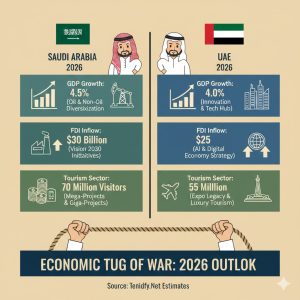
Saudi vs UAE the 2026 Economic Tug of War
2026 Outlook: Actionable Strategies for Traders
The Saudi vs. UAE rivalry isn’t just about friction; it’s an evolution of the market. To safeguard your bottom line:
Diversify Origins: Mix Saudi and UAE sourcing to hedge against sudden tariff changes.
Leverage CEPA: Utilize the UAE’s Comprehensive Economic Partnership Agreements to cut external duties.
Invest in Compliance Tech: Use automated systems for Rules of Origin (RoO) tracking to save up to 10% in unnecessary duties.
Explore Neutral Hubs: Consider Oman or Bahrain as secondary logistics bases.
Seizing the Opportunity
Smart merchants turn friction into fuel. As GCC trade evolves, positioning your business across both giants is no longer optional—it’s essential.
Ready to lead in the 2026 GCC boom?
Tendify.net connects you with verified partners to navigate these disruptions. التسجيل, post your RFQs, and secure deals that weather any geopolitical storm.
For more insights, check our guide on the hidden goldmine in Gulf exports or why high-margin export portfolios beat traditional assets.
Opportunities Beyond the GCC: Regional Exporters Step In
This Saudi-UAE tug-of-war isn’t just reshaping intra-GCC flows—it’s creating real openings for exporters in the broader Middle East region.
As both giants push hard for local manufacturing و supply chain self-reliance under their diversification visions, they’re increasingly looking to source commodities, raw materials, and intermediate goods from reliable non-GCC partners. This shift can bypass some of the new tariff frictions and RoO hurdles within the bloc.
Think petrochemical feedstocks, agricultural products, construction materials, and machinery components—these are areas where regional suppliers often hold cost and logistics advantages over distant Asian or European alternatives.
In 2026, with GCC non-oil imports projected to keep climbing (driven by $1.5 trillion in mega-projects), savvy exporters who build direct relationships now can capture market share that might otherwise stay locked in old intra-GCC patterns.
The key? Focus on compliance, speed, and trust-based partnerships.
If you’re trading in these categories, this rivalry could be your entry point to consistent, high-volume Gulf business.
Ready to explore matches? التسجيل on Tendify.net today and connect directly with verified GCC buyers posting real-time RFQs.
For more on navigating Gulf trade shifts, check out our guides on Strategic Business Networking 2026 و B2B E-commerce Trends 2026.