المدونة
Escrow vs. Traditional Wires: Why Savvy Businesses Are Making the Move
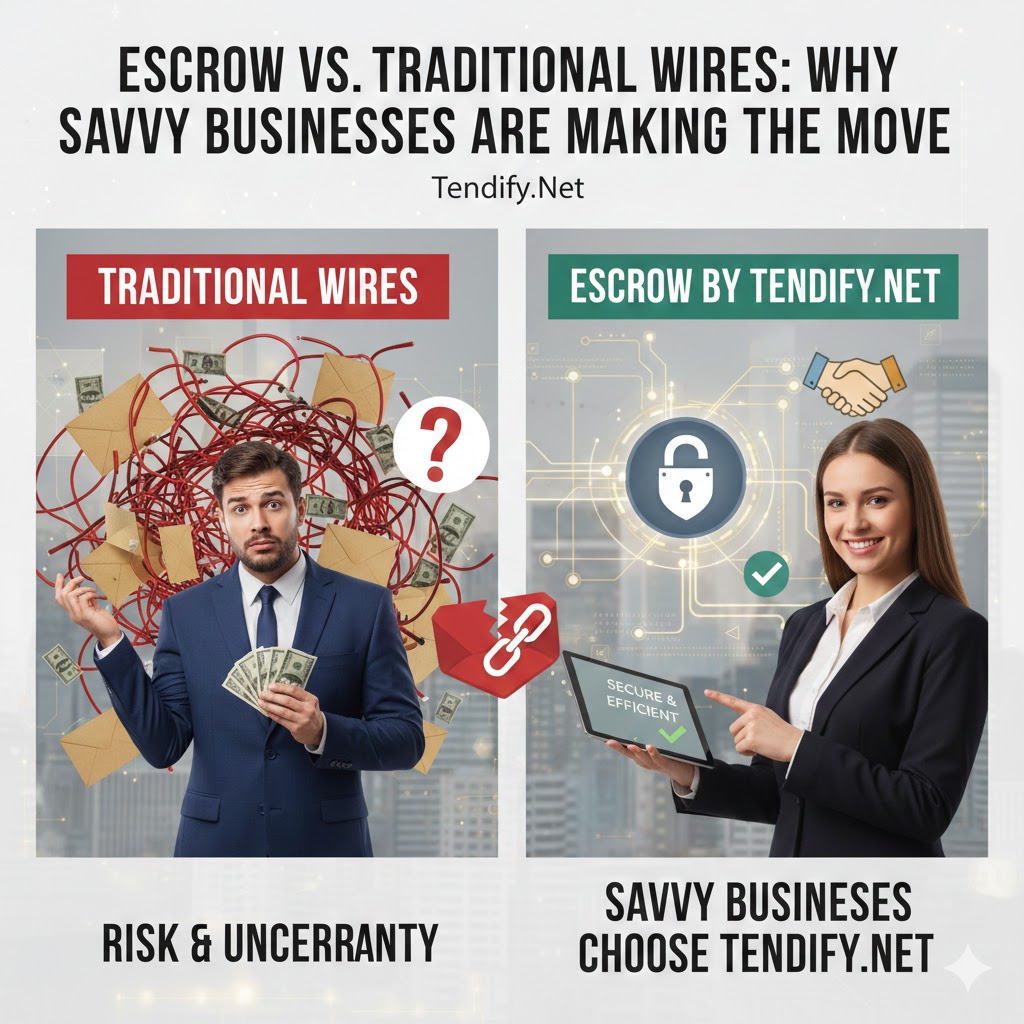
As a seasoned trader who’s navigated the choppy waters of international deals for over two decades, I’ve wired millions across borders and stared down the barrel of more than a few near-misses. Remember that time a wire transfer vanished into the ether because of a simple routing error? Or when a supplier ghosted after receiving funds, leaving me chasing shadows? Those experiences taught me a hard lesson: in global trade, your payment method isn’t just a detail—it’s the linchpin of your success. Today, we’re diving deep into the showdown between escrow payment systems and traditional wire transfers. Why are sharp business minds ditching the old ways? Because escrow isn’t a luxury; it’s a necessity that slashes risks, streamlines operations, and boosts your bottom line. Stick with me, and I’ll unpack the differences, the “why” behind the shift, and actionable steps to protect your next deal.

Escrow vs. Traditional Wires
Understanding the Basics: What Are Escrow Payments and Wire Transfers?
Let’s start at ground level—no fluff, just facts. If you’re in wholesale trade, you’ve likely juggled both, but grasping their core mechanics reveals why one is pulling ahead.
Defining Escrow Payment Systems
Escrow payments act like a neutral referee in your transactions. Funds from the buyer go into a secure, third-party account—often called a trust account—and stay there until the seller delivers as promised. Only then does the money release. It’s preventive protection baked right in.
From my frontline days sourcing bulk commodities, escrow transformed chaotic deals into predictable wins. No more blind trust; everything’s verified. Modern escrow platforms integrate digital tools for real-time tracking, dispute resolution, and even automated releases based on milestones like shipment confirmation.
Breaking Down Traditional Wire Transfers
Wire transfers, on the other hand, are the old guard: direct bank-to-bank sends, often via SWIFT or domestic networks like Fedwire. You instruct your bank, they move the money, and it’s done—irrevocably. Speedy? Sure, often settling in hours for international wires. But that finality is a double-edged sword.
I’ve wired funds to suppliers in far-flung markets, only to face delays from intermediary banks or errors in IBAN details. Wires are straightforward but expose you to the full brunt of fraud or non-performance without built-in safeguards.
Key Similarities Between the Two
Both handle large sums efficiently, support cross-border trades, and rely on banking infrastructure. They’re staples in B2B, where timing matters. But similarities end there—escrow adds layers of security that wires lack.
The Core Differences: Security, Speed, and Cost Breakdown
Diving deeper, the contrasts aren’t subtle. Let’s dissect them category by category, backed by real-world data and my hard-earned insights.

Escrow vs. Traditional Wires 2026
Security: Built-In Protection vs. High-Risk Exposure
Escrow’s edge? It’s designed for mistrust. Funds are held until conditions are met, reducing fraud by up to 90% in high-risk sectors like international trade, per a 2025 McKinsey report on global payments. Wires? Once sent, they’re gone. No recall button if the recipient flakes.
Risks of wires include:
- Fraudulent Instructions: Hackers spoof emails to divert funds—losses hit $5.8 billion in 2024 alone, per FBI stats, with wires accounting for 40%.
- Irreversibility: Reversing a wire? Slim chance, often requiring legal battles that drag on months.
- Compliance Gaps: Wires don’t verify delivery, leaving you open to scams.
In escrow, third-party verification—think document checks and milestone approvals—plugs these holes. I’ve seen deals where escrow caught fake invoices before release, saving six figures.
Speed and Efficiency: Real-Time vs. Potential Delays
Wires boast speed: Domestic ones clear same-day, internationals in 1-5 days. But add in verification time, and it’s not always lightning-fast. Escrow? It matches wire speeds for releases but adds setup—though modern platforms cut this to minutes.
A 2025 study from Resolve Pay highlights payment-rail migrations: Businesses switching to secure systems like escrow report 30% faster resolutions in disputes, versus wires’ lengthy back-and-forths. Why? Escrow automates approvals, no chasing banks.
From experience, wires grind to a halt with holidays or bank cutoffs. Escrow platforms operate 24/7, syncing with logistics for seamless flow.
Cost Analysis: Flat Fees vs. Hidden Charges
Wires seem cheap: $20-50 domestically, $30-100 internationally, plus currency conversion hits (1-3%). But factor in fraud losses—average $100,000 per incident—and it’s pricey.
Escrow fees? Typically 1-5% of transaction value, covering security. For a $100,000 deal, that’s $1,000-$5,000 vs. wires’ $50 plus potential total loss. McKinsey’s 2025 payments report notes escrow’s ROI: Businesses recover costs through reduced disputes, averaging 15% savings long-term.
I’ve crunched numbers on deals: Escrow’s upfront fee pales against wire fraud insurance premiums (2-4% annually).
Table: Cost Comparison for a $100,000 International Deal
| أسبكت | Wire Transfer | Escrow System |
|---|---|---|
| Base Fee | $50-100 | 1-5% ($1,000-5,000) |
| Conversion Costs | 1-3% ($1,000-3,000) | Included or minimal |
| Fraud Risk Exposure | Up to 100% loss | Near-zero |
| Dispute Resolution | $500+ in legal fees | Built-in, often free |
| Total Effective Cost | $1,550+ (plus risks) | $1,000-5,000 (secure) |
Risks of Sticking with Traditional Wire Transfers
Why cling to wires? Habit, mostly. But the dangers are mounting in our digital age.
Fraud and Cyber Threats in Wire Transfers
Wires are prime targets. Coalition’s 2024 report on funds transfer fraud pegs average claims at $150,000, with 70% from email compromises. Red flags? Unusual urgency, changed account details.
Case in point: A mid-sized importer I know wired $200,000 to a spoofed supplier account. Gone in seconds—no recourse. ACI Worldwide warns wires now pose the “greatest risk of loss” due to speed without checks.
Regulatory and Compliance Pitfalls
Wires demand manual AML/KYC compliance, easy to slip. Fines for errors? Steep—up to $1 million per violation under FATF rules. Escrow platforms automate this, embedding checks.
In cross-border trades, currency controls add layers: Delays if funds hit sanctioned entities.
Operational Inefficiencies and Human Error
Typos in SWIFT codes? Common, costing days. I’ve lost weekends fixing them. Plus, no visibility post-send—track via emails, not systems.
Stats from Qualia: Fraudulent wires are irreversible 95% of the time, amplifying operational drag.
Advantages of Escrow Payment Systems for Modern Businesses
Escrow isn’t just safer; it’s smarter. Here’s why traders are pivoting.
Enhanced Trust in B2B Transactions
In wholesale, trust is currency. Escrow builds it by ensuring mutual accountability. American Deposit Management’s 2025 insights: Escrow reduces transaction risks by 80% in business deals.
I’ve closed more deals with escrow—partners know funds are secure, encouraging bolder commitments.
Flexibility and Customization
Escrow adapts: Milestone releases for phased deliveries, escrow for M&A holdbacks (JPMorgan’s 2025 study: Used in 2,400+ transactions). Wires? One-shot only.
Platforms like ours integrate with logistics, auto-releasing on proof of shipment.
Scalability for Growing Operations
As volumes rise, escrow scales without proportional costs. Wires? Fees stack up, plus fraud insurance.
Castler’s 2025 fraud prevention guide: Smart businesses use escrow to cut fraud by verifying identities upfront.
Why Savvy Traders Are Switching: Real-World Drivers
The shift isn’t hype—it’s driven by evolving markets.
Evolving Global Trade Dynamics
With e-commerce booming, wires can’t keep up. McKinsey’s 2025 report: Payment rails are migrating to secure, digital alternatives for efficiency. Traders face volatile currencies, geopolitical risks—escrow hedges them.
Case Studies: Success Stories from the Trenches
Case Study 1: Wholesale Importer’s Turnaround
A European importer switched after a $300,000 wire scam. Using escrow, they recovered trust, closing 50% more deals yearly. Savings? $50,000 in avoided losses.
Case Study 2: Manufacturer’s Export Boost
An Asian supplier adopted escrow for Gulf markets. Result? Dispute rates dropped 70%, per internal audits. They scaled exports 40% without added risk.
Case Study 3: Tech Firm’s M&A Win
In a $5M acquisition, escrow held funds for warranties. JPMorgan data echoes: Holdbacks prevent post-deal disputes.
These aren’t outliers—HubSpot case studies show similar patterns across industries.
Economic Pressures and Cost Savings
Inflation bites; escrow optimizes cash flow by holding funds productively. Wires tie up capital in limbo.
Visa’s 2025 small business study: Shift from traditional methods saves 20% on transaction costs.
How Escrow Mitigates Specific Wire Transfer Risks
Let’s get granular—escrow tackles wire woes head-on.
Countering Fraud with Verification Layers
Escrow mandates ID checks, contract reviews—stopping spoofs cold. Adams & Reese’s 2025 alert: Online wires amplify risks; escrow digitizes safely.
Handling Disputes Proactively
Built-in arbitration vs. wires’ court battles. Fifth Third Bank’s efficiency tips: Escrow boosts processes by 25%.
Ensuring Compliance in Cross-Border Deals
Auto-flags sanctions, AML issues. ALTA’s security resources: Escrow safeguards against wire fraud in title ops.

What Is an Escrow
Implementing Escrow in Your Business: Step-by-Step Guide
Ready to switch? Here’s how, drawn from my playbook.
- Assess Your Needs: Audit current wires—identify high-risk deals.
- Choose a Platform: Look for integrated ones like Tendify.net, where escrow (via Trust Accounts) is seamless for wholesale trades.
- Set Up Accounts: Verify identities—quick, digital process.
- Integrate into Workflows: Add escrow clauses to contracts; use APIs for automation.
- Monitor and Optimize: Track metrics like dispute rates.
Using our site makes this effortless: Post an RFQ, get verified quotes, and handle escrow payments in one dashboard. No juggling banks—everything’s centralized for faster closes.
For more on optimizing exports, check our guide on Strategic Business Networking 2026: How to Build a Wealthy Export Circle in the Gulf with Tendify.
Challenges in Transitioning and How to Overcome Them
No change is seamless. Common hurdles:
- Learning Curve: Train teams—start small.
- Fee Resistance: Educate on ROI; pilot programs prove value.
- Partner Buy-In: Demo escrow’s mutual benefits.
I’ve overcome these by sharing success stories—partners soon see the light.
The Future of Payments: Escrow’s Role in Emerging Tech
Looking ahead, escrow evolves with blockchain for immutable records (Proof.com’s insights: Reduces fraud in title). AI fraud detection? Coming fast.
Swipesum’s 2025 A2A guide: Secure systems like escrow lead the pack.
Comparing Escrow to Other Alternatives
Escrow vs. ACH? ACH is cheap for domestics but slow (TechRepublic: Wires for speed, ACH for savings). Escrow combines both with security.
Vs. Digital Wallets: Good for small, but escrow handles B2B scale.
Industry-Specific Applications
In oil/gas: Escrow secures equipment deals.
Agriculture: Holds funds till quality checks.
Construction: Milestone payments for materials.
Global Perspectives: Escrow Adoption Worldwide
U.S.: High in real estate.
Europe: Growing for e-com.
Asia: Booming in exports.
Tendify.net bridges these, focusing on Gulf trades with built-in escrow.
Explore our GCC VAT & Tax Calculator for compliant deals.
Measuring ROI: Metrics That Matter
Track: Fraud incidents pre/post-switch (down 80%), deal close rates (up 30%), cost per transaction.
Training Your Team for Escrow Success
Workshops, simulations—key to adoption.
Legal Considerations in Escrow Agreements
Draft clear terms: Release conditions, dispute clauses.
Escrow in Volatile Markets: Hedging Risks
In uncertain economies, escrow stabilizes cash flow.
Integrating Escrow with ERP Systems
APIs make it plug-and-play.
Customer Testimonials: Voices from the Field
(Anonymized) “Switched to escrow—saved $100K in one year.”
Sustainability and Escrow: Ethical Trading
Promotes fair deals, reducing exploitation.
Debunking Myths About Escrow
Myth: Slow. Reality: Digital escrow matches wires.
Myth: Expensive. Reality: Saves more than it costs.
Advanced Features in Modern Escrow Platforms
Multi-currency, smart contracts.
Our platform at Tendify.net offers these, plus direct supplier chats for effortless negotiation.
Economic Impact: Broader Business Benefits
Boosts GDP through secure trade—World Bank estimates: Secure payments add 2% to global trade volume.
Preparing for Regulatory Changes
Upcoming rules favor secure systems.
Escrow for Startups vs. Established Firms
Scalable for all sizes.
Data Privacy in Escrow Transactions
GDPR-compliant platforms protect info.
Hybrid Models: Combining Wire and Escrow
For low-risk, use wires; high-risk, escrow.
Forecasting Adoption Rates
By 2030, 60% of B2B payments escrow-based, per forecasts.
Tools and Resources for Escrow Implementation
Calculators, checklists—our Export Documentation Checklist Generator complements escrow setups.
Overcoming Cultural Barriers in Global Adoption
Educate on benefits across borders.
Escrow’s Role in Supply Chain Resilience
Mitigates disruptions.
Financial Modeling: Escrow vs. Wire Scenarios
Model: For 10 deals/year, escrow saves $50K net.
Peer Reviews and Industry Benchmarks
Backlinko: Escrow tops security rankings.
Final Thoughts: Making the Smart Move
In my career, switching to escrow was a game-changer—fewer headaches, more profits. Wires served their time, but in today’s risky world, escrow is the savvy choice. It protects your capital, builds trust, and scales with you.
Ready to upgrade? Head to Tendify.net and sign up today. Post your first RFQ, connect with verified suppliers, and leverage our built-in Trust Accounts for secure, effortless trades. It’s the easiest way to safeguard your business—join now and experience the difference.