


المدونة
India Fresh Produce Export: Strategy, Markets & High-Value Trade
A container of Indian Alphonso mangoes clears customs in Jebel Ali within 48 hours of harvest. Across the Gulf, supermarket buyers restock onions and green chillies that left Indian farms only days earlier. Meanwhile, European importers negotiate grape contracts timed to the exact harvest window in Nashik. These movements are not isolated successes. They reflect a structural mismatch that still defines global fresh-produce trade: India produces at scale, yet converts only a fraction of that volume into consistent, high-value exports.
India ranks among the world’s largest producers of fruits and vegetables. Production of fruits exceeds 110 million metric tonnes and vegetables more than 200 million metric tonnes in recent seasons. Fresh fruit and vegetable exports reached approximately USD 1.82 billion in FY 2024-25, with fruits contributing nearly USD 1 billion and vegetables around USD 819 million. Grapes, bananas, mangoes, pomegranates, onions, potatoes, green chillies and okra dominate the basket. The opportunity is not production. It is the disciplined connection of that production to markets that cannot grow what they consume.
This article maps the highest-potential export categories, the markets that absorb them, the operational requirements that determine success or rejection, and the practical sequence exporters must follow to convert volume into reliable revenue.
Why Gulf Markets Form the Core Opportunity
Gulf Cooperation Council economies depend heavily on imported fresh produce. Limited arable land, high temperatures and water scarcity make local production costly and seasonal. The UAE, Saudi Arabia, Oman, Qatar, Kuwait and Bahrain therefore maintain continuous import pipelines. Short sea transit times from Indian ports—often 3 to 7 days to major Gulf destinations—give Indian produce a decisive freshness advantage over shipments from more distant origins.
India Fresh Produce Export
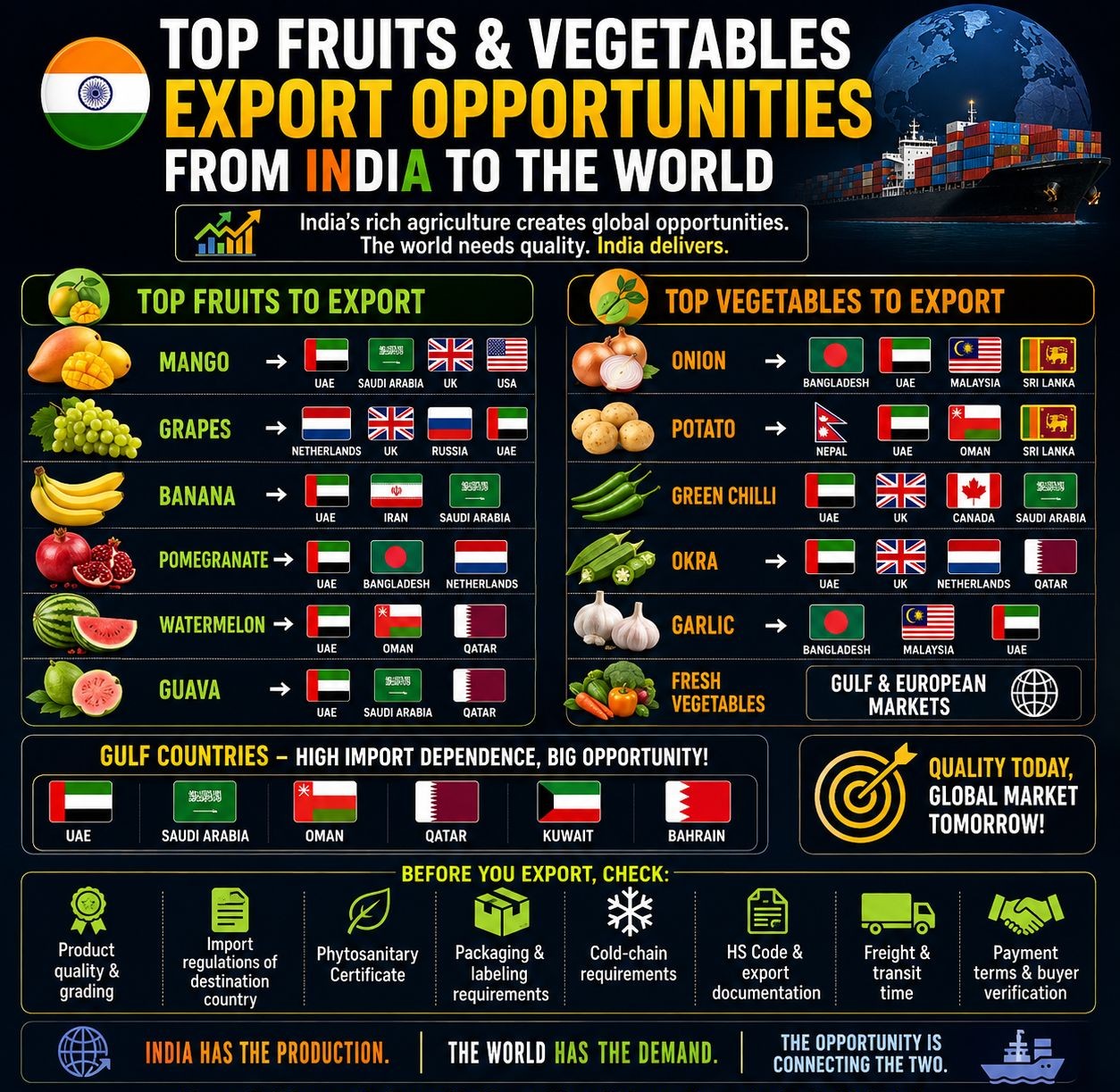
Operational assessments of regional supply chains show that Indian mangoes, bananas, grapes, onions and green chillies already command strong shelf presence in these markets. Diaspora demand for familiar varieties further stabilises offtake. European destinations, particularly the Netherlands and the United Kingdom, absorb premium table grapes and selected vegetables when residue and phytosanitary standards are met. Bangladesh, Sri Lanka, Nepal, Malaysia and Oman complete the near-market cluster that rewards reliable volume and competitive pricing.
The structural advantage is clear: India has the production base; these markets have the structural deficit. The margin is captured by those who master quality consistency, documentation speed and cold-chain integrity.
Top Fruits with Proven Export Traction
Mango
India remains the global leader in mango production. Export volumes of fresh mangoes hovered near 30,000 metric tonnes in recent seasons, valued at roughly USD 56 million. Key destinations are the UAE, the United Kingdom, the United States, Kuwait and Qatar. Alphonso, Kesar and Banganapalli varieties drive premium positioning. Market access to the United States and certain Asian destinations requires vapour heat treatment or irradiation to eliminate fruit-fly risk. Gulf buyers prioritise consistent size grading, colour and firmness for both retail and food-service channels.
Grapes
Table grapes from Maharashtra, especially the Nashik belt, form one of India’s most organised export programmes. The Netherlands consistently ranks as the largest destination, followed by the United Kingdom, Russia and the UAE. Cold treatment protocols for the European Union market are non-negotiable. Exporters who maintain residual monitoring plans and pack-house hygiene certifications secure repeat contracts. Seasonality alignment with European off-season windows creates natural price support.
Sustainability, Recyclable Packaging & Mandatory Certifications
European buyers operate under strict European Green Deal frameworks and retail standards. Beyond stringent Maximum Residue Limits (MRLs), entry into EU supply chains mandates compliance with GLOBALG.A.P. certification for Good Agricultural Practices and SMETA (SEDEX) social audits for ethical labor standards. Furthermore, single-use plastic packaging is rapidly being phased out in favor of 100% recyclable, biodegradable, or compostable materials.
The Tendify Advantage: Exporters holding verified GLOBALG.A.P. credentials can highlight their compliance status directly on تينديفاي دوت نت, allowing premium European importers to source verified, sustainable produce with zero audit friction.
Banana
Banana shipments have expanded rapidly, with Middle Eastern markets absorbing the bulk of volume. Major buyers include the UAE, Saudi Arabia, Oman, Kuwait, Bahrain and Qatar. Cavendish and certain local varieties travel well under controlled atmosphere when harvested at the correct maturity stage. The short voyage times to Gulf ports allow higher maturity at packing, improving flavour upon arrival.
Pomegranate
Bhagwa and similar varieties from Maharashtra and Gujarat find steady demand in the UAE, Bangladesh and the Netherlands. The fruit’s longer shelf life and perceived health attributes support both fresh and processed channels. Careful post-harvest handling to prevent cracking and scald is essential for premium realisation.
Watermelon and Guava
These crops serve primarily Gulf markets—UAE, Oman, Qatar and Saudi Arabia. Watermelon benefits from volume demand in the summer months; guava appeals to both fresh and pulp processors. Packaging that minimises mechanical damage during container loading determines arrival quality.
Top Vegetables with Sustained Demand
Onion
Onion remains the largest vegetable export by volume in many seasons. Primary destinations include Bangladesh, the UAE, Malaysia and Sri Lanka. Price volatility linked to domestic policy and monsoon outcomes requires careful contract timing and hedging strategies. Graded, well-cured bulbs with low moisture content travel more reliably.
Government Export Restrictions & Dynamic Duty Structures
A primary operational risk for international produce buyers is India’s dynamic export policy regime. To stabilize domestic prices during seasonal shortfalls, the Directorate General of Foreign Trade (DGFT) frequently imposes sudden Minimum Export Prices (MEP), unexpected export duties (such as 20%–40% tariffs), or outright temporary export bans on staple commodities like onions and non-basmati rice.
Strategic Mitigation: International buyers and Indian shippers must incorporate adaptive contract clauses that account for abrupt regulatory shifts. Utilizing real-time trade policy updates and verified supply networks through تينديفاي دوت نت allows market participants to adjust sourcing corridors swiftly when regulatory interventions occur.
Potato
Nepal, the UAE, Oman and Sri Lanka form the core offtake markets. Table and processing varieties both move, though processing grades require tighter size and dry-matter specifications. Cold storage capacity at origin remains a binding constraint for year-round supply.
Green Chilli
The UAE, the United Kingdom, Canada and Saudi Arabia absorb significant volumes. Heat levels preferred by South Asian diaspora communities in these markets create a natural preference for Indian varieties. Rapid cooling after harvest and appropriate packaging prevent moisture loss and wilting.
Okra
Demand is concentrated in the UAE, the United Kingdom, the Netherlands and Qatar. Okra is highly perishable; exporters who operate integrated pack-houses with forced-air cooling capture higher margins. Frozen okra offers an alternative channel with longer shelf life for buyers seeking year-round availability.
Garlic and Mixed Fresh Vegetables
Bangladesh, Malaysia and the UAE take garlic. Broader mixed vegetable consignments—carrots, beans, capsicum and leafy items—serve both Gulf and European buyers when residue compliance and packaging standards are met.
Operational Checklist Before the First Shipment
Successful exporters treat the following requirements as non-negotiable gates rather than afterthoughts.
- Product Quality and Grading
Destination markets publish precise size, colour, maturity and defect tolerances. Investment in calibrated grading lines and trained sorting teams reduces rejection rates more effectively than any marketing campaign. - Import Regulations of the Destination Country
Each market maintains its own list of permitted plant-protection products and maximum residue limits. Residual monitoring plans aligned to the strictest destination in the portfolio protect against simultaneous rejection across multiple buyers. - شهادة الصحة النباتية
Issued by the Plant Quarantine authorities after inspection. Without a valid certificate, the consignment cannot clear destination customs. Timing of inspection relative to packing and loading must be planned with precision. - Packaging and Labelling
Gulf markets increasingly require Arabic labelling for product name, origin, net weight and best-before date. Carton strength, ventilation and palletisation standards differ between sea and air shipments. Inadequate packaging is one of the most common causes of arrival quality claims. - Cold-Chain Requirements
Continuous temperature control from pack-house to destination is the single largest determinant of shelf life. Pre-cooling, reefer container integrity and real-time temperature monitoring are now standard buyer expectations rather than differentiators.
- Product Quality and Grading
Logistics Technology
Smart Reefer Containers & Controlled Atmosphere (CA) Management
Standard temperature control alone is often insufficient for long-distance sea shipments. Highly climacteric fruits like bananas, mangoes, and avocados require Smart Reefer Containers equipped with Controlled Atmosphere (CA) systems. These containers actively manage relative humidity, scrub ethylene gas (which triggers premature ripening), and adjust oxygen ($O_2$) and carbon dioxide ($CO_2$) ratios to put the fruit into a temporary “metabolic sleep,” preventing spoilage during transit.
Logistics Quality via Tendify: Shippers utilizing IoT-enabled smart reefers can share real-time telemetry data (temperature, humidity, and location tracking) with international buyers through Platform.Tendify.Net, establishing total supply chain transparency and drastically reducing arrival quality disputes.
- HS Code Classification and Export Documentation
Correct Harmonised System classification determines duty rates and eligibility for preferential trade agreements. Commercial invoice, packing list, bill of lading or airway bill, certificate of origin and phytosanitary certificate form the core set. Incomplete or inconsistent documentation triggers delays that erase the freshness advantage. - Freight and Transit Time Sea freight to the UAE or Saudi Arabia typically ranges from 3 to 7 days depending on origin port and service. Air freight is reserved for high-value or ultra-perishable items. Transit-time modelling against product respiration rates prevents over-maturity on arrival.
- Payment Terms and Buyer Verification
Letters of credit, advance payments or confirmed documentary collections reduce exposure. New buyers should be verified through trade references, bank reports and, where possible, physical audits of their cold-storage facilities.
Platforms that aggregate verified buyers and streamline documentation workflows can compress the time between first inquiry and first shipment. One such resource is available at Platform.Tendify.Net for exporters seeking structured market connections.
Financial Settlement & Currency Risk Mitigation
Cross-border trade between India, the GCC, and European markets involves complex banking friction, FX volatility, and payment default risks. Navigating traditional Letters of Credit (LCs), Vostro/Nostro account delays, currency conversions (such as INR-AED or EUR-INR), and intermediary charges often erodes margins and delays shipment release.
How Tendify Solves This: Exporters and buyers can eliminate transaction vulnerability through Tendify.net’s Trust Account system. By securing funds in verified escrow-backed frameworks prior to dispatch, Tendify ensures seamless multi-currency settlements, guarantees payment upon compliance with shipping documents, and protects both parties against cross-border default risks.
Building a Sustainable Export Programme
Volume alone does not create margin. Exporters who treat quality systems, residue compliance and cold-chain discipline as fixed costs rather than optional upgrades capture the premium end of the market. Traceability from farm to container is increasingly demanded by European and Gulf supermarket chains. Digital systems that link farm registration, spray records, laboratory results and packing-house data reduce audit friction and accelerate market access.
Seasonality management is equally critical. Overlapping harvest windows across Indian states can be leveraged to extend supply periods for key buyers. Contract farming arrangements that lock in both volume and quality specifications reduce the risk of last-minute shortfalls.
Air-freight programmes for ultra-premium mangoes or specialty chillies serve niche segments, while bulk sea-freight programmes for onions, potatoes and bananas generate the cash flow that funds quality infrastructure. A balanced portfolio across both channels improves resilience against freight-rate spikes or temporary market closures.
Market-Specific Nuances Worth Noting
Gulf buyers prioritise visual appeal, consistent sizing and rapid turnaround. European buyers prioritise residue compliance, ethical sourcing documentation and packaging that supports extended shelf life in the retail cold chain. South Asian neighbouring markets prioritise competitive pricing and volume reliability. Matching product specification and logistics design to each cluster’s hierarchy of needs determines whether a shipment generates a claim or a reorder.
Freight cost as a percentage of FOB value varies sharply by product. High-value, low-volume items such as premium mangoes can absorb air freight; high-volume, lower-value items such as onions cannot. Accurate landed-cost modelling before pricing decisions prevents margin erosion after arrival.
The Practical Path Forward
Start with one or two products for which reliable production and post-harvest capacity already exist. Select two or three destination markets whose regulatory and logistics profiles align with current capabilities. Secure phytosanitary and residue compliance for those markets first. Build the cold-chain and packaging infrastructure required for those specific routes. Expand only after the first corridors demonstrate consistent arrival quality and payment reliability.
Internal resources that deepen specific aspects of this process include detailed guidance on Dubai Food Import Guide: FIRS, Zad, and Customs Clearance and a practical overview of Exporting to UAE: How to Sell Fruits and Fresh Vegetables Successfully in 2026. A third resource covering GCC Market Cap Leaders 2026: Top 20 Companies & Trade Trends provides additional operational context.
India possesses the production base. Destination markets possess the structural demand. The commercial opportunity resides in the systems that connect the two with consistency, compliance and speed. Exporters who treat those systems as the core of the business, rather than as administrative overhead, convert agricultural abundance into durable export revenue.

