


وبلاگ
GS1 Barcodes for B2B: The Complete Exporter’s Guide
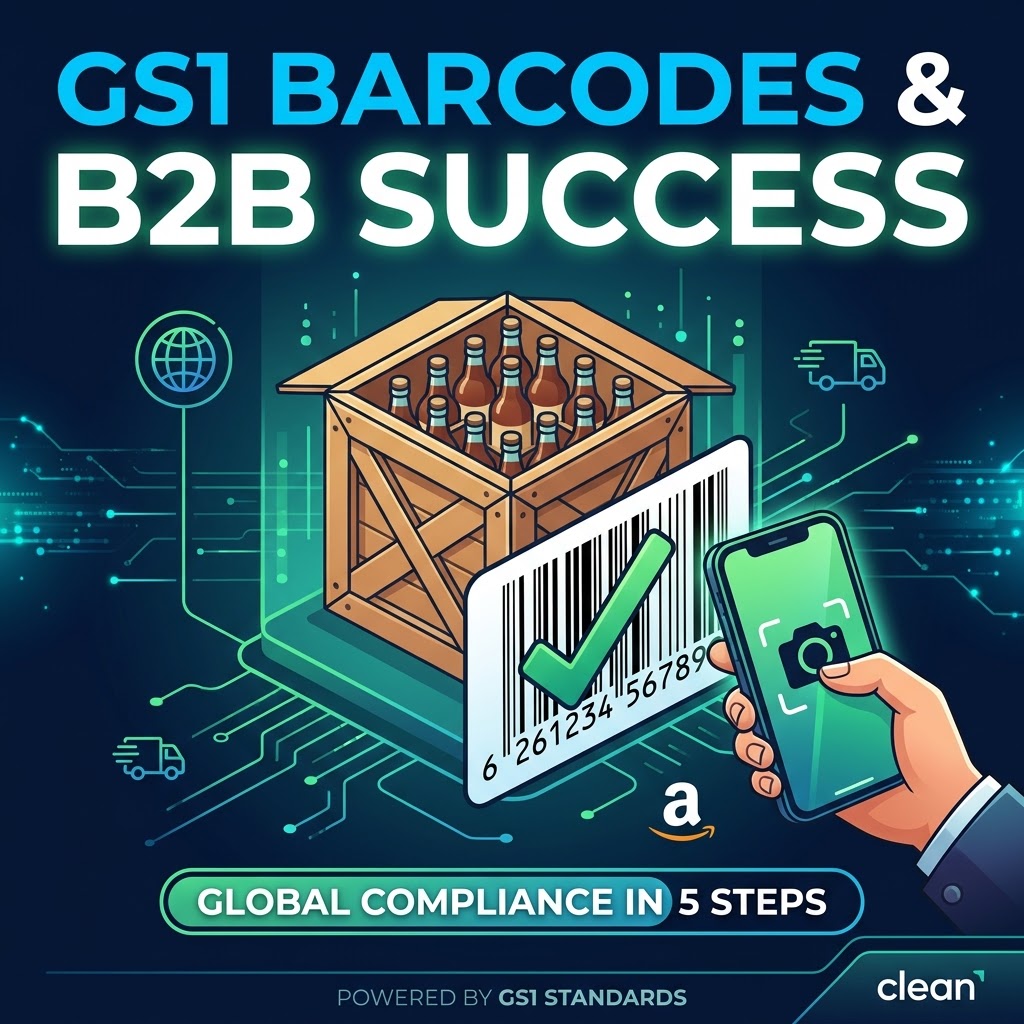
A single mismatched barcode can stop a container at the gate, trigger an Amazon listing rejection, or force a full recall. In cross-border B2B operations, that mismatch is rarely about the ink on the package. It is almost always about ownership of the number itself and whether the global database recognizes the brand behind it.
GS1 is the non-profit organization that maintains the shared language of product identification across more than 150 countries. Its standards turn a physical item into a uniquely addressable data object that retail systems, customs platforms, warehouse management software, and buyer portals can all read without translation. The most visible form of that standard is the familiar EAN-13 or UPC barcode, but the system extends far beyond the black lines on a carton.
This guide covers the structure of GS1 identifiers, the practical steps to obtain legitimate codes, the hierarchy used in multi-level packaging, the transition to GS1 Digital Link, printing and placement rules that prevent scan failures, and the decision between QR Code and DataMatrix. Every recommendation is grounded in operational requirements that appear in real export workflows.
GS1 Standards in Cross-Border B2B Trade
A visual roadmap to product identification, variable data encoding, and compliance hierarchy.
📐
1. Packaging & Identification Hierarchy
Consumer Item (GTIN-13)
EAN-13 / UPC
Case / Outer Carton (GTIN-14)
ITF-14 / GS1-128
Logistics Unit / Pallet (SSCC)
GS1-128 Label
🖼️
2. Visual Example: Standard GS1-128 Pallet Label
Pallet labels must strictly feature three horizontal sections to comply with automated port scanners and cross-docking hubs.
ORIGIN: JEBEL ALI FREE ZONE (UAE)
CARRIER: TRANS-ARABIA LOGISTICS
(01)00614141000039(17)261231(10)BATCH-9948
SSCC (00): 306141411234567891
🏷️
3. Essential Application Identifiers (AIs)
(01) GTIN
(10) Batch / Lot
(17) Expiry Date
(310X) Net Weight
⚠️
Golden OEM Ownership Rule
The Brand Owner must always license and provide the GS1 barcode—never the contract manufacturer. Using factory prefixes for client brands causes severe audit rejections in cross-border databases.
What GS1 Actually Is and Why It Matters in Cross-Border Trade
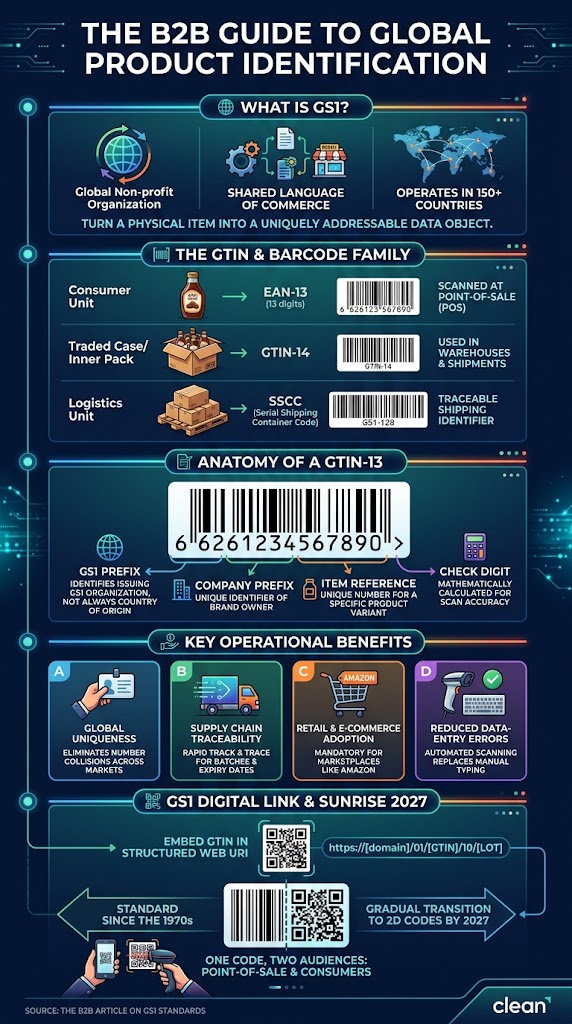
GS1 (Global Standards One) operates a single, coordinated identification system for products, locations, assets, and logistics units. National member organizations issue the numbers under a common set of rules so that a GTIN generated in one market remains unique and resolvable everywhere else.
The most common commercial identifier is the Global Trade Item Number (GTIN). In retail packaging this usually appears as a 13-digit EAN-13 barcode. The same number can also be encoded in a 14-digit GTIN-14 for cases or in a GS1 Digital Link QR code that carries additional data.
Because the identifier is globally unique and registered in a central database (Verified by GS1 / GEPIR), large retailers, marketplaces, and customs authorities can query ownership, brand name, product description, and target market in real time. Codes that do not resolve correctly are routinely rejected at listing, receiving, or clearance stages.
Anatomy of a GTIN
A standard 13-digit GTIN is built from four elements:
- GS1 Prefix (2–3 digits): Identifies the national GS1 organization that issued the number.
- Company Prefix: The unique identifier assigned to the brand owner or manufacturer.
- Item Reference: The sequential or structured number the company assigns to each distinct product.
- Check Digit: A calculated final digit that allows scanners to detect transcription or scanning errors.
The full string is registered so that any party can look it up and confirm the legitimate owner. Changing the physical product in ways that affect how it is sold, stored, or regulated usually requires a new GTIN. GS1 rules treat the following as material changes that demand a new number:
- Reformulation that alters allergens, nutritional profile, or functional claims
- Net content change greater than 20 %
- Packaging format change that affects shelf or case dimensions
- Brand name change
- Addition of promotional components that create a new consumer unit
Using the same GTIN across these changes creates inventory and compliance mismatches that surface later as chargebacks or customs holds.
GS1 Barcode Standards
Global Product Classification (GPC): Standardizing What You Sell
While a GTIN acts as a unique serial number for a specific SKU, marketplaces and customs platforms also require a standardized way to categorize the product itself. This is handled by the Global Product Classification (GPC) system—a strict, hierarchical taxonomy used within the GS1 registry to group products into defined categories (Segment, Family, Class, and Brick).
When listing products on platforms like Amazon or filing automated import declarations, assigning the correct GPC Brick code ensures that algorithms and customs screeners immediately recognize the fundamental nature of the item—whether it is processed food, apparel, or an industrial component—preventing catalog ingestion failures and incorrect regulatory risk flagging.
💡 Rule of Thumb: GTIN identifies the precise brand variant; GPC defines the exact product category across all global databases.
Variable Measure Trade Items (VMTI): Handling Catch-Weight Goods
Not all products move through cross-border trade in fixed, pre-packaged quantities. Bulk agricultural exports, fresh produce, meat, cheese, raw timber, industrial cabling, and metal tubing are sold by weight, length, or volume—known in GS1 standards as Variable Measure Trade Items (VMTIs) یا catch-weight items.
Standard fixed-GTIN barcodes cannot convey variable pricing or metric values at point-of-sale or customs check-in. GS1 addresses variable measure goods through two distinct mechanisms:
- 1. Restrictive Distribution / National Prefixes (e.g., GS1 Prefix 20-29):
For items weighed and priced dynamically at retail or local warehouses, special national prefixes (typically starting with digits 20 through 29) allow embedding the measured net weight or price directly inside the 13-digit EAN code structure. - 2. Dynamic GS1 Application Identifiers (Global B2B Logistics):
For cross-border bulk trade, exporters combine a standard base GTIN with specific dynamic Application Identifiers encoded in 2D GS1 DataMatrix or GS1-128 shipping labels:(310X)– Net weight in kilograms (where X indicates decimal placement)(311X)– Length or meterage in meters(330X)– Gross weight in kilograms
Operational Advantage for Bulk Exporters: Using dynamic weight/length AIs on variable cases or pallets enables automated weight reconciliation during customs clearance and port entry, eliminating manual re-weighing disputes between overseas buyers and freight forwarders.
Beyond the Product: Global Location Numbers (GLN) in Trade Operations
While the GTIN uniquely identifies the physical trade item, GS1 standards extend further into the supply chain to identify where goods originate, move, and arrive. The Global Location Number (GLN) is a 13-digit GS1 identifier assigned to legal entities, operational functions, and physical locations—such as manufacturing plants, bonded warehouses, customs terminals, and delivery docks.
In cross-border B2B trade, embedding GLNs alongside GTINs on shipping documents (such as packing lists, commercial invoices, and electronic Bills of Lading / e-BL) eliminates ambiguity in location data. Customs platforms and automated port operations query GLN records to verify origin and destination entities instantly, preventing administrative holds caused by conflicting facility addresses.
Key Takeaway:
GTIN identifies WHAT you are shipping; GLN identifies WHERE it is going and WHO owns the facility.
Operational Benefits That Show Up in Daily Trade Flows
Global uniqueness eliminates the risk that two unrelated products share the same number in an importer’s system. Retailers and platforms that require GS1-registered GTINs will not list or receive goods that fail verification. Traceability becomes practical: batch or lot numbers, serial numbers, and expiry dates can be linked to the base GTIN, allowing rapid isolation of affected stock during a recall or quality event.
Human data-entry errors drop because warehouse and point-of-sale systems scan rather than type. Warehouse management systems can then automate put-away, pick, and cycle-count processes against a single authoritative identifier. In multi-country supply chains these advantages compound; a single correct GTIN travels from origin packing line through intermediate free-zone warehouses to final retail shelves without re-labeling.
Middle East Trade Corridors: Regional GS1 Mandates & Free-Zone Compliance
For traders operating across Middle Eastern supply chains—particularly between the UAE, Saudi Arabia, Iraq, and Turkey—GS1 compliance is no longer just a retail preference; it is a regulatory prerequisite enforced by national authorities.
- Saudi Arabia (SFDA & ZATCA): The Saudi Food and Drug Authority mandates 2D GS1 DataMatrix serialization for all pharmaceutical and medical device imports. Additionally, food products entering the Kingdom via Saudi Customs (ZATCA) require verified GTINs to clear clearance hurdles smoothly.
- UAE & Free-Zone Hubs (Tatmeen & Dubai Customs): The UAE’s Ministry of Health utilizes the Tatmeen platform driven by GS1 standards for track-and-trace medical logistics. For re-exports passing through major hubs like Jebel Ali Free Zone (JAFZA), carrying valid GS1 barcodes prevents cargo re-labeling friction when goods transition from free zones to GCC domestic markets.
- Transit & Cross-Border Freight: When cargo moves overland across regional corridors (e.g., Turkey-Iraq or UAE-Saudi land borders), customs authorities cross-check GTIN manifest data with national product registration databases to combat counterfeit trade and streamline transit clearance.
Operational Tip: Goods re-packaged or grouped inside Middle Eastern transit hubs require proper GTIN-14 (case level) and SSCC (pallet level) labeling registered under the brand owner’s GS1 entity before leaving the free zone.
Internal Codes Versus GS1 Identifiers
| ویژگی | Internal / Private Barcode | GS1 GTIN |
|---|---|---|
| Scope of uniqueness | Limited to one warehouse or system | Worldwide |
| Export / customs use | Not accepted | Required by most major markets and platforms |
| Central registration | هیچکدام | Yes (Verified by GS1) |
| Traceability support | Local only | Full chain of custody possible |
| Marketplace acceptance | Frequently rejected | Standard requirement |
Internal codes remain useful for purely domestic operations that never leave a closed system. Once goods cross borders or enter large retail or e-commerce channels, only GS1 numbers provide the necessary interoperability.
GS1 (GTIN) vs. HS Code: Complementary Tools, Not Replacements
A common misconception among cross-border traders is whether a GS1 identifier (GTIN) can replace the Harmonized System (HS) Code on customs declarations. The short answer is خیر. They serve fundamentally different functions in international trade, operating as complementary standards that together fully define a product for both commercial and regulatory purposes.
While the کد HS classifies goods into broad tariff categories for duty assessment, trade statistics, and regulatory controls, the GTIN uniquely identifies the exact product variant (down to the brand, size, formula, and packaging) for inventory, logistics, and retail management.
| ویژگی | HS Code (Tariff Classification) | GS1 GTIN (Product Identification) |
|---|---|---|
| Governing Body | World Customs Organization (WCO) | GS1 (Global Non-Profit Organization) |
| Primary Purpose | Customs duty assessment, trade policy, & import/export regulations | Unique product identification for retail, warehousing, & supply chain tracking |
| Granularity Level | Broad category level (e.g., “Roasted Coffee”) shared by thousands of brands | Specific SKU level (e.g., “Brand X Dark Roast Whole Bean Coffee 250g Bag”) |
| Primary Users | Customs authorities, tax agencies, & freight forwarders | Retailers, marketplaces (Amazon), warehouses, & consumers |
| Cross-Border Necessity | Mandatory for custom entry declarations worldwide | Mandatory for retail listing, receiving, & track-and-trace compliance |
The Interoperability Power: Advanced customs systems (such as Dubai Customs or US CBP) increasingly link GTIN data to declared HS Codes during entry filing to auto-verify that the physical SKU aligns with the requested tariff rate, drastically cutting clearance review times.
How to Obtain Legitimate GS1 Numbers
GS1 issues identifiers through its national member organizations. Brand owners may apply through the member organization of the country where the company is registered or where it maintains commercial operations. There is no requirement to apply only in the country of manufacture.
Two common paths exist:
- Single GTIN purchase – Suitable when the product range is small (typically fewer than ten items). Each number is purchased individually and carries no ongoing company-prefix fee.
- Company Prefix – Suitable for larger catalogs. The prefix is licensed annually and the company generates its own item references within the allocated range. Capacity scales from tens to tens of thousands of GTINs depending on the prefix length purchased.
Typical steps:
- Select the national GS1 organization (for example GS1 US, GS1 UAE, GS1 UK, or another member that matches the company’s legal or commercial footprint).
- Decide between single GTINs or a company prefix based on current and projected SKU count.
- Complete the company registration with legal name, brand name, and address. These details become the official record visible in Verified by GS1.
- Pay the applicable fee. Activation is usually immediate.
- Enter product attributes (description, net content, GPC category, target market) and download the barcode image files in the required formats (PNG, SVG, EPS).
Approximate fee ranges published by GS1 US (subject to change and local variation) illustrate the structure:
| Request Type | ظرفیت | Initial Fee (approx.) | Annual Renewal |
|---|---|---|---|
| Single GTIN | 1 | $30 | $0 |
| Company Prefix (10 GTINs) | up to 10 | $250 | $50 |
| Company Prefix (100) | up to 100 | $750 | $150 |
| Company Prefix (1 000) | up to 1 000 | $2 500 | $500 |
Fees differ by national organization and by the exact prefix length. Always confirm current pricing on the official member site.
The Reseller Risk
Third-party sites offering “cheap barcodes without annual fees” typically resell numbers that were issued before modern verification systems or that remain registered to a previous owner. Major platforms now query Verified by GS1 in real time. If the brand name and company details do not match the official record, the listing is rejected or the account is restricted. The only reliable path is direct registration through an official GS1 member organization.
OEM & Private Label Manufacturing: Who Owns the GS1 Barcode?
A common point of confusion in international B2B trade involves original equipment manufacturing (OEM) and Private Label arrangements: When a manufacturer produces goods on behalf of an overseas buyer, who is legally responsible for assigning and licensing the GTIN?
According to official GS1 General Specifications, the Brand Owner is strictly responsible for obtaining and licensing the GTIN, not the contract manufacturer.
- Scenario A: Private Label / OEM (Foreign Buyer’s Brand)
If a factory in origin produces goods packaged under an overseas client’s brand name, the buyer (brand owner) must supply their own GTIN from their registered GS1 account. The manufacturer simply prints the provided barcode graphic on the packaging artwork. - Scenario B: Factory’s Own Brand (White Label / Direct Export)
If the manufacturer sells products under its own proprietary brand name to foreign importers, the manufacturer acts as the brand owner and must obtain a GS1 Company Prefix to issue legitimate GTINs.
Critical Compliance Warning for OEM Exporters: Never allow an overseas buyer to force you into using your own factory’s GS1 company prefix for their private-label brand. Doing so links your company entity to their marketplace listings and regulatory liabilities in global databases like Verified by GS1, causing severe audit flags during cross-border clearance.
Packaging Hierarchy: Item, Case, and Logistics Unit
A single consumer unit carries a GTIN-13 (or GTIN-12 in some markets). The next packaging level—the case or inner pack—usually carries a GTIN-14. The top logistics unit (pallet or shipping container) is identified by a Serial Shipping Container Code (SSCC). The SSCC is a unique serial number that links the physical shipment to the electronic advance ship notice and to the individual case and item GTINs inside. This hierarchy enables automated receiving, accurate inventory allocation, and rapid location of specific batches during a quality event.
Standardizing the Pallet Tag: The GS1-128 Logistics Label
To prevent container holds and rejection at transit ports or automated distribution centers, exported pallets must carry a standardized GS1 Logistics Label (traditionally formatted as GS1-128). This physical sticker acts as the bridge between physical cargo and electronic shipment notices (ASN).
An official GS1 pallet label is strictly divided into three horizontal blocks:
- 1. Top Building Block (Free Format / Header):
Contains human-readable company branding, exporter name, ship-from address, and destination port details. - 2. Middle Building Block (Human-Readable Text Data):
Displays essential cross-docking data clearly in text format for manual warehouse checks: Product Description, Batch/Lot Number(10), Expiration Date(17), Total Case Count, and Gross Weight(3300). - 3. Bottom Building Block (Barcode Section):
Houses the machine-scannable GS1-128 linear barcodes. Standard practice includes:- Upper Barcode: Encodes GTIN
(01), Batch(10), and Expiry(17). - Lower Barcode: Exclusively encodes the 18-digit Serial Shipping Container Code
(37)/(00)SSCC.
- Upper Barcode: Encodes GTIN
Placement Rule for Pallet Stickers: Apply label tags on at least two adjacent sides of the pallet (usually side and rear) between 400 mm and 800 mm from the base floor. This ensures automated forklift scanners and conveyor optical readers capture the SSCC without human intervention.
GS1 Digital Link and the Sunrise 2027 Transition
GS1 Digital Link embeds the GTIN and optional attributes (lot, serial, expiry) inside a structured web URI. When encoded in a QR Code or DataMatrix, the same symbol serves two audiences:
- Point-of-sale scanners extract the GTIN (and any required additional data) for pricing and inventory.
- Consumer smartphones open the full URI and can be directed to product information, authenticity checks, or usage instructions.
The URI structure follows a defined syntax:
https://[domain]/01/[GTIN]/10/[LOT]/21/[SERIAL]/17/[EXPIRY]
Short domains keep the symbol density low and improve scan reliability. GS1’s Sunrise 2027 initiative aims to make 2D symbols capable of carrying Digital Link the preferred retail standard, gradually reducing reliance on linear barcodes alone.
Encoding Dynamic Attributes: GS1 Application Identifiers (AIs)
While a GTIN identifies the base product, cross-border compliance—especially in pharmaceuticals, food safety, and track-and-trace logistics—requires printing variable dynamic data directly on packaging. GS1 standardizes this using Application Identifiers (AIs): standardized 2-to-4 digit numeric prefixes enclosed in parentheses that inform scanners exactly what data element follows.
The most critical Application Identifiers used in export workflows include:
Technical Note: When printed as human-readable text below 2D DataMatrix or GS1-128 barcodes, parentheses are used to delineate the AIs (e.g., (01)00614141000039(17)261231(10)BATCH12345). However, inside the actual machine-scannable barcode data string, parentheses are omitted and replaced with the standard GS1 FNC1 separator character.
Printing and Placement Requirements
Scan reliability depends on physical execution:
- Quiet zone: Minimum clear space on all four sides equal to at least four times the module width (approximately 2 mm or more in practice).
- Contrast: Dark modules on a light, matte background. Red, orange, and yellow modules fail under the red illumination used by many industrial scanners. Metallic or highly reflective surfaces also cause failures.
- اندازه: For QR Codes intended for retail POS, a minimum side length of approximately 13–15 mm is recommended; 15–20 mm is more robust. Module (X-dimension) size should stay within the GS1-recommended range.
- Print quality: Target ISO/IEC 15415 grade 1.5 (C) or higher; grade 2.5–3.0 is preferable for high-speed lines. Error-correction level M or Q provides resilience against minor damage.
- جایگذاری: Flat surfaces only. Avoid seams, folds, and curved edges. When both a linear barcode and a 2D symbol appear on the same pack during the transition period, maintain sufficient separation so scanners do not capture the wrong symbol.
Choosing Between GS1 QR Code and GS1 DataMatrix
Both symbols can carry the full Digital Link data set. The choice is driven by use case:
| ویژگی | GS1 QR Code | GS1 DataMatrix |
|---|---|---|
| Finder pattern | Three large corner squares | L-shaped border |
| Spatial density | Lower; needs more space for equivalent data | Higher; works at smaller physical sizes |
| Native smartphone support | Universal | Often requires additional software or browser support |
| Typical applications | FMCG retail, consumer engagement | Pharmaceuticals, medical devices, small parts, DPM |
| Direct part marking | Rarely used | Common (laser or dot-peen) |
For consumer-facing products that benefit from smartphone interaction, GS1 QR Code is the default. For regulated healthcare items, very small packages, or direct marking on components, DataMatrix remains the practical standard.
Verification Before Shipment
Before any commercial shipment, confirm that the GTIN resolves correctly in Verified by GS1. The query returns the registered brand, product description, net content, GPC category, and target market. Discrepancies between the physical label and the database record are the most frequent cause of marketplace or customs rejection. Integrating the verification API into listing or shipping workflows removes the manual check for high-volume operations.
Practical Integration into Export Workflows
Assign GTINs at the moment a new SKU is created, not after packaging design is locked. Record the hierarchy (item → case → pallet) in the product master data so that labels and electronic messages stay aligned. When shipping through free zones or multi-leg routes, ensure the SSCC on the logistics unit is transmitted in the advance ship notice; this single number becomes the key that unlocks automated receiving at the destination warehouse.
For teams managing large catalogs, a company prefix plus disciplined item-reference allocation prevents number collisions and simplifies audits. Tools that generate compliant barcode artwork and link it to the product master reduce the risk of last-minute print errors.
Cross-border operators who treat GS1 identifiers as core master data rather than an afterthought experience fewer clearance delays, fewer marketplace rejections, and cleaner inventory records across multiple markets. The same disciplined approach also prepares the organization for the broader adoption of 2D symbols and Digital Link data carriers that will become standard by the end of the decade.
Frequently Asked Questions About GS1 Compliance in B2B Trade
Q1: How should GS1 barcodes be assigned when multiple items are bundled into a single promotional multipack?
A bundled or promotional pack (e.g., “Buy 2 Get 1 Free” or a multi-flavor gift box) constitutes a new consumer unit and requires a unique GTIN separate from the individual component items. Scanning the individual items inside a bundle at point-of-sale or warehouse check-in creates inventory mismatches and pricing errors.
Q2: What happens to registered GS1 company prefixes during a brand acquisition or corporate merger?
When a brand is sold or acquired, the ownership of the associated GS1 Company Prefix must be formally transferred through the issuing national GS1 member organization. The acquiring entity submits legal documentation to update the company name and legal entity details in Verified by GS1, ensuring continuity across customs and retail databases without needing to re-label existing inventory.
Q3: Do GS1 barcodes expire if annual membership fees are not renewed?
Yes. If a company fails to pay its annual subscription fee for a Company Prefix, the GS1 national organization marks the prefix as inactive or revoked. Major marketplaces (such as Amazon) and automated customs platforms periodically re-verify active status via GS1 APIs; inactive prefixes will cause listings to be suspended and shipments to be flagged.
Q4: Can a company re-use an old GTIN from a discontinued product line for a new item?
No. Under updated GS1 global standards, GTIN reuse has been officially eliminated across almost all sectors (with minor legacy exceptions in healthcare). Once a GTIN has been assigned to a trade item and made available commercially, it can never be assigned to another product, even after the original item is permanently discontinued.
Internal resources that support the same operational discipline include the دستیار انتخاب اینکوترمز for clarifying responsibility points, the Export Documentation Checklist Generator for ensuring paperwork consistency, and the HS Code Finder for accurate tariff classification that pairs with product identification.
When the next product line or market expansion requires reliable, globally recognized identification, the registration process itself is straightforward. Completing it correctly once removes a recurring source of friction from every subsequent shipment. Teams ready to move from fragmented labeling practices to a single, verifiable identification system can begin the process through the official GS1 channel that matches their commercial footprint and then operationalize the numbers inside their existing order-to-cash and logistics workflows.

