


وبلاگ
MAWB vs HAWB Guide: Master Cross-Border Air Freight Compliance
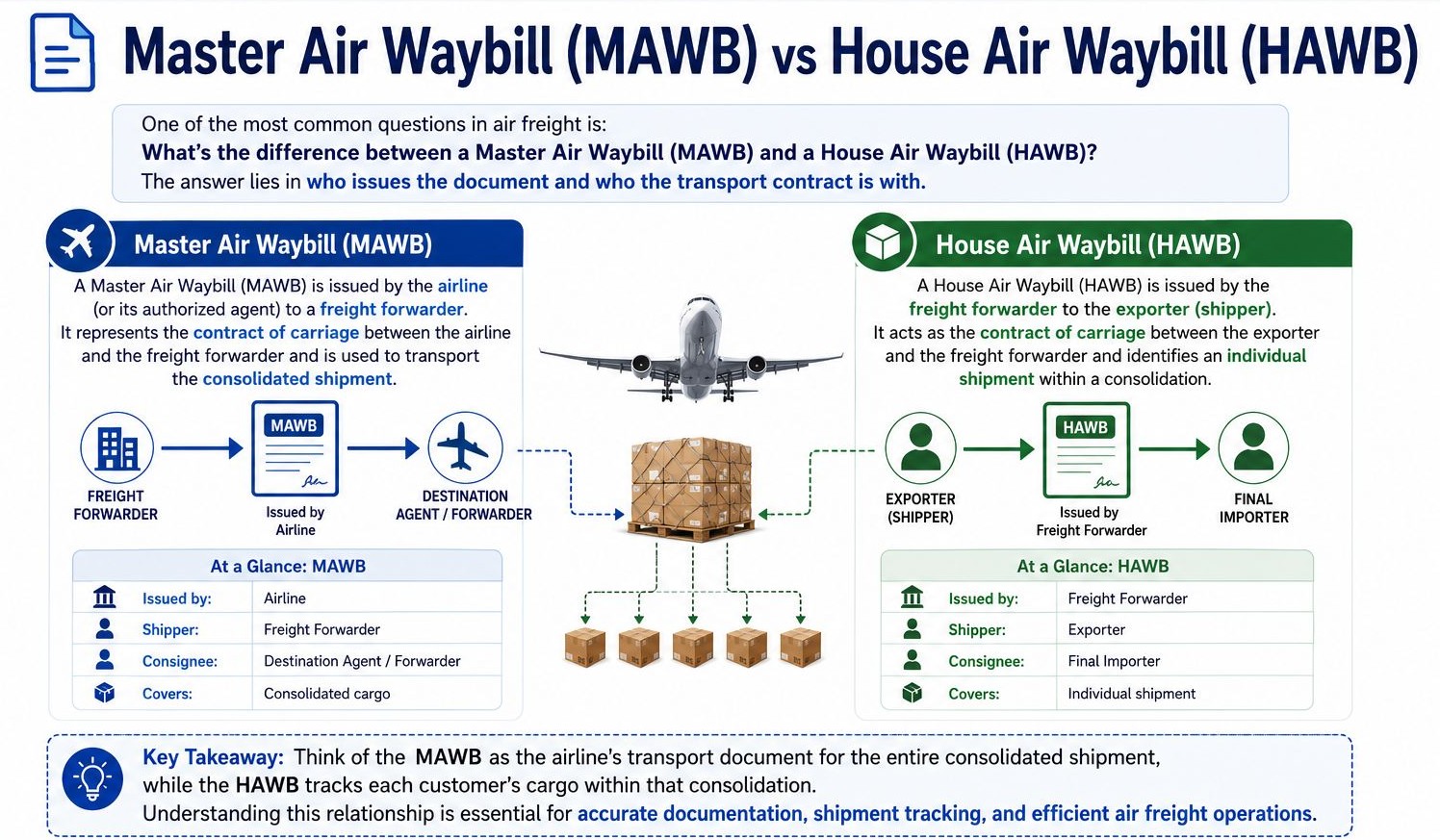
In the high-stakes world of cross-border air freight, a single mismatched field on a transport document can strand pallets at customs, trigger demurrage fees, or delay time-sensitive cargo by days. For B2B traders moving electronics, perishables, machinery parts, or high-value pharmaceuticals into GCC hubs like Dubai, Riyadh, or Doha, mastering the Master Air Waybill (MAWB) و House Air Waybill (HAWB) is not optional—it is operational survival.
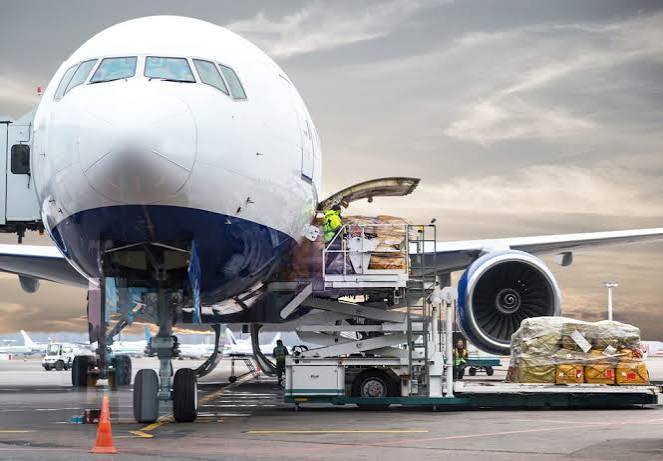
Cross-Border Air Freight
This guide delivers the deepest, most practical breakdown available. It equips exporters, importers, and logistics managers with actionable frameworks to eliminate documentation errors, accelerate clearance, and protect margins in consolidated air shipments.
Air Freight Documentation Flow: Mastering Digital Customs
Why MAWB and HAWB Matter More Than Ever in 2026
Air freight volumes in MENA corridors continue to surge, driven by e-commerce growth, Vision 2030 projects, and just-in-time supply chains. Consolidation remains the dominant model for cost efficiency: forwarders bundle multiple shippers’ cargo onto one flight. This creates the MAWB-HAWB relationship.
A minor discrepancy—such as mismatched weights, HS codes, or consignee details—between the master and house documents can halt de-consolidation, trigger additional inspections, or result in storage charges that erode thin airfreight margins. In practice, experienced operators report that 30-40% of air freight delays in regional ports stem from documentation mismatches.

MAWB vs HAWB in Air Freight
Understanding these documents delivers immediate leverage: faster turnaround, lower risk, and stronger negotiating power with forwarders and carriers.
Core Concepts: Consolidation and the Dual-Document System
Air freight rarely moves as a single dedicated shipment unless volumes justify full charter economics. Instead, forwarders consolidate:
- Individual exporters deliver cargo to the forwarder’s warehouse.
- The forwarder issues a HAWB to each exporter for their specific consignment.
- The forwarder pallets or containers the combined load and tenders it to the airline.
- The airline issues a single MAWB covering the entire consolidated shipment.
This layered structure keeps accountability clear while enabling economies of scale. The MAWB governs the airline-forwarder relationship. The HAWB governs the forwarder-shipper (and often forwarder-consignee) relationship.
Real-World Example in GCC Trade A UAE-based distributor consolidates three shipments bound for Riyadh: precision tools from Germany, medical consumables from Turkey, and electronics components from Southeast Asia. The forwarder issues three HAWBs with specific details for each. The airline receives one MAWB listing the forwarder as shipper and its Riyadh agent as consignee. Upon arrival at King Khalid International, the destination agent uses the MAWB to claim the full load from the airline, then de-consolidates using the HAWBs to release individual parcels to final importers.
Detailed Comparison: MAWB vs HAWB
| ویژگی | Master Air Waybill (MAWB) | House Air Waybill (HAWB) |
|---|---|---|
| صادر شده توسط | Airline or authorized IATA cargo agent | Freight Forwarder |
| Issued To | Freight Forwarder | Individual Shipper / Exporter |
| Contract Between | Airline and Forwarder | Forwarder and Shipper |
| Scope | Entire consolidated shipment | Individual shipment within the consolidation |
| Numbering | Standard IATA format (3-digit airline prefix + 7-8 digits) | Forwarder’s internal format |
| Shipper Field | Usually the Forwarder | Actual Exporter |
| Consignee Field | Forwarder’s destination agent | Final Importer / Buyer |
| Primary Use | Carrier-level tracking, manifest, airline billing | Customer-level tracking, customs clearance for individual cargo, insurance claims |
| Legal Status | Contract of carriage with carrier | Contract of carriage with forwarder |
| Negotiability | Non-negotiable | Non-negotiable |
| Role in Customs | Manifest for the flight | Detailed declaration for specific goods |
💡
The Letter of Credit (LC) Dilemma: Handling Non-Negotiable Documents
One of the sharpest challenges in air freight finance stems from a fundamental legal truth: unlike an ocean Bill of Lading, an Air Waybill (both MAWB and HAWB) is a non-negotiable document of title. It does not represent ownership of the goods; it is merely a receipt of cargo and a contract of carriage.
How do banks secure their financial interest under a Letter of Credit (LC) when the cargo is released immediately to the named consignee upon arrival?
The Masterclass Solution: In B2B trade backed by an LC, the HAWB’s Consignee field must never list the actual buyer. Instead, it must be issued to the order of the issuing bank (e.g., “To the order of [Bank Name] A/C [Buyer Name]”). The destination g customs and the forwarder’s agent will not release the pallets until the bank issues a formal bank release or endorses the documents—ensuring payment is secured before the importer takes physical possession at the airport.
Deep Dive: MAWB Structure and Critical Fields
A MAWB follows strict IATA standards (Resolution 600a). Core sections include:
- Air Waybill Number: The primary tracking identifier. The first three digits identify the airline.
- Shipper and Consignee: Forwarder details on both ends.
- Routing and Flight Details: Airports of departure and destination, with flight segments.
- Cargo Description: High-level summary (often “Consolidated Cargo as per attached HAWBs”).
- Weight and Dimensions: Total chargeable weight for the consolidated load.
- Freight Charges: Rates negotiated between forwarder and airline.
- Handling Information: Special instructions, security status, or dangerous goods declarations.
In 2026 operations, e-AWB (electronic Air Waybill) adoption has accelerated significantly. Many carriers now accept FWB messages instead of paper, reducing physical handling and errors.
Deep Dive: HAWB Structure and Forwarder Responsibilities
The HAWB provides granular visibility:
- Exact shipper and consignee (real parties).
- Detailed commodity description, HS codes, and quantities.
- Individual weights, dimensions, and packaging.
- Invoice value for customs valuation.
- Specific delivery instructions.
Forwarders must ensure every HAWB’s totals reconcile perfectly with the overarching MAWB. Even a 1kg discrepancy or mismatched description can flag the entire manifest.
Edge Cases and Special Scenarios
The Mechanics of Back-to-Back Shipments (1-to-1 Relationship)
Unlike a standard consolidation where a Master Air Waybill (MAWB) groups multiple individual shipments together, a Back-to-Back (B2B) shipment creates a strict 1-to-1 relationship: exactly one MAWB linked to exactly one HAWB. The cargo is not mixed with any other shipper’s goods, yet it still utilizes the dual-document framework.
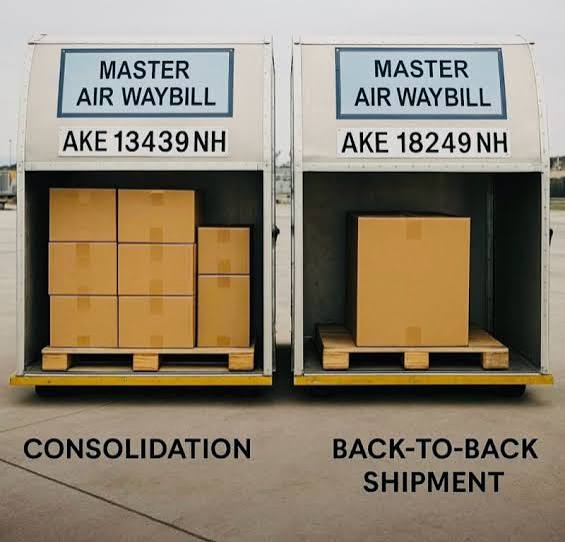
Back-to-Back Shipments
Why would an exporter pay for the administrative overhead of a House Air Waybill if their cargo isn’t being consolidated? In global B2B trade, this is a strategic move driven by two main operational requirements:
- Protecting Commercial Confidentiality: In cross-trade or drop-shipping scenarios, intermediaries often use a Back-to-Back structure to mask the identity of the original manufacturer from the ultimate buyer, and vice versa. The MAWB lists the forwarder and their agent, while the HAWB is amended to protect supply chain secrets.
- Forwarder Liability Control: When handling high-value electronics, fragile machinery, or cold-chain pharmaceuticals, freight forwarders issue a single HAWB to define their own specific terms of carriage, liability limits, and insurance conditions with the shipper, independent of the airline’s standard master terms.
Multi-Leg or Split Shipments
Cargo under one MAWB can be split across flights. Destination agents rely on HAWB references to correctly route individual pieces.
e-AWB and Digital Transition
Paper is rapidly disappearing. Forwarders transmit electronic FWB (for MAWB) and FHL (for house manifest) messages. Ensure your forwarder is e-AWB enabled with major carriers serving GCC routes for faster acceptance and reduced risk of lost documents.
Dangerous Goods or Regulated Cargo
Additional declarations on both documents become mandatory. Misalignment here leads to immediate rejection.
🌍
GCC Local Customs Systems: Synchronizing Your HAWB Data
In the GCC region, clearing air freight quickly requires strict alignment between your HAWB data and local digital customs platforms. Each country operates its own single-window system, and even minor discrepancies in descriptions or HS codes between your physical documents and these portals will flag your cargo for manual inspection.
Ensure your freight forwarder uploads accurate HAWB data matching these specific regional networks:
- Dubai (UAE): Mirsal II – Requires seamless electronic declaration linking manifest data to your HAWB for fast-track clearance through Jebel Ali and Dubai International (DXB).
- عربستان سعودی: SABER & FASAH – Compliance certificates and e-manifests must match the exact importer commercial registration and HAWB weights.
- Qatar: Al Nadeeb – The single-window system demands upfront digital submission of HAWB specifications before flight arrival to avoid severe port congestion penalties.
- Oman: Bayan – This integrated system runs automated risk management assessments based entirely on the data accuracy of the house air waybill.
Best Practices to Eliminate Errors and Delays
In high-frequency air freight corridors, operational excellence is defined by pre-emptive verification. Waiting for your cargo to arrive at the airport before checking documentation compliance is a multi-thousand-dollar gamble. To safeguard your supply chain against bottlenecks, integrate these seven industry-hardened protocols into your standard operating procedures:
1. Pre-Shipment Reconciliation
Never allow a shipment to be tendered to an airline without a dual-layer document review. Make it a strict contractual requirement for your freight forwarder to provide draft copies of both the MAWB and the HAWB manifest for your internal team’s approval 24 to 48 hours before physical cargo handover. This window gives you the necessary buffer to catch structural discrepancies, verify routing segments, and ensure special handling codes are correctly logged before data is transmitted to the carrier.
2. Exact Cross-Document Data Matching
Customs risk-assessment algorithms flag discrepancies, not just outright errors. Your commercial invoice, packing list, certificate of origin, HAWB, and MAWB must act as a perfectly mirrored data ecosystem. The total piece counts, gross weights, net weights, and commodity descriptions must reconcile down to the exact digit. If a forwarder rounds up a weight on the MAWB for airline billing purposes while the HAWB retains the exact packing list weight, the destination customs portal will automatically halt the de-consolidation process for a manual audit.
3. Absolute HS Code Discipline
Vague or generic cargo descriptions are the primary trigger for customs delays in modern B2B trade. Do not rely on broad 4-digit or 6-digit Harmonized System (HS) headers. Instead, enforce the use of the highly specific 8-to-10 digit tariff codes applicable in both the country of origin and the specific destination jurisdiction. Ensuring that your HAWB explicitly states the precise tariff classification accelerates automated green-channel clearance and guarantees accurate duty assessment upon arrival.
4. Leverage Advanced Digital Tools and Platforms
Manual document preparation using disjointed spreadsheets is a major liability. To eliminate the risk of human typographical errors, progressive traders utilize integrated logistics architecture that auto-populates and validates data fields across the entire shipping suite. Utilizing automated data engines—such as the trade compliance and documentation tools hosted on Platform.Tendify.Net—ensments are seamlessly mapped from the commercial invoice directly into standard e-AWB (FWB/FHL) message formats, eliminating manual entry risk entirely.
5. Stringent Security and Regulatory Compliance
Destination hubs across the globe now mandate pre-arrival security vetting. Your documentation must feature complete, un-abbreviated corporate names, exact physical addresses, and verified Know Your Customer (KYC) details for both the shipper and the consignee. When shipping into regional hubs, ensure that the HAWB details correspond perfectly with local compliance portals—such as matching the exact importer registration data required by Saudi Arabia’s SABER/FASAH networks or the UAE’s automated customs channels.
6. Bulletproof Insurance Alignment
In the unfortunate event of cargo damage, theft, or cold-chain breakdown, your documentation framework dictates the speed of your financial recovery. The insured value, currency designation, and coverage terms specified in your marine cargo policy must align flawlessly with the declarations stated on the HAWB. Furthermore, make sure your forwarder has not inadvertently checked the “Declined” or “NVD” (No Value Declared) box on the MAWB if your commercial agreements dictate carrier-level liability protection.
7. Proactive Destination Agent Coordination
The speed of your air freight is heavily reliant on the efficiency of the de-consolidation process at the destination airport. Before the flight departs, confirm that your primary forwarder has transmitted all electronic house manifests (FHL messages) to their breakthrough partner or destination agent at the arrival port. This agent must have clear, pre-vetted instructions tied directly to your specific HAWB number to ensure that the moment the master pallet is broken down, your individual cargo is immediately categorized for final customs clearance.
نکته حرفهای: Do not treat your shipping workflow as a static process. Build a standardized, digital documentation checklist with your preferred freight forwarders and mandate a formal quarterly review. Air freight regulations, customs portals, and regional compliance mandates evolve rapidly—your operational playbook must evolve with them.
مشکلات رایج و نحوه اجتناب از آنها
- “Cargo as per HAWB” Vagueness Without Attachment: Always ensure house manifests travel with (or are electronically linked to) the MAWB.
- Chargeable Weight Mismatches: Airlines charge based on MAWB. Disputes arise when HAWB totals do not reconcile.
- Consignee Name Variations: Even slight spelling differences can block release to the ultimate buyer.
- Late Document Submission: e-AWB messages must be transmitted before cargo acceptance.
The Role of Technology and Future-Proofing
In 2026, leading forwarders use AI-assisted validation to cross-check MAWB/HAWB data in real time. Blockchain pilots for document provenance are emerging in select GCC corridors. Staying with forwarders who invest in these technologies translates directly into faster clearance and lower total landed costs.
FAQ: MAWB vs HAWB Answered
Is the Air Waybill a document of title? No. Unlike ocean bills of lading, AWBs (both MAWB and HAWB) are non-negotiable. Goods are released to the named consignee upon arrival, subject to customs clearance and any outstanding charges.
Who pays the freight? MAWB shows charges between airline and forwarder (often prepaid or collect). HAWB details the commercial rate charged to the shipper, which may include forwarder margin and ancillary fees.
Can one MAWB cover multiple HAWBs? Yes—this is the standard consolidation model.
What happens if there is a discrepancy? Customs or the carrier may hold the cargo. The forwarder must amend documents, often incurring fees and delays.
How do I track my shipment? Use the HAWB number for customer-level visibility through the forwarder. The MAWB provides airline-level flight status.
Conclusion: Turn Documentation into a Competitive Advantage
Mastering MAWB and HAWB transforms a potential vulnerability into a source of speed and reliability. In competitive GCC and broader MENA markets, traders who eliminate documentation friction win repeat business, secure better rates, and scale faster.
For traders seeking to streamline not just air freight documentation but the full spectrum of cross-border operations—from HS code classification to contract generation and market intelligence—integrated platforms offer practical leverage. Explore tools that reduce administrative drag and enhance visibility.
Ready to professionalize your export workflows and accelerate growth in 2026? Register an account and start building more resilient, efficient trade operations today. https://tendify.net/my-account/
Related reading on the Tendify blog:

