


Blog
FIFA Tax-Free Empire: How Legal Structures and Offshore Flows Shape Global Sports Business
I’ve spent decades building supply chains across volatile borders, negotiating multimillion-dollar contracts, and watching how smart operators structure deals to minimize risk and maximize returns. What strikes me most in international trade isn’t just tariffs or logistics—it’s how certain organizations master the art of operating in legal gray zones that most businesses could never touch. The football economy, dominated by FIFA, offers one of the most instructive case studies in this space.

FIFA Tax-Free Empire
Whether you’re exporting machinery to the GCC, sourcing commodities, or scaling B2B operations, understanding these high-stakes financial architectures reveals why compliance, transparency, and strategic structuring matter more than ever in 2026. This isn’t abstract theory. It’s a blueprint (and a warning) for anyone moving capital, goods, or influence across borders.
The Emirates Goldmine: 9 High-Margin Products You Should Be Exporting to the UAE Now
The Scale of the Football Economy and Why It Matters for Global Traders
The global sports industry generates hundreds of billions annually, with football at its core. FIFA alone projects massive revenues—potentially $11 billion around major events like the 2026 World Cup—driven by broadcasting rights, sponsorships, marketing, and hosting deals.
Global Sports Trade Risk Playbook
For traders and executives, this isn’t entertainment. It’s a parallel economy with lessons on cash flows, risk management, and regulatory arbitrage. Just as you optimize container loads or navigate HS codes on platforms like ours, FIFA and affiliates have engineered structures that turn events into profit engines while shifting burdens to host nations.
Key revenue drivers include:
- Broadcasting and media rights (often 40%+ of income).
- Sponsorship and marketing partnerships.
- Ticket sales, licensing, and hospitality.
- “Development” funds funneled to confederations and national associations.
These streams create opportunities for legitimate growth but also vulnerabilities to opaque practices that echo challenges in cross-border trade: hidden intermediaries, valuation discrepancies, and jurisdiction shopping.
FIFA’s Swiss Legal Foundation: A Masterclass in Association Status
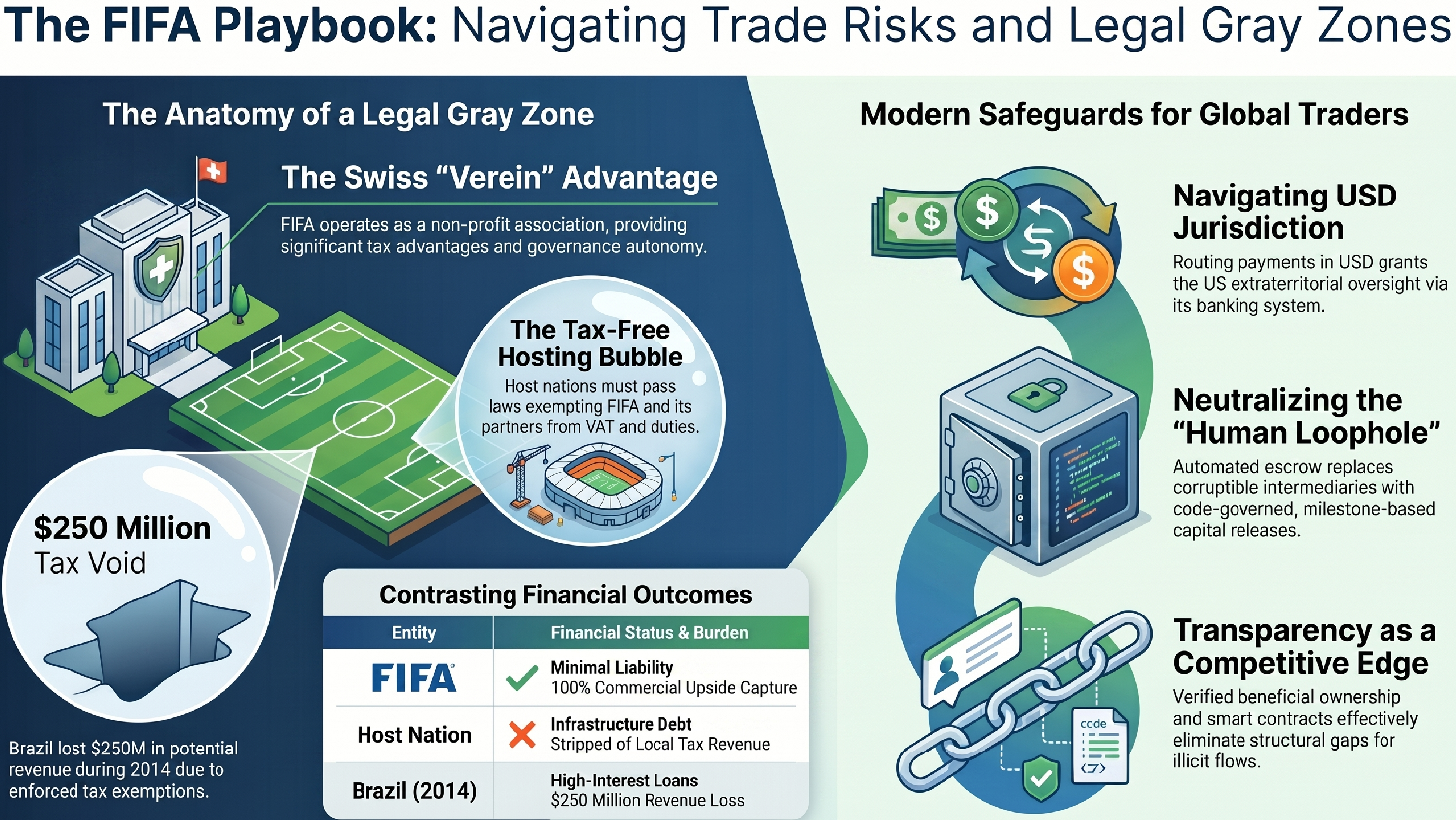
FIFA is headquartered in Zurich and registered under Swiss law as a Verein—a non-profit association, similar to a local sports club. Under Article 60 of the Swiss Civil Code, this status prioritizes public benefit (promoting football) over commercial profit.

FIFA’s Swiss Legal Foundation
Why this matters:
- Tax advantages: Minimal or zero corporate tax on core activities at the federal level. Revenues from events can flow with limited taxation in Switzerland itself.
- Governance flexibility: As a private association, FIFA sets its own rules with significant autonomy from national governments.
- Asset protection and opacity: Structures limit personal liability and complicate external scrutiny of internal finances.
This isn’t unique to sports. Many international organizations and NGOs use similar setups. For traders, it parallels choosing free zones in the UAE or other jurisdictions for tax efficiency—perfectly legal when done right, but requiring deep expertise to avoid pitfalls.
In practice, this allows FIFA to amass reserves in the billions while paying relatively modest taxes during peak periods. Host countries, meanwhile, invest billions in infrastructure with limited direct fiscal return during the event window.
Tax-Free Bubbles: The Hosting Contract Playbook
One of the most powerful mechanisms is the “Tax-Free Bubble” imposed on World Cup hosts. FIFA requires host nations to enact special legislation granting tax exemptions to the organization, its partners, sponsors, and personnel for the duration of preparations and the event.
How it works in practice:
- Host government passes enabling laws exempting FIFA-related income, imports, and activities from VAT, duties, and corporate taxes.
- This covers broadcasting deals, hospitality, merchandise, and more.
- Public funds cover stadiums, transport, and security—often with long-term debt—while FIFA retains tax-free profits.
📊 Case in Point: The $250 Million Tax Void
To put the financial weight of this “bubble” into perspective, consider the 2014 FIFA World Cup in Brazil. While the Brazilian government took on billions of dollars in high-interest loans to construct state-of-the-art stadiums and transit lines, the tax exemptions enforced by FIFA’s hosting contract stripped the country of an estimated $250 million (approx. 1 billion BRL at the time) in potential tax revenue.
For commercial strategists, this is a stark lesson in asymmetrical contract negotiation. FIFA successfully captured 100% of the commercial upside from broadcasting and corporate sponsorships, completely shielded from local liabilities, while the sovereign host absorbed all the long-term fiscal deficit.
This model has been replicated across cycles, including controversies around Russia 2018 and Qatar 2022. For business leaders, it’s a reminder of how powerful entities negotiate sovereign concessions. In trade, think of it like securing duty exemptions or special economic zone benefits—but on a governmental scale.
Actionable insight: When entering large government or event-related tenders (common in GCC reconstruction or infrastructure), map out tax and incentive clauses early. Tools like duty calculators help model these scenarios precisely.
The Secure Transaction Protocol: Navigating GCC Trade Finance in 2026
The 2015 Scandal and Money Laundering Allegations: What Really Happened
The 2015 FIFA corruption scandal (often called FIFAgate) exposed systemic issues. U.S. authorities indicted officials and executives on racketeering, wire fraud, and money laundering charges involving over $150 million in bribes related to media rights and hosting votes.
Core mechanisms highlighted:
- Marketing rights deals: Rights sold below market value to intermediaries, with kickbacks routed through offshore accounts.
- Hosting vote influence: Alleged payments disguised as development aid to secure bids.
- Banking flows: Use of accounts in multiple jurisdictions to layer and obscure funds, triggering AML scrutiny.
Money laundering here refers to integrating illicit gains into legitimate streams—classic trade-based techniques like over/under-invoicing or using shell entities, which traders must vigilantly avoid to stay compliant.
Post-scandal reforms included governance changes, but challenges persist. The case underscores how even high-profile entities face extraterritorial enforcement when touching U.S. financial systems or citizens.
💡 Geopolitical Insight: The De-Dollarization Lesson of FIFAgate
For B2B executives trading within the GCC, MENA, and ECO regions, the 2015 scandal carries a massive geopolitical warning. Many ask: How did the U.S. DOJ arrest Swiss citizens on Swiss soil over an organization based in Zurich?
The answer lies in the currency. Because the illicit bribes were routed in U.S. Dollars (USD), they inevitably cleared through the New York banking system (CHIPS). In international law, touching the U.S. dollar clearing system grants Washington extraterritorial jurisdiction. This reality is a primary driver behind the modern de-dollarization trends we are seeing in global trade today. If your supply chain relies entirely on legacy clearing systems, you remain subject to overseas regulatory oversight.
Lessons for Modern Traders: Compliance in a High-Risk World
FIFA’s story isn’t isolated. Similar dynamics appear in global commodities, construction, and energy deals—sectors central to platforms like Tendify.
Practical strategies to protect your operations:
- Due diligence on partners: Verify beneficial ownership and payment flows. Red flags include complex offshore structures without clear business purpose.
- Contract safeguards: Include robust anti-corruption, AML, and audit clauses. Specify governing law and dispute resolution carefully.
- Documentation discipline: Maintain impeccable records for audits. Use tools like export checklists and proforma builders to standardize processes.
- Tax and valuation integrity: Avoid practices resembling under/over-invoicing, which can trigger customs penalties or laundering probes.
In high-risk markets, escrow services or trust accounts (as offered in modern B2B platforms) provide safer alternatives to traditional letters of credit.
Tech Without Borders: The Comprehensive Roadmap to Globalizing Your Innovation
🛡️ Tech Architecture: How Escrow Eradicates the “FIFA Loophole”
The core vulnerability in FIFA’s legacy model was its heavy reliance on human intermediaries—marketing agencies, shell company brokers, and corrupt sports officials who manually signed off on over-invoiced contracts. This is exactly where traditional Letters of Credit (LCs) and legacy cross-border bank wires fail modern traders; they leave too much room for human discretion, hidden backbacks, and opaque routing.
Modern B2B trade platforms neutralize this risk through Smart Contracts and Automated Escrow Services. By locking funds in a decentralized or code-governed trust account, capital is only released when hard, verifiable cryptographic or logistical milestones (like clean Bill of Lading data) are met. By stripping away the human middleman, fintech-driven escrow systems effectively eliminate the structural gaps that allowed FIFA’s multi-million dollar dark cash flows to slip through undetected.
Internal resources worth checking:
- For tariff modeling: Explore related calculators on the site.
- Compliance playbooks: Articles on customs valuation and documentation.
Risk Management: Building Resilient International Operations
From my experience, the “why” behind these structures is efficiency and control. But the cost is eroded trust and regulatory backlash. Smart businesses invest in transparency as a competitive edge.
Step-by-step compliance framework:
- Map your exposure: Identify jurisdictions, counterparties, and payment paths.
- Implement controls: Training, third-party audits, and tech-enabled monitoring.
- Leverage data: Real-time tools for market intelligence and risk scoring.
- Scenario planning: Model sanctions, currency, and political risks.
- Continuous education: Stay updated on evolving AML/FATF standards.
Platform.Tendify.Net equips traders with practical engines—from sanctions checkers to logistics optimizers—to navigate these complexities without the guesswork. Whether optimizing warehouse flows or ensuring compliant documentation, having the right toolkit turns potential vulnerabilities into strengths.
The Broader Impact on Global Trade and Sports Business
FIFA’s model influences how mega-events drive economic activity: construction booms, tourism, and supply chain opportunities. Yet it also highlights imbalances—hosts bear costs, while the governing body captures upside with minimized liabilities.
For exporters, this creates openings in infrastructure, security, and services around major events. But success demands navigating the same compliance landscape that tripped up others.
Emerging trends include greater scrutiny on sports washing, ESG integration in sponsorships, and digital transparency tools. Businesses ignoring these shifts risk reputational and financial damage.
Why Mastering These Dynamics Gives You an Edge
In an era of heightened regulatory focus, knowledge of structural incentives separates survivors from casualties. FIFA’s longevity despite scandals shows the power of adaptable legal architectures. Your business can achieve similar resilience through proactive structuring.
Focus on value creation over shortcuts. Build networks on trust. Use technology to de-risk operations.
At the end of the day, sustainable success in global trade comes from understanding incentives—yours, your partners’, and the regulators’—and designing systems that align with them ethically.
Ready to strengthen your trade operations with battle-tested tools? Head over to Platform.Tendify.Net to explore AI-powered engines, compliance resources, and direct B2B connections that help you trade smarter and safer in 2026 and beyond. Whether it’s duty calculations, document builders, or market intelligence, the platform is built for professionals like you who demand efficiency without compromise.

