


Blog
GCC Rail Freight: Is Your Supply Chain Ready for the Transition?
A single delayed customs clearance on a truck convoy can wipe out the margin on a 40-foot container moving between Dammam and Sohar. Multiply that friction across six sovereign borders and the cost of intra-GCC trade becomes a structural tax on every exporter, importer, and 3PL operating in the region. The GCC Railway was designed to remove that tax. By mid-2026 the network had crossed the 50 percent completion mark, with full commercial operation still targeted for December 2030. Operational experience across Gulf logistics corridors shows the deadline remains ambitious precisely because the hardest work is no longer earthworks—it is regulatory alignment, financing sequencing, and the daily coordination of six national systems.
GCC Rail Freight
This guide maps the current physical progress, the operational bottlenecks that will decide whether 2030 is realistic, and the concrete steps B2B firms should take now to position for the first usable cross-border rail freight lanes.
Current Physical Status of the GCC Railway Network
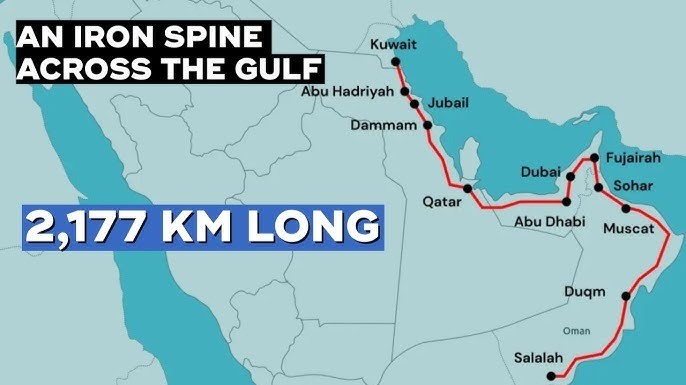
The project links Kuwait, Saudi Arabia, Bahrain, Qatar, the United Arab Emirates, and Oman on a standard-gauge network designed for both freight (80–120 km/h) and passenger services (up to 200–220 km/h). Length figures published by the GCC Railways Authority and national operators range between 1,700 km and 2,177 km depending on whether spur lines and national connections are counted. The main spine runs from Kuwait City south through the Eastern Province of Saudi Arabia, then branches toward Bahrain and Qatar before continuing through the UAE to Oman.
As of May–June 2026 the Director General of the GCC Railways Authority confirmed overall completion above 50 percent. Progress is uneven:
- The UAE has the most advanced national segment. Etihad Rail’s roughly 900 km freight network is already moving cargo between industrial zones, ports, and logistics hubs. Passenger services between major emirates were scheduled to begin in 2026. The UAE’s portion of the wider GCC network is listed at approximately 684 km.
- The UAE–Oman Hafeet Rail link (238–303 km connecting Abu Dhabi / Al Ain to Sohar) reached 40–50 percent completion in 2026, with track-laying underway. This is the first genuine cross-border freight corridor under construction and serves as the operational proof-of-concept for the rest of the network.
- Saudi Arabia’s section (approximately 663–672 km from the Kuwait border at Al-Khafji via Dammam to the UAE border at Al-Batha) moved into detailed design tendering in mid-2026. Saudi Arabian Railways is also advancing parallel national projects, including elements of the Landbridge that will eventually give Red Sea–Gulf connectivity.
The GCC Railway does not operate in a vacuum. It sits alongside broader sovereign logistics initiatives and intercontinental trade corridors designed to bypass maritime chokepoints and diversify supply routes across the Middle East.
- Saudi Landbridge Integration: While the GCC network focuses on intra-regional integration along the Gulf coast, Saudi Arabia’s Landbridge acts as a key east-west spine, connecting Red Sea ports (Jeddah) directly to Gulf hubs (Dammam) to bypass maritime bottlenecks like the Bab al-Mandab strait.
- Complementary “Green Corridors” (IMEC): Strategic frameworks like the India-Middle East-Europe Economic Corridor (IMEC) and regional bilateral Green Transit Corridors aim to overlay clean energy, digital infrastructure, and hydrogen transport onto these same physical rail tracks.
- Synergy Over Competition: For B2B traders, national landbridges and international green corridors are mutually supportive—providing multi-layered redundancy whenever maritime shipping routes face geopolitical friction.
- Kuwait signed an engineering and consultancy contract for its roughly 111–145 km section. Bahrain’s short link (around 36 km, including a planned bridge connection) and Qatar’s 283 km segment remain in planning and design stages.
Freight volume projections published by the Authority estimate 200 million tonnes in the first full year of operation rising to 271 million tonnes by 2045. Passenger numbers are forecast to start at six million and climb above eight million over the same period. These figures assume the network functions as a single system rather than six separate national lines.
Why the 2030 Target Is Still Ambitious
Track can be laid faster than six customs regimes, technical standards, and border-control protocols can be harmonised. Operational reviews of similar multi-country rail projects show that the last 20 percent of physical construction often coincides with the most difficult regulatory and commercial negotiations. Three structural constraints dominate:
1. Cross-border regulatory friction
A train that stops for full documentary inspection at every frontier loses its commercial advantage over trucks. Harmonising HS-code treatment, phytosanitary and veterinary certificates, dangerous-goods rules, and electronic data exchange across six jurisdictions is the single largest remaining risk to the 2030 date. Analysts tracking the project have repeatedly flagged that policy coordination has lagged physical works.
Bypassing Customs Bottlenecks: Automated Digital Documentation
Physical high-speed rail means little if cargo is held up by mismatched documentation at multi-jurisdictional frontiers. Resolving border friction requires shifting from manual, paper-heavy compliance to standardized, digitally-precleared trade data across GCC customs gateways.
- Harmonized HS-Code Mapping: Discrepancies in 6-to-8 digit tariff classifications between exporting and importing GCC states trigger physical inspections. Automated HS-code alignment tools eradicate classification errors before manifest submission.
- Structured Proforma & Commercial Data: Transitioning to digital proforma generators ensures commercial invoices, packing lists, and certificates of origin feed seamlessly into national single-window customs systems (such as FASAH or Bayan).
- Integrated Compliance Utilities: Traders can utilize automated invoice generation and tariff compliance software on Platform.Tendify.Net to audit trade documentation and pre-verify landed costs prior to dispatch.
2. Financing and sequencing
Each member state funds its own section. Earlier cost estimates for the core linkage sat around $15 billion; broader figures that include full national networks, stations, and supporting logistics infrastructure have ranged far higher. Oil-price cycles have delayed capital allocation in the past. Current geopolitical pressure on maritime chokepoints has accelerated political commitment, yet the actual release of multi-year budgets still depends on national fiscal calendars.
3. Technical and operational interoperability
Signalling (ETCS Level 2 is the stated standard), axle-load limits, loading-gauge clearances, and train-control systems must be identical or fully compatible. Land acquisition, desert hydrology, and the need for flood-protection works on certain UAE–Oman sections add engineering complexity. Passenger and freight services will share infrastructure in places, requiring precise capacity planning that is still being refined.
Geopolitical tension around the Strait of Hormuz in 2026 has strengthened the strategic case for an overland alternative. Leaders explicitly accelerated the railway after maritime disruption highlighted the vulnerability of truck and sea routes. That political tailwind is real; it does not automatically compress the time required for customs union-level coordination.
What the Network Actually Changes for B2B Supply Chains
Once operational, the GCC Railway will not replace sea or air freight for long-haul international moves. Its primary value is intra-GCC and near-GCC redistribution: moving bulk, containerised, and project cargo between ports, free zones, industrial cities, and inland consumption centres at lower cost and with higher predictability than road.
Practical advantages already visible in early UAE freight operations include:
- Removal of millions of truck-kilometres from highways, cutting road congestion, accident risk, and carbon emissions.
ESG & Carbon Commercial Advantage: Monetizing Green Supply Chains
For multinational enterprises and Tier-1 regional distributors, shifting freight from heavy diesel trucks to electrified or high-efficiency diesel rail is not merely an operational decision—it is a core ESG driver. Rail freight generates up to 75% fewer carbon emissions per tonne-kilometre compared to road transport.
- Scope 3 Emissions Reduction: Transitioning core Gulf corridors to rail directly tackles upstream and downstream logistics emissions, simplifying compliance with global corporate sustainability disclosures.
- Competitive Procurement Advantage: Global brands increasingly mandate low-carbon logistics in their GCC RFPs (Request for Proposals). Early rail adoption positions 3PLs to win high-value corporate tenders.
- Green Financing & Tariffs: Aligning supply chain infrastructure with GCC national net-zero targets opens opportunities for green trade financing incentives and protection against future regional carbon/fuel taxes.
- Ability to schedule regular block trains between major logistics nodes rather than relying on ad-hoc road capacity.
- Integration potential with existing free-zone and bonded-warehouse regimes, allowing goods to move under customs control with simplified documentation once electronic systems are linked.
- Lower inventory buffers for distributors serving multiple GCC markets because transit times become more reliable.
For exporters and importers the commercial question is not whether the railway will exist in 2030, but which segments become usable first and under what commercial terms. The UAE–Oman Hafeet corridor is the earliest candidate for regular cross-border freight. Saudi–UAE and Saudi–Kuwait links will follow once design and construction on the Saudi spine advance.
Step-by-Step Preparation for Operators and Traders
Firms that treat the railway as a 2030 event will miss the staged openings that begin earlier. The practical sequence is:
- Map your current Gulf origin–destination pairs against the published alignment. Identify which of your high-volume lanes will sit on or near the first operational segments (especially UAE–Oman and the Saudi Eastern Province spine).
- Review existing contracts with freight forwarders and 3PLs for rail-readiness clauses. Many current road contracts contain volume commitments or exclusivity language that will need renegotiation once rail capacity appears.
- Engage early with national rail operators (Etihad Rail, Saudi Arabian Railways, Oman Rail) on commercial terms, wagon availability, and terminal access. Early adopters typically secure better slot priority and clearer pricing.
- Audit documentation processes for electronic compatibility. Rail will reward parties that can transmit commercial invoices, packing lists, certificates of origin, and dangerous-goods declarations in structured digital form.
- Model total landed cost under three scenarios: pure road, pure rail (once available), and multimodal (rail trunk + short road last-mile). Include demurrage, detention, and inventory-holding cost differentials. The numbers usually favour rail for distances above 400–500 km once terminal handling is efficient.
- Monitor the Hafeet Rail construction progress and the Saudi design tenders as leading indicators. Physical milestones on these two segments will signal when commercial trials become realistic.
Critical Consideration: Accounting for Hidden Last-Mile & Handling Costs
Rail infrastructure rarely connects door-to-door. A common oversight in multimodal feasibility modeling is treating rail freight rates as the total transit cost. Moving cargo from a primary rail terminal to an inland warehouse requires uncoupling, drayage trucking, and secondary handling.
- Terminal Lift & Transfer Fees: Account for container crane lifts (lift-on/lift-off) and short-term intermodal yard storage.
- Final-Leg Drayage Dynamics: Ensure local drayage fleets operate with compatible chassis and under pre-cleared customs status to avoid dwell-time penalties.
- Incoterm Alignment: Transition contracts from traditional door-to-door road terms (e.g., DAP) to intermodal-friendly terms like FCA (Free Carrier) or CPT (Carriage Paid To) to clearly delineate transfer-of-risk at the rail ramp.
Strategic Contracting: Aligning Incoterms 2020 for Rail & Multimodal Freight
Shifting cross-border flows from pure road transport to rail alters where operational risk, cost, and insurance liability transfer between buyer and seller. Relying on traditional maritime or road-centric delivery terms creates liability gaps at rail terminals.
- Shift to Multimodal Rules: Transition commercial invoices and sales contracts away from sea-only terms (like FOB or CIF) toward multimodal terms like FCA (Free Carrier), CPT (Carriage Paid To), or CIP (Carriage and Insurance Paid To).
- Precise Point of Delivery: Under FCA, risk transfers when goods are delivered to the named rail terminal or handed over to the rail carrier—not when the train crosses the border.
- Clear Terminal Duty Division: Ensure sales terms explicitly clarify which party bears the cost of rail terminal handling (THC), container demurrage, and customs clearance delays at inland dry ports.
Tools that already exist for HS-code classification, duty estimation, and end-to-end trade-cost modelling remain useful while the rail network matures. One such utility set is available at Platform.Tendify.Net for rapid scenario comparison.
Related Operational Guides
For deeper treatment of complementary logistics topics already covered on the platform, see the analysis of demurrage and detention cost control in GCC ports and the practical comparison of free-zone versus mainland versus bonded re-export setups. Both remain relevant whether cargo moves by truck today or by rail tomorrow.
The Strategic Reality Check
The GCC Railway is no longer a conceptual rendering. More than half the physical network is complete or under active construction. The remaining risk is not whether steel will be laid, but whether the six national systems will function as one commercial corridor by the end of 2030. Customs harmonisation, financing discipline, and technical interoperability will decide the difference between a series of national lines and a true regional freight artery.
Operators who wait for the official launch ceremony will find capacity already allocated and commercial terms set by early movers. Those who treat the next four years as a staged build-out—mapping lanes, engaging operators, and cleaning documentation processes—will capture the first reliable, lower-cost intra-GCC rail capacity as it appears.
The physical infrastructure is advancing. The competitive advantage will belong to the firms that have already aligned their supply-chain architecture with the new map.
Download Professional Executive Guides & Checklists (PDF)
Essential resources for GCC rail readiness, landed cost optimization, and market intelligence.
Frequently Asked Questions
GCC Multimodal Rail Logistics & Trade Transition
Key insights on cross-border infrastructure, Incoterms realignment, customs data compliance, and landed cost modeling.
Q1: What is the primary operational advantage of transitioning cross-border GCC freight from road to rail?
Rail freight offers significantly higher volume density and lower linehaul transport costs over distances exceeding 400 km. A single freight train can replace up to 300 heavy trucks, reducing fuel burn, carbon emissions, and border inspection bottlenecks at traditional land crossings.
Q2: Why must commercial contracts replace maritime Incoterms (FOB/CIF) when shipping via rail?
Maritime rules like FOB or CIF require transfer of risk when cargo passes the ship’s rail, which does not exist at inland rail terminals. Using multimodal Incoterms® 2020 rules such as FCA, CPT, or CIP clearly defines risk transfer and cost responsibilities at intermodal rail ramps.
Q3: How does digital customs data alignment affect transit speed across GCC borders?
Cross-border rail movements rely on pre-arrival clearance via national single-window systems (e.g., FASAH in Saudi Arabia or Bayan in Oman). Inconsistent 8-digit HS-code classifications or manual paper manifests lead to dry port holds, resulting in severe yard demurrage penalties.
Q4: What is the financial break-even distance for rail freight versus direct trucking in the GCC?
Due to fixed intermediate handling fees—such as terminal crane lifts (Lift-on/Lift-off) and short-haul drayage trucking—rail freight typically reaches cost parity and delivers net savings on routes over 400 to 500 kilometers.
Q5: How can B2B importers and exporters prevent dry port demurrage charges?
Demurrage can be minimized by transmitting structured electronic commercial invoices and origin certificates 24 hours prior to train departure, synchronizing last-mile chassis availability with train arrival schedules, and negotiating 48 to 72 hours of free storage time in 3PL service contracts.

