


Blog
Hafeet Rail Guide: How to Cut GCC Freight Costs by 40%
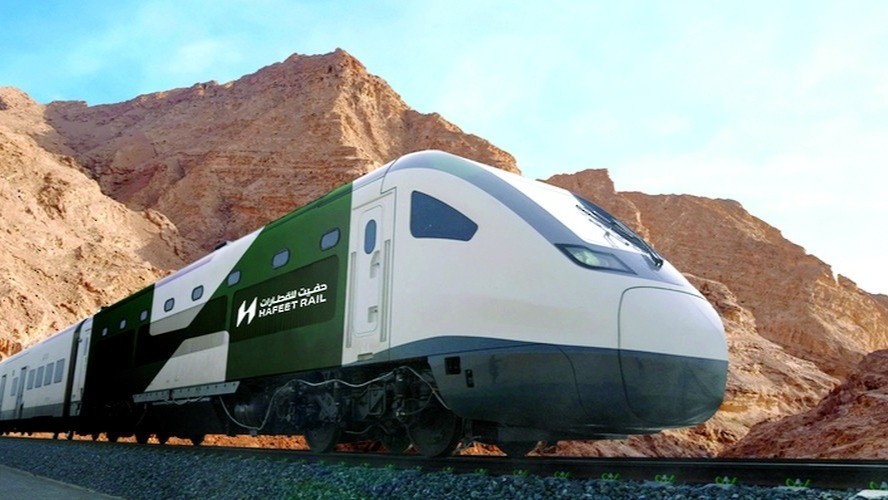
A single freight train can now move the equivalent of nearly 300 trucks between the industrial zones of Al Ain and the deep-water berths of Sohar in roughly 100 minutes. That is not a projection for 2030. Track-laying is already under way on the first cross-border railway segment of the GCC network, and the operational window is closing fast for companies that still treat road and coastal shipping as the only viable options.
Hafeet Rail—named after the mountain that straddles the UAE–Oman border—is a 238-kilometre dedicated corridor linking Etihad Rail’s national network at Al Ain with Sohar Port and Freezone. It is being delivered by a joint venture of Etihad Rail, Oman Rail and Mubadala. As of mid-2026 the project sits at approximately 40 percent complete, with more than 27 million cubic metres of earthworks finished, over 100,000 cubic metres of concrete placed, 80 major structures advancing, and track installation commenced.
For B2B operators moving bulk minerals, petrochemicals, steel, agricultural commodities or containerised general cargo, the corridor changes the cost, time and risk equation of cross-border movement inside the Gulf. This guide walks through the engineering realities, commercial mechanics, capacity numbers, and the practical steps required to position inventory and contracts ahead of commercial service.
Why This Corridor Matters More Than Another Road Upgrade
Road transport between the UAE and northern Oman remains constrained by border processing times, axle-load limits, driver availability and seasonal weather exposure. Coastal shipping via the Strait of Hormuz adds another layer of schedule variability and insurance cost. Hafeet Rail removes both variables for the core Al Ain–Sohar axis.
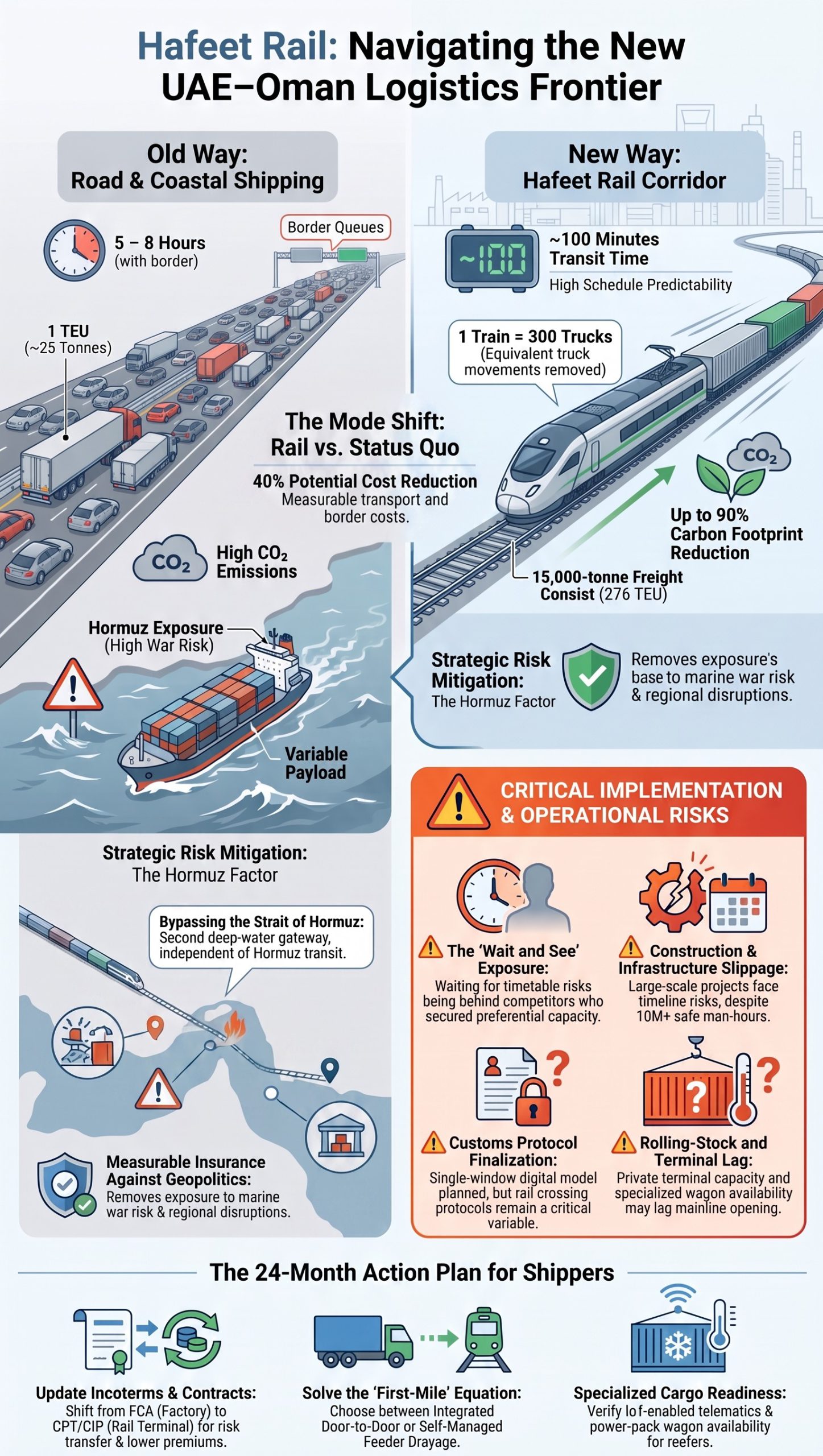
Hafeet Rail Logistics Comparison Guide
Freight trains are designed for 120 km/h and will carry approximately 15,000 tonnes—or roughly 270–276 TEU—per consist. Passenger services, when introduced, will run at up to 200 km/h and cut the Abu Dhabi–Sohar journey to about 100 minutes. Early modelling points to logistics cost reductions in the region of 40 percent for suitable cargoes once the line is fully operational and utilisation climbs.
The strategic geography is equally important. Sohar sits outside the Strait of Hormuz. Once the rail link is live, UAE industrial zones gain a second, rail-connected deep-water gateway that does not depend on Hormuz transit. For exporters and re-exporters, that redundancy is measurable insurance.
| Metric | Road Freight (Trucking) | Coastal Shipping | Hafeet Rail Corridor |
|---|---|---|---|
| Transit Time (Al Ain to Sohar) | 5 – 8 Hours (Includes border delays) | 2 – 3 Days | ~100 Minutes (Direct rail link) |
| Payload Capacity (Per Consist) | 1 TEU / ~25 Tonnes | Variable (Feeder vessels) | 276 TEU / 15,000 Tonnes (~300 trucks) |
| Strait of Hormuz Exposure | None | High Exposure (War risk insurance) | Bypassed Entirely (Direct overland) |
| Carbon Footprint / Sustainability | High CO2 Emissions | Moderate Emissions | Up to 90% CO2 Reduction |
| Schedule Predictability | Low (Traffic & border queues) | Moderate (Weather & port congestion) | High (Fixed timetables) |
Project Specifications That Affect Your Operations
Route and alignment The line runs from the Etihad Rail connection near Al Ain, crosses the border near Al Buraimi, continues through Wadi Al Jizzi and terminates at Sohar Port and Freezone. The alignment crosses urban, industrial, mountainous and wadi terrain, which explains the high number of bridges (reported figures range from 36 to 60, some up to 34 metres high) and tunnels (two main tunnels totalling approximately 2.5 km). Flood-protection systems are integrated because the Hajar Mountains generate intense seasonal runoff.
Cross-Border Customs Digitalisation & Pre-Clearance Framework
Physical border friction has historically been the primary bottleneck for road freight between the UAE and Oman, where customs queues and manual documentation can consume hours. Hafeet Rail is designed around a fully digitalised, single-window customs model integrated into both Emirati and Omani authority systems.
Digital Pre-Clearance: Cargo manifests, HS-code classifications, and risk assessments will be submitted and processed digitally while the train is in transit, eliminating static border processing for compliant cargo.
Non-Intrusive Inspection (NII): Intermodal yards at border nodes are being equipped with high-throughput rail scanner portals, allowing container scanning at speed without decoupling wagons or halting the train.
Single-Window Administrative Integration: Unified customs protocols between UAE Federal Customs Authority and Oman Customs mean that cleared block trains will pass through border facilities in dedicated clearance windows, reducing border dwell time from several hours to a scheduled operational stop.
Technical parameters
- Design axle load supports heavy freight (up to 32.4 tonnes per axle on the installed rail).
- Signalling and control systems are being specified for interoperability between the Emirati and Omani networks.
- Dedicated freight terminals and intermodal yards are planned at key nodes to minimise handling time.
Current construction status (mid-2026) Earthworks, foundation piles (900+), box culverts (130+) and major structures are well advanced. Track-laying began in June 2026. Safety performance has exceeded 10 million man-hours without major injury—an operational detail that matters when assessing contractor reliability for future private sidings or terminal build-outs.
Commercial Capacity and Service Profile
Once commercial freight operations begin, the corridor is expected to support high-frequency container and bulk services. One early commercial agreement already signed is with Noatum Logistics (AD Ports Group) for seven container trains per week, each rated at 276 TEU, equating to an annual throughput potential of roughly 193,200 TEU on that single service alone. The agreement covers 20-ft, 40-ft and 45-ft equipment and is designed for general cargo, manufactured goods, food products, pharmaceuticals and agri-foods.
Bulk operators moving aggregates, steel, petrochemicals or minerals will see even larger per-train payloads. A single 15,000-tonne train removes the equivalent of approximately 270–300 truck movements from the border roads, with corresponding reductions in fuel, driver hours, insurance and border-queue risk.
Cost, Time and Emissions Impact—What the Numbers Actually Mean
Rail is structurally cheaper per tonne-kilometre than trucking for dense, high-volume cargo once terminal handling and first/last-mile legs are optimised. Early projections of 40 percent logistics cost reduction assume reasonable utilisation and efficient intermodal transfer. Transit time savings are more immediate: the rail journey itself is scheduled at roughly 100 minutes between the key nodes, versus several hours by road including border processing.
Carbon intensity drops by roughly an order of magnitude compared with pure road haulage for the same tonnage. For companies with Scope 3 reporting obligations or buyers that score suppliers on emissions, the rail option becomes a measurable advantage rather than a nice-to-have.
Commercial Pricing Models & Tariff Framework
While early industry modeling projects an aggregate logistics cost reduction of up to 40 percent compared to road haulage, unlocking these savings depends heavily on how commercial agreements and rate structures are negotiated. Commercial tariffs on the Hafeet Corridor are structured around operational density, commitment longevity, and equipment type rather than flat-rate freight movement.
1. Ton-Kilometre (Ton-KM) Base Tariff Structures
Point-to-point pricing utilizes a distance-weight formula tailored to high-density bulk minerals and petrochemical flows, drastically driving down unit costs over long-haul intermodal legs.
2. Volume-Based Discounts & Take-or-Pay Commitments
B2B shippers entering long-term take-or-pay capacity agreements (or guaranteed annual TEU allocations) secure substantial volume rebates, mirroring the preferential rate tiering seen in major early-mover logistics contracts.
3. Differentiated Container vs. Specialized Rolling-Stock Pricing
Standard 20-ft, 40-ft, and 45-ft container slots follow standardized matrix tariffs, whereas specialized equipment (such as liquid tank-containers, temperature-controlled reefers, or hopper wagons for aggregate minerals) incorporates specialized handling premiums at terminal nodes.
Strategic Takeaway: To maximize landed-cost efficiency, commercial teams should benchmark their current door-to-door road freight costs against Hafeet Rail’s tiered volume structures prior to full commercial line activation.
Target Cargoes and Sector Playbooks
Minerals and aggregates High-density bulk is ideal for rail. Mines and quarries already connected or proximate to the Etihad network can feed trains that discharge directly into Sohar’s bulk terminals or free-zone storage.
Petrochemicals and polymers Existing UAE production clusters gain a second export route that avoids Hormuz congestion. Tank-container and specialised wagon solutions will be required; early engagement with rolling-stock providers is advisable.
Steel and construction materials Both countries continue large-scale infrastructure programmes. Rail reduces the landed cost of rebar, structural sections and finished products moving in either direction.
Agricultural and food products Temperature-controlled containers and reliable schedules support higher-value chilled and frozen cargo that currently faces road reliability constraints.
Cold Chain Infrastructure & Reefer Operations
Transporting temperature-sensitive perishables, fresh produce, and pharmaceuticals across the GCC requires unbroken cold chain integrity. Hafeet Rail incorporates specialized reefer (refrigerated container) infrastructure to eliminate thermal spikes during cross-border transit:
1. On-Wagon Power Supply & Genset Integration
Flatcar wagons configured for reefer transport are supported by central power-pack wagons or individual clip-on diesel generators (gensets). This ensures continuous electrical power to reefer cooling units throughout line-haul transit, preserving climate zones ranging from deep-frozen (-25°C) to chilled (+2°C to +8°C).
2. Real-Time Telematics & Temperature Monitoring
Reefer units operating on the corridor utilize IoT-enabled telematics, giving shippers real-time visibility over internal temperatures, humidity levels, airflow, and power status. Automated alerts notify control centres immediately if thermal thresholds drift.
3. Terminal Reefer Plugs & Cold Storage Nodes
Intermodal yards at Al Ain and Sohar Port feature dedicated reefer-plug capacity and cold-chain staging zones. These prevent temperature loss during first-mile/last-mile drayage handoffs and customs clearance windows.
Logistics Impact: By replacing unpredictable border queues with a ~100-minute powered rail transit, agro-commodity traders and pharma distributors significantly reduce spoilage risk, insurance claims, and diesel burn from idling reefer trucks.
Retail and e-commerce Containerised consumer goods can move overnight between UAE fulfilment centres and northern Oman distribution points, shortening replenishment cycles.
Solving the First-Mile & Last-Mile Equation
A core operational question for cargo owners in industrial hubs like Jebel Ali, Dubai Industrial City, or Sharjah is how inventory moves to the Al Ain rail ramp. Rail line haul only yields cost efficiency if the first- and last-mile legs are seamlessly integrated. Shippers can navigate this transition through two primary models:
1. Integrated Door-to-Door (Carrier-Haulage)
Major logistics partners and anchor operators (such as Noatum Logistics under AD Ports Group) offer end-to-end multimodal execution. Under this framework, feeder trucking from factory floors or warehouses in Dubai/Sharjah to the Al Ain intermodal yard, terminal drayage, and onward rail haulage to Sohar are bundled under a single bill of lading (BL).
2. Self-Managed Feeder Drayage (Merchant-Haulage)
High-volume shippers with existing road fleets or long-term trucking contracts can handle local drayage independently. Cargo is trucked via major highway corridors (e.g., E66 or E11/E30) directly into dedicated inland container depots (ICDs) or private sidings at Al Ain, handed off for rail loading, and collected by local Omani transport providers at Sohar Port and Freezone.
Action Item for Supply Chain Managers: Evaluate whether your volume justifies direct terminal drop-offs (Merchant-Haulage) or if partnering with an integrated 3PL for consolidated feeder trucking provides better risk management against terminal dwell fees.
Practical Steps for Shippers and Logistics Providers
- Map your current volume against the corridor
Identify SKUs or bulk streams that move regularly between the UAE and northern Oman or that could be re-routed via Sohar for onward global export. Quantify annual tonnage or TEU and the current door-to-door cost. - Engage terminal and first/last-mile partners early
Rail only delivers value if the intermodal transfer is efficient. Speak with Sohar Freezone operators, Al Ain logistics parks and existing Etihad Rail freight users about private sidings, block-train slots and container-yard capacity. - Review contract language
Incoterms, demurrage/detention clauses, and force-majeure language written for road or pure maritime legs will need updating. Rail schedules are more predictable but still require clear hand-over protocols at terminals. - Model the dual-gateway option
For cargo currently exiting via Jebel Ali or Khalifa Port, calculate the landed-cost difference of routing via Sohar once rail is live. The difference is not only freight rate; it includes insurance, inventory holding and schedule reliability. - Monitor service announcements
Commercial capacity will be released in phases. Early committed volume often secures better rates and preferential slots. The Noatum agreement already signals that major logistics groups are locking in capacity.
Incoterms 2020 & Cross-Border Contract Alignment
Transitioning cross-border freight from road trucking to rail requires updating international commercial contracts. Incoterms designed for maritime (FOB/CIF) or point-to-point road haulage (DDP) can expose buyers and sellers to unexpected demurrage fees, double-insurance risks, or ambiguous risk-transfer points at intermodal rail terminals.
1. Shifting from FCA (Factory) to CPT / CIP (Rail Terminal)
Operational Realistm: Under traditional road delivery, sellers often used FCA (Free Carrier) at their manufacturing plant in Dubai or Sharjah. For rail operations, switching to CPT (Carriage Paid To) or CIP (Carriage and Insurance Paid To) named at the Al Ain Rail Ramp or Sohar Inland Depot clearly assigns the responsibility and cost of first-mile drayage and rail line-haul to the seller, while transfer of risk occurs as soon as the cargo is delivered into the custody of the rail carrier.
2. Managing Multi-Modal Insurance & Liability Thresholds (CIP Limits)
Insurance Coverage: Under Incoterms 2020 CIP, sellers are obligated to purchase high-level insurance (Clause A / All Risks). Because rail transport dramatically lowers the risk profile compared to road transport (fewer accidents, lower cargo theft, no border queuing damage), insurance underwriters offer reduced premiums for rail-leg movements—provided the contract explicitly specifies rail as the primary transit mode.
Legal Checklist for B2B Contracts: Ensure proforma invoices and purchase orders explicitly define the exact handover point (e.g., “CIP Sohar Intermodal Terminal, Incoterms 2020”) and clarify who absorbs rail terminal storage/detention fees if customs holds occur.
Tools that accelerate this analysis include HS-code and duty calculators, container-optimisation software and real-time trade-flow maps available on the Tendify platform at Platform.Tendify.Net. These remain secondary to the physical corridor itself, but they reduce the administrative friction of switching modes.
Integration with the Wider GCC Railway Vision
Hafeet Rail is the first operational international segment of the long-planned GCC Railway. Once live, it creates a continuous rail spine from Sohar into the UAE network and, in subsequent phases, toward Saudi Arabia and the rest of the Gulf. For planners, the corridor is therefore both a bilateral logistics solution and a proof-of-concept for multi-country block trains.
Interoperability of signalling, axle loads and customs procedures will determine how quickly through-services materialise. The current joint-venture structure and the choice of international technical standards suggest that the technical barriers are being addressed deliberately.
Risk Factors Still on the Table
Construction timelines for large linear infrastructure can slip. Border-crossing protocols for rail cargo are still being finalised. Rolling-stock availability and private terminal capacity will lag the mainline opening. Companies that treat the corridor as a guaranteed 2027 solution without contingency planning will be exposed. The prudent approach is parallel contracting: maintain road and coastal options while securing early rail slots.
Positioning for the Next 24 Months
The window between now and full commercial service is the period in which supply-chain teams can secure preferential capacity, redesign packaging for rail, and negotiate long-term rates. Waiting until the first public timetable is published will place you behind operators who already have volume commitments and terminal agreements in place.
Operational experience across the region shows that the first movers on new infrastructure capture the largest cost and service advantages. The same pattern is visible in every major port expansion and free-zone launch of the last decade.
For teams that need structured frameworks for evaluating new logistics corridors, related analysis on multimodal cost structures and regional port strategies can be found in the Tendify blog under cross-border logistics and GCC trade-flow topics.
The Hafeet Rail corridor is no longer a concept paper. Track is being laid, commercial agreements are being signed, and the first trains will move cargo that currently travels by truck or coastal vessel. The companies that treat the next two years as a planning and contracting window—not a waiting period—will set the cost baseline for their competitors.
GCC Rail Freight: Is Your Supply Chain Ready for the Transition?
Saudi Multimodal Logistics: Red Sea to Gulf in 48 Hours
Secure Green Land Corridor: The New Saudi–Oman Supply Chain
Tendify Resource Hub: Executive Logistics & Legal Guides
Download the complete suite of PDF frameworks, checklists, and technical SOPs for the Hafeet Rail Corridor:
| Document Type | Document Title & Description | Pages | Download Link |
|---|---|---|---|
| Operational Checklist | GCC Rail-Ready Checklist 10 operational steps for B2B shippers transitioning freight from road to rail. | 2 Pages | Download PDF |
| Legal & Commercial Guide | Incoterms 2020 Transition Guide Adapting road contracts to multimodal rail with model legal clauses & risk matrices. | 3 Pages | Download PDF |
| Financial Framework | Landed-Cost Analysis Framework Ton-KM cost formulas, hidden border demurrage calculators, and fillable audit forms. | 3 Pages | Download PDF |
| Technical SOP | Cold Chain Standard Operating Procedures Reefer power specs, IoT telematics tracking, and fast-track border protocols. | 2 Pages | Download PDF |
| Factsheet & Map | Infrastructure Factsheet & Route Map 1-page visual executive map, engineering specs, and intermodal yard locations. | 1 Page | Download PDF |
Frequently Asked Questions (FAQ)
Q1: When will full commercial freight services commence on the Hafeet Rail corridor?
Commercial freight services are transitioning from infrastructure construction to operational trials following track-laying milestones. Early commercial volume commitments—such as the Noatum Logistics block-train agreement—are driving initial phased schedules, with full commercial capacity ramping up as terminal and signaling integration completes.
Q2: How does customs clearance work for cross-border rail freight between the UAE and Oman?
Customs procedures utilize a single-window digital pre-clearance framework. Cargo manifests and risk assessments are processed while the train is in transit. Intermodal yards are equipped with non-intrusive high-speed scanner portals, eliminating static border bottlenecks and reducing dwell times to a fraction of traditional road border waits.
Q3: What types of cargo equipment are supported on Hafeet Rail wagons?
The line supports standard ISO dry containers (20-ft, 40-ft, 45-ft), powered reefer units, liquid tank-containers, specialized hopper wagons for bulk minerals and aggregates, and heavy flatcars designed for steel and heavy equipment, supporting axle loads up to 32.4 tonnes.
Q4: Can small or medium enterprises (SMEs) book partial train capacity, or is it reserved for block trains?
While major industrial shippers engage in full block-train take-or-pay contracts, SMEs can access rail capacity via integrated 3PL freight forwarders (such as AD Ports Group / Noatum Logistics) who consolidate smaller TEU allocations into scheduled multi-customer trains.
Q5: How does routing cargo via Sohar Port protect supply chains against regional disruption?
Sohar Port and Freezone sits outside the Strait of Hormuz on the Gulf of Oman. Connecting UAE industrial zones directly to Sohar via rail establishes a redundant, overland deep-water export gateway that completely avoids Strait transit, lowering marine insurance risk premiums during regional geopolitical tension.
Secure Operational Clarity for Your GCC Cross-Border Flows
Don’t wait for full commercial activation to adjust your supply chain. Start mapping your freight volumes, calculating landed-cost differentials, and preparing your trade documentation on Tendify.
Access enterprise B2B trade tools and corridor analytics on Platform.Tendify.Net

