


Blog
Port Crane Technologies: Driving Smart Terminal Uptime
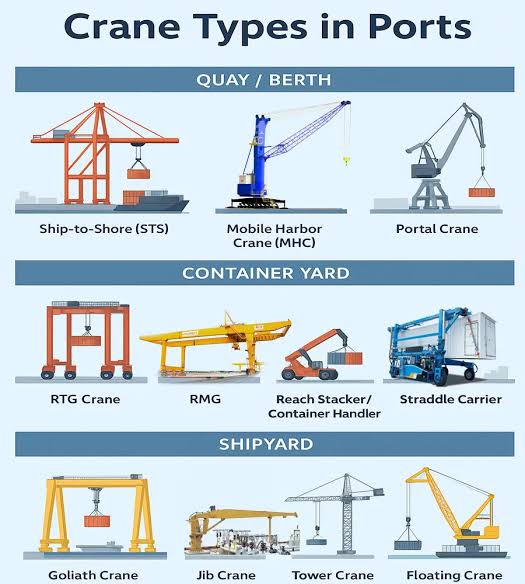
In the high-stakes world of international maritime logistics, every second counts. A single container ship carrying 20,000 TEUs can generate millions in daily revenue for operators, but only if it turns around quickly. At the heart of that speed lies specialized port crane technology—the silent workhorses that keep global supply chains moving.
Ports in the GCC and broader MENA region, from Jebel Ali to Hamad and King Abdullah, handle surging volumes driven by Vision 2030 initiatives, re-export strategies, and diversified trade corridors. Understanding the different types of port cranes is no longer optional for traders, terminal operators, freight forwarders, or B2B importers—it’s essential for optimizing costs, minimizing delays, and scaling operations reliably.
This guide breaks down the major categories of port cranes, their technical specifications, operational advantages, real-world applications, and strategic considerations for 2026 and beyond. Whether you manage yard operations or coordinate cross-border shipments, these insights will help you align equipment choices with business outcomes.
20 Documents Used in Export & Import
Why Port Cranes Define Terminal Performance
More than 90% of global trade by volume travels by sea. Container throughput at major hubs continues to climb, with larger mega-vessels demanding ever-higher handling rates. Modern port cranes directly impact key performance indicators (KPIs) such as:
- Vessel turnaround time: Faster loading/unloading reduces demurrage and detention fees.
- Yard productivity: Efficient stacking and retrieval lower storage costs.
- Safety and sustainability: Advanced systems cut accidents and emissions.
- Cost efficiency: Right equipment choice can save thousands per move.
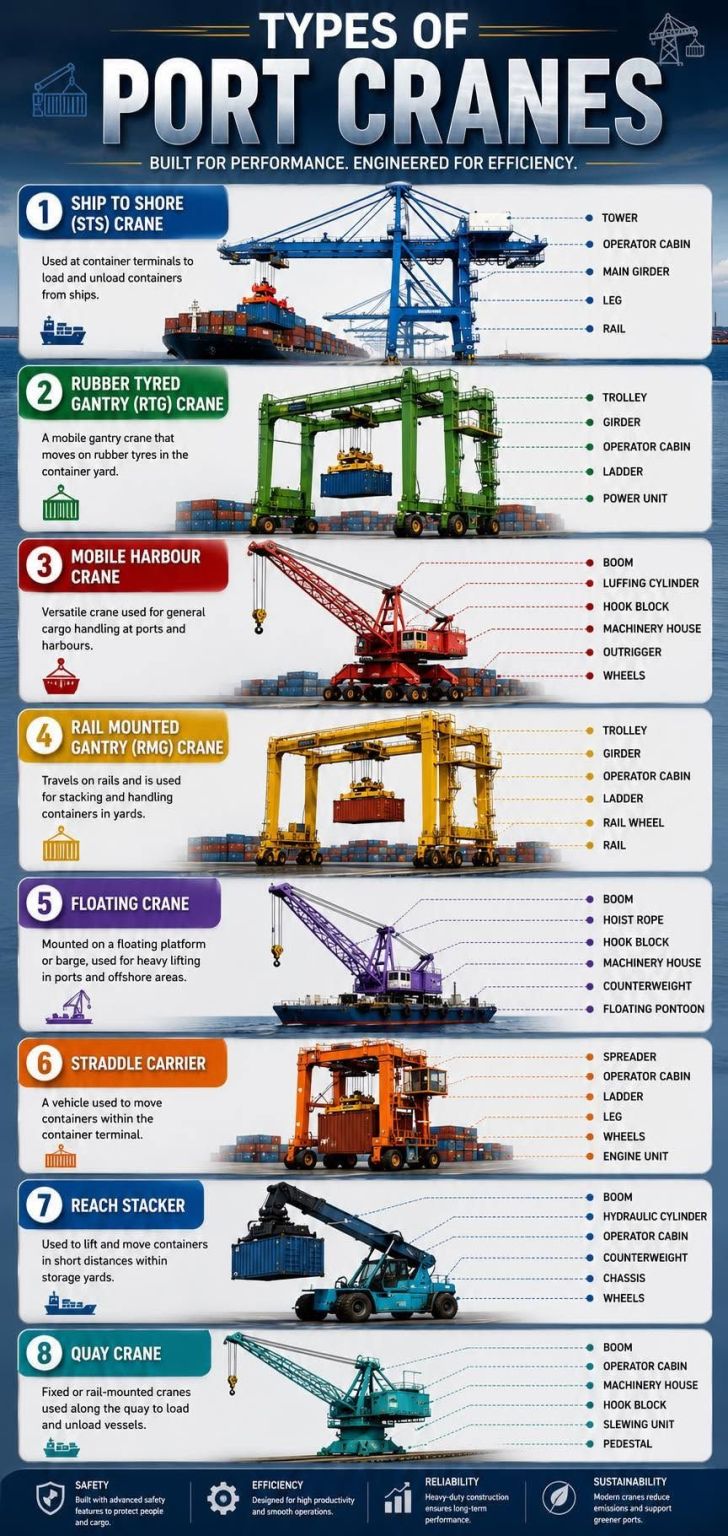
Types of Port Cranes Powering Global Trade
In GCC ports, where heat, dust, and high utilization rates test machinery daily, selecting the right crane type translates into competitive advantage.
🌍 Geopolitical Realities: Why Throughput is a Safe Haven
The global maritime landscape in recent years has proven that supply chains are highly vulnerable to regional shocks. Ongoing disruptions and rerouting vectors in the Red Sea have forced major ocean carriers to bypass volatile choke points, shifting the heavy lifting onto safe-haven hubs in the Arabian Gulf and the Gulf of Oman.
This structural shift has placed an unprecedented operational load on alternative multi-modal gateways—most notably Jebel Ali (UAE) and Salalah (Oman). With transshipment volumes surging, terminal throughput speed is no longer just a metric; it is a critical firewall against regional supply chain collapse.
“In this high-pressure environment, automated Ship-to-Shore (STS) quay giants and high-density Rail Mounted Gantry (RMG) crane networks act as the ultimate operational lifelines. By substituting variable human labor with AI-driven, continuous automated stacking, these systems allow ports to absorb sudden 30–40% spikes in unscheduled vessel arrivals without triggering catastrophic gridlocks.”
For international brands and regional distributors, booking space with carriers that utilize terminals backed by deep-tier RMG and automated STS crane infrastructure is the most reliable hedge against volatile transit times and volatile storage overheads.
1. Ship-to-Shore (STS) Cranes: The Quay Giants
Ship-to-Shore (STS) cranes, also known as quay cranes or portainers, stand as the most visible and critical assets at container terminals. Fixed along the berth, these massive gantry structures load and unload containers directly between vessel and shore.
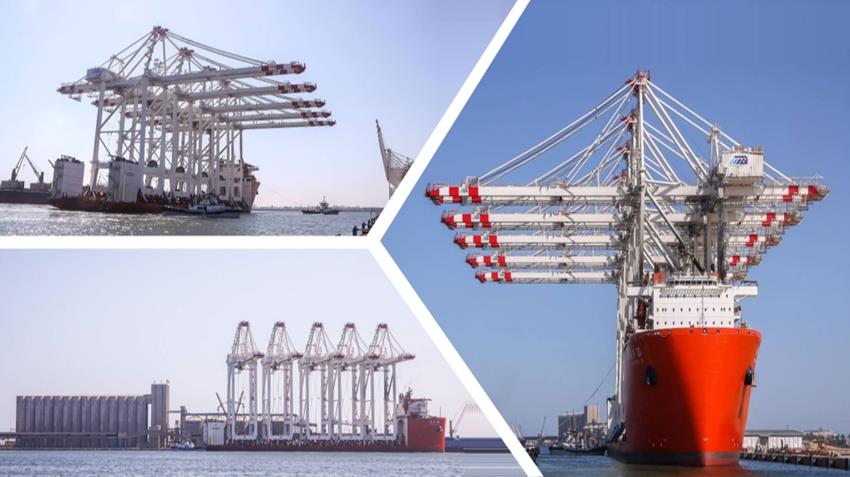
Ship-to-Shore (STS) Cranes: The Quay Giants
Key Components (as highlighted in standard port diagrams):
- Tower
- Operator cabin
- Main girder
- Legs
- Rail system
- Trolley and spreader
Typical Specifications:
- Outreach: 60+ meters to service ultra-large container vessels (ULCVs)
- Lifting capacity: 65–80 tons under spreader
- Handling rate: 35–50+ moves per hour with modern automation
Operational Strengths:
- Designed specifically for high-volume container terminals
- Dual or tandem lift capabilities accelerate operations
- Integration with automated systems for remote or semi-autonomous control
Challenges and Considerations:
- High capital investment
- Fixed installation limits flexibility
- Requires substantial quay reinforcement
In practice, STS cranes at busy GCC terminals enable vessels to berth, discharge, and depart within 24–48 hours, directly supporting re-export hubs. For traders, this means faster inventory cycles and lower overall logistics costs.
📌 Regional Benchmarks: STS Automation in Action
The theoretical advantages of modern STS cranes are best demonstrated by the record-breaking infrastructure deployed across the GCC’s premier maritime gateways:
- Jebel Ali Port (UAE) – Terminal 3: Known as one of the world’s largest semi-automated facilities, Terminal 3 utilizes highly advanced, remote-controlled STS cranes. Operators sit in a centralized control room miles away from the quay, managing dual-hoist tandem cranes capable of lifting two 40-foot containers simultaneously, drastically cutting vessel dwell times.
- Hamad Port (Qatar) – Phases 2 & 3: Qatar’s flagship hub features ultra-modern, fully electrified STS cranes equipped with sophisticated optical character recognition (OCR) and anti-sway systems. These green-powered giants have enabled the port to consistently shatter local throughput records while reducing carbon intensity per TEU moved.
- King Abdullah Port (Saudi Arabia): Strategically positioned on the Red Sea corridor, this hub integrates its deep-water STS crane fleets directly with AI-driven Terminal Operating Systems (TOS). This end-to-end digital orchestration ensures seamless syncing between ship discharge and immediate yard dispatch.
2. Rubber Tyred Gantry (RTG) Cranes: Mobile Yard Masters
Rubber Tyred Gantry (RTG) cranes bring flexibility to container yards. These mobile gantry systems move on rubber tires, stacking and retrieving containers across wide blocks.
Rubber Tyred Gantry (RTG) Cranes Mobile Yard Masters
Key Components:
- Trolley
- Girder
- Operator cabin
- Ladder
- Power unit
- Rubber tires
Typical Specs:
- Stack 4–6 containers high
- Span 6–8 container rows plus truck lane
- Diesel-electric or hybrid power options
Advantages:
- High mobility within the yard
- Cost-effective for medium-to-large terminals
- Easy relocation as terminal layouts evolve
Real-World Application: RTGs excel in ports with variable throughput. Recent deployments in UAE terminals emphasize hybrid models that reduce fuel consumption while maintaining productivity, aligning with regional sustainability targets.
Pro Tip for Operators: Proper tire management and operator training can extend equipment life significantly in hot climates.
3. Rail Mounted Gantry (RMG) Cranes: Precision Stacking Powerhouses
Rail Mounted Gantry (RMG) cranes operate on fixed rails, delivering superior stability and automation potential for high-density container storage.
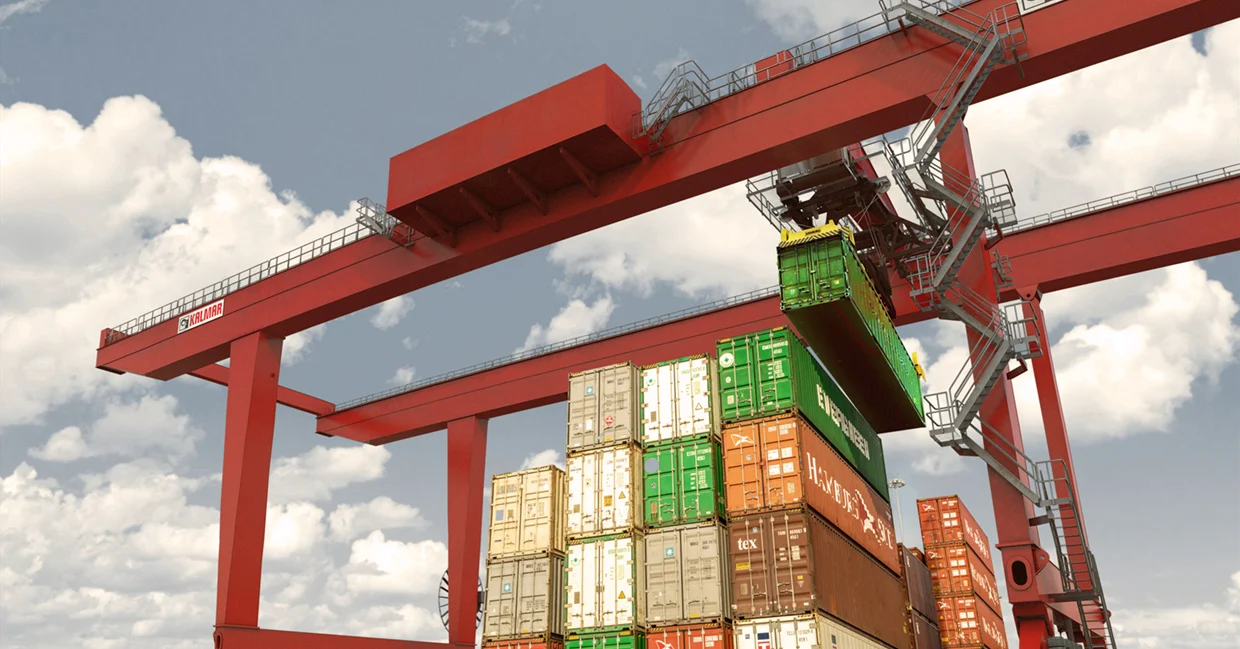
Rail Mounted Gantry (RMG) Cranes Precision Stacking Powerhouses
Key Components:
- Trolley
- Girder
- Operator cabin
- Ladder
- Rail wheels
Strengths:
- Higher stacking density and speed than RTGs
- Ideal for automated terminals
- Lower operating costs over time due to electric power
Use Cases: RMGs suit land-constrained, high-volume facilities. In automated setups, they integrate seamlessly with terminal operating systems (TOS) for optimized yard management.
4. Mobile Harbour Cranes: The Versatile All-Rounders
Mobile Harbour Cranes (MHC) offer unmatched flexibility for ports handling mixed cargo—containers, bulk, breakbulk, and project cargo.
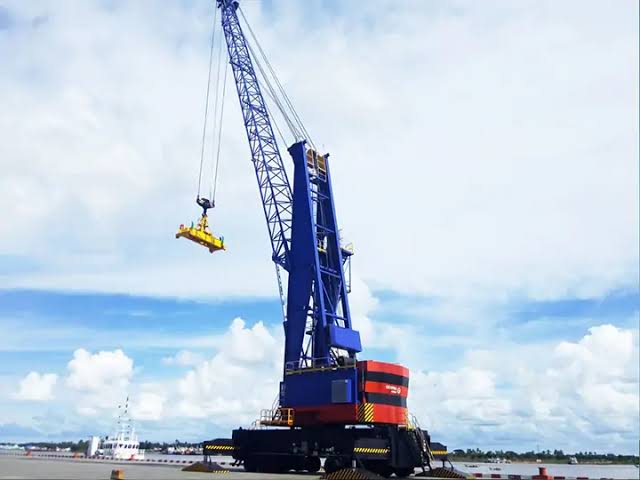
Mobile Harbour Cranes: The Versatile All-Rounders
Key Components:
- Boom
- Luffing cylinder
- Hook block
- Machinery house
- Outriggers
- Wheels
These cranes drive on rubber tires or tracks and can be repositioned quickly. They prove especially valuable in multipurpose terminals common across MENA ports.
Benefits:
- Handles diverse cargo types
- Lower infrastructure requirements than fixed cranes
- Rapid deployment for seasonal or project peaks
5. Floating Cranes: Heavy-Lift Offshore Solutions
Floating cranes mount on barges or pontoons for heavy lifting in ports, offshore areas, or where quay access is limited.
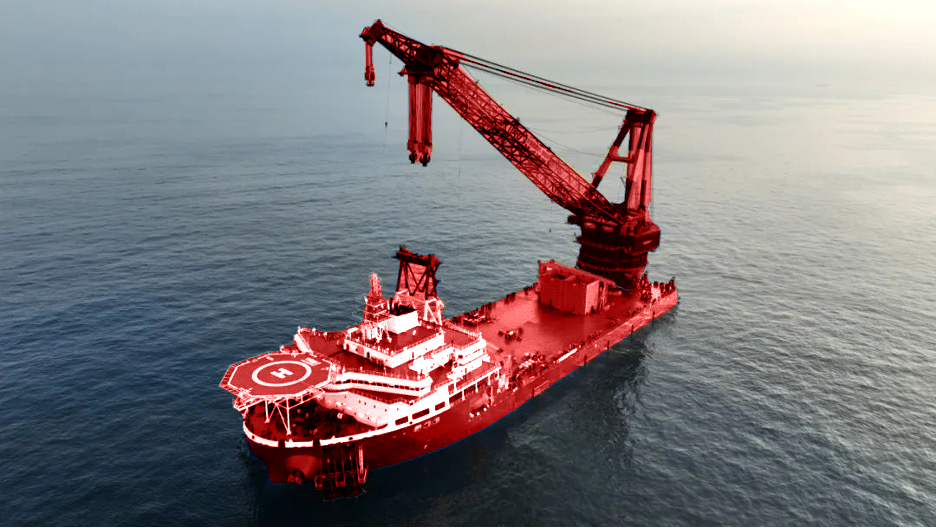
Floating Cranes: Heavy-Lift Offshore Solutions
Key Components:
- Boom
- Hoist rope
- Hook block
- Machinery house
- Counterweight
- Floating pontoon
They support ship-to-ship transfers, salvage operations, and large-scale infrastructure projects—critical for energy and construction sectors in the GCC.
6. Straddle Carriers: Efficient Horizontal Movers
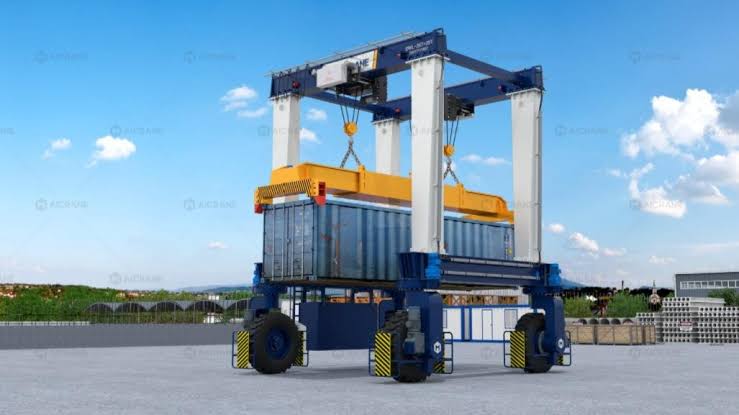
Straddle carriers straddle containers for short-distance transport and stacking within terminals. They combine lifting and transport functions, reducing the need for additional equipment.
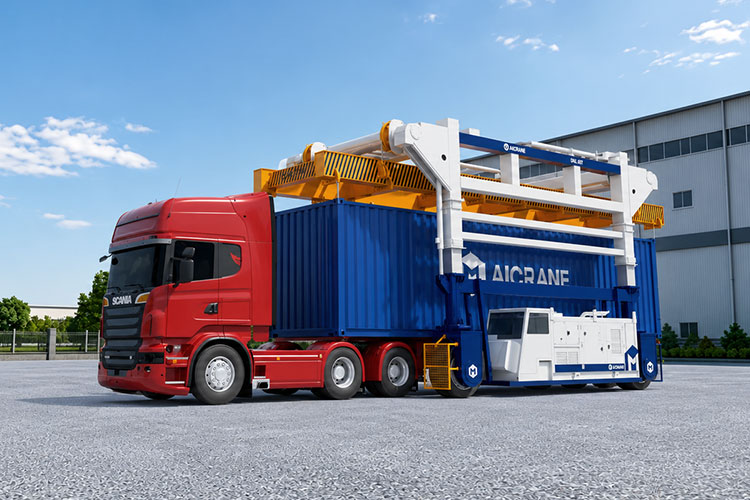
Straddle Carriers Efficient Horizontal Movers
Strengths:
- High maneuverability
- Fast container shuttling
- Good for medium-sized operations
7. Reach Stackers: Flexible Frontline Handlers
Reach stackers serve smaller terminals or as backup equipment. Their telescopic boom allows stacking in tight spaces and quick container moves.
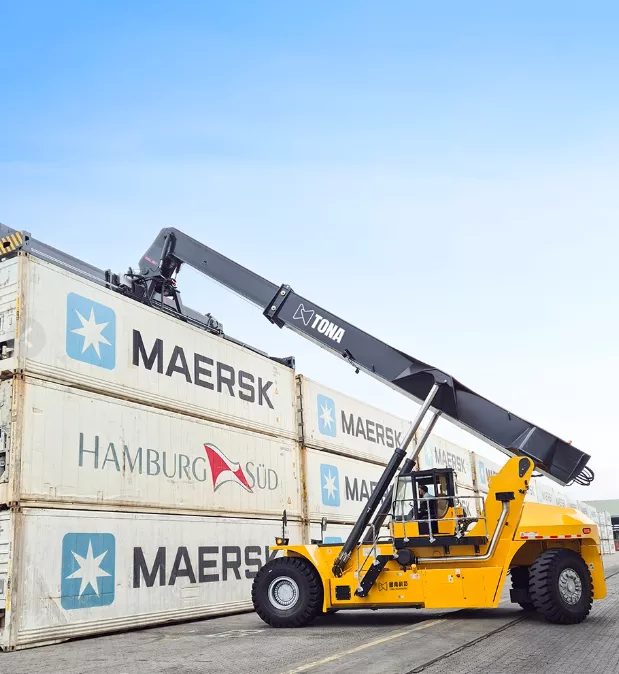
Reach Stackers: Flexible Frontline Handlers
Ideal For: Feeder ports, inland terminals, or overflow operations.
8. Quay Cranes and Specialized Variants
Quay cranes broadly refer to berth-side equipment, often overlapping with STS. Variants include portal cranes for bulk and general cargo.
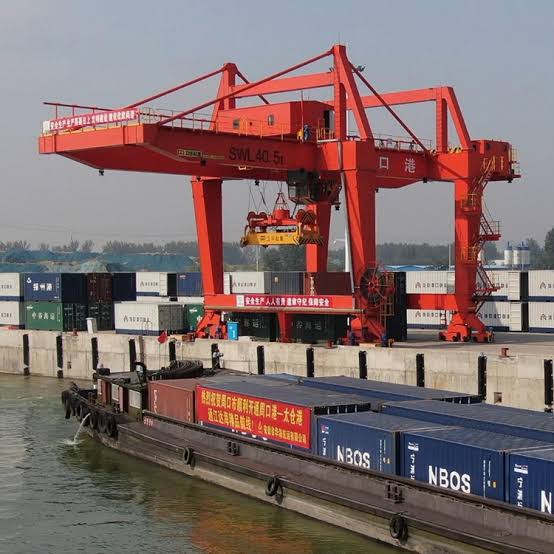
Quay Cranes and Specialized Variants
💡 Actionable Insights for B2B Traders & Importers
As an importer or B2B trader, port crane infrastructure directly dictates your supply chain constraints, customs clearance speed, and final landed costs. When routing high-value, heavy, or specialized cargo through the GCC, matching your shipment requirements with terminal capabilities is critical:
- Project & Heavy-Lift Cargo: If you are importing industrial machinery or out-of-gauge (OOG) equipment, ensure your destination hub features robust Mobile Harbour Cranes (MHC) or Floating Cranes. Without these, discharging heavy-lift project cargo is physically impossible, leading to forced vessel diversions and catastrophic demurrage fees.
- High-Volume Container Runs: For standard commercial goods where speed to market is everything, route your inventory through mega-hubs utilizing automated Ship-to-Shore (STS) and Rail Mounted Gantry (RMG) fleets (e.g., Jebel Ali Terminal 3 or Hamad Port). High automation levels minimize the risk of labor-induced delays and guarantee predictable turnaround times.
- Risk Mitigation: Before signing freight contracts, verify the terminal operating system (TOS) integration of the port. Terminals with modern yard crane setups handle peak seasonal surges far better, protecting you from unexpected port congestion surcharges.
Comparison Table: Choosing the Right Port Crane
| Crane Type | Primary Use | Mobility | Automation Potential | Best For | Approx. Moves/Hour |
|---|---|---|---|---|---|
| STS | Ship loading/unloading | Fixed | High | Large container terminals | 35–50+ |
| RTG | Yard stacking | High | Medium-High | Flexible yards | 20–30 |
| RMG | High-density stacking | Rail | Very High | Automated terminals | 25–40 |
| Mobile Harbour | Multipurpose | High | Medium | Mixed cargo ports | Varies |
| Floating | Heavy offshore lifts | High | Low-Medium | Project/specialized | Heavy lifts |
| Straddle Carrier | Short transport | High | Medium | Terminal shuttling | High throughput |
| Reach Stacker | Flexible handling | High | Low | Smaller ops/backup | 15–25 |
⚙️ GCC Climate Adaptation: Engineering for the Gulf’s Extremes
Operating multi-million dollar crane assets in the Arabian Gulf is a brutal engineering challenge. Standard port machinery would fail within months under the region’s relentless combination of extreme heat, fine desert dust, and hyper-saline marine air. To maintain near-continuous uptime, cranes deployed in major GCC hubs feature heavily customized, industrial-grade specifications:
• Heavy-Duty Anti-Heat HVAC Systems:
Ambient temperatures topping 50°C (122°F) can trigger catastrophic thermal shutdowns in electrical drives and PLC control rooms. Gulf-spec cranes utilize dual-redundant, heavy-duty air conditioning units with continuous monitoring to safeguard sensitive electronics and ensure operator safety in the cabin.
• Ingress Protection Against Desert Dust (IP65/IP66):
Shamal winds carry highly abrasive, fine silica dust that acts like sandpaper on moving parts and shorts out electrical enclosures. Critical mechanical assemblies, slip rings, and electrical cabinets are strictly rated at IP65 or IP66, featuring specialized pressurized seals to lock out airborne particulates.
• High-Durability C5-M Anti-Corrosion Coatings:
The combination of intense UV radiation, high humidity, and extreme water salinity creates one of the most corrosive environments on Earth. Structural steel on these cranes undergoes multi-layered marine painting systems meeting the ISO 12944 C5-M (Very High Marine) classification, utilizing zinc-rich primers and sacrificial anodes to stop rust before it starts.
Operational Best Practices for 2026
Maintenance and Uptime: Predictive analytics and digital twins minimize downtime. Regular inspections of spreaders, wire ropes, and electrical systems are non-negotiable in dusty GCC environments.
Safety Protocols: Advanced collision avoidance, anti-sway systems, and operator training reduce incidents.
Sustainability: Electric and hybrid cranes lower emissions. Many regional ports now prioritize green equipment for compliance and cost savings.
🌐 5G & AI: The Digital Brain of GCC Smart Ports
The integration of Digital Twins, Artificial Intelligence (AI), and private 5G networks is no longer a futuristic concept in the MENA region—it is the current operational standard driven by maritime heavyweights:
- DP World’s AI Orchestration: At the forefront of innovation, DP World has heavily invested in AI-driven scheduling algorithms. These systems predict vessel arrival variations and automatically re-route STS and RTG assets in real-time, optimizing container stacking patterns and boosting overall terminal productivity by 30–50%.
- AD Ports Group & Private 5G: Through strategic deployments at flagship facilities like Khalifa Port, AD Ports Group utilizes ultra-low latency private 5G networks. This massive digital pipeline allows massive quay cranes to be operated remotely with millisecond precision from desktop consoles, removing human operators from hazardous environments while unlocking 24/7 continuous yard flows.
- Predictive Digital Twins: By feeding real-time sensor data from crane spreaders and structural joints into a virtual “Digital Twin” model, port engineers across major Gulf hubs can accurately forecast mechanical wear. This shifts maintenance from reactive fixes to predictive scheduling, effectively eliminating unexpected crane downtime during peak transshipment windows.
Strategic Implications for B2B Traders and Logistics Managers
Understanding crane capabilities helps negotiate better terms with forwarders, anticipate delays, and select optimal ports. For example, terminals with modern STS and automated RTG/RMG fleets offer faster, more reliable service—critical for time-sensitive goods.
In cross-border trade across GCC countries, efficient cargo handling directly reduces total landed costs and improves cash flow.
Related Reading:
- Mediterranean Trade Corridor: Reviving the Iraq-Syria Route
- Demurrage vs. Detention in GCC Ports: How to Save $2,000 per Container
- Gulf Logistics 2026: The Ultimate Guide to Multimodal Transport
For deeper operational support, tools like those available on Platform.Tendify.Net can help model logistics scenarios and connect with reliable partners.
The Road Ahead: Smart and Sustainable Ports
The port crane market is expanding steadily, projected to grow at 5–7% CAGR through the mid-2030s, driven by trade volumes, vessel upsizing, and technology upgrades.
Leaders invest in automation, electrification, and data integration. Digital twins simulate operations, AI optimizes crane scheduling, and 5G enables real-time control.
For businesses in MENA, staying ahead means partnering with terminals that embrace these advancements.
Ready to streamline your trade operations? Register at https://tendify.net/my-account/ to access practical tools, market insights, and a network designed to make cross-border commerce faster, safer, and more profitable. Whether optimizing container flows or expanding into new markets, the right platform turns knowledge into results.

