


Blog
Port vs. Terminal: Why Confusing Them Costs You Thousands
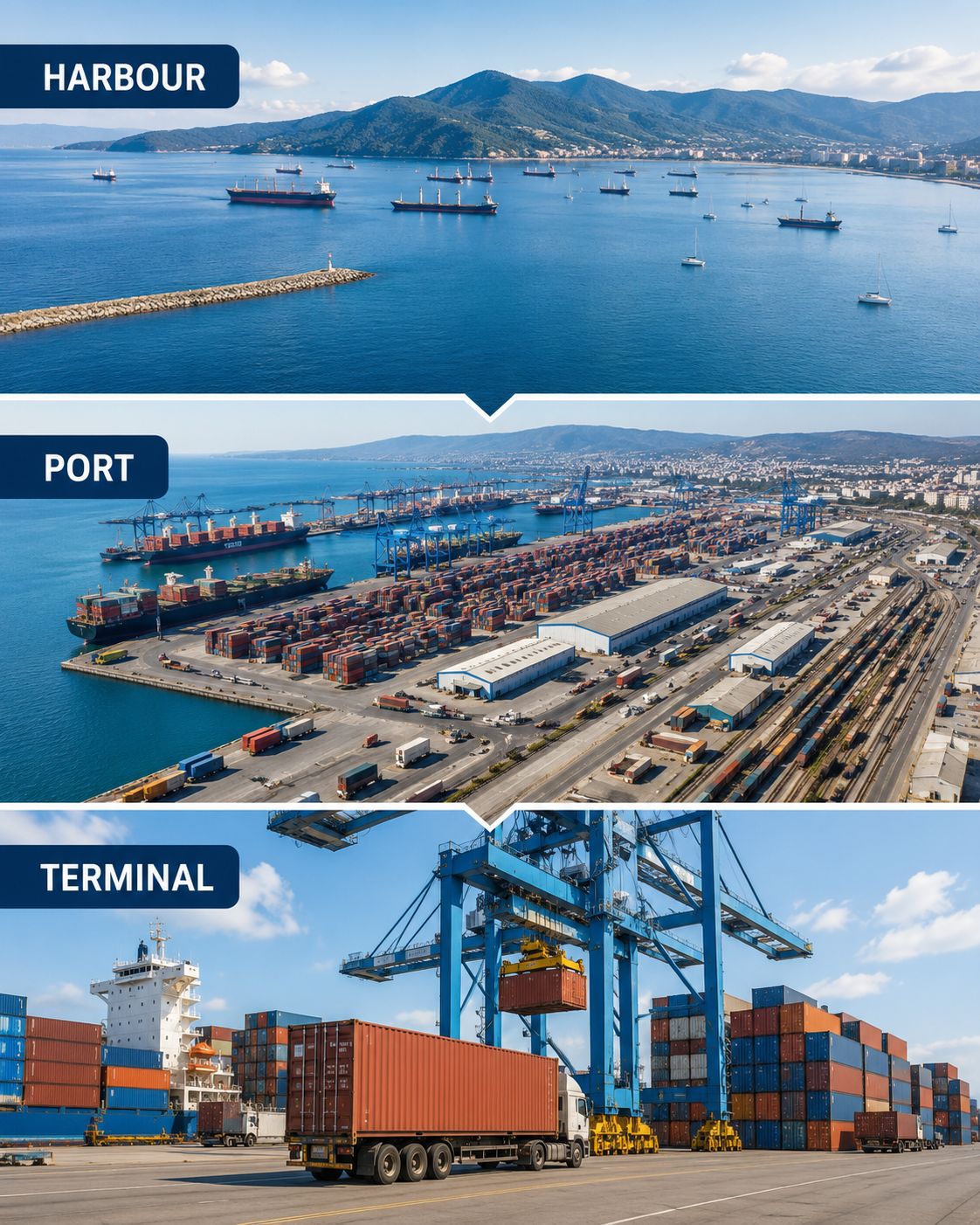
In the fast-paced world of international shipping, I’ve watched too many deals get delayed or costs balloon simply because teams blurred the lines between a port and a terminal. After years navigating complex supply chains across major trade routes, I can tell you this distinction isn’t just academic—it’s a practical edge that separates profitable operations from those bleeding money on demurrage, inefficiencies, or compliance headaches.

Port vs. Terminal
A port is the entire maritime ecosystem: the harbors, channels, infrastructure, and regulatory framework that serves as the gateway for vessels and goods. A terminal, on the other hand, is a specialized operational hub within that port focused on specific cargo handling activities. Understanding this helps you choose the right facilities, negotiate better rates, and keep your shipments moving smoothly—whether you’re exporting containers to the GCC, handling bulk commodities, or managing multimodal logistics.
In this comprehensive guide, we’ll break down the differences, explore real-world implications for traders, and equip you with actionable strategies to leverage both for maximum efficiency in your export and import operations.
Dangerous Goods (DG) Forwarding: Navigating High-Margin Risks and AI Compliance
What Is a Port in Maritime Logistics?
A port functions as a comprehensive maritime hub. It encompasses the full infrastructure supporting vessel arrival, berthing, cargo transfer, and onward transport to land networks. Think of it as the complete gateway connecting sea and land trade.

Maritime Logistics Port Vs. Terminal
Key characteristics of a port include:
- Broad Infrastructure: Channels, breakwaters, navigation aids, berths, roads, rail connections, warehouses, and utilities.
- Regulatory Oversight: Managed by a Port Authority responsible for safety, security, customs, pilotage, and overall operations.
- Multi-Purpose Role: Supports diverse vessel types (container ships, tankers, bulk carriers, Ro-Ro) and cargo categories.
- Economic Ecosystem: Generates revenue through fees, supports local economies, and facilitates international trade flows.
Major examples include Jebel Ali Port in Dubai or major hubs in the GCC, where the port authority oversees the entire area while multiple specialized terminals operate inside it.
From my experience, treating a port as your “big picture” planning unit is essential. When quoting freight or scheduling shipments, you reference the port of loading (POL) or port of discharge (POD), but the actual cargo work happens at a specific terminal.
Pallet Strategy in Global Trade: Stop Losing 20% of Your Container Space
What Is a Terminal in Shipping Operations?
A terminal is the specialized “workshop” inside the port where the hands-on cargo work gets done. It’s a dedicated area equipped and optimized for particular operations like loading/unloading, storage, and transfer.

𝐏𝐎𝐑𝐓 𝐯𝐬 𝐓𝐄𝐑𝐌𝐈𝐍𝐀𝐋
Terminals focus on efficiency in narrow scopes:
- Cargo Specialization: Container terminals, liquid bulk (tank farms), dry bulk (grains, ores), Ro-Ro for vehicles, or general cargo.
- Operational Focus: Cranes, yard equipment, storage areas, warehousing, and dedicated berths.
- Private Operation: Often run by terminal operators (like DP World or local concessions) under lease from the port authority.
- High-Throughput Design: Optimized for speed—quick vessel turnaround, efficient stacking, and seamless intermodal connections.
In practice, a large port like those in the UAE might have several container terminals, a dedicated oil terminal, and bulk handling facilities. Your bill of lading or shipping instructions will specify the terminal because that’s where your cargo physically moves.
Port vs Terminal: Side-by-Side Comparison
Here’s a clear breakdown to eliminate confusion:
| Aspect | Port | Terminal |
|---|---|---|
| Scope | Entire maritime facility and infrastructure | Specific operational area within a port |
| Management | Port Authority (public or regulatory body) | Terminal Operator (often private under concession) |
| Infrastructure | Channels, breakwaters, navigation aids, roads, rail, multiple terminals | Cranes, yard equipment, storage, dedicated berths |
| Function | Overall gateway for trade, vessel services | Cargo handling, loading/unloading, storage |
| Vessel/Cargo Range | Wide range of vessels and cargo types | Specialized (e.g., containers, bulk liquids) |
| Key Metrics | Port calls, total throughput, economic impact | Handling volume, dwell time, equipment efficiency |
Who’s Who: Key Stakeholders at the Port vs. Terminal Level
Navigating logistics successfully means knowing exactly whose door to knock on when a shipment hits a bottleneck. The human ecosystem matches the infrastructure split—shifting from regulatory oversight at the port level to intense operational execution at the terminal level:
⚓ At the Port Level (Macro & Regulatory)
- Port Authority & Customs: The government or sovereign entity managing overall safety, maritime security, vessel traffic coordination, and customs/border clearance.
- Port Agent (Shipping Agent): The localized representative of the shipping line. They act as the vital link coordinating vessel husbandry, pilotage, and administrative clearances before a ship even touches a berth.
🏗️ At the Terminal Level (Micro & Operational)
- Stevedores (Dockworkers): The specialized labor force and crane operators responsible for the heavy lifting—physically loading and unloading cargo containers or bulk goods between the vessel and the quay.
- Tally Clerks / Gate Inspectors: The data gatekeepers of the terminal. They physically check, count, and audit the seals, container numbers, and cargo condition against the manifest to guarantee zero discrepancies during gate-in or vessel discharge.
Why the Distinction Matters for Traders and Exporters
Confusing the two leads to costly mistakes. Here’s why it impacts your bottom line:
- Cost Control: Terminal handling charges (THC), storage fees, and demurrage are terminal-specific. Knowing the exact terminal helps you negotiate or choose operators with better turnaround times.
💡 Logistics Deep Dive: Demurrage vs. Storage Fees
While both penalties balloon your expenses during delays, they are issued by entirely different entities for completely different reasons. Conflating the two is a critical mistake that can lead to devastating financial blind spots:
- Storage Fees (Charged by the Port/Terminal):
This is a land-use fee. The terminal operator or port authority charges you for the physical footprint your container occupies on their property after your allotted terminal free days expire. - Demurrage (Charged by the Shipping Line):
This is an equipment-use fee. The ocean carrier charges you for holding onto their physical container box beyond the agreed-upon free time, whether it is sitting inside the yard or outside the gates.
The Trader’s Takeaway: When a shipment faces customs bottlenecks or documentation delays, you aren’t just fighting one penalty—you are bleeding money on two separate fronts simultaneously (Port/Terminal vs. Carrier).
- Planning Accuracy: When booking vessels, you select the port, but your forwarder needs the right terminal for cargo type to avoid re-handling fees.
- Compliance and Risk: Different terminals have varying customs procedures, security standards, or equipment suited to your goods (e.g., reefer points for perishables).
- Efficiency Gains: In high-volume GCC ports, selecting a terminal with advanced automation or proximity to your buyer’s warehouse can shave days off transit and reduce inland trucking costs.
I’ve seen shipments delayed because cargo was routed to the wrong terminal within the same port—extra moves add up fast.
Shipping Container Types: Master Selection & Avoid Costly Delays

Port Vs Terminal
Incoterms 2020: Where Named Ports Mask Terminal Realities
In international trade, pinpointing the exact geographical location where risk and costs transfer from the seller to the buyer is everything. However, a common trap in Incoterms 2020 is that while the rules frequently reference a named “Port,” the operational and legal execution always unfolds at a specific “Terminal.”
- The Illusion of the Named Port (FOB, CFR, CIF):
Under classic maritime rules like FOB or CIF, your sales contract or commercial invoice will typically state a broad gateway (e.g., FOB Jebel Ali Port). Yet, “delivery” and the transfer of physical risk occur only when the cargo is safely loaded on board the vessel—which happens at a designated terminal berth. If your freight forwarder mistakenly drops the cargo at the wrong terminal yard within that massive port, you face missing the vessel’s closing window, incurring steep re-handling fees, while the legal risk remains entirely on your shoulders. - The DPU Danger Zone (Delivery at Place Unloaded):
DPU is the only Incoterm that obligates the seller to unload the cargo at the destination. If you sell under DPU [Named Port], you are legally bound to choose—and pay for—a terminal equipped with the precise specialized machinery required to unload your specific cargo type (whether it is heavy-lift cranes for project cargo or specialized manifolds for liquid bulk). Selecting a terminal with inadequate infrastructure can force a vessel shifting order, triggering thousands of dollars in unexpected port penalties and demurrage—all billed directly to the exporter.
Pro-Trader Strategy: Never stop at the port level when drafting your international sales contracts, LC (Letters of Credit), or proforma invoices. Always specify the exact terminal layout. Writing “FOB Jebel Ali Port – Container Terminal 2 (T2)” instead of just “FOB Jebel Ali” seamlessly aligns your legal liability with actual terminal operations.
Regulatory Borders: Customs Jurisdictions and Free Zone Terminals
One of the most critical operational errors a trader can make is assuming that once a vessel crosses a port’s physical boundary, the cargo has legally entered the destination country’s customs territory. In reality, while a Port Authority represents the overall sovereign and regulatory border, individual Terminals within that port can operate under completely distinct fiscal and customs frameworks.

Regulatory Borders
In major global logistics hubs, certain terminals are designated as Free Trade Zones (FTZs) or Bonded Areas (such as the specialized terminals operating inside Jebel Ali in the UAE). When your container is discharged at a Free Zone terminal, it sits in a state of customs suspension. Import duties, commercial taxes, and standard domestic regulations are deferred. This makes these terminals ideal for transshipment, re-exporting, or performing value-added services like sorting and repackaging without tying up capital in upfront duty payments.
⚠️ The Customs Trap:
If your cargo is mistakenly routed to a standard domestic or mainland terminal instead of a bonded/free zone terminal, the local customs authority will immediately demand full import clearance, compliance certifications, and duty payments upon discharge. Reversing this or moving the cargo to a bonded area after a mistaken gate-in can take weeks of bureaucratic paperwork and result in heavy customs amendment penalties.
Types of Terminals You’ll Encounter in Global Trade
- Container Terminals: For standard and specialized boxes; high automation in modern hubs.
- Bulk Terminals: Dry (grains, minerals) or liquid (oil, chemicals) with conveyor systems or pipelines.
- Ro-Ro Terminals: Vehicle and machinery roll-on/roll-off.
- Multipurpose/General Cargo: Flexible for breakbulk or project cargo.
- Passenger/Cruise Terminals: Less relevant for freight but part of larger ports.
In the GCC, facilities like those in Jebel Ali offer world-class options across categories, making them ideal for re-export and transshipment.
The Poland Corridor: A Strategic Guide to Import-Export Opportunities
Inside the Container Terminal: CY vs. CFS Operations
For businesses moving ocean freight, navigating a container terminal requires understanding its internal anatomy. Depending on your shipment volume, your cargo will be routed through one of two completely different operational zones within the same terminal: the Container Yard (CY) or the Container Freight Station (CFS).
- CY (Container Yard) – The FCL Kingdom:
The CY is the massive, open-air stacking area inside the terminal where full containers (FCL – Full Container Load) are stored, organized, and staged. When you ship a full container, it moves directly from your factory gate into the CY, where straddle carriers or gantry cranes stack it until it is loaded onto the vessel. - CFS (Container Freight Station) – The LCL Consolidation Hub:
The CFS is a dedicated warehouse facility inside or directly adjacent to the terminal optimized for loose cargo or (LCL – Less than Container Load). This is where the physical acts of stuffing (consolidating multiple smaller shipments from different exporters into a single container) and stripping (de-consolidating and unpacking a container into individual consignee lots upon arrival) take place.
Why does this matter to your bottom line? The fee structures and documentation diverge completely. FCL shipments moving through the CY are billed under standard Terminal Handling Charges (THC). However, LCL shipments entering a CFS incur specific CFS Receiving/Handling Fees, cargo measuring fees, and consolidation charges. Furthermore, customs clearance procedures are often more prolonged at a CFS because a delay in just one exporter’s paperwork can temporarily hold up the stripping process for the entire shared container.
Real-World Strategies: How to Use This Knowledge in Your Operations
Step 1: Research Before Booking Use tools like port authority websites or platforms such as Platform.Tendify.Net to map facilities. Check terminal capabilities, current congestion, and equipment for your cargo type.
Step 2: Coordinate with Forwarders Provide clear instructions: “Container shipment via [Specific Terminal] at [Port Name].” This prevents misrouting.
Step 3: Factor in Terminal Performance Look at metrics like vessel turnaround time, crane productivity, and storage costs. Modern terminals with AI scheduling minimize delays.
Step 4: Optimize Multimodal Connections Choose terminals with strong rail or road links to reduce last-mile costs.
Step 5: Monitor for Disruptions Strikes, weather, or equipment failures hit terminals first. Diversify options across ports when possible.
For bulk or specialized shipments common in Middle East trade, selecting the right terminal can mean the difference between on-time delivery and costly storage.
Common Challenges and How to Overcome Them
- Congestion: Busy terminals lead to higher dwell times. Solution: Book slots early and use digital tracking.
- Regulatory Differences: Ports set broad rules; terminals enforce specifics. Stay updated via official channels.
- Cost Variations: Terminal operators compete on service. Compare quotes carefully.
- Inland Links: Not all terminals connect equally to hinterland transport.
Proactive planning here pays dividends, especially in dynamic markets.
The Bigger Picture: Ports and Terminals in Global Supply Chains
Ports act as economic engines, while terminals are the precision engines driving daily efficiency. Together, they enable the seamless flow that powers global trade. As supply chains grow more complex—with emphasis on sustainability, digitalization, and resilience—understanding these layers becomes even more critical.
Operators who master this distinction build stronger partnerships with shipping lines, terminal operators, and authorities, leading to better rates and priority service.
The Digital Backbone: Navigating PCS vs. TOS
In the era of smart logistics, the distinction between a port and a terminal is also hardcoded into the software platforms driving them. To monitor your supply chain without blind spots, you need to know which digital system holds the data you actually need:
- PCS (Port Community System) – The Port’s Macro Network:
A PCS is an electronic platform that links all stakeholders across the entire port ecosystem, including customs, port authorities, freight forwarders, and shipping lines. In the GCC, platforms like Bayyan 2.0 or integrated trade networks function as the PCS.
When to use it: Turn to the PCS when you need macro-level data—such as customs clearance status, regulatory approvals, and broad vessel arrival windows.
- TOS (Terminal Operating System) – The Terminal’s Micro Engine:
A TOS is a specialized internal software used by a specific terminal operator (such as the industry-standard Navis N4) to control the physical movement of cargo. It tracks the exact coordinates of a container in the yard, optimizes gantry crane cycles, and manages gate traffic.
When to use it: Turn to the TOS (or its direct tracking API) for micro-operational milestones, such as precise Gate-In/Gate-Out timestamps and container stack availability.
Operational Blueprint: If your customs broker claims your goods are held up, check the PCS to identify which regulatory agency has flagged the shipment. If your drayage trucker is stuck in a multi-hour queue, check the TOS to evaluate real-time terminal gate congestion and crane productivity.
Leverage Advanced Tools for Smarter Trade Decisions
In today’s competitive landscape, having the right digital support makes all the difference. Platforms that integrate logistics insights, calculators, and compliance tools help you navigate port and terminal complexities effortlessly.
Check out Platform.Tendify.Net—it offers practical resources like cost estimators, documentation builders, and market intelligence that tie directly into optimizing your port-to-terminal flows for faster, cheaper, and more reliable shipments. Whether you’re calculating duties, optimizing containers, or planning routes, these tools provide the actionable edge experienced traders rely on.
Final Thoughts: Turn Knowledge into Competitive Advantage
The difference between port and terminal might seem subtle on paper, but in practice, it drives real results—lower costs, fewer delays, and stronger margins. By treating ports as your strategic gateways and terminals as your operational powerhouses, you’ll operate with the confidence that comes from deep logistical insight.
Start applying this today: Review your next few shipments, verify terminal details, and build it into your standard operating procedures. The savings and efficiency gains will compound over time.
Ready to streamline your entire trade workflow? Head to Platform.Tendify.Net and explore the full suite of tools designed for traders like you. Sign up today and take control of your global supply chain—because in international trade, the details aren’t just important; they’re profitable.

