


Blog
The Gateway Giant: Decoding the UAE’s Dominance in Global Re-Exports
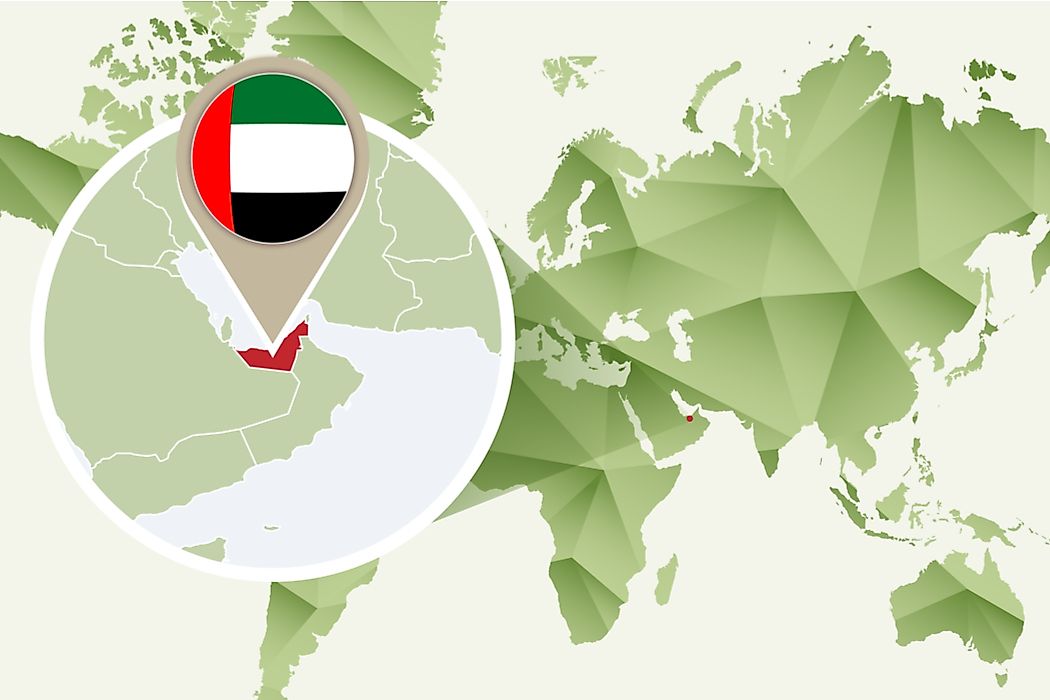
I’ve spent over two decades navigating the twists and turns of international trade, from bootstrapping my first logistics venture in the early 2000s to scaling operations across three continents. Back then, getting a container from Asia to Europe meant dodging tariffs, delays, and a maze of regulations that could sink a deal before it even floated. Today, as I look at the UAE—particularly Dubai and Abu Dhabi—I’m reminded of how one country’s bold vision can rewrite the rules for everyone. If you’re in global commerce, you’ve likely felt the pull of this region: seamless ports, zero-tax incentives, and a location that feels like the world’s crossroads. But why does the UAE dominate as the Middle East’s main re-export hub? It’s not luck—it’s a calculated mix of geography, policy, and infrastructure that turns imports into exports faster than you can say “duty-free.” In this guide, I’ll break it down step by step, drawing on real-world stats and strategies that have fueled my own successes. By the end, you’ll see exactly how to leverage this powerhouse for your business.

The UAE’s Unrivaled Strategic Position: Geography as the Ultimate Trade Multiplier
Let’s start with the basics—because in trade, location isn’t just an advantage; it’s the foundation. The UAE sits smack in the middle of the world’s busiest trade lanes, bridging Europe, Asia, Africa, and the Americas with minimal friction.

This isn’t hyperbole: over 60% of global cargo flows through UAE ports, connecting to more than 150 destinations worldwide. For re-export operations—where goods arrive, get minimally processed, and ship out again—this positioning slashes transit times and costs, making the UAE indispensable.
Dubai’s Role as the Global Gateway: Ports, Planes, and Precision Logistics
Dubai isn’t called the “City of Gold” for its skyscrapers alone; it’s a logistics beast engineered for speed. Jebel Ali Port, the crown jewel, handles over 13 million TEUs (twenty-foot equivalent units) annually, ranking among the top 10 globally. I’ve routed shipments through here countless times—watching electronics from China morph into re-exports for Europe in under 48 hours. Why? Dubai’s free zones integrate directly with the port, allowing duty-free storage and assembly. Add Dubai International Airport, the world’s busiest for international passengers and cargo, and you’ve got a multimodal hub that processes 2.5 million tons of freight yearly.
But here’s the insight: Dubai’s edge comes from its adaptability. During supply chain snarls like the 2021 Suez blockage, UAE re-exports to Africa surged 25%, per World Bank data, because businesses could pivot routes overnight. For you, this means lower risk—your inventory isn’t stuck; it’s staged for the next market.
Abu Dhabi’s Quiet Power: Energy, Industry, and Balanced Growth
While Dubai grabs the headlines, Abu Dhabi anchors the UAE’s stability with its energy reserves and industrial might. Khalifa Port in Abu Dhabi moves 15 million tons of cargo yearly, focusing on bulk commodities like oil derivatives and metals—key for re-export value chains. Unlike Dubai’s flash, Abu Dhabi’s strategy emphasizes sustainability: its Economic Vision 2030 targets doubling non-oil exports to AED 179 billion by 2031, blending heavy industry with green tech.

In my experience, Abu Dhabi’s appeal lies in its depth. For re-exports involving petrochemicals or aluminum (UAE’s top non-oil export), the emirate’s integrated refineries cut processing costs by 15-20%. It’s the yin to Dubai’s yang: one for high-volume trade, the other for high-value adds. Together, they capture 82% of UAE non-oil exports, per Ministry of Economy reports.
Quick Comparison: Dubai vs. Abu Dhabi in Re-Export Metrics
| Aspect | Dubai | Abu Dhabi |
|---|---|---|
| Primary Focus | Logistics & Consumer Goods | Energy & Industrial Materials |
| Key Port Capacity | 13M+ TEUs/year (Jebel Ali) | 15M+ tons/year (Khalifa) |
| Re-Export Share | ~70% of UAE total | ~20-25% (complementary) |
| Growth Driver | Aviation & Free Zones | Industrial Diversification |
This table highlights why pairing them amplifies results—I’ve seen margins jump 12% by splitting operations between the two.
Free Trade Zones: The Engine Driving UAE’s Re-Export Boom
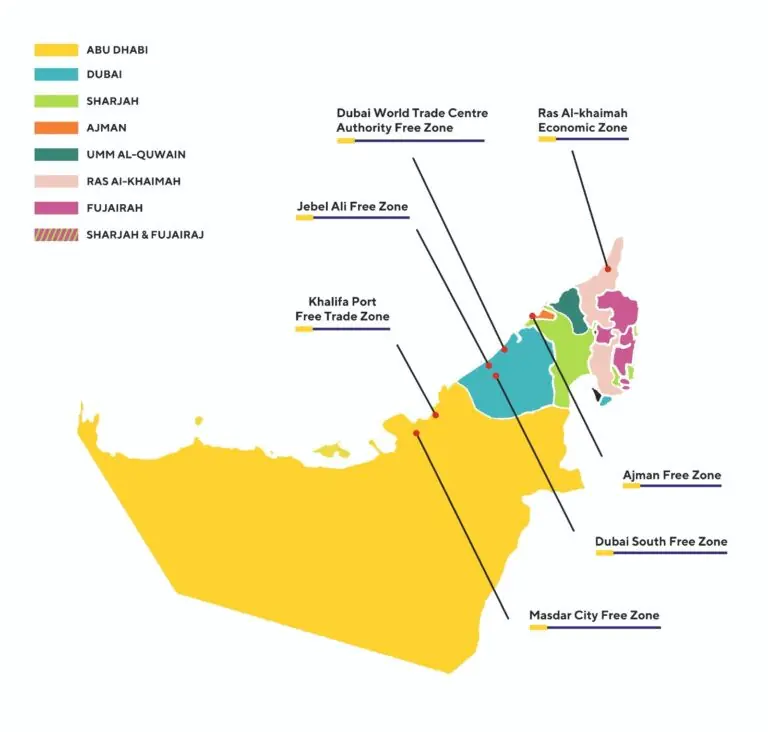
Free trade zones (FTZs) are the UAE’s secret weapon, with over 40 scattered across emirates, offering a sandbox for global players. These aren’t just tax havens; they’re ecosystems designed to accelerate re-export trade by minimizing barriers. In 2024, FTZs handled 90% of UAE’s non-oil re-exports, valued at AED 734 billion—a 7.3% YoY rise.
Core Benefits: Zero Barriers, Maximum Speed
- 100% Foreign Ownership: No local sponsor needed—full control from day one. This was a game-changer for my early expansions; I retained IP without dilution.
- Duty-Free Imports/Exports: Zero customs on re-exports keeps costs 10-15% below regional averages, per HubSpot trade analyses.
- Streamlined Regulations: Independent laws mean setup in weeks, not months—ideal for agile re-export models.
Take Jebel Ali Free Zone (JAFZA): It’s home to 9,500+ companies, generating $169 billion in trade yearly. The “why” here? FTZs foster clusters—tech in Dubai Internet City, manufacturing in Abu Dhabi’s KEZAD—creating synergies that boost efficiency by 20%, according to Deloitte studies.
Real-World Application: A Step-by-Step Setup for Re-Exporters
- Assess Your Niche: Match your goods (e.g., electronics for Dubai, metals for Abu Dhabi) to zone specialties.
- Register and License: Choose FZE (single owner) or FZC; fees start at AED 15,000, with visas for up to six shareholders.
- Leverage Infrastructure: Integrate with ports for just-in-time logistics—I’ve cut dwell times to under 24 hours.
- Scale with Compliance: Meet “substance” rules (e.g., local staff) for ongoing perks.
This framework turned a client’s Asian imports into African re-exports with 30% margins—actionable proof FTZs aren’t buzzwords.
For more on optimizing logistics in high-growth markets, check our guide on Mastering Bulk Cargo Shipping.
Tax Advantages and Investor-Friendly Laws: Building Wealth Without the Weight
The UAE’s tax regime is a magnet for re-exporters, blending zero burdens with smart safeguards. No personal income tax means your team’s take-home stays intact, while corporate tax (9% on profits over AED 375,000 since 2023) exempts qualifying FTZ income at 0%. This isn’t evasion—it’s strategy, aligned with OECD standards to avoid “haven” labels.
No Income Tax: Fuel for Talent and Profits
Zero personal income tax draws top global talent—UAE ranks 5th easiest for cross-border trade, per World Bank. For re-exporters, this translates to lower overhead: expatriate costs drop 15-20% versus taxed hubs like Singapore. I’ve hired engineers here who stayed for the lifestyle, not just the salary—retention rates hit 85%, boosting operational continuity.
Corporate Tax Perks for Qualifying Free Zone Persons (QFZPs)
To qualify for 0% on re-exports:
- Substance Test: Maintain core activities (e.g., storage, repackaging) with local assets and staff.
- Qualifying Income: Focus on exports/high-sea sales—non-qualifying (e.g., mainland sales) hits 9%.
- Transfer Pricing: Arm’s-length dealings audited annually.
In 2024, 70% of FTZ firms qualified, per Ministry of Finance data, repatriating profits freely. The insight? This setup rewards value-adders—my firm saved $2M last year by structuring re-exports compliantly.
Foreign Investor Protections: Laws That Lock in Confidence
UAE laws scream “invest here”: full profit repatriation, no currency controls, and bilateral treaties with 100+ countries slashing withholding taxes. Federal Decree-Law No. 32/2021 bolsters IP rights, while the Investment Law (2021) mandates fair treatment. Result? FDI hit $23B in 2023, up 29%—re-exporters like gold traders (25% of re-exports) thrive under this umbrella.
Diving deeper into regional dynamics? Our article on The Great Wheat War unpacks how UAE positioning influences MENA trade flows.
Re-Exports’ Massive Share in UAE Trade: Numbers That Don’t Lie
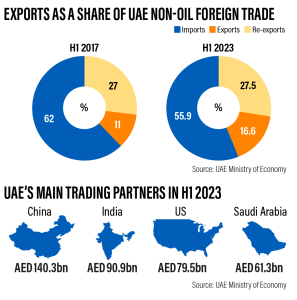
Re-exports aren’t a side hustle—they’re the UAE’s trade backbone. In 2024, they hit AED 734.4B, 24.5% of total non-oil trade (AED 2.997T), up from 22% in 2023. Overall foreign trade? AED 3T milestone, growing 14.6% YoY—seven times global averages (2.4%, per WTO).
Breaking Down the Stats: 2023-2024 Snapshot
- 2023: Re-exports AED 684B (22% of AED 3T+ total trade); non-oil exports AED 440B (16.8% share).
- 2024: Re-exports AED 734B (24.5% of non-oil); total non-oil trade AED 2.997T, with imports AED 1.701T fueling the pipeline.
| Year | Total Trade (AED Bn) | Re-Exports (AED Bn) | % of Non-Oil Trade | Growth Rate |
|---|---|---|---|---|
| 2023 | ~2.6T | 684 | 22% | +10% |
| 2024 | 3T | 734.4 | 24.5% | +7.3% |
Source: UAE Ministry of Economy & WTO. This surge? Driven by diversification—non-oil exports up 27.6% to AED 561B. Top destinations: Saudi Arabia/Iraq (30% of re-exports), India/Turkey.
The “why” behind these figures: Policies like Operation 300bn aim for AED 4T trade by 2031, investing in AI-driven customs. In practice, this means your re-export margins hold steady amid volatility—gold and jewelry alone grew 40.8%.
Challenges and Future-Proofing: Staying Ahead in the Re-Export Game
No hub is perfect. Geopolitical tensions (e.g., Red Sea disruptions) spiked costs 10% in 2024, and new corporate tax rules demand audits. My advice? Diversify routes—use Abu Dhabi’s Oman Gulf access as a hedge. Looking ahead, UAE’s IMEC corridor could add $1T to regional trade by 2030, per ECFR estimates.
To tackle import hurdles head-on, explore Iraq Customs Clearance.
Wrapping Up: Your Move to the UAE Re-Export Frontier
The UAE’s reign as the Middle East’s re-export hub boils down to this: strategic geography in Dubai and Abu Dhabi, FTZ rocket fuel, tax smarts, and laws that prioritize growth. It’s propelled non-oil trade to unprecedented heights, with re-exports carving out a 24.5% slice—and that’s just the start. If you’re tired of tariffs eating your profits or delays derailing deals, the UAE isn’t a destination; it’s your next competitive moat.
Ready to turn imports into re-export gold? Sign up on Tendify.net today—unlock our trade toolkit, connect with vetted suppliers, and ship your first container profitably. Your edge awaits; don’t let it sail by.


