


وبلاگ
Cross-Border Commerce: Mastering the Hybrid Human + AI Operating System
In the high-stakes world of cross-border commerce, a single misjudged shipment or overlooked compliance risk can erase months of margin. Markets across the GCC, MENA, and key Asian corridors are moving faster than ever. Tariffs shift overnight, supply routes face new disruptions, and buyers demand transparency at every node.
The tools have arrived. AI engines now crunch real-time market sentiment, optimize container loads in 3D, flag sanctions exposure, and generate compliant contracts in seconds. Yet the decisive edge belongs to traders who pair these capabilities with sharp human judgment.

Mastering the Hybrid Human + AI Operating System
This is not theory. Operational reviews of active trade desks in 2025–2026 show that teams blending AI speed with structured human decision-making close deals 40–60% faster while cutting compliance incidents by more than half. The real differentiator is not access to better models. It is knowing when to trust the output and when to override it with contextual intelligence only experienced operators possess.
Saudi Aramco OSP Cuts: What the Historic $11 Drop Means for GCC B2B Traders
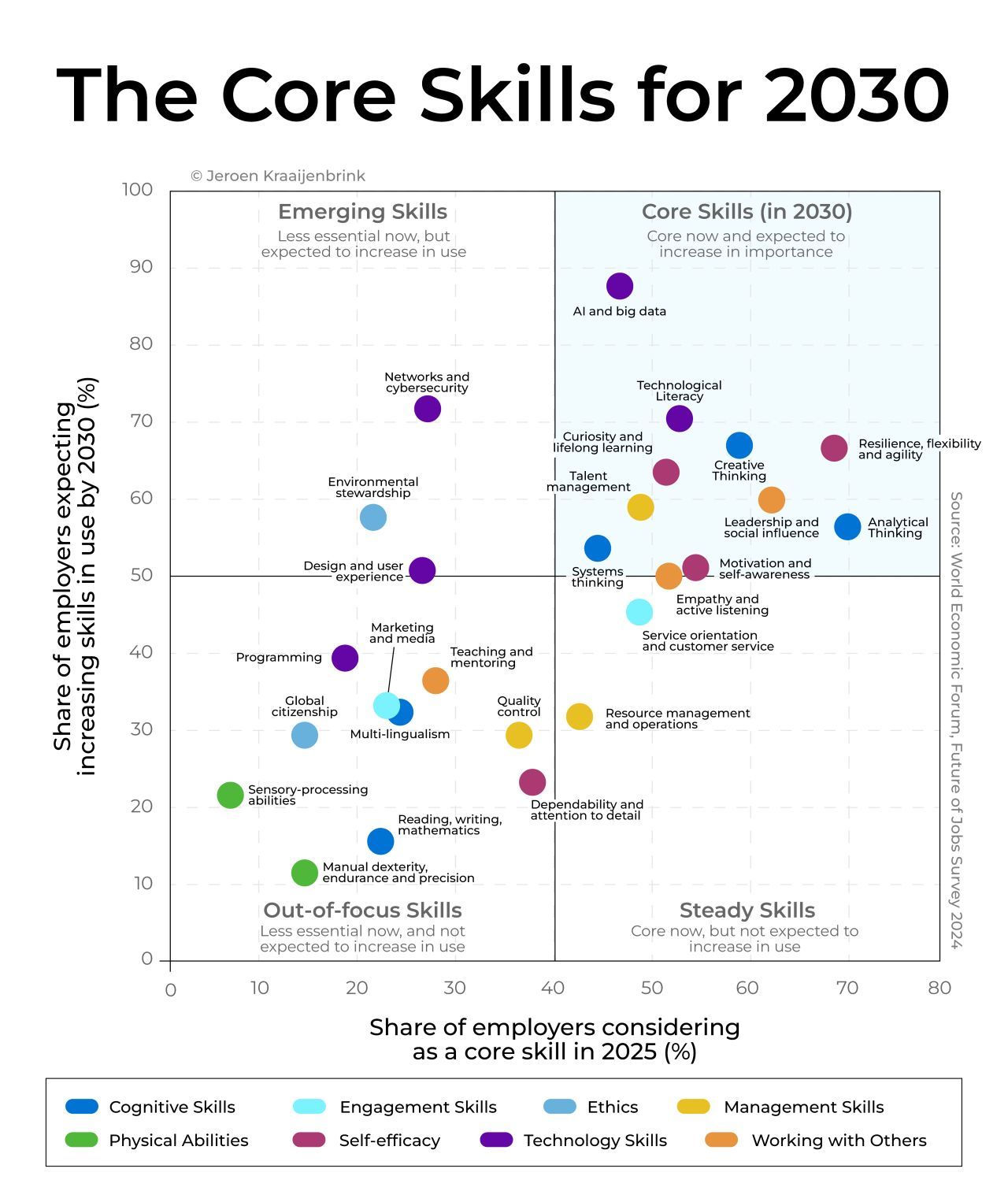
The Macro Shift: The World Economic Forum’s 2030 Skill Matrix
This integration of human wisdom and automated execution isn’t just a tactical trend—it is backed by global macroeconomic data. The World Economic Forum’s (WEF) Future of Jobs analysis highlights a dramatic realignment of what makes an operator valuable in this decade. Traditional hard technical skills, such as baseline programming and routine coding, are rapidly falling into the “Out-of-focus” quadrant, commoditized by generative models. Conversely, deeply human cognitive layers have surged into the absolute core of high-demand skills for 2030.
| WEF Skill Quadrant (2035 Horizon) | Market Status & Trajectory | Core Focus Skills |
|---|---|---|
| Core Skills (2030) | High current baseline + Expected rise in importance | AI & Big Data, Analytical Thinking, Creative Systems Thinking |
| Emerging Skills | Niche or growing use; expected to scale up | Networks & Cybersecurity, Environmental Stewardship |
| Steady Skills | Core operational value but plateauing growth | Resource Management, Quality Control, Operations |
| Out-of-Focus Skills | Rapidly declining in relative commercial value | Legacy Programming, Manual Dexterity, Routine Math |
How does this macro data manifest in international B2B commerce? It means that access to cross-border logistics tools, automated compliance checks, and market intelligence engines is no longer a moat—it is the baseline. The actual competitive edge shifts entirely to how traders synthesize these outputs to execute faster and mitigate real-world volatility.
Why AI Alone Falls Short in Global Trade
Advanced algorithms excel at pattern recognition and scale. They can scan thousands of HS codes, predict demurrage risks at Jebel Ali or Hamad Port, or surface arbitrage opportunities across GCC free zones. However, they still struggle with the messy realities of international commerce:
- Geopolitical nuance and relationship capital: A sudden shift in regional policy or a key buyer’s internal politics often requires on-the-ground insight no dataset fully captures.
- Trust calibration: Escrow services and digital signatures reduce friction, but final counterparty confidence still rests on human judgment of character, track record, and cultural alignment.
- Edge-case risk synthesis: Black-swan simulations like Ghost Trade are powerful, but interpreting their outputs against current insurance markets, local security conditions, or force majeure precedents demands experienced synthesis.
Data from trade operations in the Gulf consistently shows that pure automation initiatives plateau. The highest-performing desks treat AI as a force multiplier for human strategic thinking, not a replacement.
Core AI Capabilities Reshaping Trade Operations
Modern platforms integrate several high-impact AI layers that experienced traders now deploy daily:
1. Predictive Market Intelligence Real-time sentiment analysis and trend forecasting tools (such as AI Pulse engines) aggregate news, shipping data, and buyer signals to highlight emerging demand pockets. A trader evaluating bitumen or construction materials can spot volume surges in Saudi Vision 2030 projects weeks ahead of public tenders.
2. Compliance & Risk Engines Sanctions Pro and automated ESG trackers reduce weeks of manual screening to minutes. CarbonPro, for instance, maps carbon footprints across multimodal routes, helping exporters meet growing buyer requirements in Europe and the GCC without derailing timelines.
3. Logistics Optimization Warehouse Optimizer, SeaConnect, and 3D container tools turn complex spatial and routing decisions into data-driven recommendations. Teams report 12–18% reductions in per-container costs when layering these outputs with operator overrides based on current port congestion and weather windows.
4. Document & Contract Acceleration Proforma builders, contract generators, and export checklists produce near-perfect first drafts. The human role shifts to strategic customization—inserting protective clauses for high-risk corridors or tailoring Incoterms to cash-flow realities.
These capabilities are embedded in unified command centers that let operators move seamlessly between market scanners, calculators, and execution tools without context switching.
The Judgment Framework: When to Trust AI and When to Intervene
| Framework Layer | Operational Focus & AI Role | Human Intervention Trigger |
|---|---|---|
| 1. Speed Layer | Heavy Automation: Used for rapid data gathering, initial market scanning, and routine execution. AI handles HS code classification, tariff calculations, and baseline freight routing optimizations. | None. Highly automated with system-defined guardrails for standard corridors. |
| 2. Validation Layer | Algorithmic Guardrails: AI flags sanctions exposure, calculates compliance risks, and reviews drafts. The system surfaces anomalies based on historical shipping data and data logs. | Cross-check AI risk flags against proprietary relationship intelligence and real-time, on-ground port feedback. |
| 3. Synthesis Layer | Strategic Advisory: AI engines suggest predictive arbitrage models, optimal port windows, and tailored contract structures based on active parameters. | Align machine recommendations with corporate risk appetite, cash-flow realities, and long-term buyer retention strategies. |
| 4. Override Layer | Fail-Safe State: The system halts or flags execution when facing extreme volatility, data gaps, or highly complex multi-party compliance nodes. | Immediate human intervention required on edge cases involving regional geopolitics, sudden port force majeure, or unmapped counterparty trust dynamics. |
Practical example: An AI arbitrage hunter flags a price gap on bulk commodities between two GCC ports. The system recommends immediate action. An experienced trader reviews the output, notes an upcoming regulatory change not yet in the model, and adjusts timing and Incoterms—turning a marginal opportunity into a high-margin, low-risk move.
Building Your Hybrid Trade Operating System
To operationalize this advantage, structure your workflow around three pillars:
1. Unified Command Environment Centralize access to AI engines, calculators, document builders, and market calendars. This eliminates fragmented tools and gives operators a single pane of glass for end-to-end visibility.
2. Decision Protocols Document clear rules for AI reliance levels by transaction type. Low-value routine shipments can lean heavily on automation. High-value or strategic deals require structured human review gates.
3. Continuous Calibration Regularly feed real-world outcomes back into your processes. Teams that log intervention reasons and results improve both their judgment and the platform’s future recommendations.
Recommended Internal Playbook Sections
- Weekly AI output review meetings
- Post-deal debrief templates focusing on judgment calls
- Relationship intelligence database that complements algorithmic signals
- Scenario training using simulation tools like Ghost Trade
Measuring Success: Key Metrics for Hybrid Teams
Track these indicators to quantify the human + AI advantage:
- Cycle Time Reduction: From opportunity identification to shipment confirmation.
- Cost per Transaction: Including compliance, logistics, and error correction.
- Win Rate on Strategic Deals: Especially government tenders and long-term contracts.
- Compliance Incident Rate: Sanctions, documentation, or ESG violations.
- Margin Protection: Percentage of deals where protective clauses or timing adjustments preserved or expanded profitability.
Operations applying this hybrid model in 2026 consistently outperform pure automation or legacy manual approaches across these metrics.
Implementation Roadmap for 2026
ماه ۱: Audit current tool stack and map repetitive tasks suitable for AI acceleration. Integrate core engines (market pulse, compliance, logistics optimizers).
Month 2: Train teams on interpretation protocols. Run parallel testing—AI recommendations versus traditional methods—on a subset of transactions.
Month 3: Roll out unified command workflows. Establish review cadences and feedback loops.
Ongoing: Expand relationship intelligence systems and refine override criteria based on actual results.
Small and mid-sized traders gain the most from this approach. They can now compete on speed and sophistication with much larger players while retaining the agility that comes from sharp operator judgment.
The Enduring Value of Human Edge
AI coding and model capabilities continue to advance rapidly. Yet the traders who will dominate the next decade are those who treat technology as an extension of disciplined thinking rather than a crutch. They execute faster because AI handles the volume. They decide cleaner because they maintain clear frameworks for when to trust the machine and when to apply contextual wisdom. They lead better because they focus energy on relationship building, strategic synthesis, and creative problem-solving in complex cross-border environments.
The tools are becoming commoditized. Excellent judgment remains scarce and valuable.
For teams ready to combine the best of both, unified platforms provide the infrastructure layer that makes hybrid execution seamless. Explore how these systems can support your specific corridors and product categories by creating a free account at the platform.
https://tendify.net/my-account/
The future of global trade belongs to operators who move with both machine precision and human insight. Start building that advantage today.
Internal Link Suggestions (for SEO structure):

