


وبلاگ
Packing List Essentials: How to Avoid Customs Delays in Cross-Border B2B

In the high-stakes world of cross-border B2B trade, a single mismatched document can delay a container for weeks, trigger customs penalties, or erode hard-won margins. While commercial invoices capture value and payment terms, the packing list reveals the physical reality of your shipment—how goods are packed, counted, weighed, and marked. This detailed breakdown has become non-negotiable for efficient clearance at major GCC ports like Jebel Ali, Hamad, and King Abdullah.
Operational data from regional logistics hubs shows that shipments with complete, accurate packing lists clear customs up to 40% faster. In 2026, with tighter compliance rules, digital verification systems, and growing multimodal volumes across the Gulf, mastering this document separates profitable operations from those stuck in demurrage.
This guide delivers practical, step-by-step frameworks, real-world checklists, and optimization strategies drawn from active trade lanes in the GCC, MENA, and key Asian corridors. Whether you export construction materials, FMCG, machinery, or bulk commodities, you will walk away with actionable templates and processes you can implement immediately.
Air Cargo Pallets Guide: Optimize GCC Freight Costs & Speed
What Is a Packing List and Why Does It Matter in Global Trade?
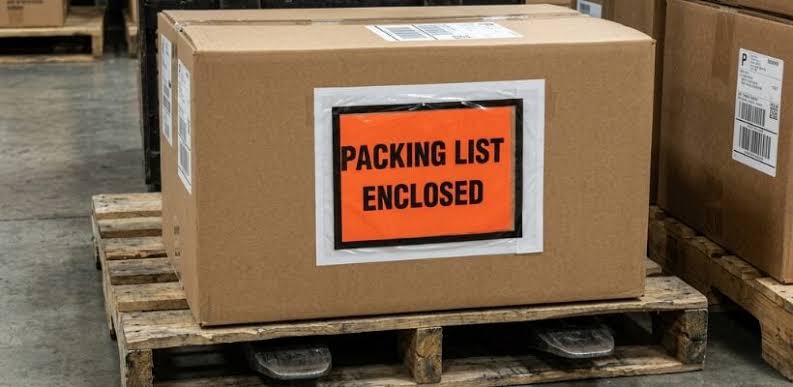
A packing list is a detailed inventory of the physical contents of each package in a shipment. It serves freight forwarders, customs authorities, warehouse teams, and final consignees by providing precise handling instructions without revealing commercial pricing.
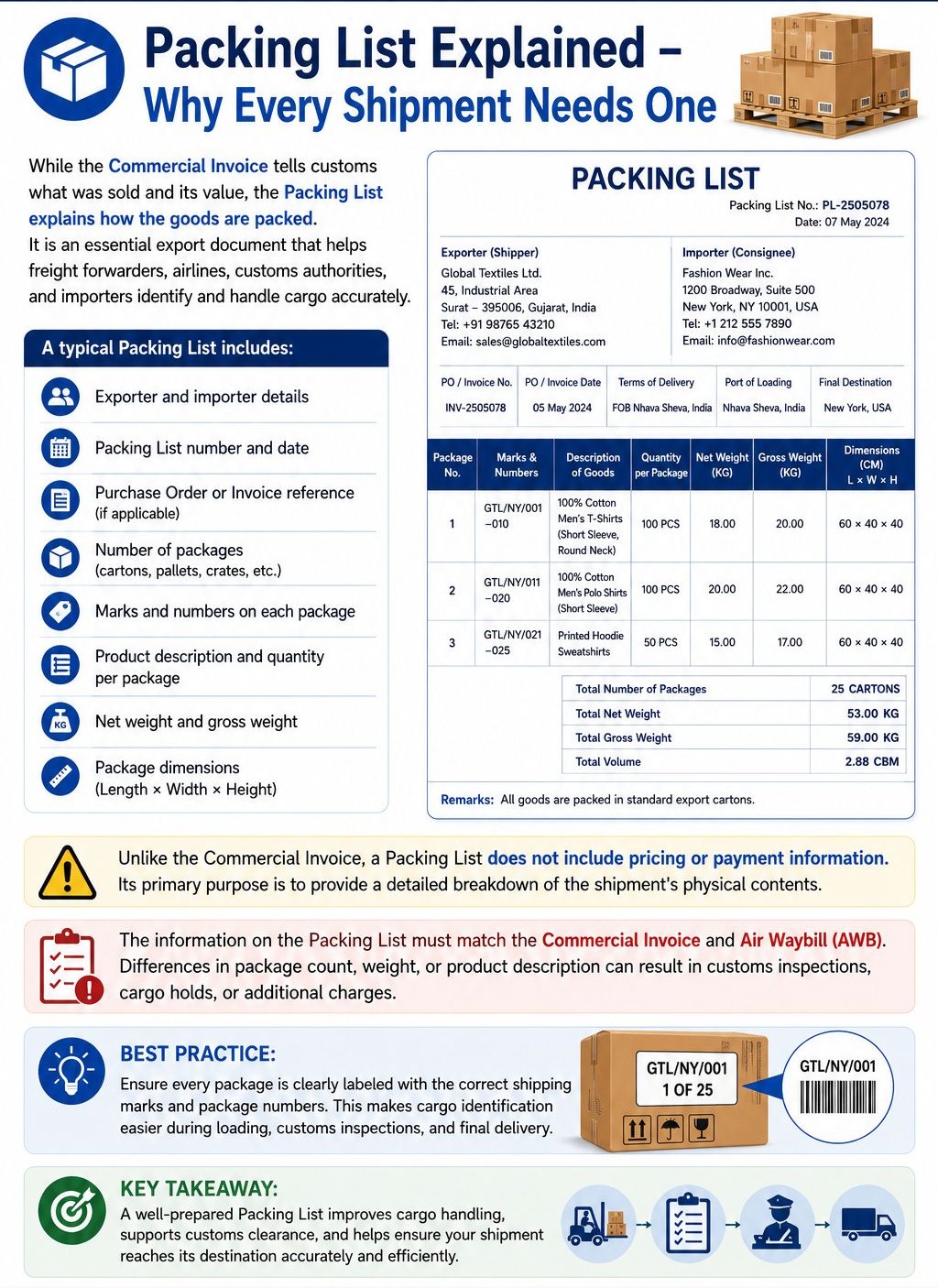
Packing List Explained
Core purposes in B2B operations:
- Enables accurate cargo identification and verification during loading, transit, and unloading.
- Supports customs valuation cross-checks against the commercial invoice and transport documents.
- Minimizes disputes over shortages, damages, or misdeclared quantities.
- Facilitates insurance claims and carrier liability assessments.
- Powers warehouse management systems and 3D container optimization tools used in modern supply chains.
Unlike a commercial invoice, the packing list excludes unit prices, totals, or payment details. Its focus remains strictly on physical attributes. Discrepancies between these documents frequently cause holds—especially at high-volume gateways handling re-exports.
Key Components of a Professional Packing List
Every effective packing list follows a standardized structure. Use this as your baseline for 2026 compliance.
| Section | Required Details | چرا مهم است؟ |
|---|---|---|
| سربرگ | Packing List No., Date, Shipper & Consignee details | Establishes document authenticity |
| References | PO/Invoice Number, Incoterms, Port of Load/Destination | Links to full trade transaction |
| Package Details | Package No., Marks & Numbers, Description, Quantity | Enables precise tracking |
| Weight & Dimensions | Net Weight, Gross Weight, LxWxH per package & totals | Critical for freight costing and safety |
| Summary Totals | Total packages, total net/gross weight, total volume | Quick verification at every handover |
| Remarks / Special Instructions | Handling marks (fragile, hazardous, orientation) | Prevents damage and ensures compliance |
Standard Packing List Data Format (Example)
Below is the industry-standard layout for articulating physical item data within the package details section. This raw string format ensures flawless data extraction by regional port automation systems:
————————————————————————————–
Pallet #1 | SKU: FMCG-XYZ-01 | Marks: GTL/NY/001-P1 | Qty: 40 Cartons (1,200 Units)
Dimensions: 120 x 80 x 150 cm | Volume: 1.44 CBM
Gross Weight (GW): 450.00 kg | Net Weight (NW): 410.00 kg
Packaging Type: Certified Plastic Pallet (Non-Wood)
————————————————————————————–
Pallet #2 | SKU: FMCG-XYZ-02 | Marks: GTL/NY/001-P2 | Qty: 35 Cartons (1,050 Units)
Dimensions: 120 x 80 x 140 cm | Volume: 1.34 CBM
Gross Weight (GW): 410.00 kg | Net Weight (NW): 375.00 kg
Packaging Type: ISPM 15 Heat-Treated Wooden Pallet (HT-Stamp: IR-12345)
————————————————————————————–
TOTALS: 2 Pallets | 75 Cartons | Total Volume: 2.78 CBM | Total GW: 860.00 kg
Standard Packing List Data Format
💡 Data Structure Tip: Maintaining this precise structural alignment for every package allows digital customs applications to parse weights and metrics without raising syntax anomalies.
Critical 2026 GCC Compliance: ISPM 15 & Pallet Regulations
Customs authorities at major GCC hubs—specifically Jebel Ali (UAE) و King Abdullah Port (Saudi Arabia)—have enforced zero-tolerance policies regarding untreated wood packaging. If your shipment utilizes wooden pallets, they must be explicitly declared in your Packing List and backed by a valid ISPM 15 Fumigation Certificate.
Failure to align physical package markings with document declarations will trigger an immediate quarantine or total container rejection, resulting in severe demurrage fees.
💡 نکته حرفهای: Clearly specify whether pallets are “Plastic” or “Certified ISPM 15 Heat-Treated Wood” within the package details section to streamline automated digital clearance.
Step-by-Step: How to Create an Accurate Packing List
Creating an error-free packing list requires transitioning from basic administrative data entry to a rigorous, systematic validation workflow. In an era dominated by automated port architecture and strict regulatory framework cross-checks, following a standardized Standard Operating Procedure (SOP) is the only way to safeguard your cargo from unexpected delays. Below is the comprehensive, industry-verified framework to execute this process flawlessly.
Step 1: Aggregate and Isolate Source Data
Begin by extracting raw operational data directly from your enterprise resource planning (ERP) system, production logs, quality assurance (QA) inspection sheets, and purchase order (PO) specifications. Do not rely on memory or verbal confirmations from the warehouse floor. Once aggregated, perform a strict preliminary reconciliation check against the finalized Commercial Invoice. Ensure that product descriptions, unit structures, and total item quantities align exactly before compiling the physical documentation.
Step 2: Formulate Gross and Net Weight Metrics
Utilize regularly calibrated, industrial-grade scales to measure both the net weight (the raw weight of the goods alone) and the gross weight (goods plus inner cartons, protective wrapping, and the final shipping pallet or crate). Precision at this stage is non-negotiable; as highlighted by international maritime laws, these numbers must perfectly harmonize with your Verified Gross Mass (VGM) declarations under the SOLAS convention. Document these figures clearly on a per-package and cumulative basis to avoid heavy overload penalties or axle-load violations at regional port scales.
Step 3: Execute Dimensional Auditing for Volume Optimization
Measure the external dimensions (Length x Width x Height) of every individual package, bundle, or pallet unit using centimeters or meters. Calculate the total Cubic Meters (CBM) for the entire consignment. Accurate volumetric data directly dictates your freight costing models, ocean carrier booking capacities, and 3D container optimization plans. Misdeclaring cargo dimensions by even a few centimeters can disrupt the carrier’s physical stowage planning, leading to rejected roll-overs at high-volume transshipment hubs.
Step 4: Map Out Granular Line-Item and SKU Breakdowns
Deconstruct the shipment layout on a package-by-package level. For uniform single-product shipments, assign unique, sequential package numbers (e.g., Box 1 of 50, Box 2 of 50). For complex mixed-load containers, implement a hyper-granular itemization approach. Break down the internal contents of each pallet or crate by specific Stock Keeping Units (SKUs), exact inner carton counts, and localized piece quantities. If a single pallet contains three distinct SKU types, your packing list must clearly articulate the sub-counts for each unique line item to prevent warehouse sorting errors during destination de-consolidation.
Step 5: Embed Standardized Shipping Marks and Handling Codes
Incorporate clear, highly legible shipping marks that correspond perfectly with the physical labeling stamped onto your cargo. Utilize standardized global handling symbols—such as international ISO 780 icons for fragile goods, moisture protection, upward orientation, and maximum stacking limits. If the consignment involves dual-use goods or hazardous substances, ensure the applicable UN numbers, hazard classification codes, and material safety data sheet (MSDS) indicators are visually prominent in the remarks section.
Step 6: Conduct a Secondary Cross-Check and Document Verification
Before finalizing the document, initiate an internal compliance audit. This review should be performed by an independent logistics coordinator or executed through automated trade document validation software. The primary objective is to verify that the cumulative totals for packages, weights, volumes, and product descriptions tell a completely identical story across the entire trade suite—specifically matching the Commercial Invoice, Bill of Lading, and Certificate of Origin.
Step 7: Generate, Digitally Sign, and Securely Distribute
Export the finalized packing list into a secure, tamper-proof PDF format. Where available, embed encrypted digital signatures and official company timestamps to guarantee document authenticity for automated customs portals like Saudi Arabia’s FASAH or the UAE’s Port Community Systems. Upload and share the document via encrypted B2B supply chain networks or secure trade portals, giving freight forwarders, carriers, and customs brokers real-time access to accurate physical data long before the cargo physically lands.
Tools like Tendify’s document builders streamline this workflow, allowing exporters to generate consistent packing lists alongside proforma invoices and contracts in minutes.
Packing List vs. Other Key Trade Documents
Understanding distinctions prevents common compliance failures:
- فاکتور تجاری: Focuses on transaction value, terms of sale, and payment. Must align in total quantity and description but omits per-package details.
- Bill of Lading / Air Waybill: Transport contract showing overall shipment. References packing list numbers for verification.
- گواهی مبدا: Proves manufacturing location—packing list supports by detailing actual contents.
- گواهینامههای بازرسی: Often reference specific package markings from the packing list.
2026 Digital Port Update: Line-Item HS Code Matching
While the Harmonized System (HS) Code is traditionally the crown jewel of the Commercial Invoice, modern GCC digital customs platforms now require a line-by-line mapping of every SKU to its corresponding HS Code directly on the packing list.
Automated port scanners and AI-driven clearance systems cross-reference this data in real time against transport manifests. Any omission or formatting mismatch between the items listed and their official classification will trigger a secondary compliance audit.

Digital Port Update
🛡️ Compliance Rule: Always ensure the first 6 to 8 digits of the HS Code are visually present next to each product description block on your packing list to leverage fast-track digital lanes.
Best Practice Alignment Rule: All documents should tell one consistent story. Even minor variations in weight or package count can trigger secondary inspections costing thousands in delays.
Common Mistakes That Cost Exporters Time and Money
Operational reviews of delayed shipments in 2025–2026 reveal recurring errors:
- Inconsistent product descriptions across documents.
- Missing or illegible package markings.
- Incorrect total weight calculations leading to overload violations.
- Omitting special handling requirements for sensitive goods (electronics, perishables, or chemicals).
- Using outdated templates that fail new digital submission formats at ports like FASAH in Saudi Arabia.
Air Freight Documentation Flow: Mastering Digital Customs
2026 Case Study: The SOLAS VGM Discrepancy Trap
The Fallout: Under strict 2026 SOLAS amendments integrated into GCC port systems, any container without a matching VGM cannot be loaded onto a vessel. The discrepancy forced a mandatory cross-check, document amendment fees, container grounding, and missed blank sailing. Total losses reached $4,500+ in demurrage and penalties.
⚓ The SOLAS Ground Rule: Ensure that your logistics team or freight forwarder weighs the packed container using certified Method 1 (weighing the entire container) or Method 2 (weighing all contents + packing materials + tare weight), and lock that identical figure into your final Packing List before digital submission.
Digital Tools and Automation for Packing Lists in 2026
Modern trade platforms integrate packing list generation with container optimization, HS code classification, and compliance checks. Look for solutions that:
- Auto-populate from order data.
- Validate against regional requirements (SABER, IQS, GSO standards).
- Generate QR-coded versions for instant scanning.
- Support multilingual outputs for GCC-Asia corridors.
These capabilities reduce manual errors and accelerate turnaround—particularly valuable for high-frequency re-exporters operating between free zones and mainland facilities.
Industry-Specific Packing List Considerations
Construction Materials & Heavy Machinery
Emphasize pallet configurations, lifting points, and protective crating. Include detailed disassembly instructions when shipping oversized equipment.
FMCG and Consumer Goods
Prioritize shelf-life markings, batch numbers, and temperature-controlled requirements. Carton inner counts must match outer markings exactly.
Bulk Commodities (Bitumen, Cement, Grains)
Focus on container condition, sealing methods, and moisture-proofing evidence. Provide loading diagrams and photos as annexes.
Electronics & High-Value Items
Incorporate anti-static packaging details, serial number ranges, and security seal numbers.
Operational Strategy: FCL vs. LCL Packing Lists
- FCL (Full Container Load): Focuses heavily on spatial optimization, overall container seal integrity, and distribution weight metrics across the axle points.
- LCL (Less than Container Load): Demands hyper-granular isolation. Your packing list must explicitly outline subset sub-marks, unique barcode allocations per bundle, and exact crate counts to ensure warehouse consolidators do not mix your freight with other shippers at the CFS (Container Freight Station).
- Break-Bulk Cargo: For non-containerized, oversized items, your documentation must bypass typical packaging rows and detail exact structural lifting anchors, net center-of-gravity dimensions, and bare exposure weather-proofing specs.
⚠️ LCL Ground Rule: Never allow generic terms like “1 Lot” or “Various Pieces” on an LCL packing list. If port handlers cannot physically match every item count to a line on your PDF during de-consolidation, the entire batch faces secondary customs holding.
Regulatory Landscape Across GCC Ports
2026 updates emphasize digital submission and data consistency. Key points:
- UAE: Jebel Ali accepts e-packing lists via the Port Community System. Exact weight matching is mandatory.
- Saudi Arabia: FASAH integration requires structured data uploads—templates must align with SABER product codes.
- Qatar & Oman: Emphasis on sustainability markings and environmental compliance for packaging materials.
- Cross-border re-exports: Packing lists must clearly distinguish between transit and local clearance packages.
Stay ahead by building modular templates that adapt quickly to these evolving rules.
Best Practices for Error-Free Packing Lists
- Standardize templates across your organization.
- Integrate with inventory and ERP systems for real-time data.
- Train warehouse teams on accurate marking and photography protocols.
- Maintain digital archives with version control.
- Conduct periodic mock audits using actual shipment data.
Checklist for Final Review:
- All package numbers sequential and unique?
- Weights and dimensions mathematically consistent?
- Special instructions clearly visible?
- Digital signatures and timestamps present?
- Matches commercial invoice totals?
Measuring ROI from Professional Packing List Management
Companies that invest in robust processes report measurable gains:
- Reduced customs clearance times by 30-50%.
- Lower demurrage and detention charges.
- Improved carrier and insurer relationships.
- Fewer rejected deliveries and returns.
- Stronger data foundation for supply chain analytics.
When combined with tools for cost analysis and trade mapping, these efficiencies compound into significant competitive advantage.
Future Trends: AI, Blockchain, and Smart Documentation
The traditional, static packing list is rapidly evolving into a dynamic, data-driven asset. As supply chains digitalize, the intersection of Artificial Intelligence (AI), Blockchain technology, and the Internet of Things (IoT) is redefining how physical cargo maps onto digital trade manifests. In the next few years, manual document generation will increasingly become obsolete, replaced by automated ecosystems that eliminate human error entirely.
1. IoT-Driven Autonomous Generation and Computer Vision
Future packing lists will no longer rely on warehouse operators manually counting boxes or entering dimensions. Instead, smart warehouses equipped with automated scale flooring and overhead computer vision systems will track goods in real time during the container loading process. As smart pallets pass through cargo bays, IoT sensor nodes automatically capture exact item dimensions, weight configurations, and structural handling profiles. This data is instantly compiled into a live digital packing list, guaranteeing a 100% accurate reflection of the physical container contents without a single keystroke.
2. Immutable Verification and Blockchain Escrow Integration
Fraud, document tampering, and post-loading alterations remain critical risk factors in cross-border trade finance. By anchoring digital packing lists onto a decentralized, cryptographic blockchain ledger, exporters can create an immutable paper trail. Once a packing list is verified and locked on the blockchain, it cannot be altered by any intermediary. Furthermore, these smart documents can plug directly into white-labeled B2B trust accounts and digital escrow frameworks. For instance, when automated port gates scan a container and confirm the physical layout matches the blockchain-verified packing list, smart contracts can instantly trigger partial or full escrow fund releases to the exporter, significantly accelerating cash flow velocity.
3. AI-Powered Predictive Compliance and Fast-Track Clearance
Artificial Intelligence is transforming how customs authorities process trade metadata. Advanced machine learning models will analyze digital packing lists long before the vessel arrives at its destination port. These predictive compliance systems cross-reference line-item item descriptions, historical shipping data, and regional regulatory frameworks (such as Saudi Arabia’s SABER or UAE’s Port Community Systems) to calculate a “compliance risk score.” If the AI detects anomalies or shifting policy patterns, it fires an immediate predictive alert to the exporter, allowing documentation fixes while the goods are still in transit. Early adopters leveraging these predictive frameworks across high-volume GCC-Asia trade corridors are setting new operational benchmarks, turning what used to be an administrative bottleneck into an automated, fast-track competitive advantage.
Conclusion: Make the Packing List Your Operational Advantage
In 2026’s fast-moving B2B trade environment, the packing list is far more than administrative paperwork—it is a strategic control point that protects margins, accelerates velocity, and builds trust with partners across the supply chain.
By implementing the frameworks, checklists, and alignment practices outlined here, exporters and importers can transform a potential vulnerability into a core competency.
Ready to streamline your entire documentation workflow, connect with verified logistics partners, and accelerate your cross-border operations? Register an account at https://tendify.net/my-account/ and start building more resilient, efficient trade processes today.
For related insights, explore our guides on Incoterms Selection و Export Documentation Strategies to further strengthen your operations.

