Blog
GCC Food Security: Scaling AI, DeFi, and Smart Logistics for B2B Resilience
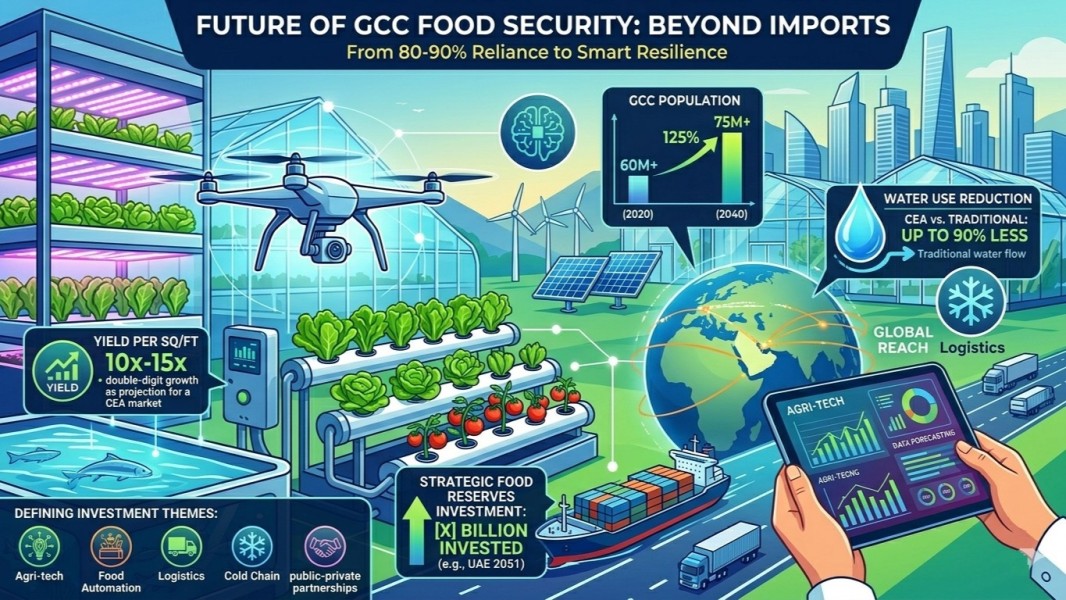
The GCC region stands at a pivotal moment in its approach to feeding a growing population amid arid landscapes, volatile global supply chains, and ambitious national visions for sustainable growth. With food imports historically accounting for 80-90% of needs in many member states, recent disruptions—from geopolitical tensions to climate variability—have underscored the urgency of building deeper resilience.
This shift is not about achieving full self-sufficiency in a resource-constrained environment. It is about creating a smarter, technology-enabled food ecosystem that blends strategic imports, local innovation, and advanced logistics to ensure availability, affordability, and sustainability for decades ahead.
Navigating GCC Food Security
Business leaders navigating B2B trade in the Gulf recognize that food security now drives investment decisions, supply chain strategies, and partnership opportunities across agri-tech, cold chain logistics, and food manufacturing. This guide examines the current landscape, key challenges, transformative solutions, and practical steps for stakeholders to engage effectively in this evolving sector.
Understanding GCC Food Security: The Scale of the Challenge
The GCC’s population is projected to exceed 75 million by 2040, up significantly from around 60 million in 2020, driven by economic diversification and expatriate inflows. This growth, combined with rising incomes and changing consumption patterns toward protein-rich and processed foods, intensifies pressure on food systems.

GCC Food Security
Traditional agriculture faces severe limitations: scarce arable land (often less than 1-2% in key economies), extreme temperatures, and water resources stretched to their limits. Desalination provides critical support but remains energy-intensive, while climate projections indicate further challenges to precipitation and soil quality.
Key statistics highlight the stakes:
- Food imports constitute 80-90% of consumption in countries like the UAE and Qatar, with staples such as rice, cereals, and dairy heavily dependent on global markets.
- Annual food consumption in the GCC is expected to rise toward 55-63 million metric tons by 2029-2030.
- Supply chain shocks, including port delays or freight disruptions, can rapidly affect availability and pricing for importers and distributors.
These realities have elevated food security to a core element of national strategies, aligning with broader economic diversification goals like Saudi Vision 2030 and the UAE’s initiatives. The focus is shifting toward “smart resilience”—leveraging technology to optimize every link in the chain while maintaining efficient cross-border trade flows.
Strategic Pillars: How GCC Nations Are Building Resilience
Governments across the GCC are deploying multi-layered approaches that integrate policy, investment, and innovation. Public-private partnerships (PPPs) play a central role, channeling billions into projects that enhance local production without ignoring the necessity of reliable imports.
1. Agri-Tech and Controlled Environment Agriculture (CEA)
Vertical farming, hydroponics, and aeroponics are expanding rapidly, delivering yields 10-15 times higher per square foot than traditional methods while slashing water usage by up to 90%.
- Dubai’s Food Tech Valley serves as a hub for testing AI-driven vertical systems, with projects like gigafarms targeting significant import substitution through waste-to-value recycling.
- Saudi initiatives under Vision 2030 emphasize precision farming, smart irrigation, and large-scale controlled-environment projects in clusters like Jeddah.
- Aquaculture and alternative proteins (including insect-based and cultured options) are gaining traction to diversify protein sources sustainably.
These technologies not only boost domestic output of leafy greens, herbs, tomatoes, and strawberries but also create year-round production immune to seasonal extremes.
2. Water Management and Resource Efficiency
Water scarcity remains the defining constraint. GCC states lead globally in desalination, increasingly powered by renewables. Smart irrigation systems using sensors and AI reduce consumption by 40-50% in pilot projects.
Investments in wastewater recycling and precision agriculture further stretch limited resources. For B2B operators, this means opportunities in supplying advanced irrigation tech, monitoring solutions, and drought-resistant crop varieties.
3. Logistics, Cold Chain, and Supply Chain Optimization
Efficient movement of goods is foundational. Investments in cold chain infrastructure, port automation, and multimodal transport reduce spoilage and costs. Strategic food reserves and diversified sourcing mitigate risks from single-origin dependencies.
Digital tools for traceability, predictive analytics, and inventory management are becoming standard, enabling faster response to market fluctuations.
4. Investment and Policy Frameworks
Over $3.8 billion has flowed into food technologies across the GCC, with potential economic contributions reaching $30.5 billion through related projects. Initiatives include food clusters, R&D hubs, and incentives for foreign investors in agri-tech and processing.
For traders and suppliers, understanding these frameworks—such as local content requirements or certification standards—is essential for market access.
5. Bulk Commodities and Smart Storage Infrastructure
While high-tech CEA systems excel at localizing fresh produce like leafy greens, the true cornerstone of regional food security lies in bulk commodities—specifically grains, wheat, and cereals. These staples cannot be grown efficiently in arid vertical farms, meaning the GCC’s resilience is entirely dependent on large-scale maritime logistics and advanced strategic stockpiling.
The Scale Challenge: Managing bulk commodities is not just a trading game; it is a complex engineering and logistics challenge. It requires minimizing grain degradation, optimizing throughput at major ports, and maintaining quality during prolonged storage in extreme ambient temperatures.
To secure the supply of these critical calories, B2B operators and regional authorities are transitioning from legacy warehousing to next-generation bulk infrastructure:
- Smart Silo Technologies: Modern grain silos are becoming data-driven ecosystems. Integrating IoT sensor networks allows operators to monitor temperature, humidity, and carbon dioxide levels in real time, automatically triggering aeration systems to prevent spoilage and pest infestation without excessive energy use.
- Automated Bulk Handling and Discharging: To reduce port congestion and demurrage costs, massive investments are flowing into high-capacity pneumatic ship unloaders and continuous conveyor systems that transfer thousands of tons of grain per hour directly from vessels to deep-inland storage facilities.
- Predictive Inventory and Demand Sensing: By utilizing predictive analytics, trade houses and national supply boards can cross-reference global harvest data, freight market rates, and local consumption metrics to optimize purchasing cycles and maintain perfect buffer stocks ahead of market shifts.
Islamic Trade Finance: A Guide for GCC SMEs
The Geopolitical Overlay: Navigating Trade Corridors and Chokepoints
In the GCC, food security is inextricably linked to geopolitical stability. While technological advancements in domestic production are critical, the sheer volume of required imports means that securing global supply lines is paramount. Relying on traditional maritime routes is no longer a static equation; it requires active, predictive management.
Strategic Imperative: The vulnerability of maritime chokepoints, particularly the Strait of Hormuz, necessitates dynamic supply chain modeling. A single disruption in these narrow, heavily trafficked corridors can cascade into immediate regional food deficits and price volatility.
Furthermore, shifting global macroeconomics are fundamentally redefining agricultural trade flows. The expansion of the BRICS economic bloc and evolving relations between major global powers are creating new, decentralized trade corridors. For B2B stakeholders handling bulk commodities—such as wheat, cement, and staple grains—this geopolitical shift dictates new operational strategies:
- Corridor Diversification: Strategic investments are rapidly accelerating in alternative overland routes, multimodal transport networks, and Red Sea port integrations to bypass traditional maritime bottlenecks.
- Geopolitical Risk Hedging: As global alliances shift, major traders are increasingly looking toward trade-based settlement frameworks and decentralized protocols to mitigate cross-border friction during periods of volatility.
- Predictive Stockpiling: National strategic reserves are evolving from static warehouses into intelligent, AI-monitored bulk silos designed to anticipate geopolitical supply shocks before they impact local markets.
Next-Gen Trade Finance: Smart Contracts and DeFi in Agribusiness
The modernization of the GCC’s physical food supply chain demands an equally sophisticated financial infrastructure. Traditional cross-border B2B trade finance is often plagued by slow settlement times, high intermediary fees, and substantial currency risk. To overcome these bottlenecks, the integration of decentralized finance (DeFi) protocols and smart contracts is transitioning from a theoretical concept to an operational necessity.
Operational Efficiency: By automating execution through self-executing code, smart contracts eliminate the traditional delays of legacy banking, turning multi-day clearance processes into near-instantaneous verifications.
For large-scale food importers, distributors, and agribusiness tech providers, this digital financial shift introduces three transformative pillars:
- Automated Escrow Systems: Smart contracts act as immutable, neutral arbiters. Funds are locked securely in a digital escrow and released to global suppliers automatically, but only when verifiable data points—such as phytosanitary clearance at customs or real-time cold chain temperature logs—confirm successful delivery.
- Tokenization of Real-World Assets (RWA): Bulk food commodities, warehouse receipts, and shipping manifests can now be tokenized on the blockchain. This grants small to medium enterprises (SMEs) and large trade houses access to instant liquidity, allowing them to use tokenized transit inventory as collateral for fast, decentralized trade financing.
- Mitigating Cross-Border Currency Risks: Utilizing multi-currency stablecoin frameworks and decentralized settlement paths allows B2B buyers and sellers to lock in prices instantly. This effectively hedges against sudden fiat currency fluctuations and cuts down the heavy conversion fees imposed by traditional international corridors.
Investment Themes Shaping the Future of GCC Food Security
Several high-potential areas stand out for B2B engagement:
- Agri-Tech Solutions: Sensors, drones, AI analytics, and automation platforms for farms and greenhouses.
- Food Automation and Processing: Equipment for efficient manufacturing, packaging, and waste reduction.
- Logistics and Cold Chain: Temperature-controlled transport, warehousing optimization, and last-mile delivery innovations.
- Sustainable Inputs: Bio-fertilizers, efficient packaging, and renewable energy integration for production facilities.
Comparative Overview of Key Technologies:
| Technology | Water Savings Potential | Yield Improvement | Primary GCC Applications | Implementation Considerations |
|---|---|---|---|---|
| Vertical/Hydroponic Farming | Up to 90% | 10-15x | Urban leafy greens, herbs | High initial capex, energy needs |
| Precision Irrigation | 40-50% | 20-30% | Field crops, date palms | Integration with existing farms |
| Aquaculture Systems | Significant (closed-loop) | High protein | Fish and shrimp production | Disease management, feed sourcing |
| AI Predictive Analytics | N/A | Efficiency gains | Supply forecasting, risk mgmt | Data infrastructure required |
These themes align with broader sustainability goals, including ESG compliance increasingly demanded by regional buyers and international partners.
Practical Steps for B2B Stakeholders: Entering and Scaling in the GCC Food Ecosystem
Success in this market demands more than product quality—it requires alignment with local priorities and operational excellence.
Step 1: Market Research and Opportunity Mapping Analyze demand gaps in specific categories (e.g., high-quality proteins, specialty ingredients) using trade data and sector reports. Focus on clusters like food processing zones or free zones that offer logistical advantages.
Step 2: Technology and Partnership Alignment Collaborate with local players through joint ventures or technology licensing. Platforms facilitating B2B connections can streamline identification of reliable partners for distribution or co-development.
For example, tools supporting compliance, tariff calculations, or logistics optimization prove invaluable in navigating GCC-specific requirements.
Step 3: Compliance and Quality Assurance Prioritize certifications (e.g., halal, ISO, food safety standards) and robust documentation. Understanding customs valuation and phytosanitary rules minimizes delays.
Step 4: Supply Chain Resilience Planning Diversify routes and suppliers. Invest in digital visibility solutions to track shipments in real time and maintain buffer stocks strategically.
Step 5: Pilot and Scale Start with targeted pilots in high-demand segments, leveraging events and exhibitions for networking. Measure outcomes against key metrics like cost per unit, shelf life, and sustainability impact before full-scale commitment.
Internal resources on related topics, such as streamlining cross-border logistics for B2B trade in the Gulf region, offer deeper operational insights. Similarly, exploring Saudi Arabia Exhibitions 2026 can accelerate buyer connections.
The Technical Blueprint: AI Architecture and Data Infrastructure in Modern Logistics
To move beyond high-level buzzwords like “AI analytics,” B2B trade platforms must rely on highly scalable, production-grade software architectures. Seamless cross-border trade requires a continuous, real-time bridge between legacy customs frameworks, IoT hardware networks, and predictive machine learning models.
Architectural Overview: Modern supply chain dashboards operate on a decoupled microservices architecture, ensuring that heavy data processing from customs APIs does not latency-spike the user-facing operational interfaces.
Data Integration and Unified Customs APIs
The foundation of a resilient trade dashboard lies in its data ingestion layer. This layer utilizes high-throughput RESTful and Webhook APIs to pull heterogeneous data—ranging from customs clearance statuses and phytosanitary certification logs to port congestion metrics—and normalize it into a unified database. Below is a conceptual representation of the core JSON data structure used to track and process an active food commodity shipment across GCC borders:
{
  "shipment_id": "TX-GCC-2026-8841",
  "commodity": {
    "type": "Bulk Wheat",
    "hscode": "1001.99.00",
    "total_weight_tons": 5200
  },
  "origin_details": {
    "supplier_id": "SUP-992",
    "port_of_loading": "Port of Kandla, India"
  },
  "transit_metrics": {
    "current_coordinates": {"lat": 26.1523, "lng": 56.4812},
    "current_chokepoint_risk_index": 0.12,
    "cold_chain_status": {
      "average_humidity_percentage": 42.5,
      "alert_triggered": false
    }
  },
  "customs_clearance": {
    "destination_port": "Sultan Qaboos Port, Oman",
    "declaration_status": "PENDING_PHYTOSANITARY",
    "api_sync_timestamp": "2026-06-26T10:14:22Z"
  }
}
Predictive Modeling and Demand Sensing
Once data is normalized, it feeds into predictive pipelines designed for supply chain optimization. Time-series forecasting algorithms (such as LSTM networks or advanced gradient boosting models) process historical import volumes, localized weather anomalies, and real-time freight pricing indices. This computational layer delivers key operational capabilities to B2B stakeholders:
- Dynamic Lead-Time Forecasting: Instead of relying on static ETAs, the system continuously recalculates arrival windows based on real-time port processing times and historical customs bottlenecks at specific GCC entrance points.
- Automated Anomaly Detection: Machine learning models monitor sensor telemetry streaming from connected cold chain assets. If humidity or temperature levels diverge from the standard deviation for bulk grain storage, the system automatically dispatches an optimized rerouting or maintenance alert via Webhooks to the logistics operators.
- Optimized Buffer Stock Calculators: By processing macro-economic indicators alongside geopolitical risk scores, the engine suggests mathematically optimal inventory thresholds, reducing physical holding costs while guaranteeing zero out-of-stock scenarios.
Karachi Port Tariff Freeze: What It Means for GCC & Regional B2B Traders in 2026
Case Studies: Real-World Progress in Action
The transformation of the Gulf’s food ecosystem is no longer theoretical. Across the region, multi-million dollar deployments demonstrate how integrated technology and public-private cooperation deliver measurable advancements in economic resilience and supply chain security.
UAE’s Vertical Farming Infrastructure: Bustanica
As the world’s largest hydroponic farm, the Bustanica facility near Dubai International Airport represents a paradigm shift in commercial-scale Controlled Environment Agriculture (CEA). Spanning 330,000 square feet, the modular facility operates continuously without relying on unpredictable weather or scarce topsoil.
Annual Produce Capacity
Water Savings vs Traditional Farms
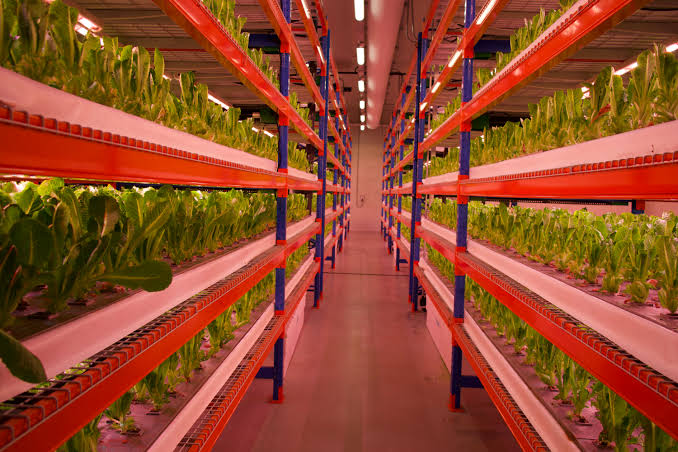
Bustanica vertical hydroponic cultivation racks under LED lighting
Inside a high-yield regional vertical farming facility
Industrial Localization
Saudi Food Clusters: Vision 2030 Localization
Under the umbrella of the National Industrial Development and Logistics Program (NIDLP), Saudi Arabia is actively establishing specialized agro-industrial clusters around Jeddah and Dammam. These clusters combine heavy automated processing plants, temperature-controlled transit networks, and dedicated R&D facilities to internalize downstream operations.
Target Domestic Coverage by 2030
Downstream Equipment Demand
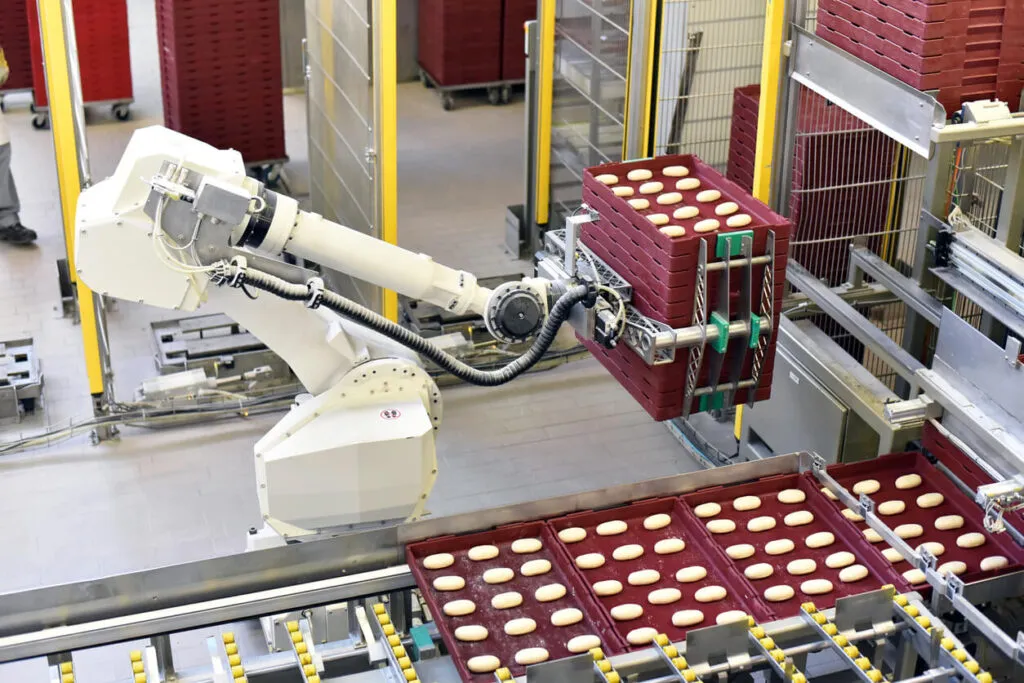
Automated manufacturing line within an advanced food industrial hub
Strategic Frameworks
Cross-Border Ecosystems: Regional PPP Frameworks
Public-Private Partnerships (PPPs) are acting as the execution vehicle for rapid technology deployment in the Gulf. By linking sovereign wealth investment with international agronomic IP, member states are accelerating knowledge transfer, importing specialized workflows, and joint-venturing infrastructure risks.
Sovereign capital offsets high upfront technical capex.
Local talent pipelines gain hands-on operational training.
Streamlined licensing for vetted global technology providers.
Overcoming Remaining Barriers
Challenges persist: high upfront costs for tech adoption, skilled labor shortages in specialized areas, and the need for harmonized regional standards. However, ongoing policy support, declining technology costs, and growing private sector interest are addressing these effectively.
For businesses, the key is proactive adaptation—integrating data-driven decision-making and fostering ecosystems that share risks and rewards.
Conclusion: Positioning for Long-Term Success in GCC Food Systems
The future of GCC food security lies in intelligent integration: advanced local production complemented by sophisticated global sourcing and logistics networks. This hybrid model not only mitigates risks but unlocks new avenues for growth in a region committed to innovation and sustainability.
Stakeholders who invest early in understanding these dynamics—through technology adoption, strategic partnerships, and operational refinement—will be best positioned to thrive. Whether supplying solutions, facilitating trade, or developing infrastructure, the opportunities are substantial and aligned with national priorities.
To facilitate, secure, and accelerate your cross-border operations in this dynamic landscape, consider registering on the platform to access specialized tools and networks designed for efficient B2B trade. https://tendify.net/my-account/