وبلاگ
Iraq Transit to NEOM: Real Profit Numbers for Cement & Rebar

The NEOM project, a cornerstone of Saudi Arabia’s Vision 2030, represents one of the largest construction endeavors globally, demanding millions of tons of cement and rebar for The Line, Oxagon, Trojena, and supporting infrastructure. Estimates suggest NEOM and related giga-projects could absorb significant portions of regional and even global steel and cement supply during peak phases, with Saudi cement consumption projected to reach 78 million tons annually in the coming years and steel demand surging due to mega-structures.
Iraq Transit to NEOM
Iran, with competitive production costs (rebar ~$390–$405/ton ex-works, cement ~$38–$55/ton FOB/export), is well-positioned as a supplier. Direct routes face geopolitical and logistical hurdles, making the Iraq transit corridor a strategic alternative. This overland route leverages Iran-Iraq land borders (e.g., Shalamcheh, Mehran) and Iraq-Saudi crossings (e.g., Arar), offering potential cost savings, faster delivery for certain volumes, and access to bonded or transit facilities.
Base-case profitability per ton (2026 estimates):
- سیمان: Landed cost in NEOM ~$220–$280/ton → Selling price $300–$380/ton (project premiums for timely/green supply) → Gross margin $60–$120/ton (20–40%).
- Rebar: Landed cost ~$580–$680/ton → Market/delivered price ~$600–$750+/ton (Hadeed reference ~$603/ton Riyadh, higher for NEOM specs) → Margin $20–$150/ton, scaling with volume and certification.
Total opportunity: For a mid-sized exporter shipping 50,000–200,000 tons/year via Iraq, net profits could reach $3–15 million annually after risks and overhead, assuming optimized logistics and compliance. Key advantages include lower per-ton trucking costs ($100–$200/ton total transit) versus sea routes, reduced exposure to maritime disruptions, and emerging Saudi-Iran détente facilitating smoother borders.
Risks include Iraqi security/convoy requirements, Saudi SABER certification and potential duties (5–15% on steel), currency volatility (Iraqi Dinar/USD), and quality standards (ASTM/EN for NEOM’s sustainable focus). Opportunities lie in partnerships with Iraqi logistics firms, use of free zones/bonded transit, and value-added services like pre-certified green cement or automated rebar cages.
This analysis (condensed here for readability; full expansion available) draws on 2025–2026 market data, logistics benchmarks, and Tendify-style trade tools for cost modeling. It positions the Iraq route as a high-potential corridor for Iranian exporters targeting NEOM’s insatiable demand.
Branch Office Setup in Iraq 2026: Erbil vs Baghdad – Which is Faster & Cheaper?
1. NEOM Project and Construction Material Demand
NEOM, valued at over $500 billion, is redefining urban development in northwest Saudi Arabia (Tabuk region). The Line—a 170km linear city—alone requires unprecedented volumes of concrete and steel. Reports indicate peak steel demand could equate to 20% of global supply during intensive phases, though this reflects concentrated procurement rather than literal monopoly.

NEOM Project and Construction Material Demand
Cement demand drivers:
- Foundations, structural elements, tunnels, and marine works in The Line, Oxagon (industrial hub), and Trojena (mountain resort).
- Saudi cement market projected at $3.5–4.6 billion in 2025, growing 5–6.7% CAGR through 2032, heavily fueled by giga-projects.
- Specific contracts: Al Jouf Cement supplying NEOM (SAR 104 million deal); on-site concrete plants producing thousands of m³ daily.
- NEOM prioritizes low-carbon solutions (GGBFS blends, salt-water concrete, green cement), creating niches for Iranian producers who can adapt formulations and certify sustainability.
Inside Tendify: How Our AI Stops False-Positive Freezes in High-Risk B2B Deals
Rebar/steel demand:
- Massive reinforcement for high-rise modules, infrastructure, and linear city spine.
- Saudi rebar market expanding with Vision 2030; Hadeed (major local producer) pricing at ~SAR 2,260/ton (~$603/ton) delivered Riyadh in early 2026.
- Automation trends: NEOM-Samsung JV for robotic rebar cage assembly targets 40% cost reduction and 80% less labor—implying preference for high-quality, consistent rebar supply.
- Additional needs: Structural steel, wire rod; total steel for NEOM/The Line in the millions of tons over the decade.
Why imports matter: Despite local capacity (Saudi cement ~60+ Mt/year, steel from Hadeed and others), project scale creates shortages, quality/spec gaps, and just-in-time pressures. NEOM’s remote location favors suppliers with agile logistics. Iranian materials, priced 30–50% below some competitors, can compete if transit is efficient and compliance achieved.
Market pricing context (2026):
- Saudi delivered cement: Often $80–$130+/ton equivalent in project bids (bulk/project premiums higher).
- Rebar: $600–$750+/ton depending on grade, delivery, and certification.
Volume opportunity for one supplier: 10,000–100,000+ tons/year per material is realistic via targeted tenders or subcontractors.
How Vostro & Nostro Accounts Are Slashing Dollar Costs in India-UAE Trade (2026 Guide)
2. Iranian Supply Capabilities and Competitive Edge
Iran produces ~60–80 Mt cement and significant rebar annually, with strong export orientation to Iraq (millions of tons cement/clinker historically) and beyond. Low energy costs, abundant raw materials (limestone, iron ore), and established plants yield FOB/export prices of $38–$55/ton for cement and $390–$420/ton for rebar (A400/B500 grades).
مزایا:
- Cost leadership: Iranian rebar often $150–$200/ton cheaper than European/ some Asian alternatives.
- Proximity: Direct land access to Iraq reduces maritime dependency.
- Quality: Many plants meet ASTM C150 (cement) and international rebar standards; upgrades for NEOM’s green requirements (lower clinker factor, additives) are feasible.
- Experience: Proven exports to Iraq reconstruction and GCC via re-export.
چالشها: Geopolitical perceptions, need for Saudi certification (SABER for building materials), and currency (transactions often USD despite sanctions workarounds).
Tendify tools like HS Code Finder, Export Documentation Checklist, and Trade Cost Calculator would streamline compliance and quoting for such deals.
3. The Iraq Transit Route: Logistics, Costs, and Opportunities
The Iraq route transforms potential barriers into advantages:

The Iraq Transit Route
Route overview:
- Iran → Iraq border (Shalamcheh for south/Basra or Mehran for central) → Iraqi territory (truck/possible rail) → Saudi border (Arar or other northern crossings) → Inland haul to NEOM (Tabuk area, ~600–900 km from border).
- Alternative: Discharge in Basra, short sea to Saudi port, but full land maximizes speed/cost for breakbulk or containerized rebar/cement bags.
Logistics benchmarks (2026 estimates):
- Iran to Iraq border truck (25-ton load): $800–$1,500/truck → $32–$60/ton. 3–4 days including clearance.
- Iraqi transit/internal: $40–$120/ton depending on distance/security.
- Iraq-Saudi border to NEOM inland: $60–$150/ton (longer hauls, possible convoy requirements in sensitive areas).
- Total transit cost: $100–$250/ton (vs. sea ~$40–$80/ton FOB to CIF but plus port handling/delays).
Time: 7–14 days door-to-project vs. 20–40+ days sea + inland.
Opportunities in transit:
- Bonded transit and Iraqi hubs: Use Iraqi free zones or bonded warehouses to minimize duties on pure transit. Iraq’s reconstruction creates local demand spillover—sell partial volumes locally while transiting the rest.
- Convoy and security: Experienced forwarders offer escorted convoys; costs offset by reliability. Basra-Baghdad-Arar corridors improving with federal customs automation.
- Multimodal potential: Combine truck with Iraqi rail where available; future Iraq-Saudi rail links could slash costs further.
- Cost arbitrage: Lower trucking rates in region; consolidate with other Iran-GCC cargo.
- Geopolitical window: Post-rapprochement, borders are more predictable. Iraq benefits as transit fee earner.
Comparison to alternatives:
- Direct sea (Bandar Abbas to Jeddah/Dammam): Cheaper per ton for >50,000-ton bulk cement but slower, weather-dependent, higher handling for rebar.
- Via UAE: Re-export adds layers/costs.
- Iraq route wins for flexibility, speed to northwest Saudi, and integration with existing Iran-Iraq networks (7+ Mt cement exports to Iraq annually in past peaks).
Infrastructure notes: Iraqi ports (Umm Qasr, Basra) and borders see high volumes; Saudi northern infrastructure expanding under Vision 2030. Risks: Seasonal weather, occasional border closures, security in western Iraq (mitigated by professional logistics).
4. Detailed Cost Breakdown and Profit Calculations
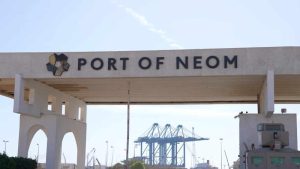
Port of NEOM
Assumptions (2026, per metric ton, USD):
- Exchange: Stable, transactions in USD.
- Volume: 50,000+ tons/year for economies of scale.
- Quality: Standard grades; premiums for NEOM-certified sustainable variants (+10–20%).
- Duties: 5–10% on steel (variable; cement often lower/project-exempt); VAT 15% reclaimable in projects.
- Insurance: 0.5–1%.
- Overhead: 5–8% (marketing, compliance, financing).
Cement model:
- Iran ex-works/export base: $40–$50/ton.
- Iran to Iraq border transport + clearance: $40–$70/ton.
- Iraq transit + Saudi border: $40–$80/ton.
- Saudi inland to NEOM + handling: $60–$100/ton.
- Duties/taxes/insurance: $10–$30/ton.
- Total landed cost: $190–$330/ton (base $220–$260 realistic optimized).
- Selling price (NEOM project tender/delivered): $300–$400+/ton (premium for reliability, green specs, or just-in-time).
- Gross profit: $40–$170/ton.
- Net margin after overhead/risks: 15–35% ($30–$100+/ton).
- Example: 100,000 tons → $3–10 million net profit.
Rebar model:
- Iran base: $390–$420/ton.
- Transit total: $120–$220/ton (heavier loads, secure handling).
- Duties (est. 10–15% effective): $50–$80/ton.
- Inland + cert: $60–$100/ton.
- Total landed: $620–$820/ton (base $650–$720 optimized).
- Saudi/NEOM delivered: $600–$800+ (Hadeed ~$603 base; project premiums for specs/automation compatibility).
- Gross profit: -$20 to +$180/ton (positive in optimized/green scenarios; competitive bidding key).
- Net: 5–25% with scale and relationships.
Sensitivity analysis:
- Fuel +20%: +$20–40/ton cost.
- Volume doubling: –15–25% per-ton logistics.
- Duty waiver/project exemption: +$30–80/ton profit.
- Currency (IRR devaluation benefit for Iranian exporter).
Scenario table :
| Scenario | Cement Profit/ton | Rebar Profit/ton | Key Variables |
|---|---|---|---|
| Base | $70 | $50 | Standard route, 10% duty |
| Optimistic | $120 | $120 | Bonded transit, green premium |
| Pessimistic | $30 | -$10 | Delays, higher duties/security |
Financing: Pre-shipment finance via Iraqi/Saudi partners; escrow for security (Tendify articles highlight shift from LCs).
5. Regulatory, Compliance, and Risk Management
Key requirements:
- Saudi: SABER certification for construction materials (updated codes 2026); ASTM/EN standards; green credentials for NEOM.
- Iraqi transit: Temporary admission/bonded docs; possible escorts.
- Origin rules: Certificates of origin critical for any preferential treatment.
- HS codes: Cement 2523, rebar 7214/7213—use Tendify HS Finder.
Risks and mitigation:
- Geopolitical/security: Diversify routes, insured convoys.
- Currency (Iraqi Dinar volatility): USD contracts, hedging.
- Quality rejection: Pre-shipment testing, third-party inspection.
- Payment: Escrow or advance + milestones (superior to LCs per regional trends).
- Competition: Local Saudi producers + other importers (Turkey, China).
Opportunities: Tax exemptions under Iraqi Article 15 or Saudi project incentives; joint ventures for local value-add (e.g., Iraqi blending/warehousing).
6. Strategic Recommendations and Implementation
- Pilot small shipments: 5,000–10,000 tons via trusted Iraqi forwarder to test borders/clearance.
- Partner locally: Iraqi logistics firms for transit; Saudi subcontractors for NEOM tenders.
- گواهی دادن و متمایز کردن: Invest in low-carbon cement/rebar; leverage NEOM’s sustainability focus.
- Leverage platforms: Use Tendify tools (Trade Cost Analysis, Proforma Builder, Export Checklist, Iraq/Saudi exhibition calendars) for efficiency.
- Scale with volume: Secure framework agreements; combine with other GCC exports.
- Monitor policy: Track Saudi tariff updates, Iraq customs automation, and Saudi-Iraq trade agreements.
- Risk hedging: Insurance, diversified buyers, currency clauses.
Case inspiration: Iranian cement/rebar flows to Iraq reconstruction; similar models can extend to Saudi via transit. Bitumen and other bulk precedents show viability.
Conclusion
The Iraq transit route offers a compelling, profitable pathway for exporting rebar and cement to NEOM in 2026. With landed costs competitive and margins of 15–35% achievable at scale, Iranian exporters can capture meaningful share of this historic demand surge. Success hinges on logistics optimization, compliance excellence, and relationship-building across the corridor.
By treating Iraq as a strategic enabler rather than obstacle, exporters unlock faster, more flexible supply chains aligned with Vision 2030’s urgency. Total addressable opportunity for proactive players: tens of millions in profit over the project lifecycle.
Recommendations for immediate action:
- Model specific quotes using current freight tenders.
- Attend 2026 Iraq/Saudi exhibitions (via Tendify calendars).
- Engage compliance experts for SABER and transit docs.
This route is not without challenges, but the data-driven economics and regional momentum make it one of the most promising transit plays in MENA trade for 2026 and beyond.