وبلاگ
Wheat Market Trends 2026: US-China Deal Impacts and Supply Chain Shifts

Over two decades moving bulk commodities across borders, I’ve learned that the wheat market doesn’t just fluctuate—it reveals who prepared and who reacted. This week, the global grain market entered another intense phase of volatility. A potential major US-China agricultural agreement collided with severe drought conditions in key American growing regions, sending prices higher before partial profit-taking set in. For traders in the Gulf, Middle East, and emerging supply corridors, these shifts aren’t distant noise. They directly impact sourcing costs, contract margins, and long-term positioning.
2026 Wheat Volatility Trader Playbook
In this comprehensive guide, I’ll break down exactly what’s driving the current wheat market moves, why they matter for your operations, and—most importantly—actionable strategies to turn uncertainty into advantage. Whether you’re importing for regional distribution or exporting value-added grains, understanding these dynamics can protect your margins and uncover new revenue streams.
High vs. Low Gluten Wheat: A 2026 Profit Margin Guide for Global Traders
Understanding the Dual Forces: Geopolitical Demand Boost Meets Weather-Driven Supply Constraints
The current volatility stems from two powerful, opposing pressures colliding in real time.
The US-China Trade Momentum
Recent high-level discussions between the US and China have traders buzzing about expanded agricultural purchases. Reports indicate commitments for China to buy significantly more US farm products, including grains, potentially adding billions in annual demand. While details remain fluid and markets have tempered initial enthusiasm, the direction is clear: China continues prioritizing food security and diversified sourcing.
Geopolitical Demand Boost Meets Weather-Driven Supply Constraints
This isn’t abstract. China remains one of the world’s largest wheat importers alongside strong demand for feed grains like corn and soybeans. Any meaningful increase in US purchases ripples through global supply chains, tightening availability for other buyers and supporting baseline price floors.
For Gulf traders, this dynamic matters because many regional markets compete for the same exportable surpluses. When major buyers like China step up, alternative suppliers (including those in the Black Sea region or local Middle East players) gain pricing power.
Export Import Business in India: The Ultimate 2026 Guide
US Drought Reality Check
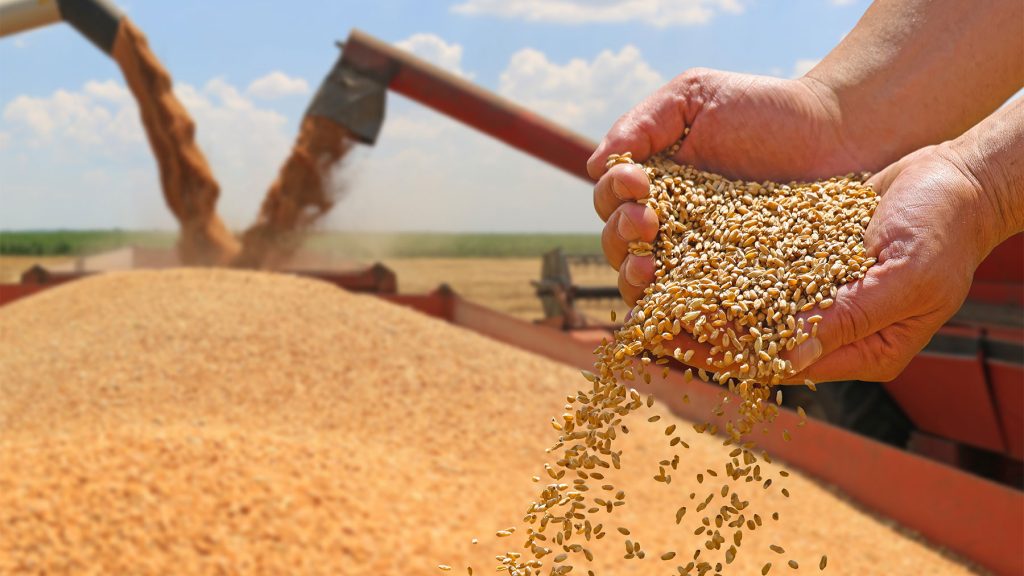
Simultaneously, extreme weather is hammering US winter wheat. The USDA and satellite assessments show critically low soil moisture in key states like Kansas, Texas, Oklahoma, and Colorado. Production forecasts for US winter wheat have been revised sharply downward, with some analysts pointing to the lowest output in decades.
Only a small percentage of the crop is currently rated good-to-excellent, with widespread drought stress affecting yields. This isn’t a one-off event—persistent dry conditions are reshaping expectations for the 2026 harvest. Lower US production means tighter global supplies at a time when demand signals are strengthening.
The combination creates classic market tension: bullish demand expectations versus bearish (or at least constrained) supply fundamentals. Prices spiked on the news before settling as traders digested uncertainties around the exact scale of Chinese commitments.
The Black Sea Factor and ECO Transit Corridors
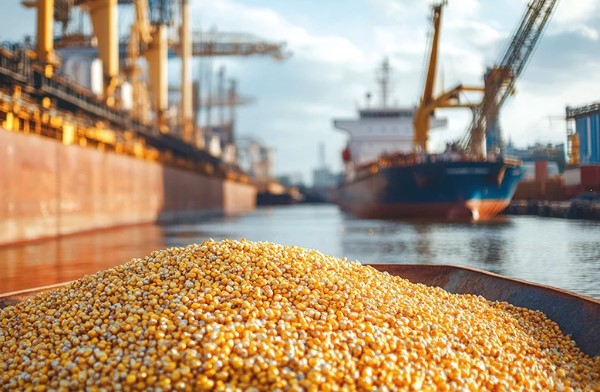
While US and Chinese dynamics set the global psychological benchmarks, the reality for MENA and GCC buyers is that Black Sea origins—primarily Russian and Ukrainian wheat—often dictate actual landed costs. Record Russian harvests have consistently priced aggressively into the Middle East, capturing major state tenders. Furthermore, the Economic Cooperation Organization (ECO) region plays a pivotal role in regional food security. Transit routes through Turkey, Iran, and the Caspian corridor provide critical overland and hybrid logistics alternatives for moving Central Asian and Russian wheat into the broader Middle East. Traders who actively map and utilize these specific ECO transit routes can often bypass traditional maritime chokepoints, securing more reliable supply chains and better final margins.
The 2026 Wheat War: Russia, Iran, and the Battle for Africa’s Breadbasket
Why This Volatility Matters for Middle East and GCC Traders
As someone who’s negotiated deals in Jebel Ali, handled clearances in Basra, and tracked shipments to Riyadh, I can tell you that global wheat signals hit home fast in our region.
Import Cost Implications
Many GCC countries rely on wheat imports to feed growing populations and support food processing industries. Higher global prices translate directly to elevated landed costs. However, savvy importers who lock in contracts during relative dips or diversify origins can maintain competitive edges. Current conditions favor those with flexible sourcing strategies across multiple origins—US, Black Sea, Australia, and regional alternatives.
Navigating CIF Volatility and Trade Finance
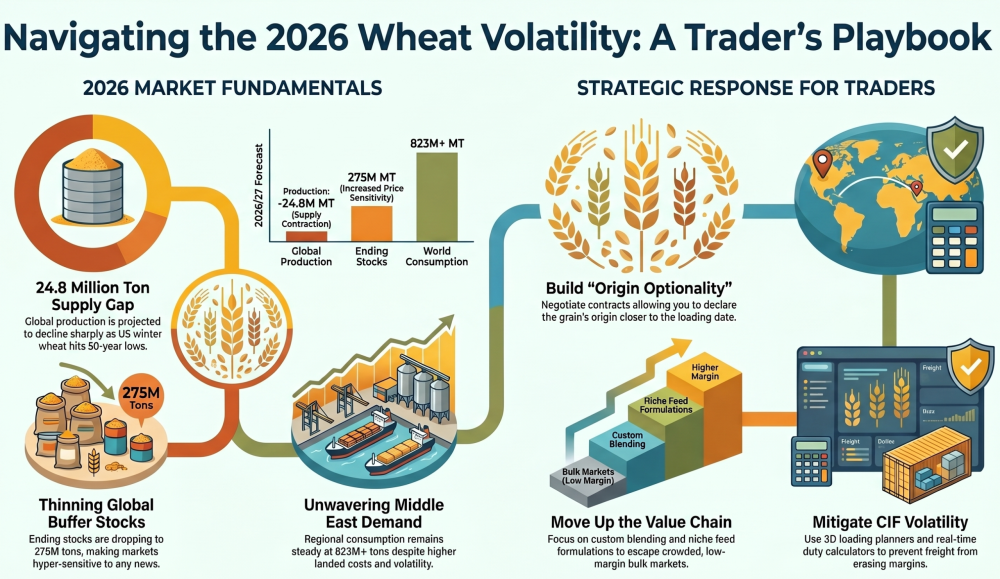
When FOB prices spike alongside volatile ocean freight rates, your CIF (Cost, Insurance, and Freight) valuation doesn’t just increase—it multiplies your customs duties and tax exposure upon arrival. This compound effect can instantly wipe out projected margins before the vessel even docks. Higher transaction values also place immense pressure on trade finance, making the issuance of Letters of Credit (LCs) mathematically tighter and more expensive. Structuring contracts with clear freight escalation clauses and utilizing real-time customs valuation calculators ensures your landed cost projections remain accurate, protecting your cash flow against sudden geopolitical shocks.
Export and Re-Export Opportunities
For traders positioned in free zones or with re-export capabilities, volatility creates arbitrage windows. Price differentials between origins widen during uncertainty. A container optimized for specific markets (using tools like 3D loading planners) can turn small margin differences into meaningful profits.
Supply Chain Ripple Effects
Drought in the US and shifting trade flows affect freight rates, container availability, and even related commodities like fertilizers. This is where integrated platforms become essential—having visibility across tariffs, logistics, and compliance in one place saves weeks of coordination.
Key Wheat Market Fundamentals to Watch in 2026
To trade effectively in the current climate, understanding the macro-level data is just as important as knowing your local port logistics. As we navigate the complexities of the 2026/27 marketing year, successful B2B trading operations must closely monitor these five core market drivers:

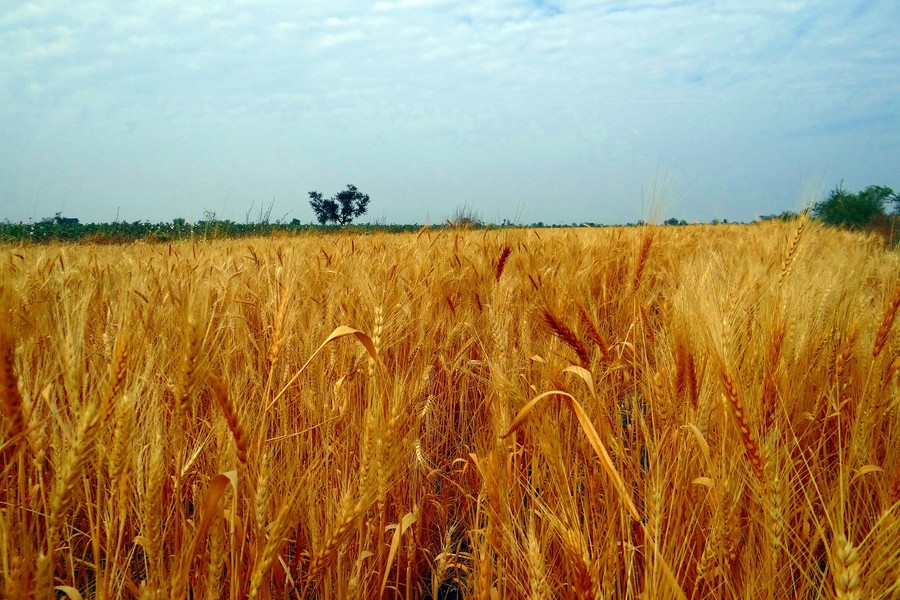
Wheat Market
1. Global Production Outlook: The 2026/27 Supply Contraction
The early 2026 data confirms a significant shift in global supply dynamics. According to the latest USDA forecasts released this May, global wheat production is projected to decline by roughly 24.8 million metric tons from last year’s record highs. This contraction is heavily concentrated among the world’s primary exporters. The United States is facing its smallest winter wheat crop in over 50 years due to severe, lingering droughts in the Plains. Simultaneously, production forecasts have been revised downward for the European Union, Australia, Canada, and Argentina. For MENA and GCC buyers, this means relying even more heavily on Russian output—which is still expected to lead global exports at roughly 47 million tons—and strategically navigating a market where overall exportable supplies are fundamentally tightening.
2. Consumption Trends: Unwavering Demand in the Middle East and Asia
Despite tightening supplies and elevated prices, global consumption shows no signs of retreating. Total world wheat consumption remains remarkably steady, projected at over 823 million tons for the 2026/27 season. This is driven by relentless baseline food security requirements and expanding milling capacities in the Middle East, North Africa, and Southeast Asia. Furthermore, the feed-wheat sector remains highly competitive; as corn and alternative grain markets face their own supply constraints, structural demand for feed-quality wheat continues to support global price floors. Traders who can secure long-term off-take agreements with regional flour mills and feed processors will be highly insulated from short-term spot market shocks.
2026 Grain Logistics: The Ultimate Sea Freight Survival Manual
3. Stock Levels: The Thinning Global Buffer
Global ending stocks are the ultimate shock absorber for commodity markets, and that cushion is currently shrinking. World wheat ending stocks for 2026/27 are projected to drop to 275 million metric tons, a year-over-year decrease of over 4 million tons. More importantly, when you exclude China’s massive state reserves—which are largely unavailable to the global export market—the actual stocks-to-use ratio available to international traders is exceptionally tight. This structural deficit makes the market hyper-sensitive to any new weather threats or geopolitical disruptions. A thinner buffer means that price spikes will be sharper and faster, requiring traders to have capital and credit lines prepared well in advance.
4. Currency and Geopolitical Factors: Amplifiers of Volatility
Agricultural fundamentals do not exist in a vacuum. Because global wheat is predominantly priced in US Dollars, the sustained strength of the USD dramatically amplifies landed costs for importing nations holding local currencies. Beyond forex risks, the geopolitical landscape of 2026 continues to heavily tax supply chains. Ongoing friction in the Black Sea and localized transit challenges in the Red Sea and ECO corridors mean that war-risk insurance premiums and rerouting costs must be factored into every CIF calculation. In this environment, a trader’s ability to seamlessly manage foreign exchange hedging and navigate complex regional sanctions or tariffs is just as crucial as their commodity expertise.
5. Quality Specifications: The Ultimate Differentiator
As origins shift and alternative suppliers enter the market to fill the gaps left by the US and EU, managing quality specifications has become the most critical operational risk. Buyers in the Gulf and broader MENA region are increasingly uncompromising on grades. A deep, technical understanding of international standards—whether it is the exact falling number and protein requirements under ASTM, or the specific moisture and test-weight metrics of GOST standards for Black Sea wheat—separates tier-one traders from those facing disastrous cargo rejections. Ensuring precise alignment between the supplier’s lab analysis, phytosanitary certificates, and the final buyer’s exact milling requirements is non-negotiable for protecting your margins and reputation.
Practical Strategies for Profiting in Volatile Grain Markets
Navigating extreme price swings requires more than just reacting to the news; it requires a proactive, system-driven approach. When supply chains tighten and prices fluctuate wildly, the margin for error shrinks. Here are five advanced strategies that top-tier traders use to protect their downside and capture maximum value during periods of high market volatility.

Practical Strategies for Profiting in Volatile Grain Markets
1. Diversify Your Supplier Network and Build Origin Optionality
Never rely on a single origin, no matter how historically reliable it has been. Geopolitics, sudden export quotas, or localized weather anomalies can lock up a supply chain overnight. Build active, vetted relationships with suppliers across multiple distinct agricultural zones. When US prices surge due to domestic drought or political shifts, you must be ready to pivot immediately toward alternatives—such as Black Sea, Australian, or Central Asian origins—that may offer better parity or faster transit times to Gulf ports. Advanced traders take this a step further by negotiating “origin optionality” into their forward contracts, allowing them to declare the final origin of the wheat closer to the loading date. However, remember that shifting origins requires a deep understanding of varying quality specifications (like protein content, falling number, and moisture levels) to ensure the alternative grain still meets your end-buyer’s exact milling requirements.
Inside the Wheat Cartel: The 5 Giants Controlling 71% of Global Trade
2. Master Contract Timing, Hedging, and Basis Trading
While physical commodity traders in the region may not always trade futures directly, treating the physical market in isolation is a critical mistake. Understanding macroeconomic trends on major exchanges like CBOT (Chicago) and MATIF (Paris) is essential for timing your physical purchases. Instead of taking flat-price risks, consider structuring contracts with basis pricing—agreeing on the premium or discount to the futures market while leaving the final price unfixed until a strategic moment. Utilize fixed-price agreements for immediate needs, but integrate escalation clauses tied to published indices for long-term supply contracts. Furthermore, since global grain is predominantly traded in USD, managing currency exposure is non-negotiable. Utilizing tools that monitor real-time tariffs, forex fluctuations, and landed costs helps you quantify these multidimensional risks mathematically before signing any binding agreements.
3. Optimize Logistics and Freight Aggressively
In high-volatility environments, the commodity price is only half the battle; freight and logistics can make or break the deal. Sudden shifts in trade routes often lead to port congestion, vessel shortages, and skyrocketing freight rates. In these periods, devastating demurrage and detention fees can entirely erase your trading margins. Optimization is your strongest defense. Whether you are chartering bulk break vessels or moving containerized grain, you must be aggressive in your planning. Use advanced 3D container loading software to maximize every cubic meter, select your Incoterms strategically to control freight risks, and partner exclusively with forwarders who have proven track records in agricultural commodities. Integrated trade platforms that offer live calculators for customs duties, shipping routes, and loading optimization transition this complex process from a logistical nightmare into a manageable, data-driven workflow.
4. Focus on Value-Added Opportunities and Niche Markets
When raw commodity margins are squeezed by global volatility, the smartest move is often to step away from the crowded baseline market and move up the value chain. Instead of simply trading bulk, raw wheat back-to-back, explore processing, blending, or segregating grains for specific buyer requirements. Regional food security initiatives in the GCC have created massive demand for specialized products. Custom-blending different wheat grades to achieve the perfect protein mix for commercial bakeries, sourcing certified organic grains, or diverting lower-grade wheat into specialized animal feed formulations creates high-margin niches. By offering a tailored, ready-to-use product rather than a raw material, you distance yourself from pure price speculation and build long-term, sticky relationships with end-users who value consistency over minor price fluctuations.
5. Leverage Technology for a Decisive Competitive Edge
Modern agricultural trade demands unprecedented speed and absolute accuracy. In a volatile market, the trader who can quote a fully landed CIF price first usually wins the deal. Relying on scattered spreadsheets, manual compliance checks, and disjointed email threads slows you down and introduces critical human errors. Technology is the ultimate equalizer. Whether you are generating complex proforma invoices, building legally compliant international contracts, running instant cost-and-freight simulations, or verifying a buyer’s KYC and sanctions status, having the right digital tools accelerates your workflow exponentially. Centralizing your operations on a unified digital platform reduces costly documentary errors, speeds up the issuance of Letters of Credit (LCs), and ensures that when a fleeting arbitrage window opens, you have the digital infrastructure to execute the deal instantly and flawlessly.
The $39 Million Clauses: 9 Legal Secrets That Secured Global Wheat Deals
Regional Perspectives: GCC, Iraq, and Beyond
Saudi Arabia and UAE as Hubs
Vision 2030 initiatives and massive infrastructure projects drive consistent wheat and grain demand. Free zones offer tax advantages for re-export plays. Traders who understand local compliance (like SABER or FASAH systems) clear goods faster and cheaper.
Iraq Reconstruction Demand
Ongoing projects create steady opportunities for bulk grains. Security considerations, port logistics at Umm Qasr and Basra, and currency dynamics require careful planning. Contracts here reward those who master documentation and risk mitigation.
Oman and Qatar Growth
Smaller but strategically important markets reward agility. Exhibitions and networking events provide direct buyer access.
Risk Management: Protecting Your Deals
Volatility brings opportunities but also traps. Always include strong force majeure and quality clauses. Verify counterparties thoroughly. Use escrow where appropriate for larger deals. Monitor phytosanitary requirements and fumigation standards closely—rejections are expensive.
Document everything. Top trading firms treat their operations like precision engineering: repeatable processes, clear SOPs, and continuous improvement.
How Integrated Platforms Streamline Grain Trade
In today’s environment, succeeding requires more than market knowledge. You need tools that reduce friction across the entire workflow.
From real-time market pulse analysis to document builders, calculators for duties and costs, and compliance checklists, having everything accessible in one command center changes the game. It lets you focus on relationships and strategy instead of chasing paperwork.
How Integrated Platforms Streamline Grain Trade
For traders serious about scaling, exploring a unified trade operating system that connects these capabilities makes professional operations more efficient. Head over to Platform.Tendify.Net to see how these tools integrate into daily workflows—many traders find features like the HS code finder, cost calculators, and contract generators immediately useful for grain deals.
Building Resilience for Long-Term Success
The wheat market in 2026 will likely remain dynamic. Weather patterns, trade negotiations, and geopolitical developments will continue creating both risks and openings.
Successful traders treat this as normal. They build diversified networks, invest in knowledge and tools, and maintain discipline in risk management. They turn data into decisions faster than competitors.
Whether you’re moving thousands of tons of wheat or exploring related commodities, the principles remain the same: understand the fundamentals, act decisively on real signals, and execute with precision.
The current volatility isn’t a crisis—it’s a test of preparation. Those who invest time now in understanding these dynamics and implementing better systems will capture the most value as markets evolve.
Frequently Asked Questions (FAQ) About Global Wheat Trade
What are the main factors driving wheat prices in 2026?
Wheat prices are currently driven by a combination of severe weather conditions in key producing regions (like US droughts), shifting geopolitical alliances, increased demand from major buyers like China, and ongoing logistics constraints in the Black Sea and regional transit corridors.
How does volatility affect CIF customs valuation for grain imports?
When global grain prices and freight rates rise, the total CIF value of the shipment increases. This directly impacts the calculation of import duties and taxes at destination ports, meaning importers must prepare for higher clearance costs, not just higher commodity prices.
Why is diversifying supply origins important for Middle East wheat buyers?
Relying on a single origin exposes buyers to localized weather events, export bans, or shipping delays. Diversifying across US, Black Sea, Australian, and Central Asian origins allows traders to maintain consistent supply and leverage price arbitrage when specific markets experience disruptions.
How can digital platforms help in bulk commodity trading?
Modern trade operating systems streamline the complexities of international logistics by centralizing real-time cost calculators, HS code compliance, automated contract generation, and logistics tracking. This reduces manual errors and helps traders lock in margins faster during volatile market conditions.
Ready to strengthen your trade operations? Visit Platform.Tendify.Net and explore the suite of tools designed specifically for professionals handling complex global transactions like grain trading. Many features are available to get you started immediately, helping you move faster and trade smarter in 2026 and beyond.