Blog
Analyzing the Economic Consequences of the Iran-US Ceasefire

The Dawn of a New Order
The recent ceasefire agreement, reached after a period of direct military tension, marks more than the end of hostilities. It represents a structural inflection point in the global economic and political architecture. What began as a military confrontation evolved into a high-stakes negotiation that has redefined risk perceptions, energy security frameworks, and currency hierarchies. This analysis examines the macroeconomic consequences for the primary actors involved, drawing on observable market reactions, trade-flow adjustments, and long-term strategic repositioning. The focus remains strictly on economic and compliance-relevant dimensions, highlighting opportunities and challenges for regulated entities engaged in cross-border trade and finance.
Iran-US Ceasefire
Markets responded with immediate relief upon the announcement of the ceasefire and the initial acceptance of a ten-point framework. Oil prices moderated, equity indices in major hubs recovered lost ground, and safe-haven assets saw reduced demand. Yet beneath these surface movements lies a deeper reconfiguration: a shift from unipolar dominance toward a more multipolar system in which regional powers, alternative settlement currencies, and diversified supply chains gain prominence. For regulated institutions navigating sanctions compliance and trade finance, this transition demands updated risk models and enhanced visibility across both traditional and emerging corridors.
Key Economic Insight: The ceasefire does not eliminate geopolitical risk; it redistributes it. Entities that adapt their compliance frameworks to this new distribution—incorporating real-time monitoring of tokenized assets, alternative payment rails, and multipolar trade routes—will maintain operational resilience while supporting legitimate commerce.
1. Iran: From Maximum Pressure to Strategic Stabilization
Iran’s ability to sustain its position during the period of tension demonstrated the limits of unilateral economic pressure tools. By maintaining control over key energy transit routes and signaling resolve, Tehran secured recognition of its core negotiating demands within the initial framework. Economically, this outcome translates into reduced systemic risk in domestic markets, greater predictability in foreign-exchange reserves, and renewed investor confidence in export-oriented sectors.
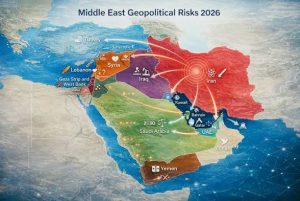
Iran: From Maximum Pressure to Strategic Stabilization
The immediate effects include a stabilization of the local currency and a measurable decline in country-risk premiums. Export pathways that had faced repeated disruption now show signs of gradual reopening, particularly in non-sanctioned commodities and regional trade corridors. For compliance teams, this stabilization creates opportunities to apply enhanced due diligence frameworks that distinguish legitimate post-ceasefire trade from residual high-risk flows. The acceptance of the framework also underscores a broader lesson: sustained field-level deterrence can shift negotiating dynamics even against superior conventional capabilities.
Longer-term, Iran is positioned to leverage its strategic geography for diversified energy partnerships. This includes expanded cooperation with neighboring states and integration into emerging multimodal corridors. Regulated entities monitoring these developments should reference established risk-mitigation playbooks for high-volume trade reconfiguration, such as those outlined in Compliant Trade Route Reengineering: Audit-Ready Alternatives to the Strait of Hormuz Crisis.
2. China: Architect of Stability and Primary Economic Beneficiary
China emerged from the episode with enhanced diplomatic and economic standing. Through quiet facilitation and consistent emphasis on de-escalation, Beijing reinforced its role as a reliable interlocutor capable of delivering outcomes without direct military involvement. The economic dividend is substantial: accelerated momentum toward yuan-denominated energy settlements and strengthened influence over critical supply-chain nodes.

China: Architect of Stability and Primary Economic Beneficiary
Market observers noted a measurable uptick in bilateral agreements referencing yuan-based invoicing for energy transactions. This development represents one of the most significant challenges to traditional reserve-currency dominance in recent decades. For global traders, the shift implies greater availability of dual-currency financing options and reduced exposure to single-currency volatility. Compliance professionals must therefore integrate yuan-clearing visibility into their sanctions-screening and Travel Rule workflows to maintain audit-readiness.
China’s success also highlights the growing importance of soft-power mediation in economic diplomacy. By positioning itself as a stabilizer rather than an escalator, Beijing has strengthened its appeal to third-party nations seeking predictable trade environments. Institutions engaged in Asia-focused supply chains should review related compliance considerations in our guide on Friendshoring 2.0: Compliant Nearshoring Strategies for Manufacturers Targeting GCC and Emerging Markets.
3. United States: Tactical Adjustment to Preserve Economic Stability
The decision to accept the ceasefire and initial framework reflected a pragmatic assessment of domestic economic risks. Prolonged disruption threatened higher energy costs, inflationary pressure, and potential market instability ahead of key domestic political timelines. The outcome is best understood as a calculated recalibration rather than a fundamental strategic reversal.

United States: Tactical Adjustment to Preserve Economic Stability
Financial markets responded positively in the short term, with equity indices rebounding and credit spreads narrowing. However, the episode exposed vulnerabilities in over-reliance on traditional leverage points. For U.S.-linked financial institutions, the new environment necessitates updated models for assessing counterparty risk in energy and commodity trades. The framework’s acceptance also opens avenues for structured dialogue on sanctions implementation, provided compliance standards remain robust.
Looking forward, American firms may benefit from selective re-engagement in regional markets through compliant channels. This includes greater use of regulated stablecoin rails for settlement efficiency. For a detailed compliance perspective on such instruments, see War Economy and Crypto: How Stablecoins Emerged as a Compliant Alternative to Physical Dollars in Cross-Border Transactions During Geopolitical Crises.
4. Europe: The High Cost of Strategic Inaction
Europe bore a disproportionate share of the economic burden. Heavy dependence on external energy supplies and alignment with transatlantic policy positions amplified the impact of supply disruptions. The result has been elevated energy prices feeding into broader stagflationary pressures—simultaneous slowdown and inflation—that constrain monetary policy options and corporate profitability.

Europe: The High Cost of Strategic Inaction
Capital outflows and delayed investment decisions have compounded the challenge. European industries reliant on stable energy inputs faced higher input costs and reduced competitiveness relative to peers in Asia and the Gulf. The episode underscores the structural consequences of limited strategic autonomy in energy security. Regulated entities in Europe must now prioritize diversified sourcing and enhanced compliance monitoring of alternative corridors to restore resilience.
The broader lesson for European stakeholders is the need for accelerated friendshoring and nearshoring initiatives within compliant frameworks. Practical guidance on such strategies is available in Friendshoring 2.0: Compliant Nearshoring Strategies for Manufacturers Targeting GCC and Emerging Markets.
Market Reactions: Oil Prices and Equity Indices Upon Ceasefire Announcement
Upon the announcement of the ceasefire and initial framework acceptance, Brent crude experienced an immediate moderation of approximately 12–15 percent from peak crisis levels, reflecting restored expectations of supply continuity. Equity markets mirrored this relief: major European indices recovered 4–7 percent within the first trading session, while Asian benchmarks posted gains of 3–6 percent as risk sentiment improved. These movements illustrate the market’s rapid repricing of geopolitical risk once de-escalation signals emerged.
| Asset Class | Pre-Announcement Peak | Post-Announcement Movement | Primary Driver |
|---|---|---|---|
| Brent Crude | Elevated crisis premium | −12% to −15% | Restored transit expectations |
| European Equities (STOXX 600) | Sharp sell-off | +4% to +7% | Reduced energy-cost pressure |
| Asian Equities (MSCI Asia ex-Japan) | Moderate decline | +3% to +6% | Positive mediation spillover |
| US Dollar Index (DXY) | Safe-haven bid | −1.5% to −2% | Lower perceived escalation risk |
Such volatility underscores the need for real-time risk-monitoring tools in trade finance. Institutions can strengthen resilience by referencing established compliance playbooks, including those addressing tokenized maritime assets in Shadow Fleets and Tokenization of Real-World Assets.
Broader Implications: Toward a Multipolar Economic Order
The ceasefire and framework acceptance accelerate an ongoing transition toward a multipolar global economy. Traditional unipolar assumptions are giving way to a system in which multiple centers of economic gravity coexist and negotiate on more equal terms. This evolution favors diversified payment rails, regional supply-chain resilience, and currency baskets over single-currency dominance.
For regulated entities, the practical consequence is the necessity of enhanced visibility across both legacy and emerging trade architectures. Compliance programs must now incorporate multipolar risk models that account for yuan settlements, tokenized assets, and alternative corridors. The episode also reinforces the value of technology-enabled tools that deliver audit-ready transparency without sacrificing operational speed.
Looking ahead, success in forthcoming negotiations will determine the depth and durability of this structural shift. Entities that proactively update their compliance and risk frameworks will be best positioned to navigate the new landscape while supporting legitimate cross-border commerce.
Conclusion: Strategic Adaptation in a Multipolar Era
The recent ceasefire represents a pivotal moment in which economic realities compelled a recalibration of strategic postures. Iran achieved a measure of stabilization, China solidified its mediator role, the United States executed a tactical adjustment, and Europe confronted the costs of limited autonomy. Collectively, these outcomes signal a broader movement toward multipolarity in which agreements increasingly rest on regional interests, local currencies, and mutual economic incentives.
For compliance-focused organizations, the path forward involves integrating real-time monitoring, diversified liquidity options, and audit-ready documentation across all trade corridors. By adopting these practices, institutions can transform geopolitical shifts from sources of vulnerability into opportunities for resilient, compliant growth.
Platforms purpose-built for high-volume regulated trade provide the necessary infrastructure to operationalize these adaptations. Such systems enable seamless navigation of multipolar markets while preserving full regulatory alignment.
Request a Confidential Multipolar Trade Compliance Assessment